


Holset users unite!


Honda-Tech Member
Joined: Oct 2004
Posts: 1,832
Likes: 0
From: RIP Duke of Turbo, CA
 Re: (KeyserSoze)


Honda-Tech Member
Joined: Dec 2004
Posts: 4,126
Likes: 0
From: PA
Re: (boostAbear)
<TABLE WIDTH="90%" CELLSPACING=0 CELLPADDING=0 ALIGN=CENTER><TR><TD>Quote, originally posted by BlkChryKord »</TD></TR><TR><TD CLASS="quote">How are you guys getting around or using the electronics on the HE351?</TD></TR></TABLE>
What he said. How do I use the turbo and not the vgt??? Or how do I use the vgt???
What he said. How do I use the turbo and not the vgt??? Or how do I use the vgt???

Honda-Tech Member
Joined: Aug 2002
Posts: 4,417
Likes: 0
From: ashEVILle, NC, USSR
Re: (Gold DA9)
Most of the VGTs use a PWM signal to control a solenoid that opens or closes the turbine via oil pressure. You could use an EBC, alternately I'm pretty sure it could be supported intelligently in eCtune - I know Calvin would make sure of it if I asked him.

Honda-Tech Member
Joined: Dec 2004
Posts: 4,126
Likes: 0
From: PA
Re: (zex_cool)
<TABLE WIDTH="90%" CELLSPACING=0 CELLPADDING=0 ALIGN=CENTER><TR><TD>Quote, originally posted by zex_cool »</TD></TR><TR><TD CLASS="quote">im kind of lost, what are you guys asking ? im using the he351cw. </TD></TR></TABLE>
yours got the VGT???
How small is a holset HE221W
yours got the VGT???
How small is a holset HE221W
Honda-Tech Member
Joined: Dec 2004
Posts: 4,126
Likes: 0
From: PA
Re: (Joseph Davis)
<TABLE WIDTH="90%" CELLSPACING=0 CELLPADDING=0 ALIGN=CENTER><TR><TD>Quote, originally posted by Joseph Davis »</TD></TR><TR><TD CLASS="quote">Most of the VGTs use a PWM signal to control a solenoid that opens or closes the turbine via oil pressure. You could use an EBC, alternately I'm pretty sure it could be supported intelligently in eCtune - I know Calvin would make sure of it if I asked him.</TD></TR></TABLE>
That would be awesome if eCtune could work with the vgt setup. I would definately buy one then.
That would be awesome if eCtune could work with the vgt setup. I would definately buy one then.
Honda-Tech Member
Joined: Jan 2006
Posts: 634
Likes: 0
From: IA, USA
Re: (CaseBone)
<TABLE WIDTH="90%" CELLSPACING=0 CELLPADDING=0 ALIGN=CENTER><TR><TD>Quote, originally posted by CaseBone »</TD></TR><TR><TD CLASS="quote">
</TD></TR></TABLE>
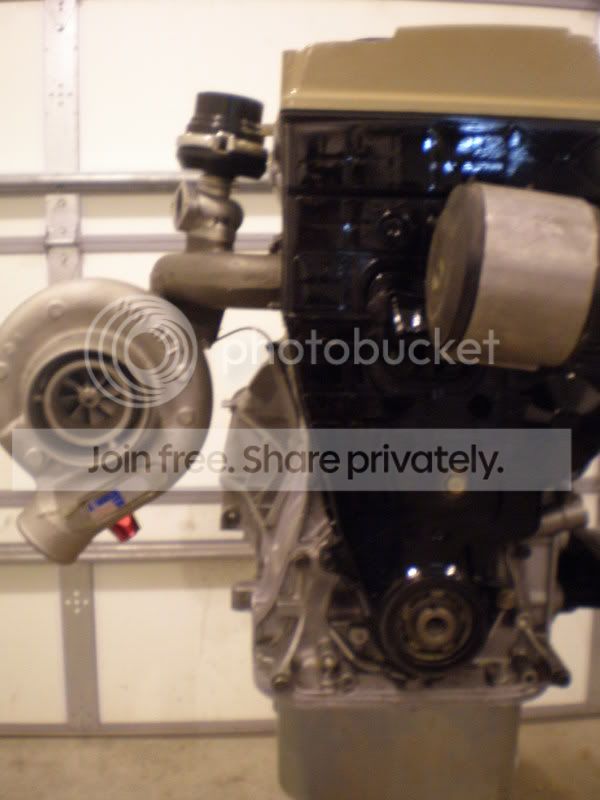
Selling my turbo in this picture! It's an HX35 BRAND NEW! Pm me if interested.
</TD></TR></TABLE>
Selling my turbo in this picture! It's an HX35 BRAND NEW! Pm me if interested.


Honda-Tech Member
Joined: Dec 2004
Posts: 42
Likes: 0
Re: (Gold DA9)
Don't, VGT diesel turbos cannot withstand the higher Egt's from gasoline engines and will deteriorate very quickly. This is well known here in Europe, where diesel abound.
They are oly now, since a year maybe less, starting to make Vgt's for gasoline cars (I think VW is using it), but they are very pricey and only brand new.
They are oly now, since a year maybe less, starting to make Vgt's for gasoline cars (I think VW is using it), but they are very pricey and only brand new.
Honda-Tech Member
Joined: Dec 2004
Posts: 42
Likes: 0
Re: (KeyserSoze)
here's what the manual says about oil pressure:
11. Oil return pipes are permitted to decline at an overall angle of not less than 30 degrees below horizontal. All turbocharger applications require a pipe of internal diameter greater than 19 mm which has integrated connectors. To ensure oil drains into the engine under all operating conditions, the return connection into the engine sump must not be submerged and the outlet flange of the turbocharger must be 50 mm above the maximum oil level of the engine sump pan.
12. Crankcase pressure should be limited to 0.8 kPa (0.12 lbf/in2). Pressure above this level should be referred for further evaluation. Closed crankcase ventilation (CCV) systems are known to operate at elevated pressure and all applications must be referred for approval.
13. Oil pressure of 150 kPa (20 lbf/in2) must show at the turbocharger oil inlet within 3 - 4 seconds of engine firing to prevent damage to turbocharger bearing system. Aflexible supply pipe is recommended.
14. The minimum oil pressure when the engine is on load must be 210 kPa (30 lbf/in2). Maximum permissible operating pressure is 500 kPa (72 lbf/in2) although 600 kPa (88 lbf/in2) is permitted during cold start up. Under idling conditions pressure should not fall below 70 kPa (10 lbf/in2).
15. Recommended oil flows for the turbochargers are 2 litre/min at idle and 3 litre/min above maximum torque speed.
11. Oil return pipes are permitted to decline at an overall angle of not less than 30 degrees below horizontal. All turbocharger applications require a pipe of internal diameter greater than 19 mm which has integrated connectors. To ensure oil drains into the engine under all operating conditions, the return connection into the engine sump must not be submerged and the outlet flange of the turbocharger must be 50 mm above the maximum oil level of the engine sump pan.
12. Crankcase pressure should be limited to 0.8 kPa (0.12 lbf/in2). Pressure above this level should be referred for further evaluation. Closed crankcase ventilation (CCV) systems are known to operate at elevated pressure and all applications must be referred for approval.
13. Oil pressure of 150 kPa (20 lbf/in2) must show at the turbocharger oil inlet within 3 - 4 seconds of engine firing to prevent damage to turbocharger bearing system. Aflexible supply pipe is recommended.
14. The minimum oil pressure when the engine is on load must be 210 kPa (30 lbf/in2). Maximum permissible operating pressure is 500 kPa (72 lbf/in2) although 600 kPa (88 lbf/in2) is permitted during cold start up. Under idling conditions pressure should not fall below 70 kPa (10 lbf/in2).
15. Recommended oil flows for the turbochargers are 2 litre/min at idle and 3 litre/min above maximum torque speed.

Honda-Tech Member
Joined: Jul 2008
Posts: 540
Likes: 17
From: Johannesburg, Gauteng, South Africa
HX35 or 40 on a LS/VTEC - Plz help
Hi guys
Im pretty new to the forum , and ive been slowly running through the pages of this thread.
From what i've been able to determine the HX35 looks like it could support 450 - 500whp on a built LS/VTEC. I just need someone to confirm this for me !!
Im in South Africa and over here no-one has really experimented with using the Holset's on performance applications.
The common turbo's used here are the Turbonetics range and a few GT-K's and Garrett GT series. If I could get Garrett GT series spool and power for half the price with the Holset range it seems like a win-win situation !!!!
So ive been doing some research on them (which lead me to this thread) and looks really promising.
Availability is not a problem as we have a large commercial turbo and turbo spare shop locally - i just need to know exactly which model to order as I cannot simply buy the ones off the Dodge Diesels as they were never sold here. Although the cummins engine is used in a variety of other applications !
The specs of the build are as follows
Ls/Vtec 82mm bore
89mm Stroke
B16A head - slight porting and polishing
Standard B16A cams with Supertech valvetrain & 0.5mm + intake and 1mm oversize exhaust valves
100 octane race gas or 95 octane pump
The aim is 450 - 500 WHP but with maximum response !!!
The motor is going into a Lotus Elise which will be used as a time attack / open track day car as well as a bit of street driving !!!
So im after a turbo combination that will give quick boost response and and a flat torque curve is more important than absolute peak power !!!
All your input will be greatly appreciated with regards to HP capability and expected boost @ x RPM with the various combinations !!!
Thanx from South Africa
--------------------------------------------------------------------------------
600 WHP LS/VTEC 95 Civic Vti in South Africa
Im pretty new to the forum , and ive been slowly running through the pages of this thread.
From what i've been able to determine the HX35 looks like it could support 450 - 500whp on a built LS/VTEC. I just need someone to confirm this for me !!
Im in South Africa and over here no-one has really experimented with using the Holset's on performance applications.
The common turbo's used here are the Turbonetics range and a few GT-K's and Garrett GT series. If I could get Garrett GT series spool and power for half the price with the Holset range it seems like a win-win situation !!!!
So ive been doing some research on them (which lead me to this thread) and looks really promising.
Availability is not a problem as we have a large commercial turbo and turbo spare shop locally - i just need to know exactly which model to order as I cannot simply buy the ones off the Dodge Diesels as they were never sold here. Although the cummins engine is used in a variety of other applications !
The specs of the build are as follows
Ls/Vtec 82mm bore
89mm Stroke
B16A head - slight porting and polishing
Standard B16A cams with Supertech valvetrain & 0.5mm + intake and 1mm oversize exhaust valves
100 octane race gas or 95 octane pump
The aim is 450 - 500 WHP but with maximum response !!!
The motor is going into a Lotus Elise which will be used as a time attack / open track day car as well as a bit of street driving !!!
So im after a turbo combination that will give quick boost response and and a flat torque curve is more important than absolute peak power !!!
All your input will be greatly appreciated with regards to HP capability and expected boost @ x RPM with the various combinations !!!
Thanx from South Africa
--------------------------------------------------------------------------------
600 WHP LS/VTEC 95 Civic Vti in South Africa
Honda-Tech Member
Joined: Jul 2008
Posts: 540
Likes: 17
From: Johannesburg, Gauteng, South Africa
Re: (robus)
Yeah i should be able to - although i was thinking of using the 12cm2 housing coz the 9cm2 might restrict topend flow too much !! Where can i expect a HX35 12cm2 to start spooling ?? Ive read a few guys stating that they see between 15 - 20psi at like 4500 rpm on similar displacement anfd flowing engines. Is this so ?
If I can have 20 psi by 5000 and at least positive pressure from 4000RPM that would work nicely !
Would the 35 be able to support the HP numbers though ?? or would a HX40 Pro be a better option ?? What can the expected difference in spool rpm be between the 2 (35 and 40 pro) ???
If I can have 20 psi by 5000 and at least positive pressure from 4000RPM that would work nicely !
Would the 35 be able to support the HP numbers though ?? or would a HX40 Pro be a better option ?? What can the expected difference in spool rpm be between the 2 (35 and 40 pro) ???
Honda-Tech Member
Joined: Oct 2004
Posts: 1,832
Likes: 0
From: RIP Duke of Turbo, CA
Re: (extremeracer)
<TABLE WIDTH="90%" CELLSPACING=0 CELLPADDING=0 ALIGN=CENTER><TR><TD>Quote, originally posted by extremeracer »</TD></TR><TR><TD CLASS="quote">Yeah i should be able to - although i was thinking of using the 12cm2 housing coz the 9cm2 might restrict topend flow too much !! Where can i expect a HX35 12cm2 to start spooling ?? Ive read a few guys stating that they see between 15 - 20psi at like 4500 rpm on similar displacement anfd flowing engines. Is this so ?
If I can have 20 psi by 5000 and at least positive pressure from 4000RPM that would work nicely !
Would the 35 be able to support the HP numbers though ?? or would a HX40 Pro be a better option ?? What can the expected difference in spool rpm be between the 2 (35 and 40 pro) ???</TD></TR></TABLE>
Use the hx35 with the 12cm^2 housing. The hy35 (9cm^2 housing) will begin to choke the turbo at that flow. Dave (Blundar) pushed the hy35 to its upper limits and posted the results earler in this thread. 47X whp was where it stopped. If thats fine with you it would be a really quickly spooling turbo for that power level. I have one on my gsr and I get full boost by 4k rpm.
If I can have 20 psi by 5000 and at least positive pressure from 4000RPM that would work nicely !
Would the 35 be able to support the HP numbers though ?? or would a HX40 Pro be a better option ?? What can the expected difference in spool rpm be between the 2 (35 and 40 pro) ???</TD></TR></TABLE>
Use the hx35 with the 12cm^2 housing. The hy35 (9cm^2 housing) will begin to choke the turbo at that flow. Dave (Blundar) pushed the hy35 to its upper limits and posted the results earler in this thread. 47X whp was where it stopped. If thats fine with you it would be a really quickly spooling turbo for that power level. I have one on my gsr and I get full boost by 4k rpm.


Honda-Tech Member
Joined: Jan 2006
Posts: 212
Likes: 0
From: illinois
I am also going turbo, Motor is built and running NA right now, I am curious as to what is needed to run one of these turbos HX35 or HY35, I have a Del Sol with ls swap, full radiator out of integra (custom brackets used). I also already own an inlinePRO Cast Iron B-Series T3 turbo exhaust manifold. I also have a 3" 5-bolt downpipe which I understand I can't use ( would I cut and weld a new flange or just buy a new downpipe) . What else am I missing from having a complete setup to run this turbo? (internal wastegate closing options) fitment issues and of course COST of parts and accessories. I read the first ten pages and this looks very promising but I got tired of reading thanks for the help
Modified by mskansan at 12:18 AM 7/13/2008
Modified by mskansan at 12:18 AM 7/13/2008
Honda-Tech Member
Joined: Oct 2004
Posts: 1,832
Likes: 0
From: RIP Duke of Turbo, CA
Re: (mskansan)
You are gonna need to take a look at the FAQ's. Doing so will allow you to understand what you are doing and what parts are necessary. After you do that then come back and ask any specific questions regarding your holset setup. It's gonna take a whole lot of explaining to get you to understand all the parts of a turbo setup wrt the whats and whys. It would make the whole process a LOT easier if you do some research into at least the basic turbo system stuff.
One thing you will want to do for sure is to take off your headers and put on the inline 4 mani and whichever turbo you go with (can't suggest anything as you have not even listed your goals hp wise and what you will be using the car for) to see how things will need to be situated.
One thing you will want to do for sure is to take off your headers and put on the inline 4 mani and whichever turbo you go with (can't suggest anything as you have not even listed your goals hp wise and what you will be using the car for) to see how things will need to be situated.
Honda-Tech Member
Joined: Jan 2006
Posts: 212
Likes: 0
From: illinois
Re: (KeyserSoze)
I guess it was late sorry for not fully explaining myself, car 93 del sol with ls swap rebuilt forged internals, full radiator, no a/c, no p/s. Looking to make 375 to 400 whp. Will be driven at drag strip. I know the basics of a turbo kit my questions are. I understand this is a bigger turbo than a standard t3/t4 and will make more power. I'm confused as to which holset turbos have odd 5 bolt or v band exhaust housing. How are people dealing with the "diifferent" 5 bolt pattern or v band (if it has it) on exhaust side (What is the most effective way around this)? Could you modify a dodge elbow (found on some that i have seen) to fit a 3" downpipe? What is the most effective way to close the internal waste gate (bracket or weld shut)? What other strange issues come up as to compared to a standard t3/t4 turbo installed?
