


highest hp on pump gas


Honda-Tech Member
Joined: Mar 2000
Posts: 2,859
Likes: 1
From: Toronto, ON, Canada
 Re: highest hp on pump gas
To elaborate more about pump gas limits vs octane, it's not just horsepower that we look at.
Torque is the critical factor. Have you noticed that a lot of the high power pump gas setups always revolve around large turbos, cams, headwork, etc? These motors in particular can carry the same amount of torque at a high RPM, thus, more horsepower.
It's a pretty common relationship, that a small turbo car will spool sooner, which also makes more torque. The natural physics behind smaller turbos also mean a choke at higher RPM, thus, lesser HP at the same amount of boost at higher RPM. Hence, small turbos trying to push big power on pump gas means less reliability.
You can almost guarantee that not too many cars out there can surpass 180-190 WTQ per L on pump gas (93oct) alone. Just do the math, almost every import engine, DOHC 4cyl or 6cyl, tends to follow this rule. We usually rule out slow burning engines however, like truck motors or low revving engines.
Look at Evos, a lot of the big power setups are strokers, 2.4L. They hover around mid 400-450 WTQ, thus, they can get decently safe 600 WHP at 8000RPM. Stock stroke 2.0L Evos, tend to stay around the same WTQ as our 2.0L B-series setups, hovering high 350-360 WTQ. On our Hondas and carrying 360 WTQ up at 9000RPM, this nets us 580-620 WHP at maximum state. Anything higher usually won't be too reliable.
Now look at Supras.. Pump gas limits on Supra for common T67 setups nets 520-550 WTQ, and these 2JZ-GTE motors usually holds this torque until 6200RPM (after that, it falls gradually). It nets them 640-660 WHP on pump gas, and around 22-24 PSI of boost. On built Supras, pump gas power ranges up to 750-780 WHP, of course, cams, built head, GT47 or larger turbos, etc.. They however, still make about the same 580 WTQ, but carrying it up to 7500RPM. Thus, now we get 780 WHP with the same torque, also with the same octane and about the same reliability.
All these engines follow the same 180 WTQ per L. Just don't go pass that and you should be safe.
Since I am from Canada, getting race gas is a b*tch.. I am ALWAYS on a mission to make as much on pump gas as possible. With the help from meth injection, it allows me to tune the car more aggressively on pump gas alone, and only use the meth to safeguard against bad batch of gas at the pumps, hotter weather, etc..
So far, it has been a little over 3 months and I am running at 560 WHP on 94 oct and meth (only a small jet).. No problems whatsoever because I only running 320 WTQ on my 1.8L, and my torque carries all the way to 9500RPM.
Torque is the critical factor. Have you noticed that a lot of the high power pump gas setups always revolve around large turbos, cams, headwork, etc? These motors in particular can carry the same amount of torque at a high RPM, thus, more horsepower.
It's a pretty common relationship, that a small turbo car will spool sooner, which also makes more torque. The natural physics behind smaller turbos also mean a choke at higher RPM, thus, lesser HP at the same amount of boost at higher RPM. Hence, small turbos trying to push big power on pump gas means less reliability.
You can almost guarantee that not too many cars out there can surpass 180-190 WTQ per L on pump gas (93oct) alone. Just do the math, almost every import engine, DOHC 4cyl or 6cyl, tends to follow this rule. We usually rule out slow burning engines however, like truck motors or low revving engines.
Look at Evos, a lot of the big power setups are strokers, 2.4L. They hover around mid 400-450 WTQ, thus, they can get decently safe 600 WHP at 8000RPM. Stock stroke 2.0L Evos, tend to stay around the same WTQ as our 2.0L B-series setups, hovering high 350-360 WTQ. On our Hondas and carrying 360 WTQ up at 9000RPM, this nets us 580-620 WHP at maximum state. Anything higher usually won't be too reliable.
Now look at Supras.. Pump gas limits on Supra for common T67 setups nets 520-550 WTQ, and these 2JZ-GTE motors usually holds this torque until 6200RPM (after that, it falls gradually). It nets them 640-660 WHP on pump gas, and around 22-24 PSI of boost. On built Supras, pump gas power ranges up to 750-780 WHP, of course, cams, built head, GT47 or larger turbos, etc.. They however, still make about the same 580 WTQ, but carrying it up to 7500RPM. Thus, now we get 780 WHP with the same torque, also with the same octane and about the same reliability.
All these engines follow the same 180 WTQ per L. Just don't go pass that and you should be safe.
Since I am from Canada, getting race gas is a b*tch.. I am ALWAYS on a mission to make as much on pump gas as possible. With the help from meth injection, it allows me to tune the car more aggressively on pump gas alone, and only use the meth to safeguard against bad batch of gas at the pumps, hotter weather, etc..
So far, it has been a little over 3 months and I am running at 560 WHP on 94 oct and meth (only a small jet).. No problems whatsoever because I only running 320 WTQ on my 1.8L, and my torque carries all the way to 9500RPM.


Honda-Tech Member
Joined: Sep 2006
Posts: 1,235
Likes: 0
From: Mid-Michigan, USA
Re: highest hp on pump gas
Yeah, that is VERY well stated! I was just about to request that people in this thread start either posting up a bit more information about characteristics of their cams and turbo (to give a clue about the power band), or better yet, post an RPM at which they made the peak power number. For EXACTLY the reason you explained there T the T.
If you want to go fast on pump it seems like you've got to REV!
If you want to go fast on pump it seems like you've got to REV!

Honda-Tech Member
Joined: Sep 2006
Posts: 1,235
Likes: 0
From: Mid-Michigan, USA
Re: highest hp on pump gas
I am still a big fan of this post (below). It really resonates with me as far as making good power on low octane fuel.
Since I'm interested in seeing what I can do without my water/methanol injection system for the sake of curiosity, I was hoping to get some thoughts on good ballparks for timing at various RPMs.
Like for instance, I see people on here stating that they are using up to 15 degrees of timing at 22psi at 9,500 RPMs or whatever, but other people only using 4.5 degrees under similar circumstances, and seeing power go up as timing was taken out. At what point does removing more timing usually start to just jack up EGTs and maybe exacerbate boost creep?
I think it's clear that timing can safely be ramped up with RPM, but obviously has to slope down with boost pressure. So, can anyone offer any thoughts for a pump gas newbie (since I've been addicted to meth previously )?
)?
Thanks in advance!!!
Since I'm interested in seeing what I can do without my water/methanol injection system for the sake of curiosity, I was hoping to get some thoughts on good ballparks for timing at various RPMs.
Like for instance, I see people on here stating that they are using up to 15 degrees of timing at 22psi at 9,500 RPMs or whatever, but other people only using 4.5 degrees under similar circumstances, and seeing power go up as timing was taken out. At what point does removing more timing usually start to just jack up EGTs and maybe exacerbate boost creep?
I think it's clear that timing can safely be ramped up with RPM, but obviously has to slope down with boost pressure. So, can anyone offer any thoughts for a pump gas newbie (since I've been addicted to meth previously
)?Thanks in advance!!!
To elaborate more about pump gas limits vs octane, it's not just horsepower that we look at.
Torque is the critical factor. Have you noticed that a lot of the high power pump gas setups always revolve around large turbos, cams, headwork, etc? These motors in particular can carry the same amount of torque at a high RPM, thus, more horsepower.
It's a pretty common relationship, that a small turbo car will spool sooner, which also makes more torque. The natural physics behind smaller turbos also mean a choke at higher RPM, thus, lesser HP at the same amount of boost at higher RPM. Hence, small turbos trying to push big power on pump gas means less reliability.
You can almost guarantee that not too many cars out there can surpass 180-190 WTQ per L on pump gas (93oct) alone. Just do the math, almost every import engine, DOHC 4cyl or 6cyl, tends to follow this rule. We usually rule out slow burning engines however, like truck motors or low revving engines.
Look at Evos, a lot of the big power setups are strokers, 2.4L. They hover around mid 400-450 WTQ, thus, they can get decently safe 600 WHP at 8000RPM. Stock stroke 2.0L Evos, tend to stay around the same WTQ as our 2.0L B-series setups, hovering high 350-360 WTQ. On our Hondas and carrying 360 WTQ up at 9000RPM, this nets us 580-620 WHP at maximum state. Anything higher usually won't be too reliable.
Now look at Supras.. Pump gas limits on Supra for common T67 setups nets 520-550 WTQ, and these 2JZ-GTE motors usually holds this torque until 6200RPM (after that, it falls gradually). It nets them 640-660 WHP on pump gas, and around 22-24 PSI of boost. On built Supras, pump gas power ranges up to 750-780 WHP, of course, cams, built head, GT47 or larger turbos, etc.. They however, still make about the same 580 WTQ, but carrying it up to 7500RPM. Thus, now we get 780 WHP with the same torque, also with the same octane and about the same reliability.
All these engines follow the same 180 WTQ per L. Just don't go pass that and you should be safe.
Since I am from Canada, getting race gas is a b*tch.. I am ALWAYS on a mission to make as much on pump gas as possible. With the help from meth injection, it allows me to tune the car more aggressively on pump gas alone, and only use the meth to safeguard against bad batch of gas at the pumps, hotter weather, etc..
So far, it has been a little over 3 months and I am running at 560 WHP on 94 oct and meth (only a small jet).. No problems whatsoever because I only running 320 WTQ on my 1.8L, and my torque carries all the way to 9500RPM.
Torque is the critical factor. Have you noticed that a lot of the high power pump gas setups always revolve around large turbos, cams, headwork, etc? These motors in particular can carry the same amount of torque at a high RPM, thus, more horsepower.
It's a pretty common relationship, that a small turbo car will spool sooner, which also makes more torque. The natural physics behind smaller turbos also mean a choke at higher RPM, thus, lesser HP at the same amount of boost at higher RPM. Hence, small turbos trying to push big power on pump gas means less reliability.
You can almost guarantee that not too many cars out there can surpass 180-190 WTQ per L on pump gas (93oct) alone. Just do the math, almost every import engine, DOHC 4cyl or 6cyl, tends to follow this rule. We usually rule out slow burning engines however, like truck motors or low revving engines.
Look at Evos, a lot of the big power setups are strokers, 2.4L. They hover around mid 400-450 WTQ, thus, they can get decently safe 600 WHP at 8000RPM. Stock stroke 2.0L Evos, tend to stay around the same WTQ as our 2.0L B-series setups, hovering high 350-360 WTQ. On our Hondas and carrying 360 WTQ up at 9000RPM, this nets us 580-620 WHP at maximum state. Anything higher usually won't be too reliable.
Now look at Supras.. Pump gas limits on Supra for common T67 setups nets 520-550 WTQ, and these 2JZ-GTE motors usually holds this torque until 6200RPM (after that, it falls gradually). It nets them 640-660 WHP on pump gas, and around 22-24 PSI of boost. On built Supras, pump gas power ranges up to 750-780 WHP, of course, cams, built head, GT47 or larger turbos, etc.. They however, still make about the same 580 WTQ, but carrying it up to 7500RPM. Thus, now we get 780 WHP with the same torque, also with the same octane and about the same reliability.
All these engines follow the same 180 WTQ per L. Just don't go pass that and you should be safe.
Since I am from Canada, getting race gas is a b*tch.. I am ALWAYS on a mission to make as much on pump gas as possible. With the help from meth injection, it allows me to tune the car more aggressively on pump gas alone, and only use the meth to safeguard against bad batch of gas at the pumps, hotter weather, etc..
So far, it has been a little over 3 months and I am running at 560 WHP on 94 oct and meth (only a small jet).. No problems whatsoever because I only running 320 WTQ on my 1.8L, and my torque carries all the way to 9500RPM.
Last edited by Tjabo; Feb 15, 2011 at 03:08 PM.

Honda-Tech Member
Joined: Dec 2008
Posts: 365
Likes: 0
Re: highest hp on pump gas
I am still a big fan of this post (below). It really resonates with me as far as making good power on low octane fuel.
Since I'm interested in seeing what I can do without my water/methanol injection system for the sake of curiosity, I was hoping to get some thoughts on good ballparks for timing at various RPMs.
Like for instance, I see people on here stating that they are using up to 15 degrees of timing at 22psi at 9,500 RPMs or whatever, but other people only using 4.5 degrees under similar circumstances, and seeing power go up as timing was taken out. At what point does removing more timing usually start to just jack up EGTs and maybe exacerbate boost creep?
I think it's clear that timing can safely be ramped up with RPM, but obviously has to slope down with boost pressure. So, can anyone offer any thoughts for a pump gas newbie (since I've been addicted to meth previously)?
Thanks in advance!!!
Since I'm interested in seeing what I can do without my water/methanol injection system for the sake of curiosity, I was hoping to get some thoughts on good ballparks for timing at various RPMs.
Like for instance, I see people on here stating that they are using up to 15 degrees of timing at 22psi at 9,500 RPMs or whatever, but other people only using 4.5 degrees under similar circumstances, and seeing power go up as timing was taken out. At what point does removing more timing usually start to just jack up EGTs and maybe exacerbate boost creep?
I think it's clear that timing can safely be ramped up with RPM, but obviously has to slope down with boost pressure. So, can anyone offer any thoughts for a pump gas newbie (since I've been addicted to meth previously
)?Thanks in advance!!!
I'm not a tuner but I would always bet on the safer route. I would rather have a little more "regular"(non detonation) cylinder pressure with an additional lb of boost and waste part of it with conservative timing VS risk having an "extreme" pressure spike a la detonation with a few additional degrees of timing trying to get every ounce of power and not have it creep.
Boost creep shouldn't be a factor when it comes to tuning, if you are tuning the car to what you feel is a safe timing curve and boost creep occurs, i would fix the lack of a properly sized wastegate system before making a tune more aggressive.
Honda-Tech Member
Joined: Sep 2006
Posts: 1,235
Likes: 0
From: Mid-Michigan, USA
Re: highest hp on pump gas
Thanks!
Are we really only talking about a really small amount of boost creep like that? If so that is a non-issue.
What about the EGT issue? Do the timing figures have to be in the AFTER TDC area ala anti-lag for the EGTs to get out of hand, assuming that the fuel curve is reasonable?
Are we really only talking about a really small amount of boost creep like that? If so that is a non-issue.
What about the EGT issue? Do the timing figures have to be in the AFTER TDC area ala anti-lag for the EGTs to get out of hand, assuming that the fuel curve is reasonable?

Honda-Tech Member
Joined: Aug 2004
Posts: 4,680
Likes: 2
From: Carlisle, PA, USA
Re: highest hp on pump gas
Thanks!
Are we really only talking about a really small amount of boost creep like that? If so that is a non-issue.
What about the EGT issue? Do the timing figures have to be in the AFTER TDC area ala anti-lag for the EGTs to get out of hand, assuming that the fuel curve is reasonable?
Are we really only talking about a really small amount of boost creep like that? If so that is a non-issue.
What about the EGT issue? Do the timing figures have to be in the AFTER TDC area ala anti-lag for the EGTs to get out of hand, assuming that the fuel curve is reasonable?
The wastegate would open at 7-8psi, and creep to 22psi or so by 8,400 RPM.
Long story short, he pretty much told me I didn't know what I was doing, blah blah blah. They held a "Peakboost Appreciation Day" at a shop in Maryland specifically to "fix" several cars that were experiencing the same major boost control problems, and needless to say, nothing was ever "fixed."
The people that had creeping issues before that day left with the same problems.
Combined with his personal arrogance, his sheer lack of intelligence, and his terrible business etiquette, I like to think I helped put a nail or two in Peakboost's coffin.
Sorry for the tangent!
- Derek
Honda-Tech Member
Joined: Dec 2008
Posts: 365
Likes: 0
Re: highest hp on pump gas
The whole Ken Peak tuning-ideology came about from a post I made on ClubRSX last year regarding a customer's car that had one of his turbo kits on it (K20 RSX, PB manifold, GT35R with .82 exhaust side), and it's inability to hold anything lower than 21-22psi from a 7psi spring.
The wastegate would open at 7-8psi, and creep to 22psi or so by 8,400 RPM.
Long story short, he pretty much told me I didn't know what I was doing, blah blah blah. They held a "Peakboost Appreciation Day" at a shop in Maryland specifically to "fix" several cars that were experiencing the same major boost control problems, and needless to say, nothing was ever "fixed."
The people that had creeping issues before that day left with the same problems.
Combined with his personal arrogance, his sheer lack of intelligence, and his terrible business etiquette, I like to think I helped put a nail or two in Peakboost's coffin.
Sorry for the tangent!
- Derek
The wastegate would open at 7-8psi, and creep to 22psi or so by 8,400 RPM.
Long story short, he pretty much told me I didn't know what I was doing, blah blah blah. They held a "Peakboost Appreciation Day" at a shop in Maryland specifically to "fix" several cars that were experiencing the same major boost control problems, and needless to say, nothing was ever "fixed."
The people that had creeping issues before that day left with the same problems.
Combined with his personal arrogance, his sheer lack of intelligence, and his terrible business etiquette, I like to think I helped put a nail or two in Peakboost's coffin.
Sorry for the tangent!
- Derek
Ken has been a scumbag for years, unfortunately H-T let their members down by allowing that business to operate and hid thread after thread of customers that got screwed by him. Not to mention the employees he screwed over the years.
Honda-Tech Member
Joined: Dec 2008
Posts: 365
Likes: 0
Re: highest hp on pump gas
Thanks!
Are we really only talking about a really small amount of boost creep like that? If so that is a non-issue.
What about the EGT issue? Do the timing figures have to be in the AFTER TDC area ala anti-lag for the EGTs to get out of hand, assuming that the fuel curve is reasonable?
Are we really only talking about a really small amount of boost creep like that? If so that is a non-issue.
What about the EGT issue? Do the timing figures have to be in the AFTER TDC area ala anti-lag for the EGTs to get out of hand, assuming that the fuel curve is reasonable?
Honda-Tech Member
Joined: Sep 2006
Posts: 1,235
Likes: 0
From: Mid-Michigan, USA
Re: highest hp on pump gas
Thank you for some extremely helpful "on-point" information guys!!!! You can't always get high quality information on the internet, so I really appreciate it. 

 Re: highest hp on pump gas
Holy BFTD thread...
This made me LOL......
Proven huh Bryce?? RLY??? LOL. Bullshit. None of those guys at that shop wouldever say anything like that either...
2 cars in this thread alone (Jordy and Joe) made over 10-12% LESS on a run of the mill DJ 224 (The same model that the same shop uses for their high HP tuning since the packs cant take it) than they did on that thing. 2 others confirmed it as well. Most recently, Alex.
You never did really get it.
This made me LOL......
Proven huh Bryce?? RLY??? LOL. Bullshit. None of those guys at that shop wouldever say anything like that either...
2 cars in this thread alone (Jordy and Joe) made over 10-12% LESS on a run of the mill DJ 224 (The same model that the same shop uses for their high HP tuning since the packs cant take it) than they did on that thing. 2 others confirmed it as well. Most recently, Alex.
You never did really get it.

Honda-Tech Member
Joined: Jul 2007
Posts: 1,966
Likes: 3
From: USA-JAPAN
Re: highest hp on pump gas
The whole Ken Peak tuning-ideology came about from a post I made on ClubRSX last year regarding a customer's car that had one of his turbo kits on it (K20 RSX, PB manifold, GT35R with .82 exhaust side), and it's inability to hold anything lower than 21-22psi from a 7psi spring.
The wastegate would open at 7-8psi, and creep to 22psi or so by 8,400 RPM.
Long story short, he pretty much told me I didn't know what I was doing, blah blah blah. They held a "Peakboost Appreciation Day" at a shop in Maryland specifically to "fix" several cars that were experiencing the same major boost control problems, and needless to say, nothing was ever "fixed."
The people that had creeping issues before that day left with the same problems.
Combined with his personal arrogance, his sheer lack of intelligence, and his terrible business etiquette, I like to think I helped put a nail or two in Peakboost's coffin.
Sorry for the tangent!
- Derek
The wastegate would open at 7-8psi, and creep to 22psi or so by 8,400 RPM.
Long story short, he pretty much told me I didn't know what I was doing, blah blah blah. They held a "Peakboost Appreciation Day" at a shop in Maryland specifically to "fix" several cars that were experiencing the same major boost control problems, and needless to say, nothing was ever "fixed."
The people that had creeping issues before that day left with the same problems.
Combined with his personal arrogance, his sheer lack of intelligence, and his terrible business etiquette, I like to think I helped put a nail or two in Peakboost's coffin.
Sorry for the tangent!
- Derek

B*a*n*n*e*d
Joined: Apr 2009
Posts: 1,108
Likes: 0
From: Georgia

Honda-Tech Member
Joined: Aug 2004
Posts: 4,680
Likes: 2
From: Carlisle, PA, USA
Re: highest hp on pump gas
Once the solenoid was hooked up, it required a solenoid lookup table that had a ton of duty in the middle, and trickling down to zero up top to flatten the boost curve.
Axix, this has been covered elsewhere.
- Derek


Honda-Tech Member

Joined: Feb 2003
Posts: 9,820
Likes: 12
From: schooling kids in ny, usa
Re: highest hp on pump gas
i like this thread. the more i read the more im realizing my goals are very attainable. id like to make at least 450 whp safely on 93, 84mm gsr with a t3 60-1. i'd just like to make enough power to have a good shot at cracking into the 10's. i guess my big concern for pushing higher hp on pump is the consistancy of the gas..... i know i always fill my car up at the same station at the end of my street, and that will also be the gas i use when i tune it on the dyno.
just to add, my car made 425 on 18 psi no issues last time it was on the dyno
just to add, my car made 425 on 18 psi no issues last time it was on the dyno

Trial User
Joined: Apr 2010
Posts: 4
Likes: 0
Re: highest hp on pump gas
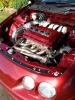
I made 513whp@16.8psi 93oct on Precision tunings dynojet. Initially I took my 14.5psi tune from evans that showed 492whp but that was on the dyno packs and ran that tune at Precision with everything the same and it showed 423whp. So that being said IDK how or if you would want to extrapolate those numbers but that would put my car at roughly 580whp@16.8psi on Evans dyno packs.Obviously estimated.....I will be going back to raise the boost with a new knock sensor and possibly race gas...trying to beat my best 608whp@18psi on race gas.
ls/vtec, head games ported/polished head,manley rods, cp pistons(83mm) Sleeved block, custom, forward facing manifold, dual tial 44's,edelbrock intake,sk2 tb, hondata s300 bosch 044 fuel pump, aem fpr, custom 3" evans dp
PT67 t3/.82
ls/vtec, head games ported/polished head,manley rods, cp pistons(83mm) Sleeved block, custom, forward facing manifold, dual tial 44's,edelbrock intake,sk2 tb, hondata s300 bosch 044 fuel pump, aem fpr, custom 3" evans dp
PT67 t3/.82
Honda-Tech Member
Joined: Jan 2006
Posts: 297
Likes: 0
From: smithfield, va, usa
Re: highest hp on pump gas
i made 509whp 335lbs torque @18psi with a little boost creep
bone stock head and itr cams with 84mm sleeved block(b18c) 10:1 comp.
sc6162 w/.82 a/r......WITH A/C AND ITS RHD!!! lol
http://www.youtube.com/watch?v=dVMev...&feature=share

bone stock head and itr cams with 84mm sleeved block(b18c) 10:1 comp.
sc6162 w/.82 a/r......WITH A/C AND ITS RHD!!! lol
http://www.youtube.com/watch?v=dVMev...&feature=share
Last edited by 2ltrgsr; Jun 28, 2011 at 08:51 AM.

Thread
Thread Starter
Forum
Replies
Last Post
z6
Forced Induction
18
Jul 21, 2004 11:07 AM
