


Rough Idle Issue



 Rough Idle Issue
Hey guys,
My D15B7 is stock and had been running well up to this point. Idle was rock solid for the 2 years I've had it but recently began to randomly go low at stop lights. I cleaned the IACV (or EACV as per FSM) and the FITV with the help of the FAQ and they both got new o-rings.
Today the idle got rough; you can feel the engine shaking at a stop light. When I push the brake pedal, the idle drops further. Turning on the blower fan drops it even more. Pulling into my driveway I stopped, mashed the brake, and it stalled. It has NEVER stalled out on me before. I'd appreciate any pointers as I start the troubleshooting game.
Investigating further it almost sounds and feels like one cylinder isn't firing, or at least not consistently. If I pull plug wire #1 while idling, it dies. If I pull #2, idle drops or sometimes doesn't seem the change. Wires 3 and 4 seem to just drop the idle.
Here are a few of the obvious things:
- Engine seems to run well once it's out of idle mode
- No obvious or audible vacuum leaks, but I'm not sure the best way to check
- Spark plugs are new NGKs and in good shape
- Wires and new NGK
- Cap, rotor are pretty new
- Timing is right at 16*
- Fuel injectors all read 12.5 Ohms
- Recent coolant exchange, bled like usual (but could be worth checking again)
- Valves adjusted maybe 10-15k ago
- Does not overheat
- Disconnected the battery for a while with no change
Thanks for the input. I do all my own work on this car. If you give me some well-educated guesses I'll work through them.
My D15B7 is stock and had been running well up to this point. Idle was rock solid for the 2 years I've had it but recently began to randomly go low at stop lights. I cleaned the IACV (or EACV as per FSM) and the FITV with the help of the FAQ and they both got new o-rings.
Today the idle got rough; you can feel the engine shaking at a stop light. When I push the brake pedal, the idle drops further. Turning on the blower fan drops it even more. Pulling into my driveway I stopped, mashed the brake, and it stalled. It has NEVER stalled out on me before. I'd appreciate any pointers as I start the troubleshooting game.
Investigating further it almost sounds and feels like one cylinder isn't firing, or at least not consistently. If I pull plug wire #1 while idling, it dies. If I pull #2, idle drops or sometimes doesn't seem the change. Wires 3 and 4 seem to just drop the idle.
Here are a few of the obvious things:
- Engine seems to run well once it's out of idle mode
- No obvious or audible vacuum leaks, but I'm not sure the best way to check
- Spark plugs are new NGKs and in good shape
- Wires and new NGK
- Cap, rotor are pretty new
- Timing is right at 16*
- Fuel injectors all read 12.5 Ohms
- Recent coolant exchange, bled like usual (but could be worth checking again)
- Valves adjusted maybe 10-15k ago
- Does not overheat
- Disconnected the battery for a while with no change
Thanks for the input. I do all my own work on this car. If you give me some well-educated guesses I'll work through them.

Honda-Tech Member
Joined: Jan 2013
Posts: 256
Likes: 0
Re: Rough Idle Issue
Yes, make sure your coolant is full.
Did you also clean the throttle body plate, it could be sticking.
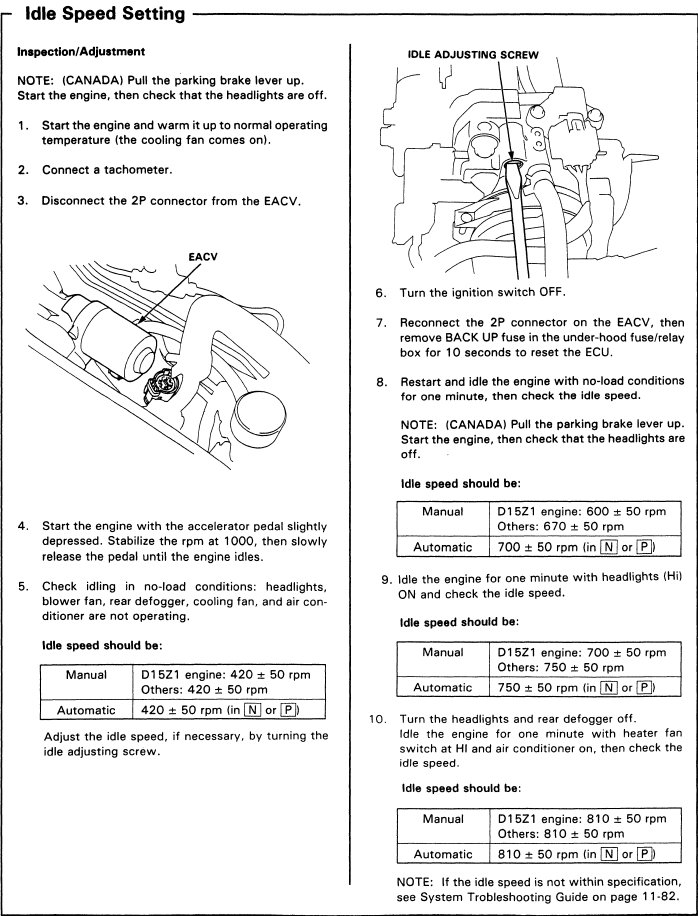
Also, it might be time for an idle adjustment. Do you have the manual and a tachometer? If you move the idle adjust screw, I recommend marking it keeping track of how much you have turned it.
Service steps can be posted of the method if you don't have the manual yet. Start at page 11-82;

A little background from a Honda Bulletin I found (from a 96-00 but still applies);
Did you also clean the throttle body plate, it could be sticking.
Also, it might be time for an idle adjustment. Do you have the manual and a tachometer? If you move the idle adjust screw, I recommend marking it keeping track of how much you have turned it.
Service steps can be posted of the method if you don't have the manual yet. Start at page 11-82;
A little background from a Honda Bulletin I found (from a 96-00 but still applies);
BACKGROUND
The ECM/PCM controls the vehicle’s idle speed with
the idle air control (IAC) valve. The IAC valve and the
air bleed screw (idle adjusting screw) work together to
allow the proper amount of air into the intake manifold
when the throttle valve is closed (the accelerator pedal
is released).
The ECM/PCM “learns” to work the IAC valve based on
the total amount of air entering the intake manifold. Air
can enter the intake manifold from several sources,
including the air bleed screw, but only the air bleed
screw is adjustable. If any changes are made that alter
this airflow, specifically with the air bleed screw, the
ECM/PCM must learn new idle parameters.
When the air bleed screw is properly set, the
ECM/PCM controls the engine’s idle speed
seamlessly. But when the air bleed screw is not
properly set, either of these symptoms may be present:
• Idle speed dips and then quickly recovers.
• Engine stalls intermittently when it is just “off-idle.”
Here are the criteria for this symptom:
– The accelerator pedal is released but the driver’s
right foot rests over the pedal, causing just enough
pressure for the ECM/PCM to detect an input, yet
there is little or no throttle valve opening (the
throttle valve is either not allowing any airflow or it
is opened so slightly that more air supply is
needed).
– The engine speed is about 1,250 rpm or less.
– The lockup clutch (A/T models) or the clutch (M/T
models) is disengaged.
– All during this time, the driver’s foot does not move
and stays resting over the accelerator pedal.
– The air bleed screw is not set properly and does
not allow enough airflow.
– The amount of “air leakage” into the intake
manifold is very low. (The normal amount of air let
into the intake manifold by sources other than the
IAC valve, the air bleed screw, and normal
operation of the throttle body can vary slightly from
vehicle to vehicle.)
NOTE: “Air leakage” cannot be easily checked. If
the first four criteria are met when the vehicle
stalls, you can assume the last two criteria are met
as well.
The ECM/PCM controls the vehicle’s idle speed with
the idle air control (IAC) valve. The IAC valve and the
air bleed screw (idle adjusting screw) work together to
allow the proper amount of air into the intake manifold
when the throttle valve is closed (the accelerator pedal
is released).
The ECM/PCM “learns” to work the IAC valve based on
the total amount of air entering the intake manifold. Air
can enter the intake manifold from several sources,
including the air bleed screw, but only the air bleed
screw is adjustable. If any changes are made that alter
this airflow, specifically with the air bleed screw, the
ECM/PCM must learn new idle parameters.
When the air bleed screw is properly set, the
ECM/PCM controls the engine’s idle speed
seamlessly. But when the air bleed screw is not
properly set, either of these symptoms may be present:
• Idle speed dips and then quickly recovers.
• Engine stalls intermittently when it is just “off-idle.”
Here are the criteria for this symptom:
– The accelerator pedal is released but the driver’s
right foot rests over the pedal, causing just enough
pressure for the ECM/PCM to detect an input, yet
there is little or no throttle valve opening (the
throttle valve is either not allowing any airflow or it
is opened so slightly that more air supply is
needed).
– The engine speed is about 1,250 rpm or less.
– The lockup clutch (A/T models) or the clutch (M/T
models) is disengaged.
– All during this time, the driver’s foot does not move
and stays resting over the accelerator pedal.
– The air bleed screw is not set properly and does
not allow enough airflow.
– The amount of “air leakage” into the intake
manifold is very low. (The normal amount of air let
into the intake manifold by sources other than the
IAC valve, the air bleed screw, and normal
operation of the throttle body can vary slightly from
vehicle to vehicle.)
NOTE: “Air leakage” cannot be easily checked. If
the first four criteria are met when the vehicle
stalls, you can assume the last two criteria are met
as well.

Honda-Tech Member
Joined: Feb 2012
Posts: 887
Likes: 1
From: Iowa
Re: Rough Idle Issue
Check how much your alt is putting out. If you have powerwindows when your at a stop try letting go of the brake real quick and roll up the window. If idle increases and gets better its just your eld being an ***.
 Re: Rough Idle Issue
Thanks for the great ideas! Let me hit all of them here...
Yes, I am suspicious of cyl #2. No loss of coolant, no smoke from exhaust. I think a compression check is in order just to know where I stand.
Can you explain what the ELD does? If it's not functioning correctly, will it affect the idle if the electrical system feels a current draw?
Looks like I need to do an idle speed adjustment carefully as per FSM. Any suggestions on a tach for this purpose?
Yes, I am suspicious of cyl #2. No loss of coolant, no smoke from exhaust. I think a compression check is in order just to know where I stand.
Can you explain what the ELD does? If it's not functioning correctly, will it affect the idle if the electrical system feels a current draw?
Looks like I need to do an idle speed adjustment carefully as per FSM. Any suggestions on a tach for this purpose?
Trending Topics
Honda-Tech Member
Joined: Jan 2013
Posts: 256
Likes: 0
Re: Rough Idle Issue
Yes, a compression test would be good. Make sure wires are on the cap tight, double check cap and rotor.
As far as a test tach, I recently had the need for one, so I looked around but no one could recommend a particular one. There are DMMs with the tach function with different price ranges, or if you have a DMM with frequency check you can multiply by 60 for RPM.
I got this one, I will let you know how it does;
http://www.esitest.com/585K.html
If you have money to burn or you are a shop tech, get the Fluke 88V, excellent, but overkill and very expensive.
Then you can find these at Harbor Freight, Autozone, and Sears;
Autozone and Sears (and Amazon);
Actron CP7605 test tach (except you have to put it on 8-cyl then multiply x2, but it can get you close); http://www.actron.com/product_detail.php?pid=16160
Actron CP7677 DMM; http://www.actron.com/product_detail.php?pid=16155
Harbor Freight Tools; http://www.harborfreight.com/lcd-aut...kit-95670.html
But I don't know about that one, the reviews kind of turned me off to it, still could be ok. You can find ones that do an inductive pickup, but personally I would just use the test lead in the test connector.
If you need to be cheap as possible, I would get the CP7605, but if you can spend a little more the CP7677, but that's just my 2 cents.
Maybe someone else on here has tried a test tach they like?
Good luck!
As far as a test tach, I recently had the need for one, so I looked around but no one could recommend a particular one. There are DMMs with the tach function with different price ranges, or if you have a DMM with frequency check you can multiply by 60 for RPM.
I got this one, I will let you know how it does;
http://www.esitest.com/585K.html
If you have money to burn or you are a shop tech, get the Fluke 88V, excellent, but overkill and very expensive.
Then you can find these at Harbor Freight, Autozone, and Sears;
Autozone and Sears (and Amazon);
Actron CP7605 test tach (except you have to put it on 8-cyl then multiply x2, but it can get you close); http://www.actron.com/product_detail.php?pid=16160
Actron CP7677 DMM; http://www.actron.com/product_detail.php?pid=16155
Harbor Freight Tools; http://www.harborfreight.com/lcd-aut...kit-95670.html
But I don't know about that one, the reviews kind of turned me off to it, still could be ok. You can find ones that do an inductive pickup, but personally I would just use the test lead in the test connector.
If you need to be cheap as possible, I would get the CP7605, but if you can spend a little more the CP7677, but that's just my 2 cents.
Maybe someone else on here has tried a test tach they like?
Good luck!
Last edited by dazebreak; Feb 7, 2013 at 07:59 AM. Reason: grammar
Honda-Tech Member
Joined: Jan 2013
Posts: 256
Likes: 0
Re: Rough Idle Issue
One last thing, it could still be your IACV you can try cleaning again, but also make sure your throttle body valve isn't sticking, did you clean the throttle body also, they tend to stick when gunky.


It goes on to specific tests... there is a testfor the fast idle valve also...
It goes on to specific tests... there is a testfor the fast idle valve also...
Honda-Tech Member
Joined: Jan 2013
Posts: 256
Likes: 0
Re: Rough Idle Issue
If you do get a test tach, check the range in the specs. I found out the one I ordered says it only goes down to 600rpm, but maybe that is only with the inductive pickup. Anyway, I might have to send it back. Hmm, hold up the specs online are different than in manual. The analog one goes to zero of course. Anyway, I'm going to try it after work....
Re: Rough Idle Issue
I ended up ordering one of these tachs. Should be good enough:
Definitely worth considering the IACV again. Does flushing them with brake cleaner kill them?

Definitely worth considering the IACV again. Does flushing them with brake cleaner kill them?
Honda-Tech Member
Joined: Jan 2013
Posts: 256
Likes: 0
Re: Rough Idle Issue
I ended up ordering one of these tachs. Should be good enough:
http://www.amazon.com/gp/product/B00...ls_o00_s00_i00
http://www.amazon.com/gp/product/B00...ls_o00_s00_i00

Definitely worth considering the IACV again. Does flushing them with brake cleaner kill them?
The tach I got works great with the inductive pickup. The test connect works ok too, but I had to make sure it stayed in the test hole and on the contact. In the end I just used a bed of nails probe on the wire.

Thread
Thread Starter
Forum
Replies
Last Post
TurboSI24
Honda Civic / Del Sol (1992 - 2000)
2
Nov 23, 2005 03:39 PM