


My 1995 Honda Del Sol S build


Thread Starter
Honda-Tech Member
Joined: Jun 2011
Posts: 21
Likes: 0
From: North Canton, OH
 My 1995 Honda Del Sol S build
I'm the kind of guy who enjoys seeing when other people document their project cars as they build them up, and seeing as I'm starting a new project with a car type I've never worked with before, I figured that I'd document my work for the benefit of others.
I purchased a 1995 Honda Del Sol S with 177,000 miles on it, with the intent of stripping it out and converting it for a track. Since the events I usually go to are not SCCA or sanctioned by any other group, I'm not concerning myself with meeting any particular regulations. In the main, I hope to do the work necessary to produce a result that I like. Otherwise, I hope to keep the car street legal, just so that I don't limit myself to just track days.
My long-term goals are to do a K20A swap, do a rear-disc conversion for the brakes, upgrade the suspension, and stiffen the chassis, while sacrificing as little as possible in terms of basic options. I'm hoping to at least keep the A/C. The stereo is already removed, mostly because in my area, that's the most likely to get stolen (already had someone try once, would have loved to see the look on his face when he found empty speaker mounts). Also, I want to keep the targa top as a removable and stowable unit. I realize that with the addition of a roll cage (which is probably the likely solution for chassis stiffening), I might not be able to stow it anymore, but I'll cross that bridge when I get there. I'm hypothesizing that I will not be able to get a good quality cage and keep the power rear window, but again, don't know for sure.
This is as much an exercise of discovery for me as anyone else. I've been able to obtain quite a bit of information, either by my own observations or word-of-mouth. I'm going to try and document everything I do and discover, as well as include pictures.
I purchased a 1995 Honda Del Sol S with 177,000 miles on it, with the intent of stripping it out and converting it for a track. Since the events I usually go to are not SCCA or sanctioned by any other group, I'm not concerning myself with meeting any particular regulations. In the main, I hope to do the work necessary to produce a result that I like. Otherwise, I hope to keep the car street legal, just so that I don't limit myself to just track days.
My long-term goals are to do a K20A swap, do a rear-disc conversion for the brakes, upgrade the suspension, and stiffen the chassis, while sacrificing as little as possible in terms of basic options. I'm hoping to at least keep the A/C. The stereo is already removed, mostly because in my area, that's the most likely to get stolen (already had someone try once, would have loved to see the look on his face when he found empty speaker mounts). Also, I want to keep the targa top as a removable and stowable unit. I realize that with the addition of a roll cage (which is probably the likely solution for chassis stiffening), I might not be able to stow it anymore, but I'll cross that bridge when I get there. I'm hypothesizing that I will not be able to get a good quality cage and keep the power rear window, but again, don't know for sure.
This is as much an exercise of discovery for me as anyone else. I've been able to obtain quite a bit of information, either by my own observations or word-of-mouth. I'm going to try and document everything I do and discover, as well as include pictures.
Thread Starter
Honda-Tech Member
Joined: Jun 2011
Posts: 21
Likes: 0
From: North Canton, OH
Re: My 1995 Honda Del Sol S build

So having purchased a del Sol S from 1995, the engine that came with it is a D15B7, a 1.5L 4-cylinder with 4 valves per cylinder and single overhead cam. As one might expect, with 177,000 odd miles, it burns about a quart of oil every 300 highway miles or so, and the valves make fun noises at any engine speed. However, the engine is sturdy, and the clutch still feels good.
Shortly after getting the car, I cleaned the intake manifold and throttle body, as well threw injector cleaner in a tank of gas. For oil, since it's summertime, I'm using SAE40 (straight 40) in the attempt to minimize burning it off. I may or may not decide to actually do something about oil-burning problem later...if I do, it will be in among a bunch of things (piston rings, valve seals, timing belt, oil pump, water pump, head gasket, etc.).
Will get some pictures of the car itself up, probably tomorrow, since it's sunny out.

Honda-Tech Member
Joined: Jul 2004
Posts: 240
Likes: 0
From: Russellville AR
Re: My 1995 Honda Del Sol S build
I am building a 93 Sol Si with a fully built z6 turbo. I have many build threads on other forums just not on here. If you are interested I can send you a like to another forum so you can check it out. I also posted up on your chassis stiffing. Good luck with the project and I will check in to see the progress.


Thread Starter
Honda-Tech Member
Joined: Jun 2011
Posts: 21
Likes: 0
From: North Canton, OH
Re: My 1995 Honda Del Sol S build
Unfortunately, no pics today of the del Sol, it's thundering out like crazy, and the lil' guy will be all wet (not to mention my HTC phone).
So here's a different picture in the meantime.

This is a buddy's Integra, complete with total interior removal, some serious suspension coilovers and stiffening mods, and a K20A swap with some extra work on the cams, intake and headers.
We were at a track day at Gingerman Raceway recently, and he was easily running with Porsche 911 Turbos and Carrera 4S and other cars way more expensive than his. I even got to ride along shotgun, but my butt's bigger than his (I swear, his seats have 10" of hip room), so I was one cheek out the whole way. Still pretty intense.
You can check his onboard video out here.
http://youtu.be/9dMwmv-6u04
So here's a different picture in the meantime.
This is a buddy's Integra, complete with total interior removal, some serious suspension coilovers and stiffening mods, and a K20A swap with some extra work on the cams, intake and headers.
We were at a track day at Gingerman Raceway recently, and he was easily running with Porsche 911 Turbos and Carrera 4S and other cars way more expensive than his. I even got to ride along shotgun, but my butt's bigger than his (I swear, his seats have 10" of hip room), so I was one cheek out the whole way. Still pretty intense.
You can check his onboard video out here.
http://youtu.be/9dMwmv-6u04
Trending Topics
Thread Starter
Honda-Tech Member
Joined: Jun 2011
Posts: 21
Likes: 0
From: North Canton, OH
Re: My 1995 Honda Del Sol S build
So, the next phase in the saga...
I've done the mathematics of material upkeep, and the numbers aren't looking good.
If you've ever priced out the parts to do valves, piston rings, clutch, oil pump, and the like, you'll have found that the bill can run up pretty high, and that's not even considering the time needed (or the tools) to get it all done.
Cue the much-needed reality check.

Say hello to a like-new engine from a Del Sol Si for less than $600. And there'll be much less time wasted doing a straight engine swap instead of a crap-ton of overdue maintenance.
I've done the mathematics of material upkeep, and the numbers aren't looking good.
If you've ever priced out the parts to do valves, piston rings, clutch, oil pump, and the like, you'll have found that the bill can run up pretty high, and that's not even considering the time needed (or the tools) to get it all done.
Cue the much-needed reality check.
Say hello to a like-new engine from a Del Sol Si for less than $600. And there'll be much less time wasted doing a straight engine swap instead of a crap-ton of overdue maintenance.
Last edited by Zephyr701; Jun 7, 2011 at 12:26 PM. Reason: Typo
Thread Starter
Honda-Tech Member
Joined: Jun 2011
Posts: 21
Likes: 0
From: North Canton, OH
Re: My 1995 Honda Del Sol S build
Sorry, no pictures today. Soon, I promise.
One of the things that I had to deal with right when I bought my del Sol was pulsing brakes. Since I wasn't going very fast in the confines of the parking lot where I originally tested it, I didn't get to feel out the brakes quite as much.
However, when I got on the highway, the brakes were pulsing extremely bad. I could feel the pulse in the brake pedal and in the steering.
Generally, this can happen several ways. One is warping of the brake rotors. The pedal is tied directly to the hydraulic system, so you can feel when the brake pads encounter irregularities when under load. With a warped rotor, you would feel a pulse in the pedal.
The other way you can get a pulse is inconsistent surface material on the rotor. This happened to be what was going on in my case. The car was left to sit during a heavy rain or snow season (or several). The rotors began to rust, but the area of the rotor covered by the pad did not. Hence, the pulse I was feeling was the brief moment of contact with good rotor material.
It was fairly easy for me to pinpoint the problem, since the '95 Del Sol S has rear drums (which cannot produce a distinctive violent pulse in the same way), I replaced the front rotors and pads with OEM. Oddly enough, the bolts and calipers came off with minimal effort, although the passenger side rotor was rusted on tight. I ended up hitting it with an acetylene torch and knocking it off with a sledgehammer.
All the bolts for the brakes were in metric: 13mm and 17mm were the socket sizes I had to use. The calipers were pretty corroded on the outside, but the piston on the inside was clean, so I'm continuing to re-use them until I can get a rear-disc conversion, at which point I'll upgrade all the brakes simultaneously.
One of the things that I had to deal with right when I bought my del Sol was pulsing brakes. Since I wasn't going very fast in the confines of the parking lot where I originally tested it, I didn't get to feel out the brakes quite as much.
However, when I got on the highway, the brakes were pulsing extremely bad. I could feel the pulse in the brake pedal and in the steering.
Generally, this can happen several ways. One is warping of the brake rotors. The pedal is tied directly to the hydraulic system, so you can feel when the brake pads encounter irregularities when under load. With a warped rotor, you would feel a pulse in the pedal.
The other way you can get a pulse is inconsistent surface material on the rotor. This happened to be what was going on in my case. The car was left to sit during a heavy rain or snow season (or several). The rotors began to rust, but the area of the rotor covered by the pad did not. Hence, the pulse I was feeling was the brief moment of contact with good rotor material.
It was fairly easy for me to pinpoint the problem, since the '95 Del Sol S has rear drums (which cannot produce a distinctive violent pulse in the same way), I replaced the front rotors and pads with OEM. Oddly enough, the bolts and calipers came off with minimal effort, although the passenger side rotor was rusted on tight. I ended up hitting it with an acetylene torch and knocking it off with a sledgehammer.
All the bolts for the brakes were in metric: 13mm and 17mm were the socket sizes I had to use. The calipers were pretty corroded on the outside, but the piston on the inside was clean, so I'm continuing to re-use them until I can get a rear-disc conversion, at which point I'll upgrade all the brakes simultaneously.
Last edited by Zephyr701; Jun 8, 2011 at 10:10 AM. Reason: Typo

Honda-Tech Member
Joined: Nov 2009
Posts: 1,809
Likes: 1
From: New York
Re: My 1995 Honda Del Sol S build
c'mon, no pictures of the sol? :p
i like your thought process though, just remember, patiences is the most important thing when building a car.
subscribed
if you need any d-series parts, i might be able to help ya out
i like your thought process though, just remember, patiences is the most important thing when building a car.
subscribed
if you need any d-series parts, i might be able to help ya out
Thread Starter
Honda-Tech Member
Joined: Jun 2011
Posts: 21
Likes: 0
From: North Canton, OH
Re: My 1995 Honda Del Sol S build
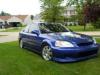
As promised, here are the photos of my Sol, taken yesterday. The only real defects you can see in the pics are the cracked front windshield and a teeny-tiny spot of rust at the top corner of the windshield frame on the driver's side.


Thread Starter
Honda-Tech Member
Joined: Jun 2011
Posts: 21
Likes: 0
From: North Canton, OH
Re: My 1995 Honda Del Sol S build
So, I have enumerated what mods I'm shooting for, after hours of experts vs. trolls surfing on the forums....
I'll probably be working with Zerolift Autolab in Cincinnati for most of these upgrades. As for body work, the only things I intend on doing is scrubbing the body and frame clean of rust and getting a new black paint job. My aim is that the car will look stock at a glance (as long as you're not glancing through the window).
- 5-lug conversion from a Civic Type-R
- Lower profile tires with wider track (hoping to keep to Honda OEM, though)
- A brake upgrade, probably no larger than 12" fronts
- Sparco Fighter seats
- Interior weight reduction, as well as trunk
- Function7 rear subframe reinforcement
- Function7 rear control arms
- Coilover suspension
- Adjustable camber kit
- Sway bar upgrade (front and rear)
- Custom fabricated roll cage
- K20A with matching 6-spd LSD transmission
I'll probably be working with Zerolift Autolab in Cincinnati for most of these upgrades. As for body work, the only things I intend on doing is scrubbing the body and frame clean of rust and getting a new black paint job. My aim is that the car will look stock at a glance (as long as you're not glancing through the window).



Thread Starter
Honda-Tech Member
Joined: Jun 2011
Posts: 21
Likes: 0
From: North Canton, OH
Re: My 1995 Honda Del Sol S build
So, for the first upgrade, I'm going to be installing Function7 rear lower control arms, along with the Function7 rear subframe brace. I'll go with an Eibach roll bar conversion (front & back) which will give me a front diameter of 26 mm and a rear diameter of 17 mm.
In every single post I've read about doing these kinds of upgrades, the rear subframe brace is cited as a must-have before bolting any sway bar larger than stock to the EG chassis. My del Sol did not come with a rear sway bar from the factory, although it does have the front sway bar (21 mm). The reason that I'm having to do the Function7 rear lower control arms is because the factory control arms do not have mount points for a sway bar.
After that, I will be doing a 5-lug conversion. This is where I could use a bit of help.
There are many different posts, with not a lot of technical specification to be found all in one place, and even fewer material experts who have done this sort of thing. That being said, here's what I've been able to piece together so far.
A good 5-lug conversion will consist of the hubs, knuckles, calipers, rotors, trailing arms, bearings, and e-brake lines. As far as my car is concerned, all of these parts are necessary for the conversion, because my car lacks identical or comparable parts to match.
The JDM Integra Type R (DC2) conversion will fit the del Sol with the exception of the axles. The del Sol S axle size is 32 mm, and the JDM ITR is 36 mm. However, the US version of the Integra Type R (USDM) has 32 mm axles. This is offset by the fact that USDM ITR conversions are a lot harder to find.
It has been established that the 1999 Honda CR-V knuckle and hub are identical to the JDM ITR configuration, but once again, the axle size is 36 mm (I believe).
This is where the expert advice is required. What options do I have for overcoming this issue of the axle sizes? I've been led to believe that obtaining 36 mm axle ends and attaching them to the stock axle, replacing the 32 mm ends will work. Is there another alternative (perhaps a wheel bearing that fits the hub but will house a 32 mm axle)? If so, can you post any relevant links or part numbers?
In every single post I've read about doing these kinds of upgrades, the rear subframe brace is cited as a must-have before bolting any sway bar larger than stock to the EG chassis. My del Sol did not come with a rear sway bar from the factory, although it does have the front sway bar (21 mm). The reason that I'm having to do the Function7 rear lower control arms is because the factory control arms do not have mount points for a sway bar.
After that, I will be doing a 5-lug conversion. This is where I could use a bit of help.
There are many different posts, with not a lot of technical specification to be found all in one place, and even fewer material experts who have done this sort of thing. That being said, here's what I've been able to piece together so far.
A good 5-lug conversion will consist of the hubs, knuckles, calipers, rotors, trailing arms, bearings, and e-brake lines. As far as my car is concerned, all of these parts are necessary for the conversion, because my car lacks identical or comparable parts to match.
The JDM Integra Type R (DC2) conversion will fit the del Sol with the exception of the axles. The del Sol S axle size is 32 mm, and the JDM ITR is 36 mm. However, the US version of the Integra Type R (USDM) has 32 mm axles. This is offset by the fact that USDM ITR conversions are a lot harder to find.
It has been established that the 1999 Honda CR-V knuckle and hub are identical to the JDM ITR configuration, but once again, the axle size is 36 mm (I believe).
This is where the expert advice is required. What options do I have for overcoming this issue of the axle sizes? I've been led to believe that obtaining 36 mm axle ends and attaching them to the stock axle, replacing the 32 mm ends will work. Is there another alternative (perhaps a wheel bearing that fits the hub but will house a 32 mm axle)? If so, can you post any relevant links or part numbers?


Thread
Thread Starter
Forum
Replies
Last Post
drivesideways46
Road Racing / Autocross & Time Attack
6
Feb 19, 2006 10:20 PM
