


Ringlands cause


Thread Starter
Honda-Tech Member
Joined: May 2010
Posts: 173
Likes: 0
From: Perth, Scotland
 Ringlands cause
Hey guys
I've managed to destroy the ringlands on 3/4 of my pistons and I'm wondering what the cause could be.
It's a stock B16a2. Stock pistons and rods. Using ARP head studs.
Running at 270WHP at 8psi of boost.
It's got a Walbro fuel pump.
I was at the end of the 1/4 mile, and as soon as I lifted off the gas, I got loads of white smoke from the exhaust. I though it was HG because if the steam, but it turns out to be the ringlands.
Does anyone know what could have caused this?
I've managed to destroy the ringlands on 3/4 of my pistons and I'm wondering what the cause could be.
It's a stock B16a2. Stock pistons and rods. Using ARP head studs.
Running at 270WHP at 8psi of boost.
It's got a Walbro fuel pump.
I was at the end of the 1/4 mile, and as soon as I lifted off the gas, I got loads of white smoke from the exhaust. I though it was HG because if the steam, but it turns out to be the ringlands.
Does anyone know what could have caused this?

Man U FTW

Joined: Sep 2005
Posts: 11,973
Likes: 2
From: Phoenix, AZ
Re: Ringlands cause
Could be the tune, but it could simply be bad ringlands. They're a cast piece and known to be failure-prone. Sucks...
EDIT: 3 of 4 is not a coincidence or problem with manufacturing. Tune or fuel-related issue causing lean conditions / detonation
EDIT: 3 of 4 is not a coincidence or problem with manufacturing. Tune or fuel-related issue causing lean conditions / detonation
Thread Starter
Honda-Tech Member
Joined: May 2010
Posts: 173
Likes: 0
From: Perth, Scotland
Re: Ringlands cause
I was right at the end of the 1/4 mile, hitting 118mph, and might have buzzed the limiter in 4th a bit. Could hitting the limiter cause this type of detonation?

Ive gotten "tunes" from "tuners" with "good reps"
Lets just say i blow my own motors now
If you have any spark plugs from that motor in good shape or the top of the pistons post em up
Lets just say i blow my own motors now
If you have any spark plugs from that motor in good shape or the top of the pistons post em up


Trending Topics
Thread Starter
Honda-Tech Member
Joined: May 2010
Posts: 173
Likes: 0
From: Perth, Scotland
Re: Ringlands cause
Yeah, it did burn a small amount of oil before it let go.
Video of the exhaust - you can see a bit of oil/fuel burning -
Video of the exhaust - you can see a bit of oil/fuel burning -
Last edited by GT500FTW; Jan 27, 2016 at 10:04 AM.


Thread Starter
Honda-Tech Member
Joined: May 2010
Posts: 173
Likes: 0
From: Perth, Scotland
Re: Ringlands cause


Thread Starter
Honda-Tech Member
Joined: May 2010
Posts: 173
Likes: 0
From: Perth, Scotland
Re: Ringlands cause
I wouldn't worry about that. I'm over in Scotland. Steel has a different "cracking" temperature over here. Something to do with the gulf stream....don't ask me, I'm not a scientist.

Honda-Tech Member
Joined: Jan 2004
Posts: 812
Likes: 2
From: Montreal


Honda-Tech Member
Joined: Mar 2005
Posts: 2,428
Likes: 11
From: CT, US
Re: Ringlands cause
I'd also say it's probably tune related, or could just be from the rev limiter. I use crome in my own car, and have tuned countless cars with it myself. and it works great, IF you know how to work with it, and if you're not looking for any special features. And I can say this; the rev limiter and "launch control" (rev limit) are not the greatest. it's just an ignition cut or ignition/fuel cut. it's not a soft limiter that alters timing a bit too.
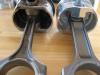
The pistons do not look like they've seen much/any serious detonation, but they are quite clean and have a specific color pattern, so that tells me you're running fairly aggressive timing near it's peak performance limit. And this alone can add some stress to the ringlands. I've shattered ringlands on stock pistons in my car from aggressive timing alone. Zero detonation, and hadnt even reached peak output yet, but was close. In my experience, stock cast honda pistons can withstand around 230-250tq with aggressive timing, and up to 350tq with conservative timing, before ringlands start shattering like clockwork
Haha!! I loved this one, actually laughed out loud 
depending on how the rev limiter functions (ignition cut, ignition retard, fuel cut, fuel enrichment, etc) it can cause some nasty shockwaves and harmonics through the internals, and sometimes can even cause detonation, and other times can start the combustion process halfway down the stroke which basically hammers the piston with a near explosion
The pistons do not look like they've seen much/any serious detonation, but they are quite clean and have a specific color pattern, so that tells me you're running fairly aggressive timing near it's peak performance limit. And this alone can add some stress to the ringlands. I've shattered ringlands on stock pistons in my car from aggressive timing alone. Zero detonation, and hadnt even reached peak output yet, but was close. In my experience, stock cast honda pistons can withstand around 230-250tq with aggressive timing, and up to 350tq with conservative timing, before ringlands start shattering like clockwork
depending on how the rev limiter functions (ignition cut, ignition retard, fuel cut, fuel enrichment, etc) it can cause some nasty shockwaves and harmonics through the internals, and sometimes can even cause detonation, and other times can start the combustion process halfway down the stroke which basically hammers the piston with a near explosion

Thread
Thread Starter
Forum
Replies
Last Post