


PCV VALVE AND CATCH CAN FOR TURBO SETUP


Thread Starter
Honda-Tech Member
Joined: Sep 2002
Posts: 483
Likes: 0
From: USA
 PCV VALVE AND CATCH CAN FOR TURBO SETUP
God I seriously am so sick of not understanding this subject. I've researched and am still frustrated.
Some people say that the pcv is that nipple on top of my valve cover, some say its on one of the runners on the intake manifold, and some say something about it being on the back of the block. Which is it???
Also, what is the function of the pcv valve? to release excess crankcase pressure which contains oily vapors?
Also, under boost the pcv valve is closed therefore no pressure is being released, are we supposed to setup our own pcv system and create our own vacuum source in order to release the pressure that is going on while boosting since the pcv can't do its job while under boost?
So in order to do that I've heard some people using the intake tube of the turbo as an vacuum source with a tube from the breather nipple on the valve cover to the turbo intake tube with a catch can inline. Wouldn't this be risky? Also would that release the pressures inside the crankcase?
What does the pcv look like and how does that little thing function as some people say you "can just place it on top of the catch can" what the hell does that mean? put it on the catch can? how does it operate up there? I'm just lost.
can someone answer this question in the same block method I've listed these question in order to insure clarification. I really want to understand this whole thing as it constantly bothers me when thinking about completing my turbo setup. HELP!!!
Some people say that the pcv is that nipple on top of my valve cover, some say its on one of the runners on the intake manifold, and some say something about it being on the back of the block. Which is it???
Also, what is the function of the pcv valve? to release excess crankcase pressure which contains oily vapors?
Also, under boost the pcv valve is closed therefore no pressure is being released, are we supposed to setup our own pcv system and create our own vacuum source in order to release the pressure that is going on while boosting since the pcv can't do its job while under boost?
So in order to do that I've heard some people using the intake tube of the turbo as an vacuum source with a tube from the breather nipple on the valve cover to the turbo intake tube with a catch can inline. Wouldn't this be risky? Also would that release the pressures inside the crankcase?
What does the pcv look like and how does that little thing function as some people say you "can just place it on top of the catch can" what the hell does that mean? put it on the catch can? how does it operate up there? I'm just lost.
can someone answer this question in the same block method I've listed these question in order to insure clarification. I really want to understand this whole thing as it constantly bothers me when thinking about completing my turbo setup. HELP!!!



B*a*n*n*e*d
Joined: Aug 2001
Posts: 2,966
Likes: 0
From: Todays date is, UK
Re: PCV VALVE AND CATCH CAN FOR TURBO SETUP (RR98DX)
the pcv valve is a valve that opens when there is undo crankcase pressure. the breather uses vaccum to pull vapors out of the head. when running a catch can setup, you ditch the pcv setup usually.

Joined: Aug 2003
Posts: 1,383
Likes: 0
From: United States of America, US
Re: PCV VALVE AND CATCH CAN FOR TURBO SETUP (RR98DX)
<TABLE WIDTH="90%" CELLSPACING=0 CELLPADDING=0 ALIGN=CENTER><TR><TD>Quote, originally posted by RR98DX »</TD></TR><TR><TD CLASS="quote">so the valve cover nipple still relieves crank case pressure under high loads without the need of a PCV?</TD></TR></TABLE>
?
?
Trending Topics
Joined: Aug 2003
Posts: 1,383
Likes: 0
From: United States of America, US
Re: PCV VALVE AND CATCH CAN FOR TURBO SETUP (BodyKits NW)
<TABLE WIDTH="90%" CELLSPACING=0 CELLPADDING=0 ALIGN=CENTER><TR><TD>Quote, originally posted by BodyKits NW »</TD></TR><TR><TD CLASS="quote">Forget the PCV, it is basically useless for a turbo setup. Just get rid of it. </TD></TR></TABLE>
how much oil will be expected after a hard day of driving? will the catch can ever fill up? I am getting this slowly I don't know why this is so hard, and everywhere you look you get conflicting information.
how much oil will be expected after a hard day of driving? will the catch can ever fill up? I am getting this slowly
I don't know why this is so hard, and everywhere you look you get conflicting information.

Honda-Tech Member
iTrader: (1)
Joined: Mar 2003
Posts: 3,215
Likes: 3
From: I drink Seafoam and poo into catch cans, USA
Re: PCV VALVE AND CATCH CAN FOR TURBO SETUP (JICEK9)
Pardon me for sounding like a dumbass as I am not completely sure about this subject either, I have read thread after thread about this and there is always controversy over how is the right way.
assuming I am going to make my own catchcan and not buy endyn's can someone confirm this will work. I would draw a picture but It would look like a 5 year old drew it.
From valve cover nipple attach hose.
Disconnect pcv valve and black box (on GSR motor), now that this is gone, attach another hose from where black box was.
now tee both of these above lines into one bigger line that goes to one side of the catch can.
From other side of catch can, run a line to intake side of turbo for constant vacuum. (also maybe need breather filter on top of catch can?)
Will this work?
assuming I am going to make my own catchcan and not buy endyn's can someone confirm this will work. I would draw a picture but It would look like a 5 year old drew it.
From valve cover nipple attach hose.
Disconnect pcv valve and black box (on GSR motor), now that this is gone, attach another hose from where black box was.
now tee both of these above lines into one bigger line that goes to one side of the catch can.
From other side of catch can, run a line to intake side of turbo for constant vacuum. (also maybe need breather filter on top of catch can?)
Will this work?
Joined: Aug 2003
Posts: 1,383
Likes: 0
From: United States of America, US
Re: PCV VALVE AND CATCH CAN FOR TURBO SETUP (mike1114)
<TABLE WIDTH="90%" CELLSPACING=0 CELLPADDING=0 ALIGN=CENTER><TR><TD>Quote, originally posted by mike1114 »</TD></TR><TR><TD CLASS="quote">Pardon me for sounding like a dumbass as I am not completely sure about this subject either, I have read thread after thread about this and there is always controversy over how is the right way.
assuming I am going to make my own catchcan and not buy endyn's can someone confirm this will work. I would draw a picture but It would look like a 5 year old drew it.
From valve cover nipple attach hose.
Disconnect pcv valve and black box (on GSR motor), now that this is gone, attach another hose from where black box was.
now tee both of these above lines into one bigger line that goes to one side of the catch can.
From other side of catch can, run a line to intake side of turbo for constant vacuum. (also maybe need breather filter on top of catch can?)
Will this work?</TD></TR></TABLE>
I had the same question in this thread...
https://honda-tech.com/zerothread?id=685008
I guess it's suppose to work I'll try it in the spring if nobody else has done it. Has anybody else tried it this way???
assuming I am going to make my own catchcan and not buy endyn's can someone confirm this will work. I would draw a picture but It would look like a 5 year old drew it.
From valve cover nipple attach hose.
Disconnect pcv valve and black box (on GSR motor), now that this is gone, attach another hose from where black box was.
now tee both of these above lines into one bigger line that goes to one side of the catch can.
From other side of catch can, run a line to intake side of turbo for constant vacuum. (also maybe need breather filter on top of catch can?)
Will this work?</TD></TR></TABLE>
I had the same question in this thread...
https://honda-tech.com/zerothread?id=685008
I guess it's suppose to work
I'll try it in the spring if nobody else has done it. Has anybody else tried it this way???
Joined: Aug 2003
Posts: 1,383
Likes: 0
From: United States of America, US
Re: PCV VALVE AND CATCH CAN FOR TURBO SETUP (mike1114)
<TABLE WIDTH="90%" CELLSPACING=0 CELLPADDING=0 ALIGN=CENTER><TR><TD>Quote, originally posted by mike1114 »</TD></TR><TR><TD CLASS="quote">Someone clear this up for me?</TD></TR></TABLE>
read what "bodykits nw" wrote on the first page of this post... I get it now
https://honda-tech.com/zerothread?id=684673

read what "bodykits nw" wrote on the first page of this post... I get it now
https://honda-tech.com/zerothread?id=684673
Honda-Tech Member
iTrader: (1)
Joined: Mar 2003
Posts: 3,215
Likes: 3
From: I drink Seafoam and poo into catch cans, USA
Re: PCV VALVE AND CATCH CAN FOR TURBO SETUP (JICEK9)
I did read that but it confused me the first time.
I read it again now and it confirms what I wrote exactly
thanks!!
I read it again now and it confirms what I wrote exactly
thanks!!

Member
Joined: Dec 2002
Posts: 1,740
Likes: 2
From: Tampa, Fl, US
Re: PCV VALVE AND CATCH CAN FOR TURBO SETUP (mike1114)
the real purpose of a pcv system is to relieve pressure in the crankcase from slight blowby from the rings. when compression leaks by the rings it obviously builds up pressure in the bottom end. your factory pcv system utilizes an oil/air seperator aka 'black box' that pulls vapors from a hole in the back of the block. these vapors are pulled out using your intake manifolds vacuum. in between the black box and the intake manifold there is a pcv valve, which is just basically a mini sprung valve that will shut if it feels anything less than vacuum to prevent intake air from being blown back into the black box and crankcase.
so obviously under WOT you basically have 0 crankcase ventilation(other than that tiny vent in your valve cover that the vapors from the block have to fight thru the oil passages to get to, and over time this will eat away at your bottom end seals(rings manily).
this is basically the same on all honda motors, now imagine a boosted motor, with a bit more blowby and a ton more pressure in the crankcase at WOT.
this is why companies like endyn have created a breather kit that allows the motor to breathe at any throttle position and any pressure, boosted or not. the endyn breather kit eliminates the factory black box and uses the 2 factory 14mm allen key plugged holes on the back of the block to pull vapor from the crankcase and collect them into a very well designed catchcan with no pcv valve inbetween the 2. the system gives u the option to run these vapors back into your intake for emission purposes mainly or the recommended open atmosphere. whetther your just driving around town or racing down the track your crankcase will always have ventilation with this system. and i highly recommend it for any application, your motor will thank you later on down the road
hope that helps
so obviously under WOT you basically have 0 crankcase ventilation(other than that tiny vent in your valve cover that the vapors from the block have to fight thru the oil passages to get to, and over time this will eat away at your bottom end seals(rings manily).
this is basically the same on all honda motors, now imagine a boosted motor, with a bit more blowby and a ton more pressure in the crankcase at WOT.
this is why companies like endyn have created a breather kit that allows the motor to breathe at any throttle position and any pressure, boosted or not. the endyn breather kit eliminates the factory black box and uses the 2 factory 14mm allen key plugged holes on the back of the block to pull vapor from the crankcase and collect them into a very well designed catchcan with no pcv valve inbetween the 2. the system gives u the option to run these vapors back into your intake for emission purposes mainly or the recommended open atmosphere. whetther your just driving around town or racing down the track your crankcase will always have ventilation with this system. and i highly recommend it for any application, your motor will thank you later on down the road
hope that helps
Joined: Aug 2003
Posts: 1,383
Likes: 0
From: United States of America, US
Re: PCV VALVE AND CATCH CAN FOR TURBO SETUP (99B16Si)
<TABLE WIDTH="90%" CELLSPACING=0 CELLPADDING=0 ALIGN=CENTER><TR><TD>Quote, originally posted by 99B16Si »</TD></TR><TR><TD CLASS="quote">in between the black box and the intake manifold there is a pcv valve, which is just basically a mini sprung valve that will shut if it feels anything less than vacuum to prevent intake air from being blown back into the black box and crankcase. </TD></TR></TABLE>
so it's ok to remove the pvc valve, right?
so it's ok to remove the pvc valve, right?
Joined: Aug 2003
Posts: 1,383
Likes: 0
From: United States of America, US
Re: (99B16Si)
<TABLE WIDTH="90%" CELLSPACING=0 CELLPADDING=0 ALIGN=CENTER><TR><TD>Quote, originally posted by 99B16Si »</TD></TR><TR><TD CLASS="quote">what kind of motor do u have?</TD></TR></TABLE>
supercharged d16
supercharged d16
Joined: Aug 2003
Posts: 1,383
Likes: 0
From: United States of America, US
Re: (JICEK9)
<TABLE WIDTH="90%" CELLSPACING=0 CELLPADDING=0 ALIGN=CENTER><TR><TD>Quote, originally posted by JICEK9 »</TD></TR><TR><TD CLASS="quote">
supercharged d16</TD></TR></TABLE>
*y8
supercharged d16</TD></TR></TABLE>
*y8

Joined: Oct 2002
Posts: 126
Likes: 0
From: Los Angeles, CA, USA
Re: PCV VALVE AND CATCH CAN FOR TURBO SETUP (Ek00fbp)
<TABLE WIDTH="90%" CELLSPACING=0 CELLPADDING=0 ALIGN=CENTER><TR><TD>Quote, originally posted by Ek00fbp »</TD></TR><TR><TD CLASS="quote">God I seriously am so sick of not understanding this subject. I've researched and am still frustrated.
Some people say that the pcv is that nipple on top of my valve cover, some say its on one of the runners on the intake manifold, and some say something about it being on the back of the block. Which is it???
It's in between the intake runners on the manifold and it looks like this:
Also, what is the function of the pcv valve? to release excess crankcase pressure which contains oily vapors?
it is a check valve that, when closed, prevents pressure from the intake manifold presurizing the crank case. When the valve is open it allows pressure from the crankcase, which does have oil vapor in it, to vent to the intake manifold
Also, under boost the pcv valve is closed therefore no pressure is being released, are we supposed to setup our own pcv system and create our own vacuum source in order to release the pressure that is going on while boosting since the pcv can't do its job while under boost?
yes
So in order to do that I've heard some people using the intake tube of the turbo as an vacuum source with a tube from the breather nipple on the valve cover to the turbo intake tube with a catch can inline. Wouldn't this be risky? Also would that release the pressures inside the crankcase?
there is no single right way to do it, you'll get a different way of doing it from every person you talk to. As long as pressure from the crank case has some way of venting you're in good shape.
What does the pcv look like and how does that little thing function as some people say you "can just place it on top of the catch can" what the hell does that mean? put it on the catch can? how does it operate up there? I'm just lost.
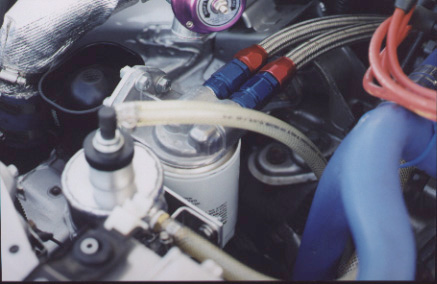
As mentioned above it's a check valve that is open when there is vacuum pulling on the top half and closed when pressure is exerted on the top half . This is a pic of my setup, with the PVC on top of the catch can. The PCV can be eliminated, there is no chance of pressure being created in the pre-turbo intake tube so the PCV hereis pointless. I plan on removing it someday
can someone answer this question in the same block method I've listed these question in order to insure clarification. I really want to understand this whole thing as it constantly bothers me when thinking about completing my turbo setup. HELP!!!</TD></TR></TABLE>
One other thing...the same mechanism that pulls air into the cylinders in a NA car, the intake stroke of the piston, also works in the crank case, when the pistons are going up and down air pressure is changing in the crank case for the same reason. So it's not just blow by from the piston rings.
Since it's such a bitch to search on this forum I posted some links to discussions I've made on the subject in other forums:
http://www.g2ic.com/forums/sho...13322
http://www.g2ic.com/forums/sho...catch
It's important to realize that the way I chose to do it relys on pressure dispacement. There is pressure being exerted on one end of the system and vacuum on the other, this creates a vacuum circuit that keeps the crank case under vacuum.
Some people say that the pcv is that nipple on top of my valve cover, some say its on one of the runners on the intake manifold, and some say something about it being on the back of the block. Which is it???
It's in between the intake runners on the manifold and it looks like this:
Also, what is the function of the pcv valve? to release excess crankcase pressure which contains oily vapors?
it is a check valve that, when closed, prevents pressure from the intake manifold presurizing the crank case. When the valve is open it allows pressure from the crankcase, which does have oil vapor in it, to vent to the intake manifold
Also, under boost the pcv valve is closed therefore no pressure is being released, are we supposed to setup our own pcv system and create our own vacuum source in order to release the pressure that is going on while boosting since the pcv can't do its job while under boost?
yes
So in order to do that I've heard some people using the intake tube of the turbo as an vacuum source with a tube from the breather nipple on the valve cover to the turbo intake tube with a catch can inline. Wouldn't this be risky? Also would that release the pressures inside the crankcase?
there is no single right way to do it, you'll get a different way of doing it from every person you talk to. As long as pressure from the crank case has some way of venting you're in good shape.
What does the pcv look like and how does that little thing function as some people say you "can just place it on top of the catch can" what the hell does that mean? put it on the catch can? how does it operate up there? I'm just lost.
As mentioned above it's a check valve that is open when there is vacuum pulling on the top half and closed when pressure is exerted on the top half . This is a pic of my setup, with the PVC on top of the catch can. The PCV can be eliminated, there is no chance of pressure being created in the pre-turbo intake tube so the PCV hereis pointless. I plan on removing it someday
can someone answer this question in the same block method I've listed these question in order to insure clarification. I really want to understand this whole thing as it constantly bothers me when thinking about completing my turbo setup. HELP!!!</TD></TR></TABLE>
One other thing...the same mechanism that pulls air into the cylinders in a NA car, the intake stroke of the piston, also works in the crank case, when the pistons are going up and down air pressure is changing in the crank case for the same reason. So it's not just blow by from the piston rings.
Since it's such a bitch to search on this forum I posted some links to discussions I've made on the subject in other forums:
http://www.g2ic.com/forums/sho...13322
http://www.g2ic.com/forums/sho...catch
It's important to realize that the way I chose to do it relys on pressure dispacement. There is pressure being exerted on one end of the system and vacuum on the other, this creates a vacuum circuit that keeps the crank case under vacuum.


Thread
Thread Starter
Forum
Replies
Last Post
