


big vs small

Honda-Tech Member
Joined: Feb 2003
Posts: 1,171
Likes: 0
From: Houston, TX
 Re: big vs small
Exhaust scavenging does play a part, obviously, but the biggest part is using the interia of the mass of air entering the engine to fill the cylinder well after the piston reaches BDC. Because of this inertia, air can still enter the cylinder even as the piston is over 40 degrees of crank angle past BDC.

Honda-Tech Member
Joined: Mar 2009
Posts: 516
Likes: 0
Re: big vs small
V8 engines have been acheiving well over 100% VE in naturally aspirated form with carburetors and single plane intake manifolds. You don't need "Sonic Pulse Tuned" manifolds to get over 100%, you just need to know what you're doing.
Exhaust scavenging does play a part, obviously, but the biggest part is using the interia of the mass of air entering the engine to fill the cylinder well after the piston reaches BDC. Because of this inertia, air can still enter the cylinder even as the piston is over 40 degrees of crank angle past BDC.
Exhaust scavenging does play a part, obviously, but the biggest part is using the interia of the mass of air entering the engine to fill the cylinder well after the piston reaches BDC. Because of this inertia, air can still enter the cylinder even as the piston is over 40 degrees of crank angle past BDC.

Honda-Tech Member
Joined: Nov 2002
Posts: 676
Likes: 0
From: Houston, TX, USA
Re: big vs small
There are allot of N/A engines that achieve over 100% VE in some areas of the powerband.. Theoretically using forced induction does not increase VE per se. The engines VE will stay pretty constant from atmosphere and above. When boosting, all your doing is artificially compounding atmospheric pressure therefore the flow compounds as well. So in relation to your new "compounded atmosphere" VE has actually remained constant. That’s why with no restrictions in flow, fueling increases are pretty much linear above atmosphere, because the VE never really changes so long as there is not a flow restriction.. It may be hard to grasp but if you think about it long enough it'll make sense.
Its really easy to understand if you use an EMS that’s a TRUE VE based EMS. Cause once properly setup and tuned, you have essentially created an airflow model, instead of a PW map. Most popular EMSs are just a pulse width map, so what you see in your graph is highly diluted with injector character and other fuel system inconsistancies and not so much a direct model of airflow.
Just sayin.
Its really easy to understand if you use an EMS that’s a TRUE VE based EMS. Cause once properly setup and tuned, you have essentially created an airflow model, instead of a PW map. Most popular EMSs are just a pulse width map, so what you see in your graph is highly diluted with injector character and other fuel system inconsistancies and not so much a direct model of airflow.
Just sayin.

Honda-Tech Member
Joined: Aug 2007
Posts: 9,865
Likes: 5
From: Oregon
Re: big vs small

Honda-Tech Member
Joined: Nov 2002
Posts: 676
Likes: 0
From: Houston, TX, USA
Re: big vs small
V8 engines have been acheiving well over 100% VE in naturally aspirated form with carburetors and single plane intake manifolds. You don't need "Sonic Pulse Tuned" manifolds to get over 100%, you just need to know what you're doing.
Exhaust scavenging does play a part, obviously, but the biggest part is using the interia of the mass of air entering the engine to fill the cylinder well after the piston reaches BDC. Because of this inertia, air can still enter the cylinder even as the piston is over 40 degrees of crank angle past BDC.
Exhaust scavenging does play a part, obviously, but the biggest part is using the interia of the mass of air entering the engine to fill the cylinder well after the piston reaches BDC. Because of this inertia, air can still enter the cylinder even as the piston is over 40 degrees of crank angle past BDC.

Honda-Tech Member
Joined: Mar 2000
Posts: 2,859
Likes: 1
From: Toronto, ON, Canada
Re: big vs small
Well, the whole 100% VE thing is pretty old, but the new thing up to current trends, is to maintain as much VE as possible for as much RPM as possible.
Most domestic V8's have only been getting 100% VE for a very narrow range of RPM. This is when VTEC, VTC, Vanos and so forth is developed, so it can maintain as much VE for as long as possible.
Anyhow, a lot of discussion is great, but seriously, the biggest factor is turbine (exhaust) flow. This is what determines what kind of power you can make from a smaller or bigger turbo. Compressor has little to do with it in comparison. Of course, either mismatched side would mean poor performance, but a mismatched turbine is sure hell of a bigger problem than a mismatched compressor.
It's so simple that you can even do a test yourself.. no joke!
I managed to do it myself all the time.
What you need to do is check your compressor map for your particular turbo. Mine is a GT4088R for example. I would hit the dyno, and make conservative and consistent power runs from 10 PSI, 15 PSI 20 PSI.
From the numbers I gather and from data easily obtained to determine what my actual CFM is, I have a very good idea on what my compressor efficiency is. First I get it from the power I am making which lets me know around what CFM, and the boost, and also the outlet temperatures and ambient temperatures. For example, I was about 70% compressor efficiency give or take a few.
What to do next? Make a big a$$ controlled boost leak. What this does is send the compressor all the way to choke line, and efficiency will plummet. Due to only running 20 PSI of boost on my car, the huge boost leak does not hinder my boost, and it can still maintain almost full boost until redline; however, it puts the compressor map totally in the wrong place. I was probably well below 60% compressor efficiency, but what revealed is that power only went down about 20 WHP on average. Efficiency is efficiency, and flow is flow. It doesn't matter if mine was a 58mm wheel or a 90mm wheel. As long as the compressor wheel is running within its map. Spool time is another topic of its own though.
The power loss from low compressor efficiency is nothing compared to say putting a banana in your tail pipe (joke), or close your E-cutout half way (if you have one). Just by choking up the exhaust a bit (I have a Varex muffler w/ electronic butterfly), I managed to lose up to 100 WHP at the same 20 PSI of boost too! Exhaust pressures skyrocketted though.
By the way, Garrett's website does offer turbine flow maps for most almost all of the popular GT turbos, just FYI for those looking for some reference
Most domestic V8's have only been getting 100% VE for a very narrow range of RPM. This is when VTEC, VTC, Vanos and so forth is developed, so it can maintain as much VE for as long as possible.
Anyhow, a lot of discussion is great, but seriously, the biggest factor is turbine (exhaust) flow. This is what determines what kind of power you can make from a smaller or bigger turbo. Compressor has little to do with it in comparison. Of course, either mismatched side would mean poor performance, but a mismatched turbine is sure hell of a bigger problem than a mismatched compressor.
It's so simple that you can even do a test yourself.. no joke!
I managed to do it myself all the time.
What you need to do is check your compressor map for your particular turbo. Mine is a GT4088R for example. I would hit the dyno, and make conservative and consistent power runs from 10 PSI, 15 PSI 20 PSI.
From the numbers I gather and from data easily obtained to determine what my actual CFM is, I have a very good idea on what my compressor efficiency is. First I get it from the power I am making which lets me know around what CFM, and the boost, and also the outlet temperatures and ambient temperatures. For example, I was about 70% compressor efficiency give or take a few.
What to do next? Make a big a$$ controlled boost leak. What this does is send the compressor all the way to choke line, and efficiency will plummet. Due to only running 20 PSI of boost on my car, the huge boost leak does not hinder my boost, and it can still maintain almost full boost until redline; however, it puts the compressor map totally in the wrong place. I was probably well below 60% compressor efficiency, but what revealed is that power only went down about 20 WHP on average. Efficiency is efficiency, and flow is flow. It doesn't matter if mine was a 58mm wheel or a 90mm wheel. As long as the compressor wheel is running within its map. Spool time is another topic of its own though.
The power loss from low compressor efficiency is nothing compared to say putting a banana in your tail pipe (joke), or close your E-cutout half way (if you have one). Just by choking up the exhaust a bit (I have a Varex muffler w/ electronic butterfly), I managed to lose up to 100 WHP at the same 20 PSI of boost too! Exhaust pressures skyrocketted though.
By the way, Garrett's website does offer turbine flow maps for most almost all of the popular GT turbos, just FYI for those looking for some reference
Honda-Tech Member
Joined: Feb 2003
Posts: 1,171
Likes: 0
From: Houston, TX
Re: big vs small
Higher than 100% VE has to do with taking advantage of higher order intake resonances and exhaust scavenging to induce more air. This only happens at certain RPMs when all the higher order pulses start to line up properly and head twords the valve right as it opens. If you look at a true airflow model of an engine you can see this and manipulate where the 100%< VE happens in the power band by changing intake/header length/volume along with camshaft profile to optimise where this happens.
Honda-Tech Member
Joined: Nov 2002
Posts: 676
Likes: 0
From: Houston, TX, USA
Re: big vs small
Yeah, I have some old dyno sheets from some 900hp NA small blocks. I'd have to dig them up and scan them at work, but I can definitely validate my claim.
Peak VE happens only once, and is right around the same RPM as peak torque, which is typically a function of the minimum cross sectional area of the port. Wave tuning can be tuned at several different points in the RPM range, so I wouldn't consider it to be a big part of manipulating peak VE, but I would agree it does play a part.
Peak VE happens only once, and is right around the same RPM as peak torque, which is typically a function of the minimum cross sectional area of the port. Wave tuning can be tuned at several different points in the RPM range, so I wouldn't consider it to be a big part of manipulating peak VE, but I would agree it does play a part.
Honda-Tech Member
Joined: Dec 2008
Posts: 417
Likes: 1
Re: big vs small
There are allot of N/A engines that achieve over 100% VE in some areas of the powerband.. Theoretically using forced induction does not increase VE per se. The engines VE will stay pretty constant from atmosphere and above. When boosting, all your doing is artificially compounding atmospheric pressure therefore the flow compounds as well. So in relation to your new "compounded atmosphere" VE has actually remained constant. That’s why with no restrictions in flow, fueling increases are pretty much linear above atmosphere, because the VE never really changes so long as there is not a flow restriction.. It may be hard to grasp but if you think about it long enough it'll make sense.
Its really easy to understand if you use an EMS that’s a TRUE VE based EMS. Cause once properly setup and tuned, you have essentially created an airflow model, instead of a PW map. Most popular EMSs are just a pulse width map, so what you see in your graph is highly diluted with injector character and other fuel system inconsistancies and not so much a direct model of airflow.
Just sayin.
Its really easy to understand if you use an EMS that’s a TRUE VE based EMS. Cause once properly setup and tuned, you have essentially created an airflow model, instead of a PW map. Most popular EMSs are just a pulse width map, so what you see in your graph is highly diluted with injector character and other fuel system inconsistancies and not so much a direct model of airflow.
Just sayin.
Ve doesn remain constant as someone else stated as well because an engine operating at 3k rpm the valves are open twice as long as one running at 6k rpm. The reduction in valve open time is inversely prportional to engine speed.
Honda-Tech Member
Joined: Feb 2003
Posts: 1,171
Likes: 0
From: Houston, TX
Re: big vs small
Now what about wave tuning in a cast single plane Ford V8 intake manifold? You have runners that reach to the outer 4 cylinders which are several inches longer than the runners reaching to the inner 4 cylinders. How does wave tuning like that acheive 118% VE?
Now I do agree that wave tuning and exhaust scavenging will help, but it can be sometimes overexaggerated. I see it like trying to make 1000hp with a turbocharged 2.0L, and stressing out about the air filter.
Honda-Tech Member
Joined: Nov 2002
Posts: 676
Likes: 0
From: Houston, TX, USA
Re: big vs small
Okay, well that's not what I was saying. My point was in reponse to your comment that VE of over 100% has to do with wave tuning and exhaust scavenging, and that I disagree with that to an extent. My point was that with wave tuning, you will hit peaks, or nodes, throughout the RPM, as well as troughs. If wave tuning was a major player in high VE, I would think you would see VE numbers graphed like a sine wave, with several peaks and troughs. But you don't. VE numbers peak only once, and that is right around peak torque.
Now what about wave tuning in a cast single plane Ford V8 intake manifold? You have runners that reach to the outer 4 cylinders which are several inches longer than the runners reaching to the inner 4 cylinders. How does wave tuning like that acheive 118% VE?
Now I do agree that wave tuning and exhaust scavenging will help, but it can be sometimes overexaggerated. I see it like trying to make 1000hp with a turbocharged 2.0L, and stressing out about the air filter.
Now what about wave tuning in a cast single plane Ford V8 intake manifold? You have runners that reach to the outer 4 cylinders which are several inches longer than the runners reaching to the inner 4 cylinders. How does wave tuning like that acheive 118% VE?
Now I do agree that wave tuning and exhaust scavenging will help, but it can be sometimes overexaggerated. I see it like trying to make 1000hp with a turbocharged 2.0L, and stressing out about the air filter.
Honda-Tech Member
Joined: Feb 2003
Posts: 1,171
Likes: 0
From: Houston, TX
Re: big vs small
I'm looking at the dyno sheet. We used Superflow's equipment to measure volumetric efficiency on a SF-902 engine dyno. Looks like this...
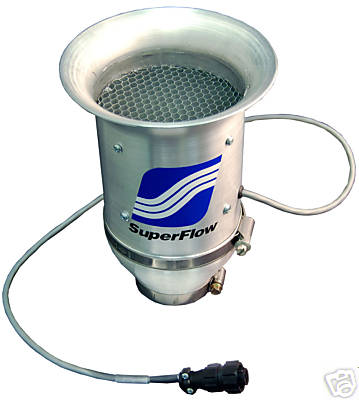
Or you could leave it off and forget about it...
Or you could leave it off and forget about it...
Honda-Tech Member
Joined: Nov 2002
Posts: 676
Likes: 0
From: Houston, TX, USA
Re: big vs small
The statement about turboing a car the ve remains constant is confusing me. An engines ve is a comparison of an engines calculated volumetric flow rate of air, versus its actual capability. For example an engine with a fixed displacement of 200ci that displacement theoretically will flow 200ci every 2 revolutions. This does not happen though due to restrictions such as a filter, exhaust, head designs, any kind of restriction. With that said. It basically means its only how well a cylinder can be filled with air or ve(volumetric effeciency) when u turbo a vehicle its forcing alot more air in since its under pressure and restrictions are still important but this makes up for them and ve does not remain constant. Turbo vehicles can achieve well over 100 percent ve.
Ve doesn remain constant as someone else stated as well because an engine operating at 3k rpm the valves are open twice as long as one running at 6k rpm. The reduction in valve open time is inversely prportional to engine speed.
Ve doesn remain constant as someone else stated as well because an engine operating at 3k rpm the valves are open twice as long as one running at 6k rpm. The reduction in valve open time is inversely prportional to engine speed.
so lets say you have N/A
4000 5000 6000 7000 8000 9000 RPM 14.7PSI/100KPA Atmospheric Pressure
98___99__101__103__105_104 VE
now add boost another 14.7PSI/100KPA exactly 100% over atmospheric pressure you will end up with
4000 5000 6000 7000 8000 9000 RPM
198__199__201_203__205_204 VE
so your VE didn't really change, you just compounded atmopheric pressure. The engines flow charactoristics still remained the same. This can be proven by the fact that required fueling with no added restrictions will be exactly 100% more at each breakpoint. Now if you run into a restriction your VE will actually become less and you will need less fueling.
Make more sence?
Honda-Tech Member
Joined: Nov 2002
Posts: 676
Likes: 0
From: Houston, TX, USA
Re: big vs small
Yeah I'd leave it off.. So you think that somhow that engine made 118% VE without the high order pressure waves lending a hand?

Honda-Tech Member
Joined: Nov 2002
Posts: 676
Likes: 0
From: Houston, TX, USA
Re: big vs small
hah yeah I noticed that too, sorry it was my fault. Its how we all learn though. Conversations like this make me re-think and re-analyse my ideas on things, somtimes I come back to my same conclusions and somtimes somone throws somthing out there that totally changes my perspective of the subject.
Honda-Tech Member
Joined: Feb 2003
Posts: 1,171
Likes: 0
From: Houston, TX
Re: big vs small
Not exactly. I think it acheived that airflow because the most important aspects of the induction system were addressed first, such as port shapes, cross sectional areas, and the valve and chamber area as well, and then some attention was paid to wave tuning. Wave tuning is a valid aspect in designing the induction and exhaust systems in any engine, but I've seen that compromising the shape and size of the induction system for better wave tuning characteristics results in less power.
Honda-Tech Member
Joined: Feb 2003
Posts: 1,171
Likes: 0
From: Houston, TX
Honda-Tech Member
Joined: Nov 2002
Posts: 676
Likes: 0
From: Houston, TX, USA
Re: big vs small
Not exactly. I think it acheived that airflow because the most important aspects of the induction system were addressed first, such as port shapes, cross sectional areas, and the valve and chamber area as well, and then some attention was paid to wave tuning. Wave tuning is a valid aspect in designing the induction and exhaust systems in any engine, but I've seen that compromising the shape and size of the induction system for better wave tuning characteristics results in less power.
Honda-Tech Member
Joined: Nov 2002
Posts: 676
Likes: 0
From: Houston, TX, USA
Re: big vs small
I guess what your getting at is that greater than 100% can be achieve without specific attention being applied to wave tuning, which I agree, but what I'm saying is that everything you do affects the resonance of the system so you are in affect still taking advantage of the extra pressure waves even if indirectly.
Honda-Tech Member
Joined: Feb 2003
Posts: 1,171
Likes: 0
From: Houston, TX
Re: big vs small
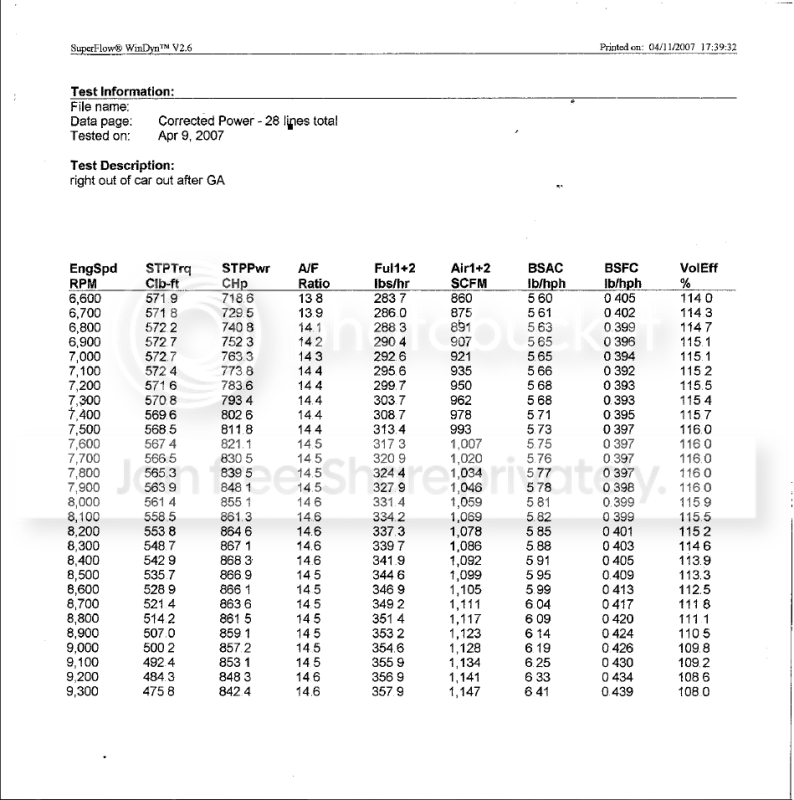
I'll post the one with 118% shortly.
Honda-Tech Member
Joined: Feb 2003
Posts: 1,171
Likes: 0
From: Houston, TX
Re: big vs small
I guess what your getting at is that greater than 100% can be achieve without specific attention being applied to wave tuning, which I agree, but what I'm saying is that everything you do affects the resonance of the system so you are in affect still taking advantage of the extra pressure waves even if indirectly.

Thread
Thread Starter
Forum
Replies
Last Post
