


EP3 Drivers: When is the recommended time to shift gears?


Thread Starter
Joined: Apr 2004
Posts: 5
Likes: 0
From: Irvine, CA, USA
 EP3 Drivers: When is the recommended time to shift gears?
For all the EP3 drivers out there,
I drive a 2004 Civic Si and I was wondering when is the best time to shift gears for my car...If anyone has knowledge as to when is the best time to shift, please write me replies...
People told me that economic way to shift is around 2500...or from 3-4K
Some people shift at 5-6K to enjoy the power...but i was just looking for safe economic way to shift... so i wanna hear your opinions...
I drive a 2004 Civic Si and I was wondering when is the best time to shift gears for my car...If anyone has knowledge as to when is the best time to shift, please write me replies...
People told me that economic way to shift is around 2500...or from 3-4K
Some people shift at 5-6K to enjoy the power...but i was just looking for safe economic way to shift... so i wanna hear your opinions...


Joined: May 2004
Posts: 35
Likes: 0
From: Bryan/College Station, Texas, United States
Re: EP3 Drivers: When is the recommended time to shift gears? (joncho)
i shift pretty consistently at around 3500-4000 rpms. i get about 29 mpg with about 80% highway and 20% city. 26-27 if i drive "spiritedly"


Trending Topics

Joined: Aug 2002
Posts: 1,793
Likes: 0
From: Mid, Ohio
I try to shift before the 2200 if I can. Keep it a gas saving 12 valver. I remember reading an Insight webpage about gas saving tips. They said low revs, wide open throttle body. The idea is to get the throttle body's butterfly out of the stream of air for a higher efficiency. And go from 2nd to 5th and floor it to speed. So, sometimes I drive that way, other times I drive normally. Gas mileage is always around 30, so I guess it's pointless.


Joined: Jul 2003
Posts: 76
Likes: 0
From: Weatherford, Tx, USA
Re: EP3 Drivers: When is the recommended time to shift gears? (joncho)
****, I cant help but to Red line mine almost everytime... lol Its so much fun, Oh by the way anyone got $200 i can barrow my freinds girl just called me up needing som bail money, he has a warrent for street racing and he just got cought running a stop light... lol

Joined: Apr 2003
Posts: 68
Likes: 0
From: Isle of Man, USA
Re: (Eee Pee)
<TABLE WIDTH="90%" CELLSPACING=0 CELLPADDING=0 ALIGN=CENTER><TR><TD>Quote, originally posted by Eee Pee »</TD></TR><TR><TD CLASS="quote">I try to shift before the 2200 if I can. Keep it a gas saving 12 valver. I remember reading an Insight webpage about gas saving tips. They said low revs, wide open throttle body. The idea is to get the throttle body's butterfly out of the stream of air for a higher efficiency. And go from 2nd to 5th and floor it to speed. So, sometimes I drive that way, other times I drive normally. Gas mileage is always around 30, so I guess it's pointless.</TD></TR></TABLE>
What page was that?
What page was that?


Joined: Aug 2002
Posts: 1,793
Likes: 0
From: Mid, Ohio
Re: (joncho)
<TABLE WIDTH="90%" CELLSPACING=0 CELLPADDING=0 ALIGN=CENTER><TR><TD>Quote, originally posted by joncho »</TD></TR><TR><TD CLASS="quote">so you first start out at 1st gear, then 2nd, then to 5th?
does that save gas even lil bit?</TD></TR></TABLE>
Thats the trick. That Insight page also said if you're real good, you powershift 1st to 2nd, to leave the throttle body wide open, again to get it out of the airstream. It's not easy, and seems real odd on the street. So go from 1 to 2 and let the revs go to 3000, then go to 5th. To continue to pick up speed you pretty much have to floor it. And this get the throttle plate out of the airstream. The engine is more efficient.
There's a flipside though. Since your lugging the engine, it has to work harder. I have a D motor in another car. I got better mileage when I got a smaller diameter tire. The engine wasn't lugging on the freeway. It was in it's sweet spot, and took less effort to move the car.
Whether I drive that way, or use all the gears, I still get about 30 mpg. Maybe if I drove one way for a week, and the "normal" way for a week, I could see what's really happening.
I'd like to add that I have gotten 37 miles to the gallon on a freeway drive cruise controlled at 70 with the Air Conditioning on. It was amazing. 70 mph for 2 hours.
Ding ding, found the Insight page. Scroll down half way to "Use full throttle acceleration".
http://www.insightcentral.net/...ation
Modified by Eee Pee at 5:56 PM 6/9/2004
does that save gas even lil bit?</TD></TR></TABLE>
Thats the trick. That Insight page also said if you're real good, you powershift 1st to 2nd, to leave the throttle body wide open, again to get it out of the airstream. It's not easy, and seems real odd on the street. So go from 1 to 2 and let the revs go to 3000, then go to 5th. To continue to pick up speed you pretty much have to floor it. And this get the throttle plate out of the airstream. The engine is more efficient.
There's a flipside though. Since your lugging the engine, it has to work harder. I have a D motor in another car. I got better mileage when I got a smaller diameter tire. The engine wasn't lugging on the freeway. It was in it's sweet spot, and took less effort to move the car.
Whether I drive that way, or use all the gears, I still get about 30 mpg. Maybe if I drove one way for a week, and the "normal" way for a week, I could see what's really happening.
I'd like to add that I have gotten 37 miles to the gallon on a freeway drive cruise controlled at 70 with the Air Conditioning on. It was amazing. 70 mph for 2 hours.
Ding ding, found the Insight page. Scroll down half way to "Use full throttle acceleration".
http://www.insightcentral.net/...ation
Modified by Eee Pee at 5:56 PM 6/9/2004

Honda-Tech Member

Joined: May 2002
Posts: 416
Likes: 0
From: Jacksonville, FL
Re: (joncho)
hey Eee Pee. i hope you are joking about shifting around 2200 rpms. that is one of the worst things to do to your car. it needs to reach vtec. not saying you need to drive only in vtec, but not letting it reach vtec is a bad thing for a vtec motor.
before you tell me i dont know what i am talking about let me tell everyone i work at a honda dealership and have seen what happens to ep's when driven like this. they start to run like ****. i own an 03 ep and had the owner drive my car to show me how he drives, and he didnt hit vtec once in my car. so we called TechLine, the honda tech support and they said his car was acting the way it did because of his driving style. they told us to give it an "italian tune-up" (drive it really hard, for a while) and to tell the guy to not drive like a ***** anymore.
oh yeah the owner's manual tells you at what mph to shift. just read through it, you'll find it.
before you tell me i dont know what i am talking about let me tell everyone i work at a honda dealership and have seen what happens to ep's when driven like this. they start to run like ****. i own an 03 ep and had the owner drive my car to show me how he drives, and he didnt hit vtec once in my car. so we called TechLine, the honda tech support and they said his car was acting the way it did because of his driving style. they told us to give it an "italian tune-up" (drive it really hard, for a while) and to tell the guy to not drive like a ***** anymore.
oh yeah the owner's manual tells you at what mph to shift. just read through it, you'll find it.


Joined: Mar 2004
Posts: 363
Likes: 0
From: MN
Re: (jaydub)
I posted this on EPhatch earlier, http://www.ephatch.com/forum/s...49161
<TABLE WIDTH="90%" CELLSPACING=0 CELLPADDING=0 ALIGN=CENTER><TR><TD>Quote, originally posted by EtherGhost »</TD></TR><TR><TD CLASS="quote">Well, after reading this link (http://www.shotimes.com/php-bi...id=23) I decided to do my own technical write-up.
Apparently, the key to acceleration is the area underneath the wheel torque curve. The goal is to maximize this area. Wheel torque is defined as the torque produced by the engine, multiplied by the gear ratios. If any of the wheel torque curves cross on a graph, you must shift at that shift point.
I took Hondata's dyno chart for a Hondata Si and estimated the torque values every 500 RPM, and at the highest recorded RPM (~6800 for stock, ~7350 for Hondata)

I used these gear ratios
1st Gear Ratio 3.062:1
2nd Gear Ratio 1.769:1
3rd Gear Ratio 1.212:1
4th Gear Ratio 0.921:1
5th Gear Ratio 0.738:1
Final Drive 4.764:1
I divided the stock rev limit (6800) by the 5th gear (.738) and the theoretical vehicle speed at red line (138 mph) to get an equalizing ratio. I multiplied this ratio by each gear ratio and RPM, to find the vehicle speed in each gear at each RPM.
I took the torque values from the Hondata dyno and multiplied each value by the gear ratio and final drive to get the wheel torque in each gear. I plotted these wheel torque values against vehicle speed. Here are the results, first for the stock Si, and secondly for the Hondata reflash Si.
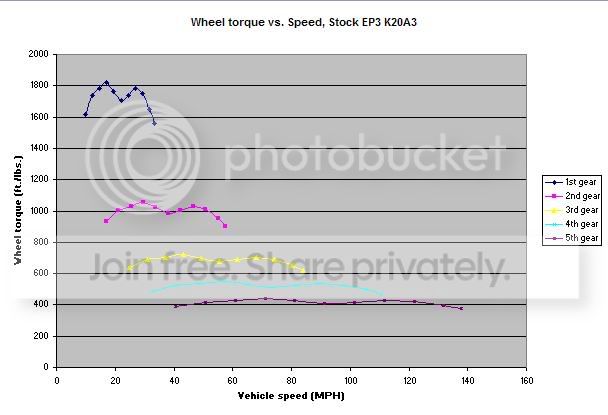
As you can see, the stock Si's wheel torque curves never cross. Therefore, to maximize the area under the curves, and ergo maximize acceleration, it is best to run out every gear to redline before shifting.
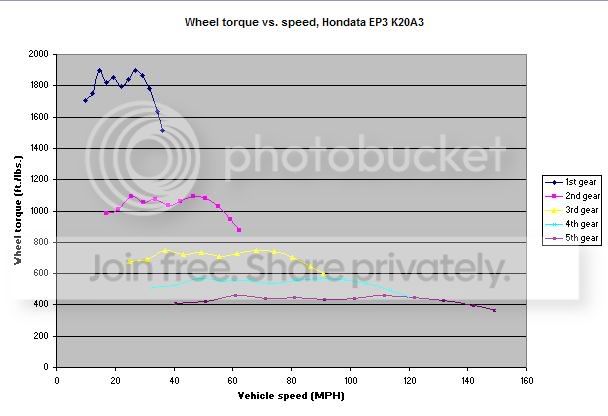
On the Hondata Si on the other hand, you can see that the wheel torque curve for 3rd gear almost touches the wheel torque curve for 4th gear at redline, and the wheel torque curve for 4th gear touches the curve for 5th gear. This is at approximately 7350 RPM, the end of the dyno. Assuming that torque continues to drop off as the RPM's approach the 7700 RPM rev limit, this means that to maximize acceleration in a Hondata Si, you should run 1st gear out to the rev limit, 2nd gear out to the rev limit (judging by how far the torque curve is from the 3rd gear torque curve at 7350 RPM, I don't have enough data to make a conclusion about 2nd gear) and 3rd and 4th gear out to about 7350 RPM before shifting.
Note that I made a lot of assumptions and simplifications, but I think that this is a decent technical explanation of how to choose when to shift.</TD></TR></TABLE>
<TABLE WIDTH="90%" CELLSPACING=0 CELLPADDING=0 ALIGN=CENTER><TR><TD>Quote, originally posted by EtherGhost »</TD></TR><TR><TD CLASS="quote">Well, after reading this link (http://www.shotimes.com/php-bi...id=23) I decided to do my own technical write-up.
Apparently, the key to acceleration is the area underneath the wheel torque curve. The goal is to maximize this area. Wheel torque is defined as the torque produced by the engine, multiplied by the gear ratios. If any of the wheel torque curves cross on a graph, you must shift at that shift point.
I took Hondata's dyno chart for a Hondata Si and estimated the torque values every 500 RPM, and at the highest recorded RPM (~6800 for stock, ~7350 for Hondata)
I used these gear ratios
1st Gear Ratio 3.062:1
2nd Gear Ratio 1.769:1
3rd Gear Ratio 1.212:1
4th Gear Ratio 0.921:1
5th Gear Ratio 0.738:1
Final Drive 4.764:1
I divided the stock rev limit (6800) by the 5th gear (.738) and the theoretical vehicle speed at red line (138 mph) to get an equalizing ratio. I multiplied this ratio by each gear ratio and RPM, to find the vehicle speed in each gear at each RPM.
I took the torque values from the Hondata dyno and multiplied each value by the gear ratio and final drive to get the wheel torque in each gear. I plotted these wheel torque values against vehicle speed. Here are the results, first for the stock Si, and secondly for the Hondata reflash Si.
As you can see, the stock Si's wheel torque curves never cross. Therefore, to maximize the area under the curves, and ergo maximize acceleration, it is best to run out every gear to redline before shifting.
On the Hondata Si on the other hand, you can see that the wheel torque curve for 3rd gear almost touches the wheel torque curve for 4th gear at redline, and the wheel torque curve for 4th gear touches the curve for 5th gear. This is at approximately 7350 RPM, the end of the dyno. Assuming that torque continues to drop off as the RPM's approach the 7700 RPM rev limit, this means that to maximize acceleration in a Hondata Si, you should run 1st gear out to the rev limit, 2nd gear out to the rev limit (judging by how far the torque curve is from the 3rd gear torque curve at 7350 RPM, I don't have enough data to make a conclusion about 2nd gear) and 3rd and 4th gear out to about 7350 RPM before shifting.
Note that I made a lot of assumptions and simplifications, but I think that this is a decent technical explanation of how to choose when to shift.</TD></TR></TABLE>


Thread
Thread Starter
Forum
Replies
Last Post
Civicman86
Drag Racing
12
Jun 22, 2005 09:13 AM
