


Structural Reinforcement


Thread Starter
Junior Member
Joined: Aug 2008
Posts: 14
Likes: 0
From: 850, FL, USA
 Structural Reinforcement
I stumbled upon this a while back http://forums.freshalloy.com/s...62693
I'd be curios to here input from any of you about it. I'm considering doing this to my 626, mainly for safety purposes. The better handling characteristics are a plus also. I thought about building some type of roll-cage type setup to increase the strenght of the saftey cage area of the car. However, this added unwanted weight, would be expensive, and is not safe for passengers. The roll cage would be a great safety feature done correctly, but not in my case. I can't afford to spend much as a full time college student, but I think the extra safety benefit would be worth it. I'll post some pictures of some of my thoughts about this later.
I'd be curios to here input from any of you about it. I'm considering doing this to my 626, mainly for safety purposes. The better handling characteristics are a plus also. I thought about building some type of roll-cage type setup to increase the strenght of the saftey cage area of the car. However, this added unwanted weight, would be expensive, and is not safe for passengers. The roll cage would be a great safety feature done correctly, but not in my case. I can't afford to spend much as a full time college student, but I think the extra safety benefit would be worth it. I'll post some pictures of some of my thoughts about this later.

Honda-Tech Member
Joined: Jun 2004
Posts: 7,539
Likes: 5
From: Sherman Oaks, CA, United States
Re: Structural Reinforcement (626ofall)
Stiffer does not necessarily mean safer.
You want the body to collapse in a controlled manner, as designed by the manufacturer. Thats how modern crumple zones work.
If you stiffen certain areas, and it results in the frame bending different than how the manufacturer intended, you could end up reducing safety.
Think of how dangerous older "full frame" cars (and trucks and SUVs) were/are, as they have rigid frames that didn't bend / collapse in collisions. Yeah, the car stays (more) intact, but nothing inside of the car does.
You want the body to collapse in a controlled manner, as designed by the manufacturer. Thats how modern crumple zones work.
If you stiffen certain areas, and it results in the frame bending different than how the manufacturer intended, you could end up reducing safety.
Think of how dangerous older "full frame" cars (and trucks and SUVs) were/are, as they have rigid frames that didn't bend / collapse in collisions. Yeah, the car stays (more) intact, but nothing inside of the car does.
Thread Starter
Junior Member
Joined: Aug 2008
Posts: 14
Likes: 0
From: 850, FL, USA
Re: Structural Reinforcement (TunerN00b)
Let me clarify real quick. The area of the car to be reinforced isn't supposed to collapse. Its not a crumple zone. The passenger area, sometimes know as the safety cage, is supposed to remain intact in the event of a collision. Collapse of the safety cage will compromise the safety of the passengers.

This shows the area of frame on my car that I want to strengthen. The A,B, and C pillars. Also, possibly some of the roof and or floor cross members. The crumple zones are not something I would want to strengthen. I'm not sure about the doors yet though.
Here is an example of why I think it should be strengthened.
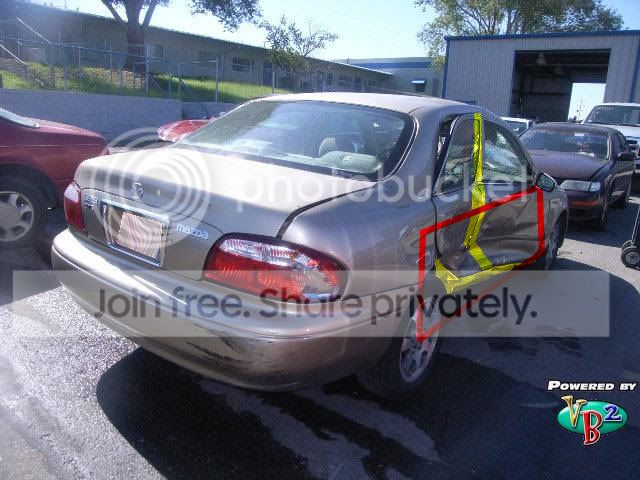
The yellow shows the damage and the red shows more how the side of the car should look. I would think that the reinforcement would allow less collapse of the B pillar and bending of the rocker panels etc. I would think in the event of frontal collision it would be beneficial.
This shows the area of frame on my car that I want to strengthen. The A,B, and C pillars. Also, possibly some of the roof and or floor cross members. The crumple zones are not something I would want to strengthen. I'm not sure about the doors yet though.
Here is an example of why I think it should be strengthened.
The yellow shows the damage and the red shows more how the side of the car should look. I would think that the reinforcement would allow less collapse of the B pillar and bending of the rocker panels etc. I would think in the event of frontal collision it would be beneficial.
Honda-Tech Member
Joined: Jun 2004
Posts: 7,539
Likes: 5
From: Sherman Oaks, CA, United States
Re: Structural Reinforcement (626ofall)
I understand what you are trying to achieve.
I just wanted to say that these things are not always so simple, and that modifications in the name of safety need to be well thought out, which is why I used the words "not necessarily" and "could end up".
And while the foam might help prevent flex, do we have any data as to how it behaves under impact? If there is enough force to bend the enclosing metal housing the foam is added to, will the foam provide additional bending resistance, or will it crack/crumble? If it does crack, will the additional material (chunks of foam) present inside of what used to be a pseudo-tube change the bending behavior of said tube?
These are questions that I don't think we can answer, and without them I don't think we can say if this mod makes the car safer, does nothing for safety, or is actually less safe.
I guess what I'm thinking is, if it was this cheap and easy to improve safety, wouldn't most manufacturers go ahead and do it to all cars from the factory? Instead, we only find factory foamed frames on high end luxury cars, and all the literature claims it is for reduced vibration and cabin noise.
I just wanted to say that these things are not always so simple, and that modifications in the name of safety need to be well thought out, which is why I used the words "not necessarily" and "could end up".
And while the foam might help prevent flex, do we have any data as to how it behaves under impact? If there is enough force to bend the enclosing metal housing the foam is added to, will the foam provide additional bending resistance, or will it crack/crumble? If it does crack, will the additional material (chunks of foam) present inside of what used to be a pseudo-tube change the bending behavior of said tube?
These are questions that I don't think we can answer, and without them I don't think we can say if this mod makes the car safer, does nothing for safety, or is actually less safe.
I guess what I'm thinking is, if it was this cheap and easy to improve safety, wouldn't most manufacturers go ahead and do it to all cars from the factory? Instead, we only find factory foamed frames on high end luxury cars, and all the literature claims it is for reduced vibration and cabin noise.
Thread Starter
Junior Member
Joined: Aug 2008
Posts: 14
Likes: 0
From: 850, FL, USA
Re: Structural Reinforcement (TunerN00b)
I'm trying to think this out thoroughly , so I posted this topic about it. Hopefully, maybe an engineer can give us some insight. I know the tried and true method to be a roll cage, but that isn't practical in my case. As for the overall goal of safety, the only way I know to prove it is with comprehensive testing. I'd love to find a good way to test it, but I don't know of a full scale realistic one off the top of my head. The Chrysler paper about the filling seems to say that it strengthens the structure at the joints most. As of now, another big question lies in the doors. What about those? I tend to think the doors are better left alone since the reinforcement beams within them are designed to transfer energy into the to the structure of the car. TunerN00b, I really appreciate what you have contributed. I hadn't even considered the potential change in bending behavior aspect. Thank you, for your ideas. I'm still open to any additional ideas.

Honda-Tech Member
Joined: Feb 2005
Posts: 206
Likes: 0
From: Shake Hands with the Dremel
Re: Structural Reinforcement (626ofall)
Aside from the safety considerations, there are other drawbacks to using structural foam. Once set, the structural foam is flammable and so if you were to forced to weld a section that has been previously injected with foam, it just might not be possible without starting a fire. Secondly, there is a likelihood of the foam trapping water in the sections where it has been injected. I am not sure if the 626 has a galvanized body or other anti-corrosive measures in place but if not you may start rust from the inside out.
If you do decide to go through with this, check out this paper and Dow's product sheet on 87100/87124 BETAFOAM.
PPG also has a similar product, Accufoam, but I could not find much information on it.
edit: For small applications, Terocore will be the easiest to find without having to go up to buying 55 gallon drums. Looks like it was used in the Ford Expedition according to this article.
Modified by uniseriate at 6:46 PM 10/3/2008
If you do decide to go through with this, check out this paper and Dow's product sheet on 87100/87124 BETAFOAM.
PPG also has a similar product, Accufoam, but I could not find much information on it.
edit: For small applications, Terocore will be the easiest to find without having to go up to buying 55 gallon drums. Looks like it was used in the Ford Expedition according to this article.
Modified by uniseriate at 6:46 PM 10/3/2008
Trending Topics
Thread Starter
Junior Member
Joined: Aug 2008
Posts: 14
Likes: 0
From: 850, FL, USA
Re: Structural Reinforcement (uniseriate)
Thank you for all the info, I'll have to look over it more, when I get a chance. I really do appreciate you finding this stuff for me! As for the fire risk, yeah that is a problem if I were to need major structural repair of some kind. However, chances are good it wouldn't happen because I doubt I could afford to have it done in the first place. As for the corrosion, I'm not too sure about what kind of corrosion protection is on the inside of the structure. I'll look into it, mainly because the corrosion would the biggest problem. I know that the strengthening the chassis won't necessarily prevent any injuries, but I doubt it would be any more likely to cause injury either. I know that I would have to strip down most of the interior and remove most of the dash for this project. I can do it, I've done it before. However, it takes a lot of time and effort. And there is alot of time in which the vehicle is disabled. I wish I had an FEA setup to add the foam to an existing car and do some comparative crash scenarios, but if I had an FEA setup, I'd probably never leave the house.
Modified by 626ofall at 6:43 PM 10/3/2008
Modified by 626ofall at 6:46 PM 10/3/2008
Modified by 626ofall at 6:43 PM 10/3/2008
Modified by 626ofall at 6:46 PM 10/3/2008

Thread
Thread Starter
Forum
Replies
Last Post
00TypeR1071
Acura Integra Type-R
28
Nov 26, 2008 05:33 PM
87100, 8710087124, 87124, accufoam, betafoam, buy, cage, car, dow, expedition, foam, honda, reinforcement, roll, safety, structural, terocore
