


Small filter on catch can?


Thread Starter
Honda-Tech Member
Joined: Apr 2010
Posts: 158
Likes: 0
 Small filter on catch can?
Hi
Thought about making a catch can for my all motor h22.
But I wonder if its any good to place a small filter so it can breath?
Or just a closed can that goes pcv - catch can - intake manifold?
If there should be a filter on it, I guess I would need to plug off the hole on my IM right?
What would work best for me, non turbo btw. Just want to catch the blow by oils.
Looking forward to hear your thoughts
Regards Rasmus
Denmark
Thought about making a catch can for my all motor h22.
But I wonder if its any good to place a small filter so it can breath?
Or just a closed can that goes pcv - catch can - intake manifold?
If there should be a filter on it, I guess I would need to plug off the hole on my IM right?
What would work best for me, non turbo btw. Just want to catch the blow by oils.
Looking forward to hear your thoughts
Regards Rasmus
Denmark

Honda-Tech Member

Joined: Jan 2012
Posts: 642
Likes: 0
Re: Small filter on catch can?
I think it would be a good idea to put a filter on a catch can, that's how I've always done it. Some people prefer the closed/vacuum-assisted catch cans to pull blowby gasses out but I've always had a simple setup work best.
Basically I just have:
-2 lines going from the valve cover to the catch can
-1 line going from the back of the block to the catch can (not a drainback system)
-filter on top of the catch can
Basically I just have:
-2 lines going from the valve cover to the catch can
-1 line going from the back of the block to the catch can (not a drainback system)
-filter on top of the catch can
 Re: Small filter on catch can?
I think it would be a good idea to put a filter on a catch can, that's how I've always done it. Some people prefer the closed/vacuum-assisted catch cans to pull blowby gasses out but I've always had a simple setup work best.
Basically I just have:
-2 lines going from the valve cover to the catch can
-1 line going from the back of the block to the catch can (not a drainback system)
-filter on top of the catch can
Basically I just have:
-2 lines going from the valve cover to the catch can
-1 line going from the back of the block to the catch can (not a drainback system)
-filter on top of the catch can

Honda-Tech Member
Joined: Jan 2013
Posts: 71
Likes: 0
From: Sussex, NJ
Re: Small filter on catch can?
Another alternative would be to have an inlet and an outlet on your catch can and simply put it in series with your stock PCV hose.
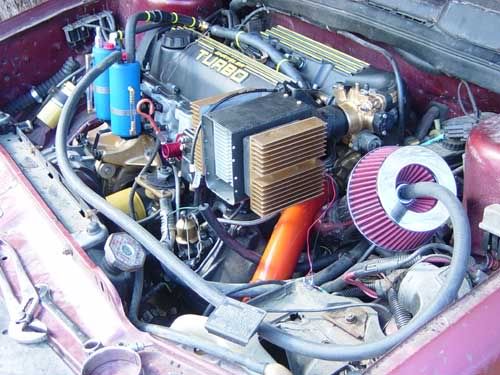
I did a double catch can on a Turbo Daytona; one on the PCV side, and one on the breather side.
Mike
I did a double catch can on a Turbo Daytona; one on the PCV side, and one on the breather side.
Mike
Thread Starter
Honda-Tech Member
Joined: Apr 2010
Posts: 158
Likes: 0
Re: Small filter on catch can?
Thanks, I'd prefer not having to weld anything on my valve cover :-) not sure how to do it simple and correct?
Reason for asking about the pcv - can - IM is because that sounds easy to me. In a closed system. But I really dont know the cons in doing it that way if there is any. Car is making around 260 on the crank fyi, if that matters
Reason for asking about the pcv - can - IM is because that sounds easy to me. In a closed system. But I really dont know the cons in doing it that way if there is any. Car is making around 260 on the crank fyi, if that matters
Thread Starter
Honda-Tech Member
Joined: Apr 2010
Posts: 158
Likes: 0
Re: Small filter on catch can?
Actually I have the moroso can laying around, but it came with only one hose.. Not sure how to connect it correctly?
I read somewhere that it was ok to run it from pcv to can and then plug off the im.
I read somewhere that it was ok to run it from pcv to can and then plug off the im.
Last edited by Rasmusm; Feb 1, 2013 at 01:11 AM.
Honda-Tech Member
Joined: Jan 2013
Posts: 71
Likes: 0
From: Sussex, NJ
Re: Small filter on catch can?
You must allow the engine to "breathe". There has to be an equalization vent of some sort, else you pop all your seals. There are 2 hoses; PCV vacuum and breather. The PCV goes to the base of the TB while the breather is vented to filtered air (factory). The objective is to create a cross-flow where vacuum pulls in some fresh air and all the blow-by out.
If you look at the picture above, there is a check valve in the breather side. When under vacuum, the PCV hose applies vacuum to the crankcase. Under acceleration, the check valve opens while the PCV valve (another check valve) simultaneously closes. Crankcase pressure is then vented to the air filter. I got the check valve from McMaster-Carr, but an old '70s era smog pump check valve would work equally as well.
Mike
If you look at the picture above, there is a check valve in the breather side. When under vacuum, the PCV hose applies vacuum to the crankcase. Under acceleration, the check valve opens while the PCV valve (another check valve) simultaneously closes. Crankcase pressure is then vented to the air filter. I got the check valve from McMaster-Carr, but an old '70s era smog pump check valve would work equally as well.
Mike
Trending Topics
Thread Starter
Honda-Tech Member
Joined: Apr 2010
Posts: 158
Likes: 0
Re: Small filter on catch can?
Thanks Mike, I think the main reason for me being this confused about it is its on a different language. Can be hard to pick up the details..
So if I weld in a extra hose on the can so I have an inlet and outlet hose where should I connect that to?
I thought about keeping the stock pcv and just run a tube from it to the can. Should it go back to the valve cover? Or could I just use a T connection thingie, and connect it to the breather side that goes to the air filter? Confusing stuff :-)!
So if I weld in a extra hose on the can so I have an inlet and outlet hose where should I connect that to?
I thought about keeping the stock pcv and just run a tube from it to the can. Should it go back to the valve cover? Or could I just use a T connection thingie, and connect it to the breather side that goes to the air filter? Confusing stuff :-)!

Thread
Thread Starter
Forum
Replies
Last Post