


String Alignment


Thread Starter
Honda-Tech Member
Joined: Dec 2003
Posts: 353
Likes: 0
 String Alignment
Hi,
I have searched some threads on string alignment for toe. I have read that I need to make a box around the car and make it parallel using the axle as a measuring point. How far from the car does this need to be. Am I correct in saying then to measure toe in or out you take a measurement from your string to the front of the rim and then one from your string to the back. This difference is your toe in/out on that side?
What about this method not using forming a box?
http://www.c-speedracing.com/howto/a.../alignment.php
I want to do my own alignments but just dont quiet understand the searched threads.
I have searched some threads on string alignment for toe. I have read that I need to make a box around the car and make it parallel using the axle as a measuring point. How far from the car does this need to be. Am I correct in saying then to measure toe in or out you take a measurement from your string to the front of the rim and then one from your string to the back. This difference is your toe in/out on that side?
What about this method not using forming a box?
http://www.c-speedracing.com/howto/a.../alignment.php
I want to do my own alignments but just dont quiet understand the searched threads.
 Re: String Alignment
I don't think the method in that article is the best way to do strings. They are using flexable bodywork to posistion the strings.
Its good that you bring this up, because I was just about to upgrade my alignments from using toe plates. I'm in the process of getting my string setup working, and have a couple of questions myself.
What I am using are a couple of peices of alumimum angle stock with notches at equal distances to rest the string in. If I use equal lengths of string on both sides, then I have formed a parallelagram. Now, what is the best way to square up the box? The "book" way is to find the centerline of the car and have each string parallel to the centerline.
Setting up off the centerline is kind of a pain in the ***, so what about using the end of the axle shaft as a reference to square up the box. If you put each string an equal distance from the reference point then you have formed a box that is square to the wheels, right?
Weel, you are correct that you measure from the front and back of the wheel to the string.
Its good that you bring this up, because I was just about to upgrade my alignments from using toe plates. I'm in the process of getting my string setup working, and have a couple of questions myself.
What I am using are a couple of peices of alumimum angle stock with notches at equal distances to rest the string in. If I use equal lengths of string on both sides, then I have formed a parallelagram. Now, what is the best way to square up the box? The "book" way is to find the centerline of the car and have each string parallel to the centerline.
Setting up off the centerline is kind of a pain in the ***, so what about using the end of the axle shaft as a reference to square up the box. If you put each string an equal distance from the reference point then you have formed a box that is square to the wheels, right?
Weel, you are correct that you measure from the front and back of the wheel to the string.

Honda-Tech Member
Joined: Mar 2005
Posts: 476
Likes: 1
From: DFW, TX
Re: String Alignment
I have used the string wrapped around the body method. It's obviously not the "best way" to do a string alignment but it actually works quite well for quick trackside adjustments.

Honda-Tech Member
Joined: May 2007
Posts: 479
Likes: 0
From: marina, ca, 90292
Re: String Alignment
I don't think the method in that article is the best way to do strings. They are using flexable bodywork to posistion the strings.
Its good that you bring this up, because I was just about to upgrade my alignments from using toe plates. I'm in the process of getting my string setup working, and have a couple of questions myself.
What I am using are a couple of peices of alumimum angle stock with notches at equal distances to rest the string in. If I use equal lengths of string on both sides, then I have formed a parallelagram. Now, what is the best way to square up the box? The "book" way is to find the centerline of the car and have each string parallel to the centerline.
Setting up off the centerline is kind of a pain in the ***, so what about using the end of the axle shaft as a reference to square up the box. If you put each string an equal distance from the reference point then you have formed a box that is square to the wheels, right?
Weel, you are correct that you measure from the front and back of the wheel to the string.
Its good that you bring this up, because I was just about to upgrade my alignments from using toe plates. I'm in the process of getting my string setup working, and have a couple of questions myself.
What I am using are a couple of peices of alumimum angle stock with notches at equal distances to rest the string in. If I use equal lengths of string on both sides, then I have formed a parallelagram. Now, what is the best way to square up the box? The "book" way is to find the centerline of the car and have each string parallel to the centerline.
Setting up off the centerline is kind of a pain in the ***, so what about using the end of the axle shaft as a reference to square up the box. If you put each string an equal distance from the reference point then you have formed a box that is square to the wheels, right?
Weel, you are correct that you measure from the front and back of the wheel to the string.
 ) .
) .JT-R

Honda-Tech Member
Joined: Aug 2005
Posts: 339
Likes: 0
From: CO
Re: String Alignment
Now, what is the best way to square up the box? The "book" way is to find the centerline of the car and have each string parallel to the centerline.
Setting up off the centerline is kind of a pain in the ***, so what about using the end of the axle shaft as a reference to square up the box. If you put each string an equal distance from the reference point then you have formed a box that is square to the wheels, right?
Setting up off the centerline is kind of a pain in the ***, so what about using the end of the axle shaft as a reference to square up the box. If you put each string an equal distance from the reference point then you have formed a box that is square to the wheels, right?

Honda-Tech Member
Joined: May 2002
Posts: 13,483
Likes: 0
From: cali
Re: String Alignment
don't use the car, get something to run it off of.
the smart camber setup is cheap when you look at making it yourself. So many issues with the way they do it in the article.
the smart camber setup is cheap when you look at making it yourself. So many issues with the way they do it in the article.

Honda-Tech Member
Joined: Feb 2006
Posts: 189
Likes: 3
From: Ontario, Canada
Re: String Alignment
4 Jackstands and two fishing reels with 25 lb braided fishing line is what I use for quick setup and neat storage. Mark the centre line on your front and rear bumpers to make repeat setups more efficient. I used to just remember the spacing to the hub centre between front and rear but after an off while at the track you can never be sure your track width has stayed the same.
Never found toe plates to be quite as consistent or accurate as strings.
Never found toe plates to be quite as consistent or accurate as strings.
Trending Topics
Re: String Alignment
The same topic started quite a discussion over on roadraceautox.com.
bsclywilly, using some equal length bars or rods to hold the strings makes it even easier.
Weel, you measure from the wheel on whatever flat spot you can find.
bsclywilly, using some equal length bars or rods to hold the strings makes it even easier.
Weel, you measure from the wheel on whatever flat spot you can find.

Honda-Tech Member
Joined: Jan 2003
Posts: 1,979
Likes: 0
From: Cogito ergo sum, Canada
Re: String Alignment
Have a look at the pictures on MK Technologies' web site:
http://www.mktechnologies.com/products/mkt-toebars.htm
That is how most of the pros do it, The bars holding the strings are always attached to the car and never on jack stands. That way you can easily move the car to settle the suspension and tires and take the tension out of the tires after any adjustment and re-measure the toe after moving the car without upsetting the string to car locations.
You can just study the pictures and make your own setup. Also a toe/camber board is invaluable. You can also make your own, like this one:
http://www.mktechnologies.com/products/mkt-toebars.htm
That is how most of the pros do it, The bars holding the strings are always attached to the car and never on jack stands. That way you can easily move the car to settle the suspension and tires and take the tension out of the tires after any adjustment and re-measure the toe after moving the car without upsetting the string to car locations.
You can just study the pictures and make your own setup. Also a toe/camber board is invaluable. You can also make your own, like this one:

Honda-Tech Member
Joined: Dec 2005
Posts: 542
Likes: 0
From: Troy, NY
Re: String Alignment
SlapSmak found really really quick and innovative way to do alignments at home.
I have been doing it this way ever since, this method cut the time it usually takes me
to do alignments down by about half. Now I can set up the rig and start measuring in about 5 minutes!
https://honda-tech.com/forums/acura-integra-type-r-8/diy-r-alignment-quick-method-2631081/
The best part is you can pick up the items needed at harbor freight for like $6.
http://www.harborfreight.com/cpi/cta...emnumber=46900
I have been doing it this way ever since, this method cut the time it usually takes me
to do alignments down by about half. Now I can set up the rig and start measuring in about 5 minutes!
https://honda-tech.com/forums/acura-integra-type-r-8/diy-r-alignment-quick-method-2631081/
The best part is you can pick up the items needed at harbor freight for like $6.
http://www.harborfreight.com/cpi/cta...emnumber=46900
Thread Starter
Honda-Tech Member
Joined: Dec 2003
Posts: 353
Likes: 0
Re: String Alignment
I have heard of guys making rigs that hook up to the car for wheel alignment I guess as long as the strings are parrallel it would be find. I could use stock number plate holes to fix bars to

Honda-Tech Member
Joined: Feb 2005
Posts: 1,190
Likes: 2
From: Idaho Falls, Idaho
Re: String Alignment
This is the method i use. it works quite well and is easy.
https://honda-tech.com/forums/showthread.php?t=2631081
https://honda-tech.com/forums/showthread.php?t=2631081
Honda-Tech Member
Joined: Jan 2003
Posts: 1,979
Likes: 0
From: Cogito ergo sum, Canada
Re: String Alignment
You need to make a "box" with the strings parallel. Super easy with two 1/2" conduits and equally spaced holes at each end for the fishing line. Then the strings have to be set perpendicular to the axle lines. Just make mounts to license plate holes or something else that allows conduits to be slid sideways and then locked in place. I can't see how you could know if your strings are forming a parallelepiped with the suction cup method.

Honda-Tech Member

Joined: Dec 2003
Posts: 961
Likes: 0
From: North Las Vegas, NV, USA
Re: String Alignment
You need to make a "box" with the strings parallel. Super easy with two 1/2" conduits and equally spaced holes at each end for the fishing line. Then the strings have to be set perpendicular to the axle lines. Just make mounts to license plate holes or something else that allows conduits to be slid sideways and then locked in place. I can't see how you could know if your strings are forming a parallelepiped with the suction cup method.
Honda-Tech Member
Joined: Jan 2003
Posts: 1,979
Likes: 0
From: Cogito ergo sum, Canada
Re: String Alignment
It's all relative, right? I would assume that you wouldn't need to draw a box on the ground. If you can set up the strings on conduit on jackstands, just setting up a relative distance from a relative center point on the car, front to back, should give you the ability to adjust toe on any car. right?
What you need is two strings parallel to each other and to the car's center line. How you achieve that is not important.
It is however much more convenient if strings are supported on the car rather than on the ground, since every time you make an adjustemnt, you need to roll the car to unbind the tires and/or suspension.

Junior Member
Joined: Sep 2009
Posts: 11
Likes: 0
From: Southeast, GA
Re: String Alignment
Lots of good information. I have done my own alignments for years and use a smart camber for setting camber, and 4 jack stands for the strings. I'll add that a cheap easy way to get the suspension settled is any two pieces of tough plastic under each wheel with a glob of wheel bearing grease between them. I use plastic "for sale" signs that are a buck or two each. This allows the suspension to settle as it would on an alignment plate that they have on alignment machines.
I have been searching with out luck to see if anyone has done a computer aided analysis of the Acura GS R that determines exact ideal ride height for optimal load transfer during cornering and acceleration and takes into account the moving roll center of the car. I bought a suspension set up guide off an engineer that told me all this for my first gen. RX7 and it make a world of difference on the auto x course and road courses.
I have been searching with out luck to see if anyone has done a computer aided analysis of the Acura GS R that determines exact ideal ride height for optimal load transfer during cornering and acceleration and takes into account the moving roll center of the car. I bought a suspension set up guide off an engineer that told me all this for my first gen. RX7 and it make a world of difference on the auto x course and road courses.

Honda-Tech Member
Joined: May 2002
Posts: 7,812
Likes: 1
Re: String Alignment
Here is how I tried to do my last string alignment.
Blue - elastic string
Purple - jackstands
Car - its obvious what that is.
I measured the distance from body lines. But reading this thread, I now know I need to measure the distance from the front and rear string (distances).
Right?
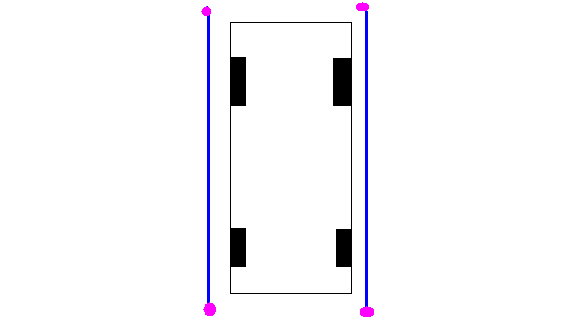
Blue - elastic string
Purple - jackstands
Car - its obvious what that is.
I measured the distance from body lines. But reading this thread, I now know I need to measure the distance from the front and rear string (distances).
Right?
Junior Member
Joined: Sep 2009
Posts: 11
Likes: 0
From: Southeast, GA
Re: String Alignment
Yes the strings need to be at the exact same distance front and rear and the car centered between them front and rear. I then like to get my measurement for toe at the hub center line which is the height I run my strings at.

Honda-Tech Member
Joined: Mar 2005
Posts: 625
Likes: 0
Re: String Alignment
Yes.
What you need is two strings parallel to each other and to the car's center line. How you achieve that is not important.
It is however much more convenient if strings are supported on the car rather than on the ground, since every time you make an adjustemnt, you need to roll the car to unbind the tires and/or suspension.
What you need is two strings parallel to each other and to the car's center line. How you achieve that is not important.
It is however much more convenient if strings are supported on the car rather than on the ground, since every time you make an adjustemnt, you need to roll the car to unbind the tires and/or suspension.
As far as reference points, I use the front and rear hubs, ensuring equi-distance Fr to Fr and Rer to rear.
 Re: String Alignment
As much as id like to learn this it makes my fricking head hurt.
Thank god for the inlaws that have a hunter hawkeye alignment system at their shop.
What id like to learn is using the tool below.
Thank god for the inlaws that have a hunter hawkeye alignment system at their shop.
What id like to learn is using the tool below.

H-T Order of Merit
Joined: Dec 1999
Posts: 96,625
Likes: 38
From: Siege Perilous
Re: String Alignment
SlapSmak found really really quick and innovative way to do alignments at home.
I have been doing it this way ever since, this method cut the time it usually takes me
to do alignments down by about half. Now I can set up the rig and start measuring in about 5 minutes!
https://honda-tech.com/forums/showthread.php?t=2631081
The best part is you can pick up the items needed at harbor freight for like $6.
http://www.harborfreight.com/cpi/cta...emnumber=46900
I have been doing it this way ever since, this method cut the time it usually takes me
to do alignments down by about half. Now I can set up the rig and start measuring in about 5 minutes!
https://honda-tech.com/forums/showthread.php?t=2631081
The best part is you can pick up the items needed at harbor freight for like $6.
http://www.harborfreight.com/cpi/cta...emnumber=46900
Honda-Tech Member
Joined: May 2007
Posts: 479
Likes: 0
From: marina, ca, 90292
Re: String Alignment
Its not so bad dude,,, it didnt make sense to me untill i did it . Its actually so simple that we think it cant be right!!!!!!!!! like the picture above just make 2 lines paralell to each other .
Even though you have someone with a Hunter system you should learn to do this for several reasons.
One, If your at the track and need to do a full alignment,
Also the hunter system is only as good as the guy operating it . While you have a relative there im sure it gets done right, however most guys operating that equipment dont give the level of "attention" that we would like as race car tuners.
The most important reason is that you will learn whats going on and develop a better understanding of whats going on. This way when the car is doing something wrong at the track YOU can address it,,, RIGHT THERE!!!
In the end you can string up a car and do an alignment in the time it takes to load up the car and take it to the alighnment shop!!! Sam Rothchild makes fixtures that fit right on to our cars, this makes it easier than using jackstands, but it can be done either way
JT-R
Re: String Alignment
Its not so bad dude,,, it didnt make sense to me untill i did it . Its actually so simple that we think it cant be right!!!!!!!!! like the picture above just make 2 lines paralell to each other .
Even though you have someone with a Hunter system you should learn to do this for several reasons.
One, If your at the track and need to do a full alignment,
Also the hunter system is only as good as the guy operating it . While you have a relative there im sure it gets done right, however most guys operating that equipment dont give the level of "attention" that we would like as race car tuners.
The most important reason is that you will learn whats going on and develop a better understanding of whats going on. This way when the car is doing something wrong at the track YOU can address it,,, RIGHT THERE!!!
In the end you can string up a car and do an alignment in the time it takes to load up the car and take it to the alighnment shop!!! Sam Rothchild makes fixtures that fit right on to our cars, this makes it easier than using jackstands, but it can be done either way
JT-R
Even though you have someone with a Hunter system you should learn to do this for several reasons.
One, If your at the track and need to do a full alignment,
Also the hunter system is only as good as the guy operating it . While you have a relative there im sure it gets done right, however most guys operating that equipment dont give the level of "attention" that we would like as race car tuners.
The most important reason is that you will learn whats going on and develop a better understanding of whats going on. This way when the car is doing something wrong at the track YOU can address it,,, RIGHT THERE!!!
In the end you can string up a car and do an alignment in the time it takes to load up the car and take it to the alighnment shop!!! Sam Rothchild makes fixtures that fit right on to our cars, this makes it easier than using jackstands, but it can be done either way
JT-R
Damn it Renan....

Ok you have convinced me again.
Is Sam selling these things?