


bpi velocity stack on s2k ?


Thread Starter
Honda-Tech Member
Joined: Dec 2003
Posts: 2,297
Likes: 0
From: da O.g Cush..., ca, us
 bpi velocity stack on s2k ?
the bpi stack has been dyno'd and proven to make power. So i'm a little suprised no one has stepped up and fork out 50 bucks for a some testing. since our engines strive for every single one. thoughts ? 


Munkyw3rkz.webs.com
Joined: Jun 2003
Posts: 22,166
Likes: 1
From: PUTTIN UR MOUTH ON CURBZ CPT, SoCal
Re: bpi velocity stack on s2k ? (dc-lefty)
<TABLE WIDTH="90%" CELLSPACING=0 CELLPADDING=0 ALIGN=CENTER><TR><TD>Quote, originally posted by dc-lefty »</TD></TR><TR><TD CLASS="quote">what does the butt dyno tell you ? any thoughts compared to the k&n drop-in, snorkel or cai ? </TD></TR></TABLE>
cant speak on the others but with the snorkal its so so.. i prefer running a stack "UNFILTERED" with a stick....
Butt tells a lot puckers up everytime i bang VTECH BRO!
cant speak on the others but with the snorkal its so so.. i prefer running a stack "UNFILTERED" with a stick....
Butt tells a lot puckers up everytime i bang VTECH BRO!

Munkyw3rkz.webs.com
Joined: Jun 2003
Posts: 22,166
Likes: 1
From: PUTTIN UR MOUTH ON CURBZ CPT, SoCal
Re: bpi velocity stack on s2k ? (SilverDc2)
<TABLE WIDTH="90%" CELLSPACING=0 CELLPADDING=0 ALIGN=CENTER><TR><TD>Quote, originally posted by SilverDc2 »</TD></TR><TR><TD CLASS="quote"> you got another one santos? weld that **** on lol.</TD></TR></TABLE>
hahahah well i ordered a new one so just waiting on it to show up..... i cant weld plastic so im stuck..
hahahah well i ordered a new one so just waiting on it to show up..... i cant weld plastic so im stuck..
Trending Topics

Munkyw3rkz.webs.com
Joined: Jun 2003
Posts: 22,166
Likes: 1
From: PUTTIN UR MOUTH ON CURBZ CPT, SoCal
Re: bpi velocity stack on s2k ? (avallach)
<TABLE WIDTH="90%" CELLSPACING=0 CELLPADDING=0 ALIGN=CENTER><TR><TD>Quote, originally posted by avallach »</TD></TR><TR><TD CLASS="quote">lord, $50 for a piece of plastic. I hope it works for you....</TD></TR></TABLE>
learn how air flows then come back and let us know what you find...
learn how air flows then come back and let us know what you find...

Honda-Tech Member
Joined: Jan 2005
Posts: 5,997
Likes: 0
From: never never land
Re: bpi velocity stack on s2k ? (dc-lefty)
<TABLE WIDTH="90%" CELLSPACING=0 CELLPADDING=0 ALIGN=CENTER><TR><TD>Quote, originally posted by dc-lefty »</TD></TR><TR><TD CLASS="quote">the bpi stack has been dyno'd and proven to make power. So i'm a little suprised no one has stepped up and fork out 50 bucks for a some testing. since our engines strive for every single one. thoughts ? </TD></TR></TABLE>
some guys down in Puerto Rico or Hawaii are using those things with their Comptech SC's. Im not sure if I would use one though.
</TD></TR></TABLE>some guys down in Puerto Rico or Hawaii are using those things with their Comptech SC's. Im not sure if I would use one though.
Munkyw3rkz.webs.com
Joined: Jun 2003
Posts: 22,166
Likes: 1
From: PUTTIN UR MOUTH ON CURBZ CPT, SoCal
Re: bpi velocity stack on s2k ? (avallach)
<TABLE WIDTH="90%" CELLSPACING=0 CELLPADDING=0 ALIGN=CENTER><TR><TD>Quote, originally posted by avallach »</TD></TR><TR><TD CLASS="quote">Why don't you explain it to me? </TD></TR></TABLE>
its called goodle try it out...
ive worked in avaition for 7years so i think i know a thing or 2 about how air flows......
its called goodle try it out...
ive worked in avaition for 7years so i think i know a thing or 2 about how air flows......

Honda-Tech Member
Joined: Aug 2005
Posts: 74
Likes: 0
Re: bpi velocity stack on s2k ? (S@nt0s)
No need for a google search.
v2/2 + p/ρ + gz = constant, where v is the velocity at a point, p the pressure, ρ the density, g the acceleration of gravity, and z the height above an arbitrary reference level.
The second form of Bernoulli's equasion is most applicable to flow through a velocity stack. In a steady flow the particles of fluid move along fixed streamlines, as on rails, and are accelerated and decelerated by the forces acting tangent to the streamlines. Under the same assumptions for the external forces and the density, but without demanding irrotational flow, we have for an equation of motion dv/dt = v(dv/ds) = -dΩ/ds - (1/ρ)dp/ds, where s is distance along the streamline. This integrates immediately to v2/2 + Ω + p/ρ = c. In this case, the constant c is for the streamline considered alone; nothing can be said about other streamlines.
Airflow is accelerated by the reduction in diameter of the velocity stack.
We were forced to study fluid/gas flow dynamics in anesthesia school.
-Pete
v2/2 + p/ρ + gz = constant, where v is the velocity at a point, p the pressure, ρ the density, g the acceleration of gravity, and z the height above an arbitrary reference level.
The second form of Bernoulli's equasion is most applicable to flow through a velocity stack. In a steady flow the particles of fluid move along fixed streamlines, as on rails, and are accelerated and decelerated by the forces acting tangent to the streamlines. Under the same assumptions for the external forces and the density, but without demanding irrotational flow, we have for an equation of motion dv/dt = v(dv/ds) = -dΩ/ds - (1/ρ)dp/ds, where s is distance along the streamline. This integrates immediately to v2/2 + Ω + p/ρ = c. In this case, the constant c is for the streamline considered alone; nothing can be said about other streamlines.
Airflow is accelerated by the reduction in diameter of the velocity stack.
We were forced to study fluid/gas flow dynamics in anesthesia school.
-Pete

Honda-Tech Member
Joined: Jan 2003
Posts: 9,359
Likes: 0
From: Torrance 310, California, USA
Re: bpi velocity stack on s2k ? (Kodokan_4)
<TABLE WIDTH="90%" CELLSPACING=0 CELLPADDING=0 ALIGN=CENTER><TR><TD>Quote, originally posted by Kodokan_4 »</TD></TR><TR><TD CLASS="quote">No need for a google search.
v2/2 + p/ρ + gz = constant, where v is the velocity at a point, p the pressure, ρ the density, g the acceleration of gravity, and z the height above an arbitrary reference level.
The second form of Bernoulli's equasion is most applicable to flow through a velocity stack. In a steady flow the particles of fluid move along fixed streamlines, as on rails, and are accelerated and decelerated by the forces acting tangent to the streamlines. Under the same assumptions for the external forces and the density, but without demanding irrotational flow, we have for an equation of motion dv/dt = v(dv/ds) = -dΩ/ds - (1/ρ)dp/ds, where s is distance along the streamline. This integrates immediately to v2/2 + Ω + p/ρ = c. In this case, the constant c is for the streamline considered alone; nothing can be said about other streamlines.
Airflow is accelerated by the reduction in diameter of the velocity stack.
We were forced to study fluid/gas flow dynamics in anesthesia school.
-Pete </TD></TR></TABLE>
thanks...i have a headache now
v2/2 + p/ρ + gz = constant, where v is the velocity at a point, p the pressure, ρ the density, g the acceleration of gravity, and z the height above an arbitrary reference level.
The second form of Bernoulli's equasion is most applicable to flow through a velocity stack. In a steady flow the particles of fluid move along fixed streamlines, as on rails, and are accelerated and decelerated by the forces acting tangent to the streamlines. Under the same assumptions for the external forces and the density, but without demanding irrotational flow, we have for an equation of motion dv/dt = v(dv/ds) = -dΩ/ds - (1/ρ)dp/ds, where s is distance along the streamline. This integrates immediately to v2/2 + Ω + p/ρ = c. In this case, the constant c is for the streamline considered alone; nothing can be said about other streamlines.
Airflow is accelerated by the reduction in diameter of the velocity stack.
We were forced to study fluid/gas flow dynamics in anesthesia school.
-Pete
</TD></TR></TABLE>thanks...i have a headache now
Munkyw3rkz.webs.com
Joined: Jun 2003
Posts: 22,166
Likes: 1
From: PUTTIN UR MOUTH ON CURBZ CPT, SoCal
Re: bpi velocity stack on s2k ? (Kodokan_4)
<TABLE WIDTH="90%" CELLSPACING=0 CELLPADDING=0 ALIGN=CENTER><TR><TD>Quote, originally posted by Kodokan_4 »</TD></TR><TR><TD CLASS="quote">No need for a google search.
Airflow is accelerated by the reduction in diameter of the velocity stack.
We were forced to study fluid/gas flow dynamics in anesthesia school.
-Pete </TD></TR></TABLE>
yes sirrrr
i had to learn it sincec i deal with aircraft strutures as well as pnumatic systems
Airflow is accelerated by the reduction in diameter of the velocity stack.
We were forced to study fluid/gas flow dynamics in anesthesia school.
-Pete
</TD></TR></TABLE>yes sirrrr
i had to learn it sincec i deal with aircraft strutures as well as pnumatic systems
Honda-Tech Member
Joined: Jan 2005
Posts: 5,997
Likes: 0
From: never never land
Re: bpi velocity stack on s2k ? (Kodokan_4)
<TABLE WIDTH="90%" CELLSPACING=0 CELLPADDING=0 ALIGN=CENTER><TR><TD>Quote, originally posted by Kodokan_4 »</TD></TR><TR><TD CLASS="quote">No need for a google search.
v2/2 + p/ρ + gz = constant, where v is the velocity at a point, p the pressure, ρ the density, g the acceleration of gravity, and z the height above an arbitrary reference level.
The second form of Bernoulli's equasion is most applicable to flow through a velocity stack. In a steady flow the particles of fluid move along fixed streamlines, as on rails, and are accelerated and decelerated by the forces acting tangent to the streamlines. Under the same assumptions for the external forces and the density, but without demanding irrotational flow, we have for an equation of motion dv/dt = v(dv/ds) = -dΩ/ds - (1/ρ)dp/ds, where s is distance along the streamline. This integrates immediately to v2/2 + Ω + p/ρ = c. In this case, the constant c is for the streamline considered alone; nothing can be said about other streamlines.
Airflow is accelerated by the reduction in diameter of the velocity stack.
We were forced to study fluid/gas flow dynamics in anesthesia school.
-Pete </TD></TR></TABLE>
you learn something new every day, thanks
v2/2 + p/ρ + gz = constant, where v is the velocity at a point, p the pressure, ρ the density, g the acceleration of gravity, and z the height above an arbitrary reference level.
The second form of Bernoulli's equasion is most applicable to flow through a velocity stack. In a steady flow the particles of fluid move along fixed streamlines, as on rails, and are accelerated and decelerated by the forces acting tangent to the streamlines. Under the same assumptions for the external forces and the density, but without demanding irrotational flow, we have for an equation of motion dv/dt = v(dv/ds) = -dΩ/ds - (1/ρ)dp/ds, where s is distance along the streamline. This integrates immediately to v2/2 + Ω + p/ρ = c. In this case, the constant c is for the streamline considered alone; nothing can be said about other streamlines.
Airflow is accelerated by the reduction in diameter of the velocity stack.
We were forced to study fluid/gas flow dynamics in anesthesia school.
-Pete
</TD></TR></TABLE>you learn something new every day, thanks


Honda-Tech Member
Joined: Apr 2003
Posts: 3,993
Likes: 0
From: Somewhere in, IL, United States
Re: bpi velocity stack on s2k ? (Kodokan_4)
<TABLE WIDTH="90%" CELLSPACING=0 CELLPADDING=0 ALIGN=CENTER><TR><TD>Quote, originally posted by Kodokan_4 »</TD></TR><TR><TD CLASS="quote">No need for a google search.
v2/2 + p/? + gz = constant, where v is the velocity at a point, p the pressure, ? the density, g the acceleration of gravity, and z the height above an arbitrary reference level.
The second form of Bernoulli's equasion is most applicable to flow through a velocity stack. In a steady flow the particles of fluid move along fixed streamlines, as on rails, and are accelerated and decelerated by the forces acting tangent to the streamlines. Under the same assumptions for the external forces and the density, but without demanding irrotational flow, we have for an equation of motion dv/dt = v(dv/ds) = -d?/ds - (1/?)dp/ds, where s is distance along the streamline. This integrates immediately to v2/2 + ? + p/? = c. In this case, the constant c is for the streamline considered alone; nothing can be said about other streamlines.
Airflow is accelerated by the reduction in diameter of the velocity stack.
We were forced to study fluid/gas flow dynamics in anesthesia school.
-Pete </TD></TR></TABLE>
ROFL!! instead of explaining it to them, you just made them all confused... and tell me you didnt "copy" "paste" that cuz im confused how you come up with "omega" symbol etc.
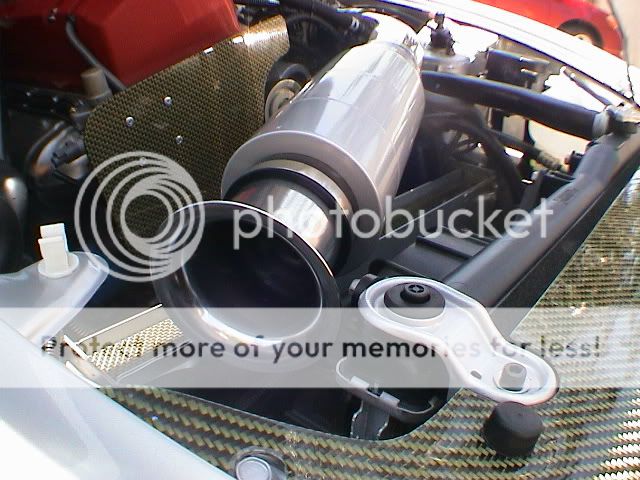
and i thought you guys are talking about velocity stack like the pic posted above with "megaphone" tip? .. now, you guys quoting "Airflow is accelerated by the reduction in diameter of the velocity stack".. tell me wheres the reduction on that? lol
the reduction you guys talking about is the tapered entrance incorporate in a carburetor...
now the purpose of the "velocity stack" that megaphone looking thing, is to allow smooth and even entry of air into the intake duct with maintain flow stream to the pipe walls.
here i found a pic..

v2/2 + p/? + gz = constant, where v is the velocity at a point, p the pressure, ? the density, g the acceleration of gravity, and z the height above an arbitrary reference level.
The second form of Bernoulli's equasion is most applicable to flow through a velocity stack. In a steady flow the particles of fluid move along fixed streamlines, as on rails, and are accelerated and decelerated by the forces acting tangent to the streamlines. Under the same assumptions for the external forces and the density, but without demanding irrotational flow, we have for an equation of motion dv/dt = v(dv/ds) = -d?/ds - (1/?)dp/ds, where s is distance along the streamline. This integrates immediately to v2/2 + ? + p/? = c. In this case, the constant c is for the streamline considered alone; nothing can be said about other streamlines.
Airflow is accelerated by the reduction in diameter of the velocity stack.
We were forced to study fluid/gas flow dynamics in anesthesia school.
-Pete
</TD></TR></TABLE>ROFL!! instead of explaining it to them, you just made them all confused... and tell me you didnt "copy" "paste" that cuz im confused how you come up with "omega" symbol etc.
and i thought you guys are talking about velocity stack like the pic posted above with "megaphone" tip? .. now, you guys quoting "Airflow is accelerated by the reduction in diameter of the velocity stack".. tell me wheres the reduction on that? lol
the reduction you guys talking about is the tapered entrance incorporate in a carburetor...
now the purpose of the "velocity stack" that megaphone looking thing, is to allow smooth and even entry of air into the intake duct with maintain flow stream to the pipe walls.
here i found a pic..
Honda-Tech Member
Joined: Apr 2003
Posts: 3,993
Likes: 0
From: Somewhere in, IL, United States
Re: bpi velocity stack on s2k ? (FR-MOB: Jerk)
more example - ITB tunnels and purpose of those are to allow smooth and even entry of air into the intake duct... NOT as a reduction to accelerate the airflow 
HAPPY LEARNING!!!!!
HAPPY LEARNING!!!!!

Honda-Tech Member

Joined: Sep 2001
Posts: 1,297
Likes: 0
From: Hardtop Hero, USA
Re: bpi velocity stack on s2k ? (Kodokan_4)
<TABLE WIDTH="90%" CELLSPACING=0 CELLPADDING=0 ALIGN=CENTER><TR><TD>Quote, originally posted by Kodokan_4 »</TD></TR><TR><TD CLASS="quote">No need for a google search.
v2/2 + p/ρ + gz = constant, where v is the velocity at a point, p the pressure, ρ the density, g the acceleration of gravity, and z the height above an arbitrary reference level.
The second form of Bernoulli's equasion is most applicable to flow through a velocity stack. In a steady flow the particles of fluid move along fixed streamlines, as on rails, and are accelerated and decelerated by the forces acting tangent to the streamlines. Under the same assumptions for the external forces and the density, but without demanding irrotational flow, we have for an equation of motion dv/dt = v(dv/ds) = -dΩ/ds - (1/ρ)dp/ds, where s is distance along the streamline. This integrates immediately to v2/2 + Ω + p/ρ = c. In this case, the constant c is for the streamline considered alone; nothing can be said about other streamlines.
Airflow is accelerated by the reduction in diameter of the velocity stack.
We were forced to study fluid/gas flow dynamics in anesthesia school.
-Pete </TD></TR></TABLE>Smartass
v2/2 + p/ρ + gz = constant, where v is the velocity at a point, p the pressure, ρ the density, g the acceleration of gravity, and z the height above an arbitrary reference level.
The second form of Bernoulli's equasion is most applicable to flow through a velocity stack. In a steady flow the particles of fluid move along fixed streamlines, as on rails, and are accelerated and decelerated by the forces acting tangent to the streamlines. Under the same assumptions for the external forces and the density, but without demanding irrotational flow, we have for an equation of motion dv/dt = v(dv/ds) = -dΩ/ds - (1/ρ)dp/ds, where s is distance along the streamline. This integrates immediately to v2/2 + Ω + p/ρ = c. In this case, the constant c is for the streamline considered alone; nothing can be said about other streamlines.
Airflow is accelerated by the reduction in diameter of the velocity stack.
We were forced to study fluid/gas flow dynamics in anesthesia school.
-Pete
</TD></TR></TABLE>Smartass
Honda-Tech Member
Joined: Apr 2003
Posts: 3,993
Likes: 0
From: Somewhere in, IL, United States
Re: bpi velocity stack on s2k ? (ntensehonda)
now is the right time to say "we learn something new errday"
im here to help cuz you guys are all my f@ckin friend...And i hope u all kno thats f@ckin true...no matter what the f@ck happens... i will stand the f@ck by u... i will f@ckin be there for u... whenever the f@ck u need me... to lend a f@ckin hand.... to do a f@ckin good deed...so f@ckin call on me....whenever the f@ck u need me...F@ck, i will always be there...Even to the bitter f@ckin end...

im here to help cuz you guys are all my f@ckin friend...And i hope u all kno thats f@ckin true...no matter what the f@ck happens... i will stand the f@ck by u... i will f@ckin be there for u... whenever the f@ck u need me... to lend a f@ckin hand.... to do a f@ckin good deed...so f@ckin call on me....whenever the f@ck u need me...F@ck, i will always be there...Even to the bitter f@ckin end...