


water temp .. were to install ...


Thread Starter
Honda-Tech Member

Joined: Aug 2004
Posts: 2,379
Likes: 1
From: Washington Dc
 water temp .. were to install ...
hi
resently install my turbo on my car .. and I wanted to install a few more gauges to see whats up with the engine when under load, so I bough the oil psi gauge and the water temp gauge .. I was woundering were did u guys install the temperature sensing bulb (capillar sensing unit) I can install to were the thermostat housing is but then were do i connect my stock ect switch sensor ? I though about installing it on the ect gauge sending unit wich I think thats were it goes to my cluster ..
THANKS IN ADVANCE
i know this is not the right place to ask but I figure most of u guys installed this gauges on ur boosted car so .......
sorry for my english
Modified by EGSR at 4:39 PM 11/20/2005
resently install my turbo on my car .. and I wanted to install a few more gauges to see whats up with the engine when under load, so I bough the oil psi gauge and the water temp gauge .. I was woundering were did u guys install the temperature sensing bulb (capillar sensing unit) I can install to were the thermostat housing is but then were do i connect my stock ect switch sensor ? I though about installing it on the ect gauge sending unit wich I think thats were it goes to my cluster ..
THANKS IN ADVANCE
i know this is not the right place to ask but I figure most of u guys installed this gauges on ur boosted car so .......
sorry for my english
Modified by EGSR at 4:39 PM 11/20/2005

Honda-Tech Member
Joined: Mar 2001
Posts: 4,408
Likes: 4
From: Somewhere in California
Re: water temp .. were to install ... (EGSR)
I'm using a Greddy water temp gauge adapter in my radiator piping. But since my water sender was NPT thread and the Greddy adapter was metric thread I had to get it drilled and tapped so my 3/8 NPT adapter could be screwed right in. With some teflon paste it has not leaked in the last year I've had it on.

Honda-Tech Member
Joined: Mar 2001
Posts: 4,408
Likes: 4
From: Somewhere in California
Re: water temp .. were to install ... (BlueShadow)
I got your IM, if you want another alternative you could try tapping your TB coolant line. You would want to use an adapter like this:
summitracing.com part number SUM-G1710 3/8" hose barbs with 1/8" NPT port
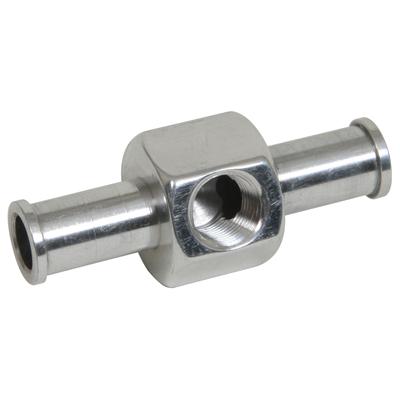
summitracing.com part number SUM-G1711 1/2" hose barbs with 1/8" NPT ports

Not sure which ones would work for the TB coolant lines. The 1/2" hose barbs might be to big, and I dont know if the 3/8" hose barbs would be small enough.
summitracing.com part number SUM-G1710 3/8" hose barbs with 1/8" NPT port
summitracing.com part number SUM-G1711 1/2" hose barbs with 1/8" NPT ports
Not sure which ones would work for the TB coolant lines. The 1/2" hose barbs might be to big, and I dont know if the 3/8" hose barbs would be small enough.

Honda-Tech Member
Joined: Nov 2003
Posts: 3,540
Likes: 1
From: GTA Ontario.
Re: water temp .. were to install ... (EGSR)
i put mine in the upper rad hose like above..
But my coolant gauge dosent work? I cant figure out why... Its just a 1 wire sender with pos and neg on gauge which is hooked up correctly...
But my coolant gauge dosent work? I cant figure out why... Its just a 1 wire sender with pos and neg on gauge which is hooked up correctly...

Joined: May 2005
Posts: 1,789
Likes: 1
From: Simi Valley, CA, USA
Re: water temp .. were to install ... (HamiltonRex)
<TABLE WIDTH="90%" CELLSPACING=0 CELLPADDING=0 ALIGN=CENTER><TR><TD>Quote, originally posted by HamiltonRex »</TD></TR><TR><TD CLASS="quote">i put mine in the upper rad hose like above..
But my coolant gauge dosent work? I cant figure out why... Its just a 1 wire sender with pos and neg on gauge which is hooked up correctly...</TD></TR></TABLE>
Do you have a good ground connection at the sender body?
But my coolant gauge dosent work? I cant figure out why... Its just a 1 wire sender with pos and neg on gauge which is hooked up correctly...</TD></TR></TABLE>
Do you have a good ground connection at the sender body?

Honda-Tech Member
Joined: Sep 2004
Posts: 1,794
Likes: 0
From: Roslyn, WA, U.S.A.
Re: water temp .. were to install ... (EnzoSpeed)
i dont have any pix but i took my thermo housing and found a good spot drilled at tapped 1/8 pipe threads into it and put it there very close to my stock sensor and i feel its a very acurate temp.
Trending Topics

Honda-Tech Member
Joined: Sep 2003
Posts: 2,412
Likes: 0
From: miami, fla, us
Re: water temp .. were to install ... (mattcivic)
the upper hose is going to only see the hot fluid coming out of the motor.......the bottom hose will hav ethe cool fluid and under the distributor on the head where the 2 factory sensors are is a mix of both ....
 Re: water temp .. were to install ... (EGSR)
You can either drill and tap the thermostat housing or the upper radiator housing depending on which head and thermostat housing you have...whichever one you prefer that gives you the greatest freedom to keep things uncluttered.
This was done with an Autometer water temperature gauge kit. The probe is 1/8" NPT x 27tpi. You could just as easily do it with a GReddy probe, with the only change being that you would use a 1/8" BSPT x 28tpi tap. It's recommended that you use a drill press. It's a lot easier on a press.


This was done with an Autometer water temperature gauge kit. The probe is 1/8" NPT x 27tpi. You could just as easily do it with a GReddy probe, with the only change being that you would use a 1/8" BSPT x 28tpi tap. It's recommended that you use a drill press. It's a lot easier on a press.
Thread Starter
Honda-Tech Member
Joined: Aug 2004
Posts: 2,379
Likes: 1
From: Washington Dc
Re: water temp .. were to install ... (IN VTEC)
thats a clean job man .. but what i did was I cut halft of my heater house and I insert a 1/2 T copper water pipe ( the one u use for ur water lines in ur home lol) and I weld a 1/8 npt copper adpater and that how it goes .. my gess is that the heater house coming from the head it has the same water temp as the one going out to the rad correct me if I'am wrong plz

Honda-Tech Member
Joined: Aug 2002
Posts: 4,810
Likes: 1
From: SOHC LAND, XX

Honda-Tech Member
Joined: Nov 2003
Posts: 3,540
Likes: 1
From: GTA Ontario.
Re: water temp .. were to install ... (EnzoSpeed)
<TABLE WIDTH="90%" CELLSPACING=0 CELLPADDING=0 ALIGN=CENTER><TR><TD>Quote, originally posted by EnzoSpeed »</TD></TR><TR><TD CLASS="quote">Do you have a good ground connection at the sender body?</TD></TR></TABLE>
Let me get this straight...
Since my sender is in the rad hose it isnt grounded. BUT the signal wire is connected.
does the sender also need to be ground via a wire to the chassis? If so can i just add another wire to the sender and go to ground?
thanks
Let me get this straight...
Since my sender is in the rad hose it isnt grounded. BUT the signal wire is connected.
does the sender also need to be ground via a wire to the chassis? If so can i just add another wire to the sender and go to ground?
thanks
Honda-Tech Member
Joined: Mar 2001
Posts: 4,408
Likes: 4
From: Somewhere in California
Re: water temp .. were to install ... (HamiltonRex)
yup, I know for my Nordskog water temp gauge the instructions say that the sender has to be grounded. Not the top part where you screw in the gauge wire, but the part below that. If you are running a setup like IN VTEC, then the sender is already grounded through the water outlet. However he put some teflon paste on the sender threads and that may affect the sender ground. Also if ther is any Hondabond between the water outlet and the head, then it might affect the ground, but I'm not sure about that. I know the autometer Instructions say to add sealant, but the insturctions for my Nordskog gauges say not ato use sealant.
When I used my Nordskog sender on my RX-7 I had it going directly to coolant fill neck which was metal and grounded. I remember the Nordskog tech guy telling me not to use teflon paste on the sender threads because it might not allow the sender to be grounded through the metal coolant fill neck.
Modified by BlueShadow at 1:29 PM 11/24/2005
When I used my Nordskog sender on my RX-7 I had it going directly to coolant fill neck which was metal and grounded. I remember the Nordskog tech guy telling me not to use teflon paste on the sender threads because it might not allow the sender to be grounded through the metal coolant fill neck.
Modified by BlueShadow at 1:29 PM 11/24/2005
Honda-Tech Member
Joined: Mar 2001
Posts: 4,408
Likes: 4
From: Somewhere in California
Re: water temp .. were to install ... (HamiltonRex)
HamiltonRex,
here is a pic of my old setup on my RX-7. You can see I didn't use any teflon sealant between the sender, sender adapter and the water fill neck. This would have affected the ground. You can also ground the sender by putting a wire around the sender body below the thick yellow line and run it to a good ground.

here is a pic of my old setup on my RX-7. You can see I didn't use any teflon sealant between the sender, sender adapter and the water fill neck. This would have affected the ground. You can also ground the sender by putting a wire around the sender body below the thick yellow line and run it to a good ground.
Honda-Tech Member
Joined: Nov 2003
Posts: 3,540
Likes: 1
From: GTA Ontario.
Re: water temp .. were to install ... (BlueShadow)
Thanks!
So i could unscrew the sender.. Strip some wire back (like a stranded 18ga) wrap it around the threads.. (very lightly) and then screw it in, and run to a ground.
Or any better idea's? (mine is in the upper rad hose)
Maybe this will solve the problem why its not working
So i could unscrew the sender.. Strip some wire back (like a stranded 18ga) wrap it around the threads.. (very lightly) and then screw it in, and run to a ground.
Or any better idea's? (mine is in the upper rad hose)
Maybe this will solve the problem why its not working
Honda-Tech Member
Joined: Mar 2001
Posts: 4,408
Likes: 4
From: Somewhere in California
Re: water temp .. were to install ... (HamiltonRex)
You should also be able to wrap it around the sender body, which is right above the threaded portion you are talking about. If you look in the pic I provided it is the part right beneath the thick yellow line.
The thing that sucks about my current setup and yours is getting a good connection on the wire. I dont really wanna wrap a piece of wire around the sender body. I might get a ring terminal and bore it out with a dremel just enough so that it screws onto the threaded part of the sender. I could screw the ring terminal all the way up and then screw my sender into my adapter. The ring terminal would then be sandwiched between the adapter and the upper part of the sender body that widens and it would have good metal to metal contact since it was screwed onto the sender.
The thing that sucks about my current setup and yours is getting a good connection on the wire. I dont really wanna wrap a piece of wire around the sender body. I might get a ring terminal and bore it out with a dremel just enough so that it screws onto the threaded part of the sender. I could screw the ring terminal all the way up and then screw my sender into my adapter. The ring terminal would then be sandwiched between the adapter and the upper part of the sender body that widens and it would have good metal to metal contact since it was screwed onto the sender.
Honda-Tech Member
Joined: Nov 2003
Posts: 3,540
Likes: 1
From: GTA Ontario.
Re: water temp .. were to install ... (BlueShadow)
<TABLE WIDTH="90%" CELLSPACING=0 CELLPADDING=0 ALIGN=CENTER><TR><TD>Quote, originally posted by BlueShadow »</TD></TR><TR><TD CLASS="quote"> The ring terminal would then be sandwiched between the adapter and the upper part of the sender body that widens and it would have good metal to metal contact since it was screwed onto the sender.</TD></TR></TABLE>
Good idea! Or even like a big washer that sticks out alot that i could solder a wire too?
Good idea! Or even like a big washer that sticks out alot that i could solder a wire too?
Honda-Tech Member
Joined: Mar 2001
Posts: 4,408
Likes: 4
From: Somewhere in California
Re: water temp .. were to install ... (HamiltonRex)
<TABLE WIDTH="90%" CELLSPACING=0 CELLPADDING=0 ALIGN=CENTER><TR><TD>Quote, originally posted by HamiltonRex »</TD></TR><TR><TD CLASS="quote">
Good idea! Or even like a big washer that sticks out alot that i could solder a wire too?</TD></TR></TABLE>
That could work too. As long as surface of the ring that is being sandwiched doesn't have solder or wire on it. Also if you get a big enough washer you could drill a hole through it at the edge and feed the wire through before soldering the wire. That would be a good way to keep the wire more secure. It might just be easier and cleaner to do the ring terminal idea like I mentioned though.
Good idea! Or even like a big washer that sticks out alot that i could solder a wire too?</TD></TR></TABLE>
That could work too. As long as surface of the ring that is being sandwiched doesn't have solder or wire on it. Also if you get a big enough washer you could drill a hole through it at the edge and feed the wire through before soldering the wire. That would be a good way to keep the wire more secure. It might just be easier and cleaner to do the ring terminal idea like I mentioned though.

Honda-Tech Member
Joined: Mar 2001
Posts: 4,408
Likes: 4
From: Somewhere in California
Re: water temp .. were to install ... (HamiltonRex)

This is a ring terminal. get one with a hole slightly smaller then your sender. You want the hole just the right size so that you have to screw it on not slip it on. I had some spares laying around and they were too small so I took my dremel with the cone shaped sander and bored out the center a bit.

Member
Joined: May 2002
Posts: 1,536
Likes: 0
From: OR
Re: water temp .. were to install ... (BlueShadow)
From personal expierence DO NOT GROUND THE SENDER FROM THE TOP. I mounted my sensor inline with my throttle body coolant line and accidently miss understood the correct way of grounding the sender. Instead of grounding the body of the sender I grounded the sender at the top so there were two wires going off of the sender, one to the guage and one to a ground. I powered up and my water temp gauge needle jerked all the way to the right to a stand still. 
 Re: water temp .. were to install ... (InfamousDC2FI)
I like the idea of installing it in the upper radiator housing like IN VTEC did. That way the sensor should already be grounded to the motor itself.
Newer Integras dont have that bleeder valve but theres a shallow hole there instead. Perfect spot for the sensor.
Newer Integras dont have that bleeder valve but theres a shallow hole there instead. Perfect spot for the sensor.
Thread Starter
Honda-Tech Member
Joined: Aug 2004
Posts: 2,379
Likes: 1
From: Washington Dc
Re: water temp .. were to install ... (Muckman)
OK SO anyways ..
do u guys think that installing the capillar sensor into the heater house that goes to the firewall would be a good choise ?
do u guys think that installing the capillar sensor into the heater house that goes to the firewall would be a good choise ?

Honda-Tech Member
Joined: Jul 2001
Posts: 5,608
Likes: 1
From: All around, De/Pa
Re: water temp .. were to install ... (EGSR)
I took the factory sender out of the head and put the aftermarket sender in there. You will lose the factory temp gauge, but who cares since your doing a new gauge anyways----great place to moung an ultra bright LED for a shift lite  . You will get the best possible reading in the head since thats what needs to be monitored. Also a perk of this is you can use the factory wire to keep the wiring cleaner, but you gotta find that wire in the car (under the dash up close to firewall) and clip it then wire the gauge to the engine harness side
. You will get the best possible reading in the head since thats what needs to be monitored. Also a perk of this is you can use the factory wire to keep the wiring cleaner, but you gotta find that wire in the car (under the dash up close to firewall) and clip it then wire the gauge to the engine harness side

Thread
Thread Starter
Forum
Replies
Last Post
monicle
Honda Civic / Del Sol (1992 - 2000)
5
May 27, 2003 10:41 AM
