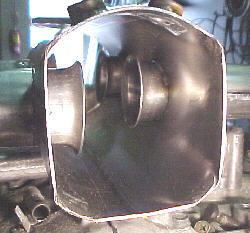
Velocity stack for turbo


Thread Starter
Honda-Tech Member
Joined: Sep 2001
Posts: 4,116
Likes: 2
 Velocity stack for turbo
I saw that Akimoto makes velocity stacks that slip over turbo inlets. I could rig up screen mesh and the velocity stack to work together so there would be some protection for the turbo. Would velocity stack produce some kinda noticable gains? I know that in theory it should, but does anyone have real world experience?

Honda-Tech Member
Joined: Mar 2002
Posts: 2,178
Likes: 1
From: Portland, OR
Re: Velocity stack for turbo (boosted hybrid)
I don't think it would do too much, maybe just a couple HP. I think it's more for really hardcore racing where every little tiny bit is a big help.
::edit::
I know that's the case with NA, atleast.
[Modified by ion_four, 6:18 AM 7/18/2002]
::edit::
I know that's the case with NA, atleast.
[Modified by ion_four, 6:18 AM 7/18/2002]

New User
Joined: Feb 2001
Posts: 1,412
Likes: 0
From: san luis obispo, ca
Re: Velocity stack for turbo (boosted hybrid)
In reality if you're running a turbo with no intake piping, you -should- have a velocity stack of some sort on it; normally the intake pipe gives the incoming air a chance to get oriented on its way to the compressor vanes, running it just wide open is going to create some pressure drop on the way in - any way you look at it, that's going to hurt you SOME.... just probably not much on your average street machine. GET A FILTER!


Honda-Tech Member
Joined: Nov 2001
Posts: 3,492
Likes: 0
From: San Jose, CA, USA
Re: Velocity stack for turbo (boostaholic)
I think if you were into "hardcore racing" you wouldn't have much of a filter at all. I know that, at least in my case, my spoolup time increased noticeably from when I was running a screen mesh "filter" and when I finally put a proper A'PEXi filter on.


Trending Topics


Junior Member
Joined: May 2001
Posts: 444
Likes: 0
From: Hamilton, Ontario, Canada
Re: Velocity stack for turbo (BoOsTeD_eK)
you should always have something that helps move the air towards the compressor. If I was to run that kind of setup, I'd have the pipe no less then three times the diameter of the compressor inlet.


Honda-Tech Member
Joined: Apr 2002
Posts: 1,019
Likes: 0
From: Jax/St. Aug, Fl
Re: Velocity stack for turbo (shadowdawn)
If you're someone that already has just mesh on an open pipe. The Velocity stack would definately help redirect the air so it wouldn't have to jump a 90 deg angle to come in from the side.
Turbonetics makes them, called Inlet horns though
Part Number 20623-X 2.35"
21-X 2.75"
22-X 3.00"
24-X 4.00"
X is just for color 1 Polished
2 Adonixed RED
3 Adonized Blue
4 Adonized Gold
They have the K&N filters too. Too many PN's to list. but the lengths are as long as 14" for a 4" inlet
Turbonetics makes them, called Inlet horns though
Part Number 20623-X 2.35"
21-X 2.75"
22-X 3.00"
24-X 4.00"
X is just for color 1 Polished
2 Adonixed RED
3 Adonized Blue
4 Adonized Gold
They have the K&N filters too. Too many PN's to list. but the lengths are as long as 14" for a 4" inlet
Junior Member
Joined: May 2001
Posts: 444
Likes: 0
From: Hamilton, Ontario, Canada
Re: Velocity stack for turbo (dustin)
I designed a wind tunnel at work to test power steering coolers, and the flow manual I was refering to stated that a tube that was AT LEAST 2x the dia., but preferably 3x as long as the Dia. would be long enough for the airstream to stabilize for optimum flow and measurement. The distance would be shorter if a flow straightener would be used, like a square or honeycomb shape...


Honda-Tech Member
Joined: Feb 2002
Posts: 2,929
Likes: 0
From: Ride Naked
Re: Velocity stack for turbo (BG Boost)
On 4.5 HP honda motors a velocity stack adds .5 HP (dyno proven) and useing acorn nuts to attach it adds .1 HP (again dyno proven). The little "sno cats" snowmobiles used in the X-games use those engines and I saw the dyno charts aa the shop that builds them.
This is an NA application, and it gains 12%, on a turbo expect very nice HP gains
-Dustin
This is an NA application, and it gains 12%, on a turbo expect very nice HP gains
-Dustin
Honda-Tech Member
Joined: Feb 2002
Posts: 2,929
Likes: 0
From: Ride Naked
Re: Velocity stack for turbo (Autocratic_1st_Gen)

Honda-Tech Member
Joined: Nov 2001
Posts: 2,685
Likes: 0
From: KOP, PA, USA
Re: Velocity stack for turbo (Autocratic_1st_Gen)
Bump for an interesting topic. What other companies make velocity stacks? I use a mesh filter, but would like to use a velocity stack. I know the Jun SR20DET and Nismo RB26DETT uses them.


Honda-Tech Member
Joined: Jun 2003
Posts: 20
Likes: 0
Re: Velocity stack for turbo (DC2R714)
<TABLE WIDTH="90%" CELLSPACING=0 CELLPADDING=0 ALIGN=CENTER><TR><TD>Quote, originally posted by DC2R714 »</TD></TR><TR><TD CLASS="quote">Bump for an interesting topic. What other companies make velocity stacks? I use a mesh filter, but would like to use a velocity stack. I know the Jun SR20DET and Nismo RB26DETT uses them.
</TD></TR></TABLE>
The purple anodized one is a 100MM HKS piece, correct me if i'm wrong.
The purple anodized one is a 100MM HKS piece, correct me if i'm wrong.
Thread Starter
Honda-Tech Member
Joined: Sep 2001
Posts: 4,116
Likes: 2
Re: Velocity stack for turbo (boosted hybrid)
I have read a great deal concerning this topic since I posted this awhile ago. Basically a velocity stack forces the air to go from turbulent to laminar as quick as possible. The laminar air entering the turbo inlet would be less likely to heat up as turbulent air. This would net some gain, but nothing really significant. The gains that are seen on N/A engines are due to the vacuum conditions the engines operate at. The velocity stacks increase the airflow from turbulent to laminar flow, and therefore speed up the airflow allowing for more overall flow to be generated. On a compressor inlet of a turbocharger air is already quite laminar so the gain is minimal. If you would add internal velocity stacks inside of an intake manifold, greater flow would be achieved and more power would be made. There arent any aftermarket intake manifolds to my knowledge that have internal velocity stacks for Honda's. Flow would improve around 10-12%.

Honda-Tech Member
Joined: Jul 2001
Posts: 5,608
Likes: 1
From: All around, De/Pa
Re: Velocity stack for turbo (boosted hybrid)
We have a couple velocity stacks in stock at the store. On the supra it seemed to help a bit, but that was also going from running a filter to putting on the stack. I had one for the old turbo but now I need a 3" inlet sized one.....I will probably run one at the track.
By the way, my Venom intake has velocity stacks....take a look

By the way, my Venom intake has velocity stacks....take a look