


DP theory



Honda-Tech Member
Joined: Feb 2003
Posts: 1,740
Likes: 1
From: Phoenix Arizona
 Re: DP theory (JDogg)
<TABLE WIDTH="90%" CELLSPACING=0 CELLPADDING=0 ALIGN=CENTER><TR><TD>Quote, originally posted by JDogg »</TD></TR><TR><TD CLASS="quote">its all about pressure drop across the turbine wheel, the lower the pressure on the exit side of the turbine the faster and quicker the turbine wheel will spin. if you put the same ammount of gasses in a 2 inch pipe, vs a 4 inch pipe the 4 inch pipe will have a lower pressure, generally it will lower th pressure in the whole system (including the intake manifold) which will allow everything to work better.</TD></TR></TABLE>
almost. It's about delta P (pressure differential accross the turbine outlet) and delta T (temperature differential accross the turbine outlet), so theoretically you have the greatest delta P and T if there is no downpipe at all, the next best thing being the largest, best flowing pipe possible.
almost. It's about delta P (pressure differential accross the turbine outlet) and delta T (temperature differential accross the turbine outlet), so theoretically you have the greatest delta P and T if there is no downpipe at all, the next best thing being the largest, best flowing pipe possible.

Honda-Tech Member

Joined: Apr 2005
Posts: 1,828
Likes: 0
From: NZ
Re: (bboysake)
<TABLE WIDTH="90%" CELLSPACING=0 CELLPADDING=0 ALIGN=CENTER><TR><TD>Quote, originally posted by bboysake »</TD></TR><TR><TD CLASS="quote">ok so changing from a 2.5" DP to a 3" DP is increasing power...but anything above that doesn't increase any power is that what everybodys saying?</TD></TR></TABLE>
No, everyone set up is different so there is no "best" size to use.
No, everyone set up is different so there is no "best" size to use.

Honda-Tech Member
Joined: Aug 2004
Posts: 2,411
Likes: 0
From: nowere, usa
Re: DP theory (Mr. Helsinki)
<TABLE WIDTH="90%" CELLSPACING=0 CELLPADDING=0 ALIGN=CENTER><TR><TD>Quote, originally posted by Mr. Helsinki »</TD></TR><TR><TD CLASS="quote">
almost. It's about delta P (pressure differential accross the turbine outlet) and delta T (temperature differential accross the turbine outlet), so theoretically you have the greatest delta P and T if there is no downpipe at all, the next best thing being the largest, best flowing pipe possible.</TD></TR></TABLE>
+
almost. It's about delta P (pressure differential accross the turbine outlet) and delta T (temperature differential accross the turbine outlet), so theoretically you have the greatest delta P and T if there is no downpipe at all, the next best thing being the largest, best flowing pipe possible.</TD></TR></TABLE>
+

Joined: Apr 2006
Posts: 20
Likes: 0
From: Owner of SQUIDS, SouthernCalifornia
Re: DP theory (DaZman69)
<TABLE WIDTH="90%" CELLSPACING=0 CELLPADDING=0 ALIGN=CENTER><TR><TD>Quote, originally posted by DaZman69 »</TD></TR><TR><TD CLASS="quote">
WHY!! I've been around turbos for a long time, I have done a lot of hydraulics work in the military. I am also going to school to be an enginneer. I am very familiar with the properties of air flow and fluid flow. I want to know why. Everybody says this, but I really don't see why a DP should be any bigger then the turbine wheel itself.</TD></TR></TABLE>
Ask Dave Coleman. I know he used to be an engineering editor for a car magazine (don't remember which one), and was very good at explaining things like this.
WHY!! I've been around turbos for a long time, I have done a lot of hydraulics work in the military. I am also going to school to be an enginneer. I am very familiar with the properties of air flow and fluid flow. I want to know why. Everybody says this, but I really don't see why a DP should be any bigger then the turbine wheel itself.</TD></TR></TABLE>
Ask Dave Coleman. I know he used to be an engineering editor for a car magazine (don't remember which one), and was very good at explaining things like this.

Honda-Tech Member
Joined: May 2002
Posts: 518
Likes: 0
From: Deutschland, Germany
Re: DP theory
man, all you guys suck!  Some of these laws and stuff were invented way back in the day when the light bulb was discovered.
  If my 1/2 inch exhaust is making more power than my 10 inch exhaust, which one do you think Im going to use? Basically, what Im trying to say is, if you slap it on and it makes more power, then by all means stick with it and stop brain storming. "Geesh!"
Some of these laws and stuff were invented way back in the day when the light bulb was discovered. If my 1/2 inch exhaust is making more power than my 10 inch exhaust, which one do you think Im going to use? Basically, what Im trying to say is, if you slap it on and it makes more power, then by all means stick with it and stop brain storming. "Geesh!"
Honda-Tech Member
Joined: Aug 2004
Posts: 2,411
Likes: 0
From: nowere, usa
Re: DP theory (crucian)
<TABLE WIDTH="90%" CELLSPACING=0 CELLPADDING=0 ALIGN=CENTER><TR><TD>Quote, originally posted by crucian »</TD></TR><TR><TD CLASS="quote">man, all you guys suck! Some of these laws and stuff were invented way back in the day when the light bulb was discovered. If my 1/2 inch exhaust is making more power than my 10 inch exhaust, which one do you think Im going to use? Basically, what Im trying to say is, if you slap it on and it makes more power, then by all means stick with it and stop brain storming. "Geesh!" </TD></TR></TABLE>
"Simple fluid dynamics!"
Its all in th Viscosity of the fluid flowing through the DP. Its best explained in a picture so i drew one up in paint.
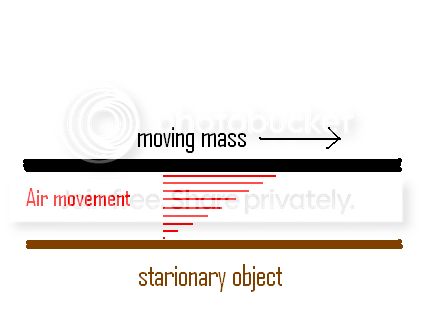
the brown on the bottom is a stationary object. the black on top is moving in the direction of the arrow and the Ambient air is not moving (no wind). what happens is, as the black moves forward a thin layer of fluid in this case air, moves with it due to friction. take note the air is not moving at the same speed as the black object, Its rubbing against it kinda pulling it with it. the next layer down in turn gets pulled along with the first layer but due to friction doesn't move as fast as layer 1. this progresses all the way down to the stationary object. this is called "shearing" like shearing metal, but shears the viscosity of the fluid instead.
this being said, the larger the ID of the DP the more room for shearing = more flow. there are a million other factors that take part, so if you need to ask ill try and answer.
Some of these laws and stuff were invented way back in the day when the light bulb was discovered. If my 1/2 inch exhaust is making more power than my 10 inch exhaust, which one do you think Im going to use? Basically, what Im trying to say is, if you slap it on and it makes more power, then by all means stick with it and stop brain storming. "Geesh!" </TD></TR></TABLE>"Simple fluid dynamics!"
Its all in th Viscosity of the fluid flowing through the DP. Its best explained in a picture so i drew one up in paint.
the brown on the bottom is a stationary object. the black on top is moving in the direction of the arrow and the Ambient air is not moving (no wind). what happens is, as the black moves forward a thin layer of fluid in this case air, moves with it due to friction. take note the air is not moving at the same speed as the black object, Its rubbing against it kinda pulling it with it. the next layer down in turn gets pulled along with the first layer but due to friction doesn't move as fast as layer 1. this progresses all the way down to the stationary object. this is called "shearing" like shearing metal, but shears the viscosity of the fluid instead.
this being said, the larger the ID of the DP the more room for shearing = more flow. there are a million other factors that take part, so if you need to ask ill try and answer.

Honda-Tech Member
Joined: Jul 2003
Posts: 2,381
Likes: 1
Re: DP theory (drumking15)
<TABLE WIDTH="90%" CELLSPACING=0 CELLPADDING=0 ALIGN=CENTER><TR><TD>Quote, originally posted by drumking15 »</TD></TR><TR><TD CLASS="quote">
couldnt have said it better myself...
pv=nRT</TD></TR></TABLE>
actually, u could have said it better...alot better. that eqn has no relevance to the gasses inside a combustion engine. infact, anyone trying to figure this out with thermodynamics had best have an awesome understanding of the subject as well as a high math skill to deal with the gradients and such needed to fully define all the variables involved
couldnt have said it better myself...
pv=nRT</TD></TR></TABLE>
actually, u could have said it better...alot better. that eqn has no relevance to the gasses inside a combustion engine. infact, anyone trying to figure this out with thermodynamics had best have an awesome understanding of the subject as well as a high math skill to deal with the gradients and such needed to fully define all the variables involved

Member
Joined: Dec 2002
Posts: 1,740
Likes: 2
From: Tampa, Fl, US
this is simple guys...as rpms/turbine speed increase so does exhaust gas speed. the exhaust gas coming out of the turbine is constantly increasing speed as rpms/turbine speeds increase. the exhaust gases infront of it, still remaining in the DP or exhaust piping, are acting as friction or a decelerating agent to the newly exited exhaust gas. Most pressure is created closest to the turbine and prior to it. if you have a dp that is larger than the turbine outlet and continues to get larger as it progresses youll have more room for the high velocity gases to acelerate the slower velocity gases in front of it as it passes them.
Honda-Tech Member
Joined: Aug 2004
Posts: 2,411
Likes: 0
From: nowere, usa
Re: (99B16Si)
<TABLE WIDTH="90%" CELLSPACING=0 CELLPADDING=0 ALIGN=CENTER><TR><TD>Quote, originally posted by 99B16Si »</TD></TR><TR><TD CLASS="quote">this is simple guys...as rpms/turbine speed increase so does exhaust gas speed. the exhaust gas coming out of the turbine is constantly increasing speed as rpms/turbine speeds increase. the exhaust gases infront of it, still remaining in the DP or exhaust piping, are acting as friction or a decelerating agent to the newly exited exhaust gas. Most pressure is created closest to the turbine and prior to it. if you have a dp that is larger than the turbine outlet and continues to get larger as it progresses youll have more room for the high velocity gases to acelerate the slower velocity gases in front of it as it passes them.</TD></TR></TABLE>
+
<TABLE WIDTH="90%" CELLSPACING=0 CELLPADDING=0 ALIGN=CENTER><TR><TD>Quote, originally posted by LSTEG96 »</TD></TR><TR><TD CLASS="quote"> actually, u could have said it better...alot better. that eqn has no relevance to the gasses inside a combustion engine. infact, anyone trying to figure this out with thermodynamics had best have an awesome understanding of the subject as well as a high math skill to deal with the gradients and such needed to fully define all the variables involved
</TD></TR></TABLE>
I agree so some existent but i know you as well as anyone else knowing anything about thermodynamics, fluid dynamics, Enthalpy etc. will agree that no equation no matter how in depth will be perfect. this goes into the chaos theory and the butterfly effect. The best you can hope for is a rough estimate. I don't know how many times i spent hours upon hours on an equation I though to be near perfect only to find out that I was completely wrong in R&D.
The reason i brought all this up was because ALL the testing I've done on FI engines came to prove one thing to me. larger/shorter down pipe = faster spool and more top end HP. now I've never tried a 5" DP on a T25 but im sure you get my point. Im open to the idea that its possible a smaller DP could produce more power due to law of Inertia.
+
<TABLE WIDTH="90%" CELLSPACING=0 CELLPADDING=0 ALIGN=CENTER><TR><TD>Quote, originally posted by LSTEG96 »</TD></TR><TR><TD CLASS="quote"> actually, u could have said it better...alot better. that eqn has no relevance to the gasses inside a combustion engine. infact, anyone trying to figure this out with thermodynamics had best have an awesome understanding of the subject as well as a high math skill to deal with the gradients and such needed to fully define all the variables involved
</TD></TR></TABLE>
I agree so some existent but i know you as well as anyone else knowing anything about thermodynamics, fluid dynamics, Enthalpy etc. will agree that no equation no matter how in depth will be perfect. this goes into the chaos theory and the butterfly effect. The best you can hope for is a rough estimate. I don't know how many times i spent hours upon hours on an equation I though to be near perfect only to find out that I was completely wrong in R&D.
The reason i brought all this up was because ALL the testing I've done on FI engines came to prove one thing to me. larger/shorter down pipe = faster spool and more top end HP. now I've never tried a 5" DP on a T25 but im sure you get my point. Im open to the idea that its possible a smaller DP could produce more power due to law of Inertia.

Honda-Tech Member
Joined: Dec 2003
Posts: 920
Likes: 0
From: bumfuck egypt, SD, US
Is the question here why does a setup make more power with a downpipe that is bigger than the rest of the exhaust system..? or is it why does a setup make more power with a downpipe that is bigger than the turbine outlet..?
Either way, the answer is basically the same. 2 reasons: 1, the exhaust is hottest at this point vs the rest of the exhaust system, and thus has the highest velocity for a given pipe diameter(in other word vs the rest of the exhaust system) since it is expanded more, and the larger downpipe compensates for this, reducing the frictional losses against the pipe and within the air itself, I guess you could call that "viscous losses", i don't know. 2, the downpipe is a curved pipe. A curved pipe always has to be bigger to maintain the same flow rate vs a straight pipe.
Now some of you engineer types are probably thinking that the exhaust flow right out of the turbine before it enters the downpipe has the highest velocity, and therefore the lowest pressure vs the larger downpipe, since pressure and velocity are inversely proportional, right? Well, to the people who say the pressure before the venturi in a carb is the same as the pressure after it, I say, how is the air going to flow through the carb if there is no pressure difference?? A pressure difference is what makes the air flow through the carb! Where am I going with this? Keep pushing the flow rate up, and you'll see the pressure difference get really big. The venturi is too small, just like the turbine outlet is too small for the mass flowrate through it... The turbine outlet is the right size to accomodate the wheel, and it is part of the design to efficiently impart the exhaust energy into the wheel. It is not the right size to model the rest of the exhaust system after. Maintaining that size for the rest of the exhaust system does not logically follow.
Well, that's about the best I can do for now..time for some more beer..
Either way, the answer is basically the same. 2 reasons: 1, the exhaust is hottest at this point vs the rest of the exhaust system, and thus has the highest velocity for a given pipe diameter(in other word vs the rest of the exhaust system) since it is expanded more, and the larger downpipe compensates for this, reducing the frictional losses against the pipe and within the air itself, I guess you could call that "viscous losses", i don't know. 2, the downpipe is a curved pipe. A curved pipe always has to be bigger to maintain the same flow rate vs a straight pipe.
Now some of you engineer types are probably thinking that the exhaust flow right out of the turbine before it enters the downpipe has the highest velocity, and therefore the lowest pressure vs the larger downpipe, since pressure and velocity are inversely proportional, right? Well, to the people who say the pressure before the venturi in a carb is the same as the pressure after it, I say, how is the air going to flow through the carb if there is no pressure difference?? A pressure difference is what makes the air flow through the carb! Where am I going with this? Keep pushing the flow rate up, and you'll see the pressure difference get really big. The venturi is too small, just like the turbine outlet is too small for the mass flowrate through it... The turbine outlet is the right size to accomodate the wheel, and it is part of the design to efficiently impart the exhaust energy into the wheel. It is not the right size to model the rest of the exhaust system after. Maintaining that size for the rest of the exhaust system does not logically follow.
Well, that's about the best I can do for now..time for some more beer..

Thread
Thread Starter
Forum
Replies
Last Post