


Discussion Topic: Let's talk Intercoolers!!


Thread Starter

Joined: Jan 2002
Posts: 24,555
Likes: 242
From: City of Wind, IL, USA
 Re: Discussion Topic: Let's talk Intercoolers!!


I'm not that familiar with that company other than hearing the name in the diesel world.

Honda-Tech Member
Joined: Apr 2003
Posts: 427
Likes: 0
From: Lost in NB
Re: Discussion Topic: Let's talk Intercoolers!!
I've read it and saved it on another tab to re read it...lol
It is at my work right now and as I said I'll get some better pics to help determine what kind of make up the fins are.
It is at my work right now and as I said I'll get some better pics to help determine what kind of make up the fins are.

Who is Mr Robot?
iTrader: (2)
Joined: Jul 2004
Posts: 21,474
Likes: 10
From: ATL - Where the Pimps and Players dwell
Re: Discussion Topic: Let's talk Intercoolers!!
Also post detail shots of the internal fin structure as well as the front so we can gauge construction type and fin density.
If they are popular with the turbo diesel crowd then they at least have to be tough, especially considering a lot of compound turbo diesels run up to and over 100psi. so the core should be stout, or course the endtank design and material thickness dictate maximum pressure levels... I've seen a lot of drag cars running high boost blow the endtanks apart at the welds or balloon the plates out if using thin material
If they are popular with the turbo diesel crowd then they at least have to be tough, especially considering a lot of compound turbo diesels run up to and over 100psi. so the core should be stout, or course the endtank design and material thickness dictate maximum pressure levels... I've seen a lot of drag cars running high boost blow the endtanks apart at the welds or balloon the plates out if using thin material
Honda-Tech Member
Joined: Apr 2003
Posts: 427
Likes: 0
From: Lost in NB
Re: Discussion Topic: Let's talk Intercoolers!!
Here's some better pics of the core, it is pretty dense, so much so it looks to be louvered but is really hard to tell if it is or not.


A pic to show what little bit of light shines through. Don't mind my co-workers mug shot...lol

And the face of the core

A pic to show what little bit of light shines through. Don't mind my co-workers mug shot...lol
And the face of the core
Thread Starter
Joined: Jan 2002
Posts: 24,555
Likes: 242
From: City of Wind, IL, USA
Re: Discussion Topic: Let's talk Intercoolers!!
I'm bumping this for those that still have questions about Intercoolers from CX Racing and ETS. Please see Page 3 as a start.
 Re: Discussion Topic: Let's talk Intercoolers!!
I have an intercooler question, may be noobish, but ill ask either ways ... So is there any difference between having an intercooler anodized or powder coating it ? Any advantage to either or?

Who is Mr Robot?
iTrader: (2)
Joined: Jul 2004
Posts: 21,474
Likes: 10
From: ATL - Where the Pimps and Players dwell
Re: Discussion Topic: Let's talk Intercoolers!!
IIRC it's the usual eBay core. works well for its size though. The endtanks are a dead giveaway.
Thread Starter
Joined: Jan 2002
Posts: 24,555
Likes: 242
From: City of Wind, IL, USA
Re: Discussion Topic: Let's talk Intercoolers!!
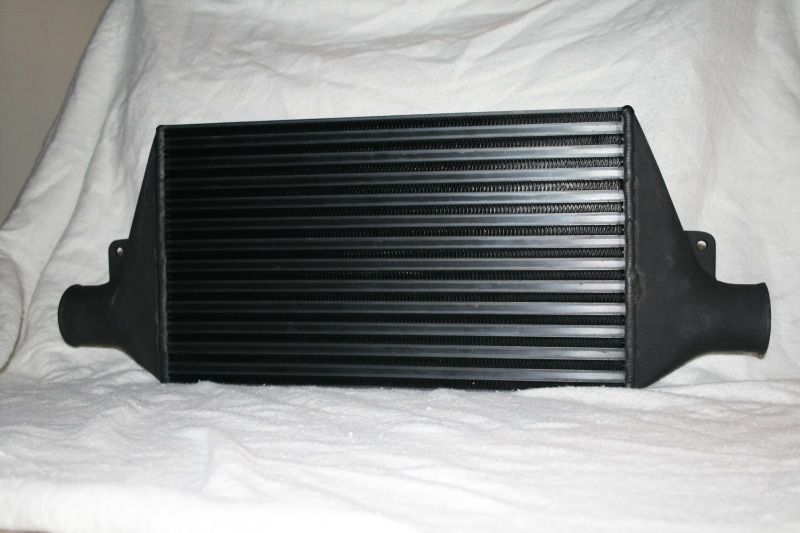
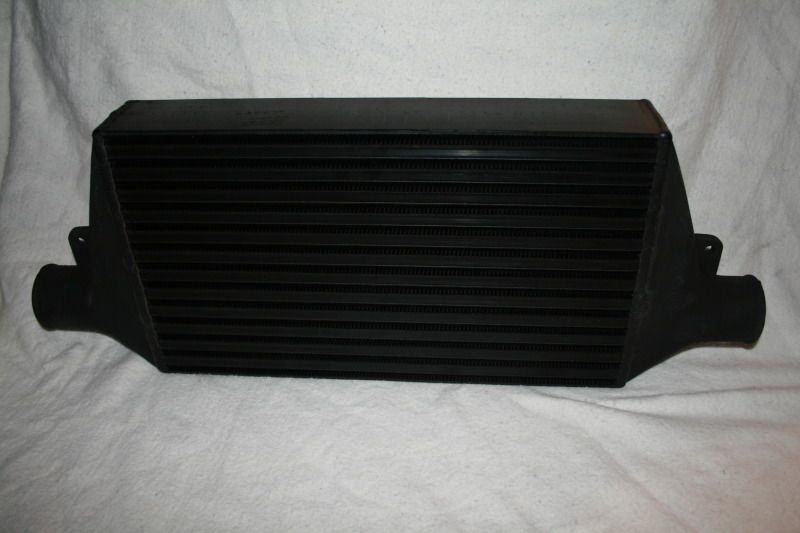
Anodizing is like tattooing, where it actually removes a surface layer (through a chemical process) and as the intercooler is literally dipped into the anodizing bath, the color is adhered to electrically. you won't have the same hindering effects with anodizing.
Done properly, it looks like this:


Honda-Tech Member
Joined: Sep 2003
Posts: 8,357
Likes: 5
From: CT
Re: Discussion Topic: Let's talk Intercoolers!!
You can't powdercoat an intercooler but you can anodize one. The powdercoat would actually hinder cooling efficiency (too much material in the pass-through area of the fins).
Anodizing is like tattooing, where it actually removes a surface layer (through a chemical process) and as the intercooler is literally dipped into the anodizing bath, the color is adhered to electrically. you won't have the same hindering effects with anodizing.
Done properly, it looks like this:
Anodizing is like tattooing, where it actually removes a surface layer (through a chemical process) and as the intercooler is literally dipped into the anodizing bath, the color is adhered to electrically. you won't have the same hindering effects with anodizing.
Done properly, it looks like this:
In short, you can powder coat an intercooler, but you have to use the proper media.
Carry on.

Thread Starter
Joined: Jan 2002
Posts: 24,555
Likes: 242
From: City of Wind, IL, USA
Re: Discussion Topic: Let's talk Intercoolers!!
Alright, I'm gonna have to step in because there are ceramic coatings, which qualify as powder coating, that can assist in heat dissipation and add heat reflection characteristics that aid in cooling. Just my .02.
In short, you can powder coat an intercooler, but you have to use the proper media.
Carry on.
In short, you can powder coat an intercooler, but you have to use the proper media.
Carry on.
 .
.So, since this thread is to include photos, Tepid1, show us some visual examples of media you know to be the correct one.. finished product would be appreciated.
If you're gonna "step in". Do us low-brows a favor ... step ALL THE WAY IN.
..educate as you correct. otherwise, there's no point to the .$02... You know that more anyone else here. You 'Da Man.. so, we need your experience as "'Da Man."
Thread Starter
Joined: Jan 2002
Posts: 24,555
Likes: 242
From: City of Wind, IL, USA
Re: Discussion Topic: Let's talk Intercoolers!!
He may either 1) not know it's killing the efficiency of the intercooler, or 2) knows which media to use as Tepid1 implicated.. even Greg may not know the answer himself. He may just be looking at this from an aesthetic point of view.

DO IT ON ALL FOURS
Joined: Sep 2007
Posts: 7,632
Likes: 15
From: IN Your Mind
Re: Discussion Topic: Let's talk Intercoolers!!
Greg sends the intercooler out to a secondary company to be "thermal coated". I can't recall the specific company but I know I did speak with a guy named Carlos. This is the only powder coating company that is from the town my intercooler was shipped from.
http://www.tiradocustomcoatings.com/default.asp
When I received the intercooler I was contacted by Carlos and 20 questioned him on the coating. He assured me that it was specifically for intercoolers yet they don't have a product like it on their website. Who knows for sure and I wouldn't know how to test it anyways since mine is already done. Needless to say I wasn't happy.
Greg says it is not for esthetics and the coating actually helps intercooler temperatures. This was from a lengthy phone conversation pertaining to my GT intercooler build.
http://www.tiradocustomcoatings.com/default.asp
When I received the intercooler I was contacted by Carlos and 20 questioned him on the coating. He assured me that it was specifically for intercoolers yet they don't have a product like it on their website. Who knows for sure and I wouldn't know how to test it anyways since mine is already done. Needless to say I wasn't happy.
Greg says it is not for esthetics and the coating actually helps intercooler temperatures. This was from a lengthy phone conversation pertaining to my GT intercooler build.

Honda-Tech Member
Joined: Nov 2003
Posts: 673
Likes: 0
From: ca
Re: Discussion Topic: Let's talk Intercoolers!!
Personally I would not rely on coating an intercooler to help it 'work better,' mostly for looks or to hide the intercooler. The purpose of an intercooler is to dissipate heat. Aluminum has a certain thermal conductivity, or ability to transfer (get rid of) heat. Copper is better, but is heavier and more expensive so aluminum is used, like with radiators. Coatings for headers and turbo turbine housings are to hold in the heat, not dissipate it.
To think about it simply, wearing a blanket that makes you cooler than not wearing any blanket at all is similar to a coating that increases thermal conductivity. There may be some processes or coatings that do this to a certain extent, but I feel the coatings are for looks more than performance. A thin coat of paint, anodizing, etc.
To think about it simply, wearing a blanket that makes you cooler than not wearing any blanket at all is similar to a coating that increases thermal conductivity. There may be some processes or coatings that do this to a certain extent, but I feel the coatings are for looks more than performance. A thin coat of paint, anodizing, etc.
Honda-Tech Member
Joined: Sep 2003
Posts: 8,357
Likes: 5
From: CT
Re: Discussion Topic: Let's talk Intercoolers!!
We tried 3 media and heat exhange were all negatively affected, and after a while it became cost-prohibitive. Now if it was the wrong type of ceramic, fine I'll accept that. But unless I see several examples of other media that don't exhibit these effects, powdercoating is NOT a standard that just anyone can use.. My $.25 .
So, since this thread is to include photos, Tepid1, show us some visual examples of media you know to be the correct one.. finished product would be appreciated.
If you're gonna "step in". Do us low-brows a favor ... step ALL THE WAY IN...educate as you correct. otherwise, there's no point to the .$02... You know that more anyone else here. You 'Da Man.. so, we need your experience as "'Da Man."
.So, since this thread is to include photos, Tepid1, show us some visual examples of media you know to be the correct one.. finished product would be appreciated.
If you're gonna "step in". Do us low-brows a favor ... step ALL THE WAY IN.
..educate as you correct. otherwise, there's no point to the .$02... You know that more anyone else here. You 'Da Man.. so, we need your experience as "'Da Man."We use Cerakote of all things requiring a thin and solid bond with the metal. It doesn't crack or flake like other coatings because it bonda with the material, thus aiding in the heat transfer process. Most know this, but ceramic coatings help dissipate the heat, but only if applied correctly. In addition, the ceramic is reflective so it doesn't absorb heat from other sources.
I use Cerakote on many different parts:
Aluminum rods - help shed oil and maintain stable temps
Piston tops - keeps the heat out of the piston
Crankshaft lobes - help shed oil
Exhaust manifold
Intake manifold
Charge piping
Intercooler
Radiator
Also use it on all my pistols and rifles. Super durable and doesn't wear off easily. In fact, it has to be media blasted with course grit to remove it.
I will have hard data in a few weeks that I can present to those interested.
PS: I'm about 90% sure Carlos uses Cerakote as well.

Thread Starter
Joined: Jan 2002
Posts: 24,555
Likes: 242
From: City of Wind, IL, USA
Re: Discussion Topic: Let's talk Intercoolers!!
That's fine. I'm not worried about the numeric data charts really. Cerakote is not a very common material in most powder coating facilities. Cerakote was one of the ones we did for some rifles and other aluminum materials. We didn't see an improvement in the efficiency of heat exchange rate of the intercooler (I have to admit we only tested the temperature of the air before exchange and at the throttle body.)
Now, Tepid1 may have had a much better way to apply the measurements of the temperature changes at the site of the intercooler, but Cerakote's main purpose is for aluminum protection from scratches or damage, not for additional heat exchange efficiency.
Cerakote is in the same boat of Duracoat, and Moly Resin when it comes to protection of aluminum, but doesn't really assist in heat-exchange efficiency. However, many firearms sources agree that for the best protection, HA-III (hard anodized type 3) is the best process to use. The HA-III electro-chemical process "transforms" the external surfaces of the Aluminum, resulting in a new surface that is very tough, very resistant to scratches, salt, and many other chemicals. It is "the" best process for Al, and companies such as SureFire and others that do military gear always use this process to protect the Aluminum pieces.
But because anodizing comes in better colors and is applied differently than powdercoat, it satisfies most people's needs for aluminum protection and a nicer aesthetic look. If you want better exchange efficiency, than really, the best thing to do to an intercooler is.... nothing. Leave it alone.
Guys. Remember, the purpose of the intercooler is to lower engine cylinder pressure temperatures by an exchange of heated air created by the compression of air (by increasing the kinectic energy of the air molecules turbocharger to cooler air that enters into the combustion chamber) for cooler air. Intercoolers do not "dissipate" heat, even by definition. To dissipate is "to disperse or scatter" something, even as anomalous as heat created by the turbocharger's compressor.
An intercooler's purpose is not to disperse or scatter anything, but to exchange its air, using forced airflow from the outside through its fins to lower the temperature of the compressed air so that the air entering into the engine's air intake system does not increase engine cylinder temperatures that are already higher from the increased engine compression and combustion when turbocharging.
Now, Tepid1 may have had a much better way to apply the measurements of the temperature changes at the site of the intercooler, but Cerakote's main purpose is for aluminum protection from scratches or damage, not for additional heat exchange efficiency.
Cerakote is in the same boat of Duracoat, and Moly Resin when it comes to protection of aluminum, but doesn't really assist in heat-exchange efficiency. However, many firearms sources agree that for the best protection, HA-III (hard anodized type 3) is the best process to use. The HA-III electro-chemical process "transforms" the external surfaces of the Aluminum, resulting in a new surface that is very tough, very resistant to scratches, salt, and many other chemicals. It is "the" best process for Al, and companies such as SureFire and others that do military gear always use this process to protect the Aluminum pieces.
But because anodizing comes in better colors and is applied differently than powdercoat, it satisfies most people's needs for aluminum protection and a nicer aesthetic look. If you want better exchange efficiency, than really, the best thing to do to an intercooler is.... nothing. Leave it alone.
Guys. Remember, the purpose of the intercooler is to lower engine cylinder pressure temperatures by an exchange of heated air created by the compression of air (by increasing the kinectic energy of the air molecules turbocharger to cooler air that enters into the combustion chamber) for cooler air. Intercoolers do not "dissipate" heat, even by definition. To dissipate is "to disperse or scatter" something, even as anomalous as heat created by the turbocharger's compressor.
An intercooler's purpose is not to disperse or scatter anything, but to exchange its air, using forced airflow from the outside through its fins to lower the temperature of the compressed air so that the air entering into the engine's air intake system does not increase engine cylinder temperatures that are already higher from the increased engine compression and combustion when turbocharging.

Thread Starter
Joined: Jan 2002
Posts: 24,555
Likes: 242
From: City of Wind, IL, USA
Re: Discussion Topic: Let's talk Intercoolers!!
I'm thinking he did it for protection purposes, but I'm pretty sure you won't see much improvement in heat exchange rate. The endtanks may not exhibit as much radiant heat on its surface, but assistance in decrease of exchanged air, doubtful.
Thread Starter
Joined: Jan 2002
Posts: 24,555
Likes: 242
From: City of Wind, IL, USA
Re: Discussion Topic: Let's talk Intercoolers!!
Webster's-Merriam Dictionary:
dis·si·pate (\ˈdi-sə-ˌpāt\)
verb
: to cause (something) to spread out and disappear
: to separate into parts and disappear or go away
: to use all or a lot of (something, such as money or time) in a foolish way
transitive verb
a : to break up and drive off (as a crowd)
b : to cause to spread thin or scatter and gradually vanish <one's sympathy is eventually dissipated — Andrew Feinberg>
c: to spend or use up wastefully or foolishly <dissipated the family fortune in reckless business ventures>
Mis-defining is how a lot of mis-information can be passed on in written form on forums and blogs. When the premise of someone's argument is based upon an incorrect essential element, the entire basis of that position becomes moot, because its incorrectly applied from the beginning. (Call me an over-educated picky-idiot if you must, I'll accept it.) This type of misnomer is no different than the "twin-scroll" / Divided housing argument (which is a whole other ball of wax I'd rather not get into).
Last edited by TheShodan; Apr 26, 2014 at 04:01 PM.
Who is Mr Robot?
iTrader: (2)
Joined: Jul 2004
Posts: 21,474
Likes: 10
From: ATL - Where the Pimps and Players dwell
Re: Discussion Topic: Let's talk Intercoolers!!
Yes, it's most commonly sold under the guise of coating kits for firearms but it should be able to be purchased in large component quantities. trust me it takes very little cerakote to do a typical handgun than engine components lol.
it should be available in Canada I think.
ps I do sincerely apologize for the Nordlock dilemma, the house fire ended up consuming so much of my time at energy I didn even have time for a haircut lol. were you ever able to locate any?
it should be available in Canada I think.
ps I do sincerely apologize for the Nordlock dilemma, the house fire ended up consuming so much of my time at energy I didn even have time for a haircut lol. were you ever able to locate any?
Honda-Tech Member
Joined: Nov 2003
Posts: 673
Likes: 0
From: ca
Re: Discussion Topic: Let's talk Intercoolers!!
TheShodan,
I am agreeing with you. No need to correct me, again. I understand you are the turbo guru of H-T but your long winded responses don't make you any more correct. I prefer to explain things (and understand them) in simple plain terms rather than verbose and complex.
I believe we both have the same point that coatings (and much of what comes up on them when searching) are more for heat retention and protection, in other words insulation and decreasing heat transfer, not so much for increasing heat transfer. Most of the data on that Cerakote and ceramic coatings is on headers and exhaust, not radiators and intercoolers.
I am agreeing with you. No need to correct me, again. I understand you are the turbo guru of H-T but your long winded responses don't make you any more correct. I prefer to explain things (and understand them) in simple plain terms rather than verbose and complex.
I believe we both have the same point that coatings (and much of what comes up on them when searching) are more for heat retention and protection, in other words insulation and decreasing heat transfer, not so much for increasing heat transfer. Most of the data on that Cerakote and ceramic coatings is on headers and exhaust, not radiators and intercoolers.
Thread Starter
Joined: Jan 2002
Posts: 24,555
Likes: 242
From: City of Wind, IL, USA
Re: Discussion Topic: Let's talk Intercoolers!!
TheShodan,
I am agreeing with you. No need to correct me, again. I understand you are the turbo guru of H-T but your long winded responses don't make you any more correct. I prefer to explain things (and understand them) in simple plain terms rather than verbose and complex.
I believe we both have the same point that coatings (and much of what comes up on them when searching) are more for heat retention and protection, in other words insulation and decreasing heat transfer, not so much for increasing heat transfer. Most of the data on that Cerakote and ceramic coatings is on headers and exhaust, not radiators and intercoolers.
I am agreeing with you. No need to correct me, again. I understand you are the turbo guru of H-T but your long winded responses don't make you any more correct. I prefer to explain things (and understand them) in simple plain terms rather than verbose and complex.
I believe we both have the same point that coatings (and much of what comes up on them when searching) are more for heat retention and protection, in other words insulation and decreasing heat transfer, not so much for increasing heat transfer. Most of the data on that Cerakote and ceramic coatings is on headers and exhaust, not radiators and intercoolers.
I'm long-winded in the name of precision of definition. Nothing more.
Sue me, I use proper English.
Again, my apologies to you, I meant no harm.
