


bore and it's effect on CR


Thread Starter
Junior Member
Joined: Oct 2001
Posts: 570
Likes: 0
 bore and it's effect on CR
Please excuse the beginner question:
But all else being equal, why would increasing the bore increase CR? The only thing I can think of is that there's no more air in the combustion chamber that is being compressed... correct?
thanks
-Shing
But all else being equal, why would increasing the bore increase CR? The only thing I can think of is that there's no more air in the combustion chamber that is being compressed... correct?
thanks
-Shing



Honda-Tech Member
Joined: Feb 2002
Posts: 4,444
Likes: 5
From: Basin, WY
Re: bore and it's effect on CR (Al Bundy)
Can you explain???
*************divided by*****************
amount of displacement when piston is at TDC (aka head cc's)

Member
Joined: Feb 2001
Posts: 1,176
Likes: 0
From: Charleston, SC, usa
Re: bore and it's effect on CR (J2turbo21)
by forcing the same ammount of fuel mixture into a smaller combustion chamber (using a thinner head gasket) you in crease the comp. ratio. LIkewise, forcing more fuel mixture into the same volume combustion chamber....willnot necessarily increase comp. ratio. However in this case it will be raised slightly...sorry dont have the formula for comp. right now. 

Joined: Oct 2002
Posts: 582
Likes: 0
From: So Cal
Re: bore and it's effect on CR (J2turbo21)
Let say you got 12.5c/r with 83.5mm bore,What would the comp ratio be if you went with a 85mm bore and same c/r pistons?
[Modified by texan, 3:31 AM 2/27/2003]
Trending Topics

Joined: Oct 2002
Posts: 582
Likes: 0
From: So Cal
Re: bore and it's effect on CR
J2turbo21- Chamber volume is the combined volume of the piston (which can be a negative amount) and the cylinder head's portion of the combustion chamber. Single cylinder displacement divided by this amount (plus gasket volume) is what satic compression ratio describes. Pistons are not correctly labeled by compression ratio, but by piston volume. It's up to the engine builder to calculate what compression ratio will be using a specific combination with the chosen piston.
civicdream- Yes, bore is the diameter of the cylinder, stroke is the swept vertical depth (really the amount the piston moves vertically in the bore). Together these determine displacement.
civicdream- Yes, bore is the diameter of the cylinder, stroke is the swept vertical depth (really the amount the piston moves vertically in the bore). Together these determine displacement.

Joined: Mar 2002
Posts: 3,281
Likes: 0
Re: bore and it's effect on CR (texan)
OK,i think that i should just leave it up to the pro's to build my engine cause that is a little confusing for me.Sorry im a noob to all motor.
So chamber volume = space between piston and head?Is that at TDC?
so Single cylinder displacement,divided by camber volume + gasket thickness = compression ratio?
How can you tell what the singel cyl literage is?
So chamber volume = space between piston and head?Is that at TDC?
so Single cylinder displacement,divided by camber volume + gasket thickness = compression ratio?
How can you tell what the singel cyl literage is?

Joined: Dec 2001
Posts: 508
Likes: 0
From: WeVA
Re: bore and it's effect on CR (J2turbo21)
ok, now that i know for sure what bore is. How would increasing the bore, increase horsepower?? Doesn't seem logical unless the stroke changes. If anything I would think that the CR would go down. Once the piston reaches TDC with at bigger bore, there is now more room. The amount of air/fuel entering is gonna remain the same?? Doesn't make sense. Someone explain. I am willing to learn.
Joined: Oct 2002
Posts: 582
Likes: 0
From: So Cal
Re: bore and it's effect on CR
J2turbo21- (Bore x Bore x Stroke x .7854) = single cylinder displacement. If your measurments are in mm, divide that answer by 1000 to find single cylinder displacement in cc. And yes, we are concerned with chamber volume at TDC.
civicdream- As is clearly visible from the math above, increasing bore increases total displacement. In fact a change in bore has double the effect of a change in stroke on displacement (due to it being squared in the equation). And no, TDC volume doesn't necessarily change because the bore is larger. If the chamber volume remains the same the compression ratio will actually inrease due to the increase in displacement relative to chamber volume. Now chamber volume must go up a bit due to increased gasket volume, but this is only a very small amount.
Further, an increase in bore allows you to further unshroud valves and/or run larger valves. Both increase total airflow ability, though increased bore benefits mainly manifest as increased high RPM power potential and not large increases in low RPM power (assuming everything else remains equal).
civicdream- As is clearly visible from the math above, increasing bore increases total displacement. In fact a change in bore has double the effect of a change in stroke on displacement (due to it being squared in the equation). And no, TDC volume doesn't necessarily change because the bore is larger. If the chamber volume remains the same the compression ratio will actually inrease due to the increase in displacement relative to chamber volume. Now chamber volume must go up a bit due to increased gasket volume, but this is only a very small amount.
Further, an increase in bore allows you to further unshroud valves and/or run larger valves. Both increase total airflow ability, though increased bore benefits mainly manifest as increased high RPM power potential and not large increases in low RPM power (assuming everything else remains equal).
Joined: Dec 2001
Posts: 508
Likes: 0
From: WeVA
Re: bore and it's effect on CR (texan)
J2turbo21- (Bore x Bore x Stroke x .7854) = single cylinder displacement. If your measurments are in mm, divide that answer by 1000 to find single cylinder displacement in cc. And yes, we are concerned with chamber volume at TDC.
civicdream- As is clearly visible from the math above, increasing bore increases total displacement. In fact a change in bore has double the effect of a change in stroke on displacement (due to it being squared in the equation). And no, TDC volume doesn't necessarily change because the bore is larger. If the chamber volume remains the same the compression ratio will actually inrease due to the increase in displacement relative to chamber volume. Now chamber volume must go up a bit due to increased gasket volume, but this is only a very small amount.
Further, an increase in bore allows you to further unshroud valves and/or run larger valves. Both increase total airflow ability, though increased bore benefits mainly manifest as increased high RPM power potential and not large increases in low RPM power (assuming everything else remains equal).
civicdream- As is clearly visible from the math above, increasing bore increases total displacement. In fact a change in bore has double the effect of a change in stroke on displacement (due to it being squared in the equation). And no, TDC volume doesn't necessarily change because the bore is larger. If the chamber volume remains the same the compression ratio will actually inrease due to the increase in displacement relative to chamber volume. Now chamber volume must go up a bit due to increased gasket volume, but this is only a very small amount.
Further, an increase in bore allows you to further unshroud valves and/or run larger valves. Both increase total airflow ability, though increased bore benefits mainly manifest as increased high RPM power potential and not large increases in low RPM power (assuming everything else remains equal).
Ok, here's what I am thinking. You have a 3" around bowl (piston at TDC) move the circumference of the bowl to 5" (increase bore) and you will be able to fit more cereal into the bowl (more volume). Sorry for the stupid analogy, but this makes sense to me. Remember I am not a tech-head so you gotta go slowly.
Now fill up your 3" bowl completely with cereal (air/fuel mixture), then try to pour that cereal into the 5" bowl. Does that even make sense at all???
Volume = Displacement. Right or Wrong???
[Modified by civicdream, 4:09 AM 2/28/2003]
Joined: Oct 2002
Posts: 582
Likes: 0
From: So Cal
Re: bore and it's effect on CR (civicdream)
Yes, volume = displacement. The equation I posted will find the volume of any cylinder with a given diameter (bore) and depth (stroke). What you are missing is that essentially chamber volume doesn't change, because the chamber surface is getting wider but not gaining any volume. Let me demonstrate this with a picture...
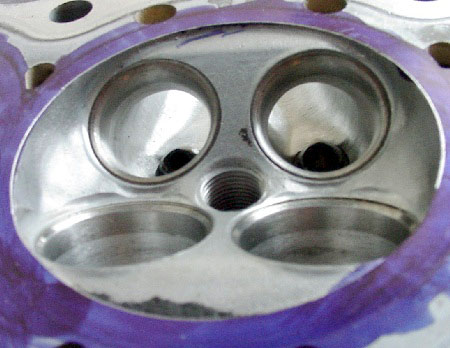
So if you open the bore of the cylinder up a few mm, thus increasing it's displacement, you don't necessarily increase chamber volume. The new, larger diameter piston need not have any volume in those new few mm at the outer edge, and the chamber if left as you see it here obviously doesn't (that purple ink denotes where the increased bore would match up, and you can see there's no volume there). So while you increase cylinder volume, you don't increase chamber volume (aside from the earlier mentioned increase in gasket volume). Meaning your compression ratio increases, about linearly, with the displacement increase. Just as I stated earlier.
So if you open the bore of the cylinder up a few mm, thus increasing it's displacement, you don't necessarily increase chamber volume. The new, larger diameter piston need not have any volume in those new few mm at the outer edge, and the chamber if left as you see it here obviously doesn't (that purple ink denotes where the increased bore would match up, and you can see there's no volume there). So while you increase cylinder volume, you don't increase chamber volume (aside from the earlier mentioned increase in gasket volume). Meaning your compression ratio increases, about linearly, with the displacement increase. Just as I stated earlier.
Joined: Dec 2001
Posts: 508
Likes: 0
From: WeVA
Re: bore and it's effect on CR (texan)
Yes, volume = displacement. The equation I posted will find the volume of any cylinder with a given diameter (bore) and depth (stroke). What you are missing is that essentially chamber volume doesn't change, because the chamber surface is getting wider but not gaining any volume. Let me demonstrate this with a picture...
So if you open the bore of the cylinder up a few mm, thus increasing it's displacement, you don't necessarily increase chamber volume. The new, larger diameter piston need not have any volume in those new few mm at the outer edge, and the chamber if left as you see it here obviously doesn't (that purple ink denotes where the increased bore would match up, and you can see there's no volume there). So while you increase cylinder volume, you don't increase chamber volume (aside from the earlier mentioned increase in gasket volume). Meaning your compression ratio increases, about linearly, with the displacement increase. Just as I stated earlier.
So if you open the bore of the cylinder up a few mm, thus increasing it's displacement, you don't necessarily increase chamber volume. The new, larger diameter piston need not have any volume in those new few mm at the outer edge, and the chamber if left as you see it here obviously doesn't (that purple ink denotes where the increased bore would match up, and you can see there's no volume there). So while you increase cylinder volume, you don't increase chamber volume (aside from the earlier mentioned increase in gasket volume). Meaning your compression ratio increases, about linearly, with the displacement increase. Just as I stated earlier.
Basically, I don't know how the cylinder can get bigger around, but not gain volume. That is really blowing my mind. It might have to do with my very low knowledge of the anatomy of an engine. Sorry.
Joined: Oct 2002
Posts: 582
Likes: 0
From: So Cal
Re: bore and it's effect on CR (civicdream)
OK, let's try thinking about this a different way first. Now we have a cylinder, and instead of making it a larger diameter we instead increase depth (stroke). This increases to volume of the cylinder, which applies directly to engine math too. However we are using the same piston and cylinder head as before, so the combustion chamber, which is made of the area of the cylinder head shown above (that has volume to hold the compressed charge) plus the piston face (that meets up with the open portion of the cylinder head), DOESN'T increase in size. The cylinder has a greater displacement, but the combustion chamber remains the same size. This dictates an increase in compression ratio.
Now apply this same logic to increasing bore size. The bore increase requires a wider piston, but not a different cylinder head in this example. So the cylinder head's portion of the chamber volume stays the same. You can get a larger piston that also has the same contribution to volume, let's say for simplicity it's a flat top piston with no valve reliefs so it has a volume of 0. Since the newly exposed cylinder head area is also flat as it was earlier used to seal the gasket (see earlier picture), again chamber volume has not increased (other than the small increase in gasket volume). Gasket volume is found by multiplying the square of it's thickness by it's diameter and then multiplying that by .7854, in other words the same thing used to find displacement of any cylinder. And what do we get? A larger cylinder volume thanks to increased bore, with no appreciable change to combustion chamber volume. Which dictates an increase in compression ratio.
Make sense now?
Now apply this same logic to increasing bore size. The bore increase requires a wider piston, but not a different cylinder head in this example. So the cylinder head's portion of the chamber volume stays the same. You can get a larger piston that also has the same contribution to volume, let's say for simplicity it's a flat top piston with no valve reliefs so it has a volume of 0. Since the newly exposed cylinder head area is also flat as it was earlier used to seal the gasket (see earlier picture), again chamber volume has not increased (other than the small increase in gasket volume). Gasket volume is found by multiplying the square of it's thickness by it's diameter and then multiplying that by .7854, in other words the same thing used to find displacement of any cylinder. And what do we get? A larger cylinder volume thanks to increased bore, with no appreciable change to combustion chamber volume. Which dictates an increase in compression ratio.
Make sense now?

Honda-Tech Member
Joined: Jul 2001
Posts: 1,510
Likes: 0
From: Bellingham, WA, USA
Re: bore and it's effect on CR (civicdream)
ok, I think what he's trying to say is that when you bore out a cylinder a couple millimeters, you don't change the head. And for the most part, the HEAD and the piston dish design is what determines the chamber volume in our engines.
At Top Dead Center (the piston is at the top of it's stroke), the top of the piston will be NEARLY flush with the top of the block.
Civicdream: Perhaps you misunderstand the basics of how an engine works. You state "Once the piston reaches TDC with at bigger bore, there is now more room. The amount of air/fuel entering is gonna remain the same". Have you heard of "Suck, Squish, Bang, Blow"? We have four stroke engines, the strokes are Intake, Compression, Power, and Exhaust". Imagine the piston starts at TDC, no air, no fuel in the chamber. you start it up, the intake valves open up, the piston goes down, which creates a vaccuum, and sucks the air and fuel into the chamber. That's the "suck" part. Once at the bottom, the intake valves close, and the piston turns around and comes back up, compressing all that air and fuel. That's the "squish". Once the piston is back at the top, the spark plug does it's thing, and ignites the air/fuel, pushing the piston back down to the bottom. That's the "bang". Once at the bottom, the exhaust valves open up, the piston comes back up, and pushes out all the exhaust from the combustion. That's the "blow".
I would like to add onto what Texan is saying. When you increase bore, you DO increase chamber size...Although only slightly. Pistons don't go all the way to to flush with the deck (deck=top of the block, where the headgasket goes). They usually stop just short of flush... B16s are .02" from the flush, B18s are .03" from flush. That has to be taken into consideration when calculating chamber volume. AS WELL, as the volume between the top of the piston, and the first piston ring. But we're splitting hairs here, and that you don't really need to know that.
Cylinder volume is the volume of the cylinder at BDC, chamber volume is the volume of the "cylinder" at TDC (because the spark causes the combustion at TDC...give or take)
Is it starting to click, or did I just confuss you more?
At Top Dead Center (the piston is at the top of it's stroke), the top of the piston will be NEARLY flush with the top of the block.
Civicdream: Perhaps you misunderstand the basics of how an engine works. You state "Once the piston reaches TDC with at bigger bore, there is now more room. The amount of air/fuel entering is gonna remain the same". Have you heard of "Suck, Squish, Bang, Blow"? We have four stroke engines, the strokes are Intake, Compression, Power, and Exhaust". Imagine the piston starts at TDC, no air, no fuel in the chamber. you start it up, the intake valves open up, the piston goes down, which creates a vaccuum, and sucks the air and fuel into the chamber. That's the "suck" part. Once at the bottom, the intake valves close, and the piston turns around and comes back up, compressing all that air and fuel. That's the "squish". Once the piston is back at the top, the spark plug does it's thing, and ignites the air/fuel, pushing the piston back down to the bottom. That's the "bang". Once at the bottom, the exhaust valves open up, the piston comes back up, and pushes out all the exhaust from the combustion. That's the "blow".
I would like to add onto what Texan is saying. When you increase bore, you DO increase chamber size...Although only slightly. Pistons don't go all the way to to flush with the deck (deck=top of the block, where the headgasket goes). They usually stop just short of flush... B16s are .02" from the flush, B18s are .03" from flush. That has to be taken into consideration when calculating chamber volume. AS WELL, as the volume between the top of the piston, and the first piston ring. But we're splitting hairs here, and that you don't really need to know that.
Cylinder volume is the volume of the cylinder at BDC, chamber volume is the volume of the "cylinder" at TDC (because the spark causes the combustion at TDC...give or take)
Is it starting to click, or did I just confuss you more?
Joined: Oct 2002
Posts: 582
Likes: 0
From: So Cal
Re: bore and it's effect on CR (martini)
martini- You are correct, and yes I didn't bother with the piston to cylinder head clearance. The difference is less that .1cc, so it's not really an issue when determining basic compression ratio change due to bore size. But yes, technically it is part of the total volume.
Joined: Dec 2001
Posts: 508
Likes: 0
From: WeVA
Re: bore and it's effect on CR (martini)
Texan and Martini,
Thanks guys it makes sense now. Pretty simple now that I think about it. I was thinking that at TDC the piston was not flush with the top of the block. So let me review.
Increase bore has pretty much the same effect as increase in stroke. Both allow more air to enter the cylinder during the "suck" stage.
At TDC the piston (with an increase bore or stroke) now has to compress more air into the same amount of space (combustion chamber, right???) that's in the head.
Therefore the air/fuel mixture will be more dense or less dense (i get density confused) and results in a greater explosion. Right???
I am 95% sure that i got it. Tell me if I am wrong.
Thanks guys it makes sense now. Pretty simple now that I think about it. I was thinking that at TDC the piston was not flush with the top of the block. So let me review.
Increase bore has pretty much the same effect as increase in stroke. Both allow more air to enter the cylinder during the "suck" stage.
At TDC the piston (with an increase bore or stroke) now has to compress more air into the same amount of space (combustion chamber, right???) that's in the head.
Therefore the air/fuel mixture will be more dense or less dense (i get density confused) and results in a greater explosion. Right???
I am 95% sure that i got it. Tell me if I am wrong.
Honda-Tech Member
Joined: Aug 2001
Posts: 15,369
Likes: 3
From: Redwood City, Ca
Re: bore and it's effect on CR (civicdream)
Texan and Martini,
Thanks guys it makes sense now. Pretty simple now that I think about it. I was thinking that at TDC the piston was not flush with the top of the block. So let me review.
Increase bore has pretty much the same effect as increase in stroke. Both allow more air to enter the cylinder during the "suck" stage.
At TDC the piston (with an increase bore or stroke) now has to compress more air into the same amount of space (combustion chamber, right???) that's in the head.
Therefore the air/fuel mixture will be more dense or less dense (i get density confused) and results in a greater explosion. Right???
I am 95% sure that i got it. Tell me if I am wrong.
Thanks guys it makes sense now. Pretty simple now that I think about it. I was thinking that at TDC the piston was not flush with the top of the block. So let me review.
Increase bore has pretty much the same effect as increase in stroke. Both allow more air to enter the cylinder during the "suck" stage.
At TDC the piston (with an increase bore or stroke) now has to compress more air into the same amount of space (combustion chamber, right???) that's in the head.
Therefore the air/fuel mixture will be more dense or less dense (i get density confused) and results in a greater explosion. Right???
I am 95% sure that i got it. Tell me if I am wrong.

Honda-Tech Member
Joined: Sep 2002
Posts: 5,517
Likes: 1
From: ME
Re: bore and it's effect on CR (martini)
Just to add to your discussion....
Having the bore of the block larger than the diameter of the heads combustion chamber (creating the small volume you guys are talking about) can be benificial to combustion by creating turbulance that helps burn more of the fuel. Just as the pistion reaches tod dead center the air trapped in this area is squished out mixing the air.....
Probably not a big diffrence but i have seen it noted in a couple of books about this stuff.
Having the bore of the block larger than the diameter of the heads combustion chamber (creating the small volume you guys are talking about) can be benificial to combustion by creating turbulance that helps burn more of the fuel. Just as the pistion reaches tod dead center the air trapped in this area is squished out mixing the air.....
Probably not a big diffrence but i have seen it noted in a couple of books about this stuff.
Joined: Dec 2001
Posts: 508
Likes: 0
From: WeVA
Re: bore and it's effect on CR (martini)
you got it bro.
like Spade said, the ratio of air to fuel will be the same, it will just end up being compressed more.
like Spade said, the ratio of air to fuel will be the same, it will just end up being compressed more.