


The be-all-end-all kill switch with a relay thread (confirmation?)


Thread Starter
Junior Member
Joined: Aug 2003
Posts: 554
Likes: 0
From: BC, Canada
 The be-all-end-all kill switch with a relay thread (confirmation?)
Ok i've read up through many searches what i should do for a kill switch, i've decided i'd definitely rather have a relay in the system than not. however, everyone has different ways of wiring the system together! can someone confirm that what i'm doing is correct (it's on a 95 teg, but i'm guessing this applies to pretty much any honda)
-cut power wire to fuel pump (yellow)
-relay: -pin 30: power to fuel pump (yellow wire)
-pin 87: power to fuel pump (other side of cut yellow wire)
-pin 85: ground (switch is somewhere on this wire)
-pin 86: tap into power wire for fuel pump (yellow)
-pin 87a: dead lead (LED connected to ground if desired)
Is this all that is needed? i've read some threads where it is mentionned that having a diode would prevent any loss of fuel if the switch is flicked while driving (where would this diode go? i'm guessing between pin 85 and 86? but in what direction?).
Any help would be appreciated - like i said i've looked through lots of threads and some sites, but everyone seems to have overly elaborate setups (or am i missing something??)
-cut power wire to fuel pump (yellow)
-relay: -pin 30: power to fuel pump (yellow wire)
-pin 87: power to fuel pump (other side of cut yellow wire)
-pin 85: ground (switch is somewhere on this wire)
-pin 86: tap into power wire for fuel pump (yellow)
-pin 87a: dead lead (LED connected to ground if desired)
Is this all that is needed? i've read some threads where it is mentionned that having a diode would prevent any loss of fuel if the switch is flicked while driving (where would this diode go? i'm guessing between pin 85 and 86? but in what direction?).
Any help would be appreciated - like i said i've looked through lots of threads and some sites, but everyone seems to have overly elaborate setups (or am i missing something??)

New User
Joined: Apr 2001
Posts: 3,129
Likes: 0
From: Los Angeles, CA, USA
Re: The be-all-end-all kill switch with a relay thread (kablamo)
<TABLE WIDTH="90%" CELLSPACING=0 CELLPADDING=0 ALIGN=CENTER><TR><TD>Quote, originally posted by kablamo »</TD></TR><TR><TD CLASS="quote">
i've read some threads where it is mentionned that having a diode would prevent any loss of fuel if the switch is flicked while driving (where would this diode go? i'm guessing between pin 85 and 86? but in what direction?).
Any help would be appreciated - like i said i've looked through lots of threads and some sites, but everyone seems to have overly elaborate setups (or am i missing something??)</TD></TR></TABLE>
For a fuel pump you want a latching setup. That way if the switch is flipped while you are driving the car does not go dead. The first example here http://www.the12volt.com/relays/page2.asp#psk is how you would set that up. Also with this setup you can use a momentary switch which is much easier to hide, plus you don't have to remember to turn it off. That example will work perfectly, just put the two ends of the fuel pume wires where the starter wires are listed.
i've read some threads where it is mentionned that having a diode would prevent any loss of fuel if the switch is flicked while driving (where would this diode go? i'm guessing between pin 85 and 86? but in what direction?).
Any help would be appreciated - like i said i've looked through lots of threads and some sites, but everyone seems to have overly elaborate setups (or am i missing something??)</TD></TR></TABLE>
For a fuel pump you want a latching setup. That way if the switch is flipped while you are driving the car does not go dead. The first example here http://www.the12volt.com/relays/page2.asp#psk is how you would set that up. Also with this setup you can use a momentary switch which is much easier to hide, plus you don't have to remember to turn it off. That example will work perfectly, just put the two ends of the fuel pume wires where the starter wires are listed.

Honda-Tech Member
Joined: Dec 2003
Posts: 409
Likes: 1
From: Maricopa, AZ
Re: The be-all-end-all kill switch with a relay thread (vteg)
If you do this type of set up just make sure that you always carry a spare relay and the tools to change it. They will eventually fail and it will leave you stranded.
Thread Starter
Junior Member
Joined: Aug 2003
Posts: 554
Likes: 0
From: BC, Canada
Re: The be-all-end-all kill switch with a relay thread (vteg)
<TABLE WIDTH="90%" CELLSPACING=0 CELLPADDING=0 ALIGN=CENTER><TR><TD>Quote, originally posted by vteg »</TD></TR><TR><TD CLASS="quote">
For a fuel pump you want a latching setup. That way if the switch is flipped while you are driving the car does not go dead. The first example here http://www.the12volt.com/relays/page2.asp#psk is how you would set that up. Also with this setup you can use a momentary switch which is much easier to hide, plus you don't have to remember to turn it off. That example will work perfectly, just put the two ends of the fuel pume wires where the starter wires are listed.</TD></TR></TABLE>
ok questions:
-what exactly is a momentary switch? a switch you push in and that's it? as opposed to a toggle switch?
-i dont understand the wiring diagram #1 (i dont have an alarm...). do these need an alarm to work (ie detect whether the alarm is armed or not?)
For a fuel pump you want a latching setup. That way if the switch is flipped while you are driving the car does not go dead. The first example here http://www.the12volt.com/relays/page2.asp#psk is how you would set that up. Also with this setup you can use a momentary switch which is much easier to hide, plus you don't have to remember to turn it off. That example will work perfectly, just put the two ends of the fuel pume wires where the starter wires are listed.</TD></TR></TABLE>
ok questions:
-what exactly is a momentary switch? a switch you push in and that's it? as opposed to a toggle switch?
-i dont understand the wiring diagram #1 (i dont have an alarm...). do these need an alarm to work (ie detect whether the alarm is armed or not?)
New User
Joined: Apr 2001
Posts: 3,129
Likes: 0
From: Los Angeles, CA, USA
Re: The be-all-end-all kill switch with a relay thread (kablamo)
This is the one I was pointing you to 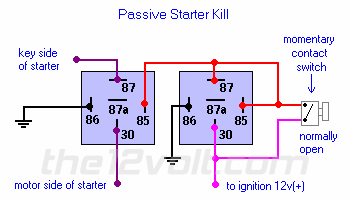
You got the momentary switch right. You just push it after putting the car to the run position, then you would start the car. When you turn off the car, you would have to do it again.
You got the momentary switch right. You just push it after putting the car to the run position, then you would start the car. When you turn off the car, you would have to do it again.
Thread Starter
Junior Member
Joined: Aug 2003
Posts: 554
Likes: 0
From: BC, Canada
Re: The be-all-end-all kill switch with a relay thread (vteg)
ok *THAT* makes sense... i was definitely looking at the wrong diagram...
one last question... which wire needs to be tapped for the ignition 12V+? is there any area where that specific wire is easier to reach? i'd check in my haynes manual ( ) but i dont want to dig through the dash anymore than i have to.
one last question... which wire needs to be tapped for the ignition 12V+? is there any area where that specific wire is easier to reach? i'd check in my haynes manual (
) but i dont want to dig through the dash anymore than i have to.
New User
Joined: Apr 2001
Posts: 3,129
Likes: 0
From: Los Angeles, CA, USA
Re: The be-all-end-all kill switch with a relay thread (kablamo)
<TABLE WIDTH="90%" CELLSPACING=0 CELLPADDING=0 ALIGN=CENTER><TR><TD>Quote, originally posted by kablamo »</TD></TR><TR><TD CLASS="quote">
one last question... which wire needs to be tapped for the ignition 12V+? is there any area where that specific wire is easier to reach? i'd check in my haynes manual ( ) but i dont want to dig through the dash anymore than i have to.</TD></TR></TABLE>
I think you can use any accesory or ignition wire. I would check with a voltmeter to make sure there is no power loss on the line you choose while cranking though
one last question... which wire needs to be tapped for the ignition 12V+? is there any area where that specific wire is easier to reach? i'd check in my haynes manual (
) but i dont want to dig through the dash anymore than i have to.</TD></TR></TABLE>I think you can use any accesory or ignition wire. I would check with a voltmeter to make sure there is no power loss on the line you choose while cranking though
Trending Topics

Junior Member
Joined: Jul 2002
Posts: 313
Likes: 1
From: Mitchell, NE, United States
One suggestion I do have for you guys is to have 87a wired to a siren or a pain generator (loud high pitched siren under the dash) so that way it not only kills the fuel pump lead, but it also will set off an audio deterrent. Just make sure that the siren's does not draw more current than what the fuel pump relay is rated at.

Thread
Thread Starter
Forum
Replies
Last Post
StreetRacnGsR
Honda Civic / Del Sol (1992 - 2000)
23
Jun 18, 2003 05:05 AM
