When you click on links to various merchants on this site and make a purchase, this can result in this site earning a commission. Affiliate programs and affiliations include, but are not limited to, the eBay Partner Network.
First, vehicle specs: 1998 Accord LX, 4cyl, AT, 285,000 miles
My girlfriend's Accord started acting like it was slipping the other day.. it was most pronounced going from 1st gear to 2nd gear, and it would go up to 5-6k RPM's and then shift. It was MUCH more frequent and pronounced after making a left-hand turn in particular (although it did still happen while driving completely straight). I looked under the car and noticed her passenger side axle boot was completely ripped apart, and there was no grease inside. I replaced that Sunday. We took it for a short test drive and it wasn't exhibiting the "slipping" symptoms, so we called it good.
I should mention that she has been keeping an eye on the transmission fluid, and it has always read full on the dipstick.
Well, tonight she called me to say it was acting up again, and this time there was a CEL. Read the code and it is P0740 - Torque Converter Clutch Solenoid Circuit / Open.
We briefly read some other threads which mentioned that people had needed to get their transmissions rebuilt after having this code in particular. I am hoping it has something to do with the solenoid itself, as it is RIGHT there on the top of the transmission.
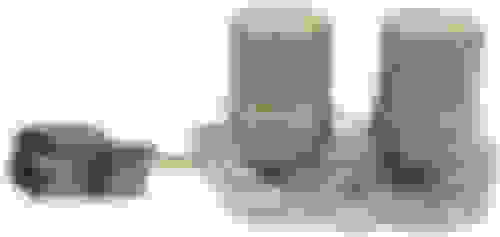
How should I proceed? Is there a resistance I can test for on the two pins on the connector? This particular solenoid looks like this, correct?
Thanks for the input. I am hoping this will not involve her needing a transmission rebuild..
The solenoid is a two pin connector, in your picture, the yellow wire is terminal 1 and the green wire is terminal 2.
To test function of the solenoid, apply voltage to terminal 1 and use the solenoid body as ground. If you hear a click, the solenoid is functioning properly.
There is a screen underneath the solenoids, you can clean this screen if you desire.
Terminal 1 is for your lockup solenoid assembly (torque converter clutch) and terminal 2 is shift solenoid A.
When testing resistance, apply the test lead to either terminal and ground it on the body, the tests should be between 12-25Ω. The resistance specifications are the same for both terminals.
After you've done all of this, please note that these tests have been absolutely useless because if either of these two items were the culprit, you would've gotten a P1753 code for the lock up (TCC) solenoid or P0753 for the shift solenoid. Along with either one of these codes, the D4 light would be blinking.
Unfortunately for you, the P0740 only sets when the TCU detects transmission slippage. You can try changing your transmission fluid three times as per Honda's instructions, but there's a very small chance this will solve your problem. As you may have read, the biggest problem with these cars is that Honda engineeers couldn't build a good automatic transmission to save their lives, so a rebuild or replacement may be required to fix this problem.
Oh, if you do decide to change your fluid first, do one other step before you waste your time. Jack the car up, crawl underneath it and grab the axle stub that goes into the transmission. See if you can move the stub up/down and if there's any lateral movement, then don't waste your time with the fluid because your differential bearing is bad and the transmission needs to be rebuilt or replaced. Those differential bearings were a huge problem with Accord transmissions which caused slipping and P0740 codes.
After you've done all of this, please note that these tests have been absolutely useless because if either of these two items were the culprit, you would've gotten a P1753 code for the lock up (TCC) solenoid or P0753 for the shift solenoid. Along with either one of these codes, the D4 light would be blinking.
Unfortunately for you, the P0740 only sets when the TCU detects transmission slippage. You can try changing your transmission fluid three times as per Honda's instructions, but there's a very small chance this will solve your problem. As you may have read, the biggest problem with these cars is that Honda engineeers couldn't build a good automatic transmission to save their lives, so a rebuild or replacement may be required to fix this problem.
Oh, if you do decide to change your fluid first, do one other step before you waste your time. Jack the car up, crawl underneath it and grab the axle stub that goes into the transmission. See if you can move the stub up/down and if there's any lateral movement, then don't waste your time with the fluid because your differential bearing is bad and the transmission needs to be rebuilt or replaced. Those differential bearings were a huge problem with Accord transmissions which caused slipping and P0740 codes.
Thank you for the very helpful, and frank responses. I might be testing the solenoid just for the hell of it this weekend..I will see what the girlfriend wants to do. This has been a great car to her this far, and I'd hate to see her part with it over this. It has 285,000 on the clock and was still going strong! A MT swap would be a fun (but too costly and time-consuming) idea.
What would the smartest way to tackle this be (assuming the worst, that she needs a transmission). Rebuild from a transmission shop? Good (hopefully) used donor? Or remanufactured?
My parents had a '00 Odyssey that went through THREE transmissions by 180,000. They got rid of it when it started clunking into gear and looking like it was going to be on a fourth.. (I know that's the 6cyl platform, and doesn't apply to the 4cyl Accords..but still!)
Update - transmission needed replaced. $1500 to replace transmission with a reman (12,000 / 12 month warranty), and replace rear main seal. Thanks for the help guys.
Just to make some use of this thread, These solenoids rarely fail. In most cases debris from clutch shedding blocks the oil passages and prevents the right amount of oil into the apply circuits. Cleaning a solenoid may help in the short run, but it is a far cry from a true solution. This debris also ends up clogging the filter reducing oil pump output, leading to gears that may slip or shift excessively late.
These types of problems are easily remedied with a new filter and cleaning. That obviously requires a rebuild of the unit. I am of the opinion it is better to rebuild the unit you have, there is no telling what was or was not replaced with a purchased reman.



 1998 Accord 4cyl - P0740 - Torque Converter Clutch Solenoid Circuit