


Linear Shock Valving


Thread Starter
Honda-Tech Member
Joined: Oct 2003
Posts: 6,619
Likes: 0
From: Chicago
 Linear Shock Valving
Is there any advantage with linear shock valving? Why do so many Japanese shocks use it?
(and a slightly ot question: the guy who dyno'd these bought them so that he could have Bilstein's revalved to these spec's. Any reason for someone to do that instead of just using the OEM shocks?)
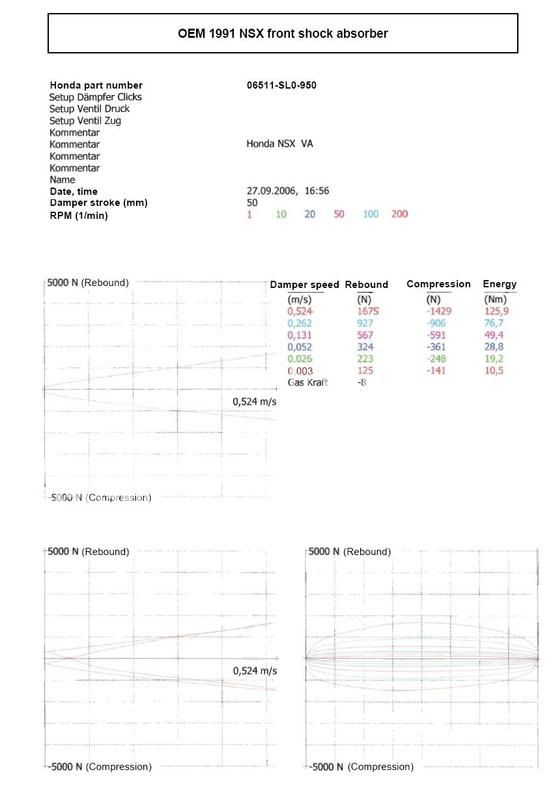
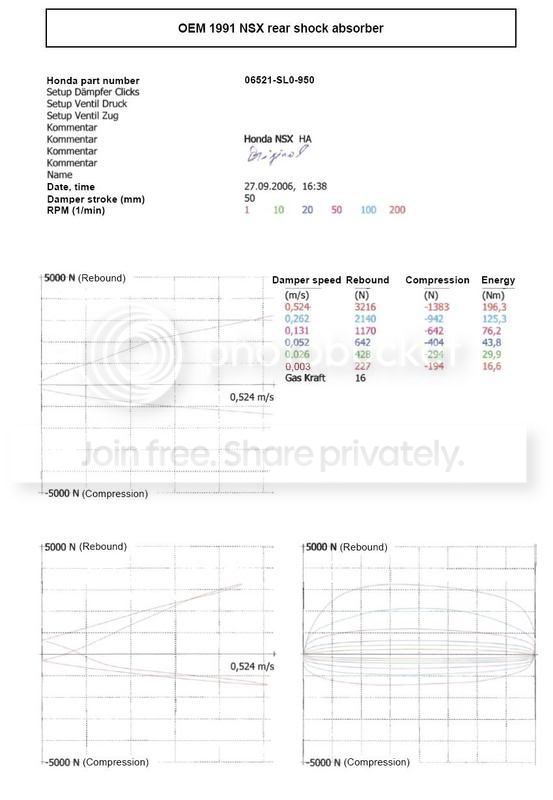
Brand new OEM NSX dampers:
Btw, what's going in the second graph? There are two curves, neither of which start at 0 N.
Modified by vinuneuro at 12:23 PM 3/31/2008
Modified by vinuneuro at 9:23 PM 3/31/2008
(and a slightly ot question: the guy who dyno'd these bought them so that he could have Bilstein's revalved to these spec's. Any reason for someone to do that instead of just using the OEM shocks?)
Brand new OEM NSX dampers:
Btw, what's going in the second graph? There are two curves, neither of which start at 0 N.
Modified by vinuneuro at 12:23 PM 3/31/2008
Modified by vinuneuro at 9:23 PM 3/31/2008

Honda-Tech Member
Joined: Mar 2004
Posts: 2,972
Likes: 0
From: IL, USA
Re: Linear Shock Valving (vinuneuro)
Possibly because the owner believes that Bilstein uses higher quality components that will provide more consistent performance over a longer period of time. I believe Bilstein's are user serviceable too but I'm not positive.
The second graph shows force vs absolute velocity. Due to internal pressure changes and the speed at which the piston is moving during a typical dyno test, the piston is never truly generating 0 force, and remains at 0 velocity for only an extremely short period of time.
The second graph shows force vs absolute velocity. Due to internal pressure changes and the speed at which the piston is moving during a typical dyno test, the piston is never truly generating 0 force, and remains at 0 velocity for only an extremely short period of time.
Thread Starter
Honda-Tech Member
Joined: Oct 2003
Posts: 6,619
Likes: 0
From: Chicago
Re: Linear Shock Valving (PIC Performance)
What do you mean by absolute velocity? The entire damper isn't moving, only the piston. Is the first graph supposed to be relative velocity then (which wouldn't make sense..to me).
Why are there two (four) curves?
Why are there two (four) curves?

Honda-Tech Member
Joined: May 2002
Posts: 13,483
Likes: 0
From: cali
Re: Linear Shock Valving (vinuneuro)
it isn't very clear dyno to begin with so it wont be easy to really tell anything with certainty.
A the graph is just like any other graph, if you scale it down enough, or zoom out enough everything looks linear. I do see a knee in the graph so it isn't really linear. With out a more labeled and detailed graph it is pretty hard to tell.
A the graph is just like any other graph, if you scale it down enough, or zoom out enough everything looks linear. I do see a knee in the graph so it isn't really linear. With out a more labeled and detailed graph it is pretty hard to tell.
Thread Starter
Honda-Tech Member
Joined: Oct 2003
Posts: 6,619
Likes: 0
From: Chicago
Re: Linear Shock Valving (slammed_93_hatch)
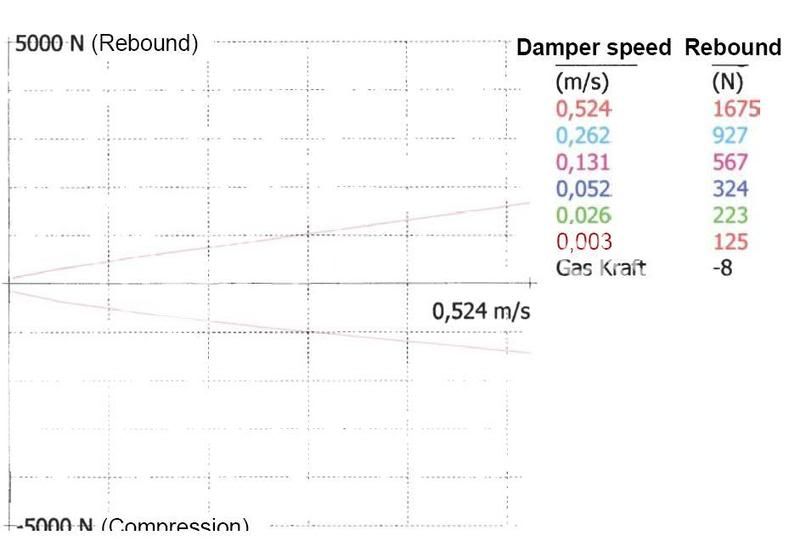
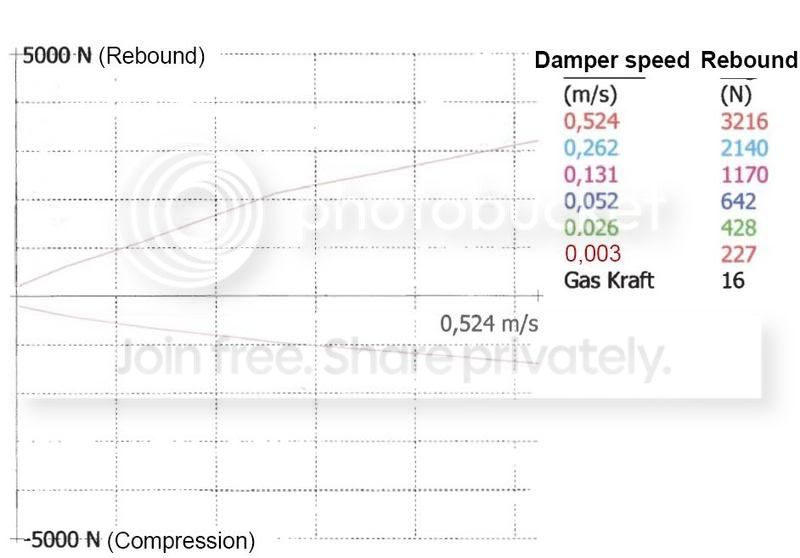
The labels seems perfectly clear to me. The max value on the velocity axis is .524m/s and 5000N on the force axis, each divided into five points. What other labeling is required?
Here's a clearer view. I don't see a knee in the front damper graph at all. Even in the graph of the rears, the knee isn't what seems like would be high-velocity on koni graphs.
Front:
Rear:
Here's a clearer view. I don't see a knee in the front damper graph at all. Even in the graph of the rears, the knee isn't what seems like would be high-velocity on koni graphs.
Front:
Rear:

Honda-Tech Member
Joined: Jan 2004
Posts: 2,350
Likes: 1
From: Cerritos, CA, USA
Re: Linear Shock Valving (vinuneuro)
<TABLE WIDTH="90%" CELLSPACING=0 CELLPADDING=0 ALIGN=CENTER><TR><TD>Quote, originally posted by vinuneuro »</TD></TR><TR><TD CLASS="quote">What do you mean by absolute velocity? The entire damper isn't moving, only the piston. Is the first graph supposed to be relative velocity then (which wouldn't make sense..to me).
Why are there two (four) curves?</TD></TR></TABLE>
The first graph is Force (N) vs. Velocity (m/s) and the second graph is Force vs. Shaft displacement at a fixed velocity where each trace is run at a different shaft velocity.
Why are there two (four) curves?</TD></TR></TABLE>
The first graph is Force (N) vs. Velocity (m/s) and the second graph is Force vs. Shaft displacement at a fixed velocity where each trace is run at a different shaft velocity.
Thread Starter
Honda-Tech Member
Joined: Oct 2003
Posts: 6,619
Likes: 0
From: Chicago
Re: Linear Shock Valving (Johnny Mac)
<TABLE WIDTH="90%" CELLSPACING=0 CELLPADDING=0 ALIGN=CENTER><TR><TD>Quote, originally posted by Johnny Mac »</TD></TR><TR><TD CLASS="quote">
The first graph is Force (N) vs. Velocity (m/s) and the second graph is Force vs. Shaft displacement at a fixed velocity where each trace is run at a different shaft velocity.
</TD></TR></TABLE>
By second graph, I meant the one at the bottom left. I realize the bottom right is displacement v. velocity, but the bottom left is labeled like the first.
The first graph is Force (N) vs. Velocity (m/s) and the second graph is Force vs. Shaft displacement at a fixed velocity where each trace is run at a different shaft velocity.
</TD></TR></TABLE>
By second graph, I meant the one at the bottom left. I realize the bottom right is displacement v. velocity, but the bottom left is labeled like the first.
Trending Topics
Honda-Tech Member
Joined: Mar 2004
Posts: 2,972
Likes: 0
From: IL, USA
Re: Linear Shock Valving (vinuneuro)
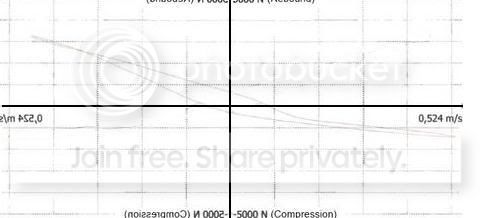
Absolute meaning there is no "negative" values in piston velocity, they are all measured on a positive increasing scale. There are only two curves. The one you have posted is the force vs absolute velocity curve, and the one above is the force vs. velocity curve, which is just the force vs. absolute velocity curves mirrored. It is easier for some to understand what the graph is showing if you give them the f vs. v curve.
The f vs. v dyno shows the behavior of the shock with the valves open and closed in both compression and rebound, and the difference you see in where they cross the y-axis is again due to internal pressure changes - never totally equaling out on either side of the piston.
edit:
Perhaps Mark Ortiz can explain it better:
http://shock-dyno.com/Ortiz/Ortiz9-10-2003.htm
Or Roehrig:
http://www.roehrigengineering....d.pdf
Modified by PIC Performance at 8:43 PM 3/31/2008
Honda-Tech Member
Joined: Mar 2004
Posts: 2,972
Likes: 0
From: IL, USA
Re: Linear Shock Valving (vinuneuro)
The top one appears to be a simple force vs peak velocity curve that we are all used to seeing. You set the dyno to crank at a fixed speed and you get the forces generated in compression and rebound at that speed. You plot the two data points, and then do it again at a different speed and get more data points. Then you connect the dots and get a graph. Since the data acquisition starts at zero velocity, then there is no force being generated and the points will be measured from 0 on the y-axis. The bottom graph has data points collected during the entire cycle of a shock as the dyno cranks it through compression and rebound.
edit: in fact, that is also explained much more clearly on Roehrig's page. you should probably just read what they have instead of trying to figure out what I wrote - they have diagrams too, which is helpful.
edit: in fact, that is also explained much more clearly on Roehrig's page. you should probably just read what they have instead of trying to figure out what I wrote - they have diagrams too, which is helpful.

Honda-Tech Member
Joined: Jan 2003
Posts: 1,979
Likes: 0
From: Cogito ergo sum, Canada
Re: Linear Shock Valving (slammed_93_hatch)
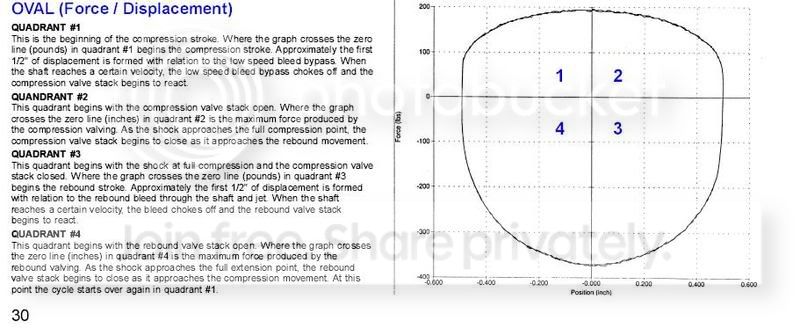
I would assume that the difference between the top chart and the bottom chart is that in the top one the force from the pressurized gas in the damper has been removed (subtracted out) while in the bottom one it has not. If you leave a pressurized damper disconnected, there is a steady force that pushes the shaft out of the damper. This force is F=PA where the Pressure times the piston Area gives a constant force independent of the position of the piston. Thus in the damper stroke, when you pull up on the shaft (rebound), you don't need as much force since the gas pressure is helping you get the shaft to extend. That puts the zero point below the axis. When you push the shaft in (bump), you have to add force to overcome the gas force and this moves the zero above the axis as you need a steady force to hold it in any position (otherwise it will just extend out to its limit by itself), giving you the bottom chart. Then just subtract/add off the constant force depending on motion direction, say about 200 N in your chart to get the typical chart like the top one. This gas pressure helps support the weight of the car like a spring in some sense, but it is a constant force independent of damper shaft position. It can be used to tune the handling in some dampers such as Moton, JRZ, Penske, etc.
Thread Starter
Honda-Tech Member
Joined: Oct 2003
Posts: 6,619
Likes: 0
From: Chicago
Looks like Al was onto it. Found a pretty simple explanation in the Penske manual:
Can someone please explain this, because I haven't been able to find the answer anywhere. What is the biggest advantage with linear valving? When is it used? These are general questions.

Modified by vinuneuro at 4:33 PM 4/1/2008
Can someone please explain this, because I haven't been able to find the answer anywhere. What is the biggest advantage with linear valving? When is it used? These are general questions.
Modified by vinuneuro at 4:33 PM 4/1/2008

Joined: May 2002
Posts: 3
Likes: 1
From: banned NC
Re: Linear Shock Valving (PIC Performance)
the non-zero start is most likely that the damper is a monotube type, which will exert a static force due to the gas inside.
linear damping is a benefit in racing applications over a "degrading" curve due to it being able to keep wheel hop down. it is also more predictable, but less comfortable.
linear damping is a benefit in racing applications over a "degrading" curve due to it being able to keep wheel hop down. it is also more predictable, but less comfortable.
Honda-Tech Member
Joined: Mar 2004
Posts: 2,972
Likes: 0
From: IL, USA
Re: Linear Shock Valving (dfoxengr)
<TABLE WIDTH="90%" CELLSPACING=0 CELLPADDING=0 ALIGN=CENTER><TR><TD>Quote, originally posted by dfoxengr »</TD></TR><TR><TD CLASS="quote">the non-zero start is most likely that the damper is a monotube type, which will exert a static force due to the gas inside.</TD></TR></TABLE>
The difference is due to hysteresis, and hysteresis will be present whether you have a gas-pressurized shock or an emulsion type shock. OEM NSX shocks are twin-tube.
<TABLE WIDTH="90%" CELLSPACING=0 CELLPADDING=0 ALIGN=CENTER><TR><TD>Quote »</TD></TR><TR><TD CLASS="quote">
linear damping is a benefit in racing applications over a "degrading" curve due to it being able to keep wheel hop down. it is also more predictable, but less comfortable.
</TD></TR></TABLE>
Please explain how linear valving reduces wheelhop, and what you mean by more predictable.
The difference is due to hysteresis, and hysteresis will be present whether you have a gas-pressurized shock or an emulsion type shock. OEM NSX shocks are twin-tube.
<TABLE WIDTH="90%" CELLSPACING=0 CELLPADDING=0 ALIGN=CENTER><TR><TD>Quote »</TD></TR><TR><TD CLASS="quote">
linear damping is a benefit in racing applications over a "degrading" curve due to it being able to keep wheel hop down. it is also more predictable, but less comfortable.
</TD></TR></TABLE>
Please explain how linear valving reduces wheelhop, and what you mean by more predictable.
Honda-Tech Member
Joined: Jan 2003
Posts: 1,979
Likes: 0
From: Cogito ergo sum, Canada
Re: Linear Shock Valving (PIC Performance)
From Roehrig dynos: WHY THERE IS A FORCE VALUE AT ZERO VELOCITY
http://www.roehrigengineering....d.pdf
http://www.roehrigengineering....d.pdf
Joined: May 2002
Posts: 3
Likes: 1
From: banned NC
Re: Linear Shock Valving (PIC Performance)
im no "expert" so i guess my best advice would be to read RCVD. its all discussed in the third to last chapter. I just finished reading the whole book last night. It is really long, lol.
Linear improves road holding over falling rate because more force, over falling rate, is still being generated at higher velocities. That helps the unsprung mass to follow the road better and keep wheels from becoming unloaded, which in turn would cause wheel hop or lifting. This of course comes with the price of ride harshness, but the racer isnt as concerned about that.
More predictable because you have one damping coefficient. It isnt a piecewise function or a curve function, so you can run equations of motion and simulations quicker and easier.
I didnt know NSX dampers were twin tube, but yes, the hysteresis is true, and what I said about mono-types still holds.
Linear improves road holding over falling rate because more force, over falling rate, is still being generated at higher velocities. That helps the unsprung mass to follow the road better and keep wheels from becoming unloaded, which in turn would cause wheel hop or lifting. This of course comes with the price of ride harshness, but the racer isnt as concerned about that.
More predictable because you have one damping coefficient. It isnt a piecewise function or a curve function, so you can run equations of motion and simulations quicker and easier.
I didnt know NSX dampers were twin tube, but yes, the hysteresis is true, and what I said about mono-types still holds.

Honda-Tech Member
Joined: Jun 2002
Posts: 3,569
Likes: 0
From: MA
Re: Linear Shock Valving (dfoxengr)
dfoxengr, that is an interesting theory. However, a digressive curve could accomplish the same thing while giving you more control at lower piston velocities so that the chassis responds to driver input quicker. And generally speaking, harshness usually means reduced road holding and increasing load variation.
What I've found is that as spring rate increases, the damper curve needs to move more linear. Less is demanded of the damper to give the chassis resonsiveness, and a softer damper in the low speed range makes for a car that is more forgiving of ham-fisted driving. That is a highly generalized statement though, and certainly not a statement that should heavily influence the selection of your damper curve.
Does PIC dyno their dampers?
What I've found is that as spring rate increases, the damper curve needs to move more linear. Less is demanded of the damper to give the chassis resonsiveness, and a softer damper in the low speed range makes for a car that is more forgiving of ham-fisted driving. That is a highly generalized statement though, and certainly not a statement that should heavily influence the selection of your damper curve.
Does PIC dyno their dampers?
Joined: May 2002
Posts: 3
Likes: 1
From: banned NC
Re: Linear Shock Valving (solo-x)
lower velocities arent changed linear to falling rate if the first part of the curve is the same so i dont really know what you meant by giving more control at lower velocities. im talking only higher velocities, and more damper force gives better road holding characteristics.
like i said, youll probably need to read the milliken book to get the full comprehension as i didnt memorize it and i dont want to repeat it all.
like i said, youll probably need to read the milliken book to get the full comprehension as i didnt memorize it and i dont want to repeat it all.
Honda-Tech Member
Joined: Mar 2004
Posts: 2,972
Likes: 0
From: IL, USA
Re: Linear Shock Valving (dfoxengr)
<TABLE WIDTH="90%" CELLSPACING=0 CELLPADDING=0 ALIGN=CENTER><TR><TD>Quote, originally posted by dfoxengr »</TD></TR><TR><TD CLASS="quote">lower velocities arent changed linear to falling rate if the first part of the curve is the same so i dont really know what you meant by giving more control at lower velocities. im talking only higher velocities, and more damper force gives better road holding characteristics.
like i said, youll probably need to read the milliken book to get the full comprehension as i didnt memorize it and i dont want to repeat it all.</TD></TR></TABLE>
For being only 4 years old, my copy of RCVD is pretty well worn as I refer to it very often but I wouldn't call myself an expert either. The section on damping is very brief when compared to how in depth they cover other topics. But a quick look at other sources will show that a linear damping curve is rarely optimal on a performance application.
I think the point here is that a digressive curve will provide more damping where you want it (low speed) and less where you don't (high speed). I don't see how a digressive curve can be unpredictable; specifically, why would you be using the damping curve itself to make any calculations? A damping curve is usually the product of calculations, and any adjustments made to damping are fine-tuning which will affect entire sections of the damping curve.
Improved road-holding requires maintaining as much grip as possible, and part of that is keeping the wheels in contact with the ground. Too much compression damping (and to a lesser extent, increased rebound) in both high and low piston speeds will reduce the tires ability to remain in contact with the ground, and if you want your dampers to provide adequate low speed damping to control body movement, then you will quickly run into the situation of having too much damping at higher speeds. Whatever the reason is, auto racers prefer digressive to linear valving.
like i said, youll probably need to read the milliken book to get the full comprehension as i didnt memorize it and i dont want to repeat it all.</TD></TR></TABLE>
For being only 4 years old, my copy of RCVD is pretty well worn as I refer to it very often but I wouldn't call myself an expert either. The section on damping is very brief when compared to how in depth they cover other topics. But a quick look at other sources will show that a linear damping curve is rarely optimal on a performance application.
I think the point here is that a digressive curve will provide more damping where you want it (low speed) and less where you don't (high speed). I don't see how a digressive curve can be unpredictable; specifically, why would you be using the damping curve itself to make any calculations? A damping curve is usually the product of calculations, and any adjustments made to damping are fine-tuning which will affect entire sections of the damping curve.
Improved road-holding requires maintaining as much grip as possible, and part of that is keeping the wheels in contact with the ground. Too much compression damping (and to a lesser extent, increased rebound) in both high and low piston speeds will reduce the tires ability to remain in contact with the ground, and if you want your dampers to provide adequate low speed damping to control body movement, then you will quickly run into the situation of having too much damping at higher speeds. Whatever the reason is, auto racers prefer digressive to linear valving.
Honda-Tech Member
Joined: May 2002
Posts: 13,483
Likes: 0
From: cali
Re: Linear Shock Valving (PIC Performance)
there was a topic about linear valving here or in the suspension forum. A few people kept saying what Dfoxengr says, but it just doesn't makes since. In theory, or application.
Standing on the side of the track you can watch a linear valved equipped car follow a digressive valved equipped car. The digressive valved shock car runs higher rates front and rear, yet the linear valved car is bouncing up and down all over the place. (the cars are similiar enough that they have the same wheel rate.
While it isn't scientific it really seems to show true again and again and again.
Standing on the side of the track you can watch a linear valved equipped car follow a digressive valved equipped car. The digressive valved shock car runs higher rates front and rear, yet the linear valved car is bouncing up and down all over the place. (the cars are similiar enough that they have the same wheel rate.
While it isn't scientific it really seems to show true again and again and again.
Honda-Tech Member
Joined: Jun 2002
Posts: 3,569
Likes: 0
From: MA
Re: Linear Shock Valving (dfoxengr)
<TABLE WIDTH="90%" CELLSPACING=0 CELLPADDING=0 ALIGN=CENTER><TR><TD>Quote, originally posted by dfoxengr »</TD></TR><TR><TD CLASS="quote">more damper force gives better road holding characteristics.
</TD></TR></TABLE>
That is completely wrong. Damper tuning is a balancing act between minimizing load force variation and getting the car to change direction. You can't just increase the damper force and get better road holding. That's just absurd.
If you took two dampers, one with a digressive curve, the other with a linear curve, and both dampers made the same forces at 3in/s, the digressive shock will make more force at 2in/s. If your platform required more damper force at 2in/s, and you tried to do it with a linear valved shock, you'd wind up with a) too much damper force at 3in/s,b) too little at 2in/s, or c) completely miss both trying to find the middle ground.
One cannot say that a particular damper curve is the best.
</TD></TR></TABLE>
That is completely wrong. Damper tuning is a balancing act between minimizing load force variation and getting the car to change direction. You can't just increase the damper force and get better road holding. That's just absurd.
If you took two dampers, one with a digressive curve, the other with a linear curve, and both dampers made the same forces at 3in/s, the digressive shock will make more force at 2in/s. If your platform required more damper force at 2in/s, and you tried to do it with a linear valved shock, you'd wind up with a) too much damper force at 3in/s,b) too little at 2in/s, or c) completely miss both trying to find the middle ground.
One cannot say that a particular damper curve is the best.
Joined: May 2002
Posts: 3
Likes: 1
From: banned NC
Re: Linear Shock Valving (solo-x)
<TABLE WIDTH="90%" CELLSPACING=0 CELLPADDING=0 ALIGN=CENTER><TR><TD>Quote, originally posted by solo-x »</TD></TR><TR><TD CLASS="quote">
You can't just increase the damper force and get better road holding. That's just absurd.
</TD></TR></TABLE>
Thats not what i was saying. But to an extent, yes you can
I want making a blanket statement.
Please read the book.
I cant explain anything nearly as well.
You can't just increase the damper force and get better road holding. That's just absurd.
</TD></TR></TABLE>
Thats not what i was saying. But to an extent, yes you can
I want making a blanket statement.
Please read the book.
I cant explain anything nearly as well.
Honda-Tech Member
Joined: Jun 2002
Posts: 3,569
Likes: 0
From: MA
Re: Linear Shock Valving (dfoxengr)
<TABLE WIDTH="90%" CELLSPACING=0 CELLPADDING=0 ALIGN=CENTER><TR><TD>Quote, originally posted by dfoxengr »</TD></TR><TR><TD CLASS="quote">
funny, sure looked like it when you wrote:
<TABLE WIDTH="90%" CELLSPACING=0 CELLPADDING=0 ALIGN=CENTER><TR><TD>Quote, originally posted by dfoxengr »</TD></TR><TR><TD CLASS="quote"> more damper force gives better road holding characteristics.
</TD></TR></TABLE>
You've got the book, post where it says that. And no, more damper force does not give better road holding characteristics. Too much rebound force will cause the tire to hang on the backside of a bump. Too much compression force will cause the tire to bounce off the bump, sending both chassis and tire into the air. Too much of both will make for a car that is harsh, terrible at putting power down, and very difficult to drive, let alone drive fast.
Nate
Originally Posted by solo-x
You can't just increase the damper force and get better road holding. That's just absurd.</TD></TR></TABLE>
Thats not what i was saying. But to an extent, yes you can
Thats not what i was saying. But to an extent, yes you can
<TABLE WIDTH="90%" CELLSPACING=0 CELLPADDING=0 ALIGN=CENTER><TR><TD>Quote, originally posted by dfoxengr »</TD></TR><TR><TD CLASS="quote"> more damper force gives better road holding characteristics.
</TD></TR></TABLE>
You've got the book, post where it says that. And no, more damper force does not give better road holding characteristics. Too much rebound force will cause the tire to hang on the backside of a bump. Too much compression force will cause the tire to bounce off the bump, sending both chassis and tire into the air. Too much of both will make for a car that is harsh, terrible at putting power down, and very difficult to drive, let alone drive fast.
Nate