


Drilled/slotted rotors


Thread Starter
Honda-Tech Member
Joined: Mar 2007
Posts: 167
Likes: 0
From: Seattle, Wa, US
 Drilled/slotted rotors
I have a set of drilled/slotted rotors that I got for free. The brand is iRotors. I was thinking about installing these, but would like to know if this would be a downgrade from the stock rotors. I am concerned about brake dust and pad wear the most. I don't track my car so I am not worried about cracking. First hand experiences would be much appreciated. Also, are there any pads you would personally recommend?

 Re: (Black S2K)
i dont see the need if you're just daily driving.. i mean unless if ur absolutely mashing it on the streets and braking hard, ur brake's temps shouldnt be that high right? drilled/slotted is overkill IMO, but then again u got em for free haha. really its up to you.


Junior Member
Joined: Oct 2003
Posts: 520
Likes: 0
From: DM, Iowa, United States
If you dont track your car, then its purely for cosmetic purposes. You wont see a downgrade in braking performance, pad wear may be slightly increased, but I dont think it will be horribly noticeable. Dusting depends greatly on the pads as well. You will get dust buildup in the slots though from the slotted rotors ive seen. Just make sure to inspect them more for cracking.
I wouldn't sink thousands of dollars into a spoon bbk unless your serious about tracking your car, there's better things to waste money on.
I wouldn't sink thousands of dollars into a spoon bbk unless your serious about tracking your car, there's better things to waste money on.
Trending Topics

Honda-Tech Member
Joined: Jun 2007
Posts: 260
Likes: 0
From: Nashville, TN, USA
Re: (b18c1995)
I've got drilled rotars on the front and I don't get a lot more dust then just the factory ones and my pads have lasted me a while too. I say take the 2 hours and do it and see for yourself.
Thread Starter
Honda-Tech Member
Joined: Mar 2007
Posts: 167
Likes: 0
From: Seattle, Wa, US
Re: (megalomaniac001)
<TABLE WIDTH="90%" CELLSPACING=0 CELLPADDING=0 ALIGN=CENTER><TR><TD>Quote, originally posted by megalomaniac001 »</TD></TR><TR><TD CLASS="quote">I've got drilled rotars on the front and I don't get a lot more dust then just the factory ones and my pads have lasted me a while too. I say take the 2 hours and do it and see for yourself.</TD></TR></TABLE>Cool, I just wanted to hear some testimonials. I just bought Axxis ultimate ceramic pads as suggested above. My buddy's gonna mount and balance my new tires, adjust alignment and change my rotors and brakes all at once......all for $47. I bought his lift ticket last week!

Junior Member
Joined: Mar 2006
Posts: 151
Likes: 0
From: San Diego, CA, United States
Re: (mingus)
Drilled OEM size rotors don't make you stop faster or reduce temps, if anything, they increase temps and reduce overall braking in the as they will be less effective at dissipating heat.
The largest benefit with drilleed rotors is the reduced weight which isn't too much unless you are utilizing a two-piece rotor. Other than that, they are just bling.
Modified by IIGQ4U at 10:51 AM 2/13/2008
The largest benefit with drilleed rotors is the reduced weight which isn't too much unless you are utilizing a two-piece rotor. Other than that, they are just bling.
Modified by IIGQ4U at 10:51 AM 2/13/2008
Junior Member
Joined: Mar 2006
Posts: 151
Likes: 0
From: San Diego, CA, United States
Re: (mingus)
Drilled OEM size rotors don't make you stop faster or reduce temps, if anything, they increase temps and reduce overall braking in the as they will be less effective at dissipating heat.

Honda-Tech Member
Joined: Mar 2004
Posts: 7,536
Likes: 0
From: London, UK
Re: (s2kpinoyboy)
<TABLE WIDTH="90%" CELLSPACING=0 CELLPADDING=0 ALIGN=CENTER><TR><TD>Quote, originally posted by s2kpinoyboy »</TD></TR><TR><TD CLASS="quote">Sell em' and save up for Spoon BBK</TD></TR></TABLE>
I wouldn't consider the Spoon calipers to be a BBK. They still utilize the stock size pads and rotors.
I wouldn't consider the Spoon calipers to be a BBK. They still utilize the stock size pads and rotors.
Honda-Tech Member
Joined: Mar 2004
Posts: 7,536
Likes: 0
From: London, UK
Re: (IIGQ4U)
<TABLE WIDTH="90%" CELLSPACING=0 CELLPADDING=0 ALIGN=CENTER><TR><TD>Quote, originally posted by IIGQ4U »</TD></TR><TR><TD CLASS="quote">True, though the calipers are larger, the rotor and brake pad sizes remain the same. </TD></TR></TABLE>
And lighter. And come in a nice blue color and has Spoon written on the side. <3 LOL
And lighter.
And come in a nice blue color and has Spoon written on the side. <3 LOL

Honda-Tech Member
Joined: Aug 2003
Posts: 232
Likes: 0
From: Ocean Springs, MS, United States
Re: (b18c1995)
<TABLE WIDTH="90%" CELLSPACING=0 CELLPADDING=0 ALIGN=CENTER><TR><TD>Quote, originally posted by b18c1995 »</TD></TR><TR><TD CLASS="quote">If you dont track your car, then its purely for cosmetic purposes. You wont see a downgrade in braking performance, pad wear may be slightly increased, but I dont think it will be horribly noticeable. Dusting depends greatly on the pads as well. You will get dust buildup in the slots though from the slotted rotors ive seen. Just make sure to inspect them more for cracking.
I wouldn't sink thousands of dollars into a spoon bbk unless your serious about tracking your car, there's better things to waste money on.</TD></TR></TABLE>
Good advice
I wouldn't sink thousands of dollars into a spoon bbk unless your serious about tracking your car, there's better things to waste money on.</TD></TR></TABLE>
Good advice

Honda-Tech Member
Joined: Oct 2002
Posts: 2,322
Likes: 3
From: OuterSpace
Re: (bky)
is gonna be for cosmetic reasons only 
you got them for free so use them
the only thing is you might get some "squealing" noises from them if they use cheap metals. but you won't know until you put them on!
you got them for free so use them
the only thing is you might get some "squealing" noises from them if they use cheap metals. but you won't know until you put them on!

Honda-Tech Member
Joined: Sep 2007
Posts: 526
Likes: 0
From: Olympia, wa, usa
Re: (IIGQ4U)
<TABLE WIDTH="90%" CELLSPACING=0 CELLPADDING=0 ALIGN=CENTER><TR><TD>Quote, originally posted by IIGQ4U »</TD></TR><TR><TD CLASS="quote">Drilled OEM size rotors don't make you stop faster or reduce temps, if anything, they increase temps and reduce overall braking in the as they will be less effective at dissipating heat. </TD></TR></TABLE>
drilled oem size WILL disapate heat faster causing make break fade less of an issue under hard consistant breaking. i dont see how you figure that drilling the rotor is done to save weight? how effective would that be, saveing less then 16 ounces of metal is not the reason that rotors get drilled and or/ slotted. im sure that porch, and mclaren sacrifice performance over the weight of the metal. and slotted rotors will help the breaking process but you will be changeing pads more often then wanted.
drilled oem size WILL disapate heat faster causing make break fade less of an issue under hard consistant breaking. i dont see how you figure that drilling the rotor is done to save weight? how effective would that be, saveing less then 16 ounces of metal is not the reason that rotors get drilled and or/ slotted. im sure that porch, and mclaren sacrifice performance over the weight of the metal. and slotted rotors will help the breaking process but you will be changeing pads more often then wanted.
Junior Member
Joined: Mar 2006
Posts: 151
Likes: 0
From: San Diego, CA, United States
Re: (140sx)
Porsche rotors do provide increased benefits in the wet. Porsche cross-drilled rotors are uniquely engineered in that their holes are much smaller which reduces the amount of surface area lost. Porsche rotors holes are cast (Not drilled) and are along the vanes to prevent large cracks. Have you ever thought about why those Porsche rotors are so large? To keep pad temps under control and offset the reduced heat dissipation caused as a result of the holes in the rotor.
A rotor is essentially a large piece of metal used to dissipate heat (AKA heatsink). The additional surface area of a typical rotor will allow decreased stopping distances over that of an equally sized cross-drilled rotor as again there is a greater surface area to dissipate heat.
A better alternative to a cheap set of cross-drilled rotors would be slotted because most cross-drilled rotors can not stand up to the demands of track conditions. Many of these rotors have been engineered to look good, not to perform on the track.
Brake pads do not outgas as they did years ago and I believe that was the primary reason behind cross-drilling. I have yet to see a Formula One car with a set of cross-drilled rotors or a NASCAR. Nor have I seen any serious race team utilize cross-drilled rotors.
Believe me, you don't want a severely hot rotor because you will literally cook your brake pads. Do you know what happens to a brake pad that has been overheated?
One more thing, you say that you don't see how drilling a number of holes into a cast-iron rotor will save weight but you do see how it will decrease stopping distances? Something seems a little off here.
Bottom line:
If you really want to see how well your crossdrilled rotors will perform, take your car to the track... You will be off of the track within a couple of laps when your rotors crack or you crash into a wall because your rotors are glazed and you can't stop. Remember, a place for everything and everything in its place. The place for cross-drilled rotors should definitely not be the track.
A rotor is essentially a large piece of metal used to dissipate heat (AKA heatsink). The additional surface area of a typical rotor will allow decreased stopping distances over that of an equally sized cross-drilled rotor as again there is a greater surface area to dissipate heat.
A better alternative to a cheap set of cross-drilled rotors would be slotted because most cross-drilled rotors can not stand up to the demands of track conditions. Many of these rotors have been engineered to look good, not to perform on the track.
Brake pads do not outgas as they did years ago and I believe that was the primary reason behind cross-drilling. I have yet to see a Formula One car with a set of cross-drilled rotors or a NASCAR. Nor have I seen any serious race team utilize cross-drilled rotors.
Believe me, you don't want a severely hot rotor because you will literally cook your brake pads. Do you know what happens to a brake pad that has been overheated?
One more thing, you say that you don't see how drilling a number of holes into a cast-iron rotor will save weight but you do see how it will decrease stopping distances? Something seems a little off here.
Bottom line:
If you really want to see how well your crossdrilled rotors will perform, take your car to the track... You will be off of the track within a couple of laps when your rotors crack or you crash into a wall because your rotors are glazed and you can't stop. Remember, a place for everything and everything in its place. The place for cross-drilled rotors should definitely not be the track.

Honda-Tech Member
Joined: Feb 2007
Posts: 6,574
Likes: 1
From: Chicago land
Re: (IIGQ4U)
havnt<TABLE WIDTH="90%" CELLSPACING=0 CELLPADDING=0 ALIGN=CENTER><TR><TD>Quote, originally posted by IIGQ4U »</TD></TR><TR><TD CLASS="quote"> Brake pads do not outgas as they did years ago and I believe that was the primary reason behind cross-drilling. I have yet to see a Formula One car with a set of cross-drilled rotors or a NASCAR. Nor have I seen any serious race team utilize cross-drilled rotors. .</TD></TR></TABLE>
Formula One brakes have to be hot to work
Formula One brakes have to be hot to work
Junior Member
Joined: Mar 2006
Posts: 151
Likes: 0
From: San Diego, CA, United States
Re: (HondaKyle)
All brakes need heat to work effectively. No friction, no braking. All brakes are also capable of overheating and your brake temperatures need to be kept in check which is why venting the heat is so important!

* B A N N E D *
Joined: Oct 2004
Posts: 8,291
Likes: 0
From: Orange County, CA, USA
Re: (IIGQ4U)
<TABLE WIDTH="90%" CELLSPACING=0 CELLPADDING=0 ALIGN=CENTER><TR><TD>Quote, originally posted by IIGQ4U »</TD></TR><TR><TD CLASS="quote">
A rotor is essentially a large piece of metal used to dissipate heat (AKA heatsink). The additional surface area of a typical rotor will allow decreased stopping distances over that of an equally sized cross-drilled rotor as again there is a greater surface area to dissipate heat.
</TD></TR></TABLE>
Correction. The additional surface area has nothing to do with braking distances. You can only brake as hard as your traction threshold of the front tires. However, increased pad surface area will require less modulation, and increased rotor mass helps to lessen fade after repeated use.
I've had a set of Brembo drilled/slotted rotors on my car, at the tracks, and they've faded worse than my OEMs. Cut my sessions down from 15 laps to about 10-12.
A rotor is essentially a large piece of metal used to dissipate heat (AKA heatsink). The additional surface area of a typical rotor will allow decreased stopping distances over that of an equally sized cross-drilled rotor as again there is a greater surface area to dissipate heat.
</TD></TR></TABLE>
Correction. The additional surface area has nothing to do with braking distances. You can only brake as hard as your traction threshold of the front tires. However, increased pad surface area will require less modulation, and increased rotor mass helps to lessen fade after repeated use.
I've had a set of Brembo drilled/slotted rotors on my car, at the tracks, and they've faded worse than my OEMs. Cut my sessions down from 15 laps to about 10-12.
Thread Starter
Honda-Tech Member
Joined: Mar 2007
Posts: 167
Likes: 0
From: Seattle, Wa, US
Re: Drilled/slotted rotors (mingus)
Here they are, I'm glad to get those rusty oems off. The wheel gap sucks, but this is my DD and I live on a crazy hill.
[IMG]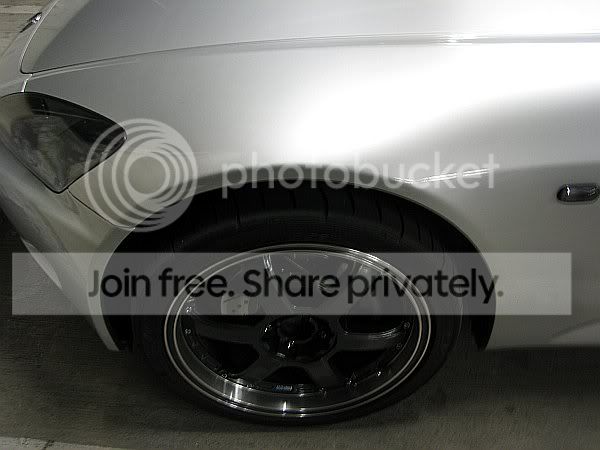 [/IMG]
[IMG] [/IMG]
[IMG]
 [/IMG]
[IMG]
 [/IMG]

Thread
Thread Starter
Forum
Replies
Last Post
H2290
Honda Civic / Del Sol (1992 - 2000)
10
Jul 28, 2006 01:56 PM
