


Different ANL Fuse Holders


Thread Starter
Honda-Tech Member
Joined: Sep 2004
Posts: 892
Likes: 2
From: Miami, FL
 Different ANL Fuse Holders
I am wondering which ANL fuse holder to get.
This one is cheap and VERY simple. I heard this might be the best to use by putting ring terminals on your power wire and attaching them directly to those posts where the ANL fuse is held.

Another I saw is like this one. Someone told me this might be a less attractive alternative because instead of having the wire tight with terminals, you just squish the wire in the hole on the side with the screw at the top
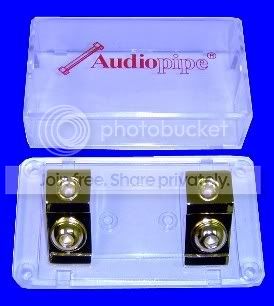
Which ANL fuse holders are the best to use? I am trying to make the power/ground paths as clean and reliable as possible. Thanks
This one is cheap and VERY simple. I heard this might be the best to use by putting ring terminals on your power wire and attaching them directly to those posts where the ANL fuse is held.
Another I saw is like this one. Someone told me this might be a less attractive alternative because instead of having the wire tight with terminals, you just squish the wire in the hole on the side with the screw at the top
Which ANL fuse holders are the best to use? I am trying to make the power/ground paths as clean and reliable as possible. Thanks

Honda-Tech Member
Joined: Jan 2004
Posts: 4,407
Likes: 5
From: Locash
Re: Different ANL Fuse Holders (imadigitalgod)
If you have a good 4 gauge ring terminal then the top would be the cleanest. But I commonly use the bottom style. It's easier and if you cut the insulation back the right length and not too long, it comes out clean.

Honda-Tech Member

Joined: Jan 2003
Posts: 6,565
Likes: 1
From: Herkimer, NY, USA
^^^ If you've got the appropriate crimpers to make a proper connection, then by all means, use the rings.
However, if you don't have the right crimpers, use the bottom fuse holder.
However, if you don't have the right crimpers, use the bottom fuse holder.
Thread Starter
Honda-Tech Member
Joined: Sep 2004
Posts: 892
Likes: 2
From: Miami, FL
Re: Different ANL Fuse Holders (fcm)
<TABLE WIDTH="90%" CELLSPACING=0 CELLPADDING=0 ALIGN=CENTER><TR><TD>Quote, originally posted by fcm »</TD></TR><TR><TD CLASS="quote"> Use the top one, solder the ring terminals to the power cable, pretty much bullet proof. 94</TD></TR></TABLE>
what wattage would you recommend using to solder the terminals to the wire?
94</TD></TR></TABLE>what wattage would you recommend using to solder the terminals to the wire?

Member
Joined: Dec 2005
Posts: 1,137
Likes: 0
From: NY, USA
Re: Different ANL Fuse Holders (imadigitalgod)
never tried this, but...
it might work..
take your solder.. and wrap it around the battery wire... but not alot.. just enough so that when you hit it with a heat gun.. the wire will absorb it... in theory..
but then again after i typed that - i see solder dripping everywhere and skin burning...
imo, just use the screw/crush type.. cause if you don't have the right tools to do the crimp and solder for the wire that you are using..... i don't think the benefit of buying those tools to use them only once.. outweighs the cost...
it might work..
take your solder.. and wrap it around the battery wire... but not alot.. just enough so that when you hit it with a heat gun.. the wire will absorb it... in theory..
but then again after i typed that - i see solder dripping everywhere and skin burning...
imo, just use the screw/crush type.. cause if you don't have the right tools to do the crimp and solder for the wire that you are using..... i don't think the benefit of buying those tools to use them only once.. outweighs the cost...
Trending Topics

Old Fart
Joined: May 2004
Posts: 26,173
Likes: 18
From: kelowna, bc, canada
Re: Different ANL Fuse Holders (imadigitalgod)
<TABLE WIDTH="90%" CELLSPACING=0 CELLPADDING=0 ALIGN=CENTER><TR><TD>Quote, originally posted by imadigitalgod »</TD></TR><TR><TD CLASS="quote">
what wattage would you recommend using to solder the terminals to the wire?</TD></TR></TABLE> That depends on the gauge of the power wire, but if you do not have a soldering gun you should get one if you are going to work on your car or any of it's electrical systems including audio.
A good all around solder gun is a dual watt Weller... http://www.cooperhandtools.com...79480
This one will work well, but not really good for anything smaller then 8 gauge wire... http://www.lowes.com/lowes/lkn...=none
BTW the set screw "cinch" type connectors/fuse holders are a poor way to make an electrical connection they will start oxidizing as soon as the power is connected, soldering is one of the best ways, even with proper crimping oxidization will still occur. 94
94
what wattage would you recommend using to solder the terminals to the wire?</TD></TR></TABLE> That depends on the gauge of the power wire, but if you do not have a soldering gun you should get one if you are going to work on your car or any of it's electrical systems including audio.
A good all around solder gun is a dual watt Weller... http://www.cooperhandtools.com...79480
This one will work well, but not really good for anything smaller then 8 gauge wire... http://www.lowes.com/lowes/lkn...=none
BTW the set screw "cinch" type connectors/fuse holders are a poor way to make an electrical connection they will start oxidizing as soon as the power is connected, soldering is one of the best ways, even with proper crimping oxidization will still occur.
94
Thread Starter
Honda-Tech Member
Joined: Sep 2004
Posts: 892
Likes: 2
From: Miami, FL
Re: Different ANL Fuse Holders (fcm)
i might run to my local audio shop to have them solder my wire/terminal. I have a soldering iron but nothing big enough to solder terminal to a 4 gauge wire. i have 4 gauge wire from KnuKonceptz.

I decided to go with the Stinger ANL fuse holder:

I decided to go with the Stinger ANL fuse holder:
Old Fart
Joined: May 2004
Posts: 26,173
Likes: 18
From: kelowna, bc, canada
Re: Different ANL Fuse Holders (imadigitalgod)
<TABLE WIDTH="90%" CELLSPACING=0 CELLPADDING=0 ALIGN=CENTER><TR><TD>Quote, originally posted by imadigitalgod »</TD></TR><TR><TD CLASS="quote">I decided to go with the Stinger ANL fuse holder:</TD></TR></TABLE> 94
94
Thread Starter
Honda-Tech Member
Joined: Sep 2004
Posts: 892
Likes: 2
From: Miami, FL
Re: Different ANL Fuse Holders (fcm)
<TABLE WIDTH="90%" CELLSPACING=0 CELLPADDING=0 ALIGN=CENTER><TR><TD>Quote, originally posted by fcm »</TD></TR><TR><TD CLASS="quote"> 94</TD></TR></TABLE>
how much would you charge at your shop to solder 3 quality gold plated terminals to a 4 gauge wire?
94</TD></TR></TABLE>how much would you charge at your shop to solder 3 quality gold plated terminals to a 4 gauge wire?
Old Fart
Joined: May 2004
Posts: 26,173
Likes: 18
From: kelowna, bc, canada
Re: Different ANL Fuse Holders (imadigitalgod)
One large Tim Horten coffee, [cream/sugar on the side] and small box of Tim Bits, make that a big box of Tim Bits. 
It's a 15 min. job, give an installer $5, [assuming he will do it properly]. 94
94
It's a 15 min. job, give an installer $5, [assuming he will do it properly].
94
Thread Starter
Honda-Tech Member
Joined: Sep 2004
Posts: 892
Likes: 2
From: Miami, FL
Re: Different ANL Fuse Holders (fcm)
<TABLE WIDTH="90%" CELLSPACING=0 CELLPADDING=0 ALIGN=CENTER><TR><TD>Quote, originally posted by fcm »</TD></TR><TR><TD CLASS="quote">One large Tim Horten coffee, [cream/sugar on the side] and small box of Tim Bits, make that a big box of Tim Bits.
It's a 15 min. job, give an installer $5, [assuming he will do it properly]. 94</TD></TR></TABLE>
alright thanks. I am taking my wire to Santa Fe Auto Sound in Overland Park, Kansas (USA). They have always been knowledgeable in parts and services.
It's a 15 min. job, give an installer $5, [assuming he will do it properly].
94</TD></TR></TABLE>alright thanks. I am taking my wire to Santa Fe Auto Sound in Overland Park, Kansas (USA). They have always been knowledgeable in parts and services.

Honda-Tech Member
Joined: Sep 2007
Posts: 113
Likes: 0
From: Vancouver, WA, US
Re: Different ANL Fuse Holders (imadigitalgod)
it doesnt even matter...do you wanna spend extra money on ring terminals and some shop to solder them?
you dont need special crimpers either..just use a flat head screw-driver and a hammer..done this with everything from 4g to 4/0...if you want to over-kill it just take a hot flame to the solder and fill in the terminal with the wire already stuck in..
the last thing id be worried about is the wire oxidating inside the fuse holder, lol
you dont need special crimpers either..just use a flat head screw-driver and a hammer..done this with everything from 4g to 4/0...if you want to over-kill it just take a hot flame to the solder and fill in the terminal with the wire already stuck in..
the last thing id be worried about is the wire oxidating inside the fuse holder, lol
Old Fart
Joined: May 2004
Posts: 26,173
Likes: 18
From: kelowna, bc, canada
Re: Different ANL Fuse Holders (matt360)
No0b alert no0b alert no0b alert no0b alert no0b alert no0b alert no0b
<TABLE WIDTH="90%" CELLSPACING=0 CELLPADDING=0 ALIGN=CENTER><TR><TD>Quote, originally posted by matt360 »</TD></TR><TR><TD CLASS="quote">it doesnt even matter...do you wanna spend extra money on ring terminals and some shop to solder them?
you dont need special crimpers either..just use a flat head screw-driver and a hammer..done this with everything from 4g to 4/0...if you want to over-kill it just take a hot flame to the solder and fill in the terminal with the wire already stuck in..
the last thing id be worried about is the wire oxidating inside the fuse holder, lol</TD></TR></TABLE>
ROFL, sub boxes out of plywood, you don't need the proper tool, oxidization is not a problem and it's not worth soldering???
How long have you been an installer and where do you work?
Just so I don't mistakenly send sombody there. 94
<TABLE WIDTH="90%" CELLSPACING=0 CELLPADDING=0 ALIGN=CENTER><TR><TD>Quote, originally posted by matt360 »</TD></TR><TR><TD CLASS="quote">it doesnt even matter...do you wanna spend extra money on ring terminals and some shop to solder them?
you dont need special crimpers either..just use a flat head screw-driver and a hammer..done this with everything from 4g to 4/0...if you want to over-kill it just take a hot flame to the solder and fill in the terminal with the wire already stuck in..
the last thing id be worried about is the wire oxidating inside the fuse holder, lol</TD></TR></TABLE>
ROFL, sub boxes out of plywood, you don't need the proper tool, oxidization is not a problem and it's not worth soldering???
How long have you been an installer and where do you work?
Just so I don't mistakenly send sombody there.
94
Thread Starter
Honda-Tech Member
Joined: Sep 2004
Posts: 892
Likes: 2
From: Miami, FL
Re: Different ANL Fuse Holders (fcm)
<TABLE WIDTH="90%" CELLSPACING=0 CELLPADDING=0 ALIGN=CENTER><TR><TD>Quote, originally posted by matt360 »</TD></TR><TR><TD CLASS="quote">it doesnt even matter...do you wanna spend extra money on ring terminals and some shop to solder them?
you dont need special crimpers either..just use a flat head screw-driver and a hammer..done this with everything from 4g to 4/0...if you want to over-kill it just take a hot flame to the solder and fill in the terminal with the wire already stuck in..
the last thing id be worried about is the wire oxidating inside the fuse holder, lol</TD></TR></TABLE>
I hope you dont work anywhere installing peoples audio equipment
Yes it does matter. If you have a voltage drop in any part of the power wire chain, your amp will not get the proper voltage. Oxidation causes higher resistance which means more of a voltage drop. I am doing my system 100% right; it will be a bullet proof install after I am done. Besides, for me its worth the extra $5 for a 100% reliable power wire connection with minimal resistance.
There is a lot of things you do not "need" but to do it properly, yes, you do need special tools.
Honda-Tech Member
Joined: Sep 2007
Posts: 113
Likes: 0
From: Vancouver, WA, US
Re: Different ANL Fuse Holders (imadigitalgod)
Obviously, oxidation is a bad thing...Using the first one over the second one is not going to affect your daily driver stereo system in anyway...youre not going to miss youre .2 of a volt..
yeah, im a noob...

won a world championship with a ply-wood box, mr master installer Low Void Birch ply is superior to MDF fyi..and its near 1/2 as heavy..
Modified by matt360 at 5:30 PM 9/28/2007
yeah, im a noob...
won a world championship with a ply-wood box, mr master installer
Low Void Birch ply is superior to MDF fyi..and its near 1/2 as heavy..Modified by matt360 at 5:30 PM 9/28/2007


Old Fart
Joined: May 2004
Posts: 26,173
Likes: 18
From: kelowna, bc, canada
Re: Different ANL Fuse Holders (matt360)
"Low Void Birch ply is superior to MDF fyi" Gee, I wonder why no one uses it for sub boxes anymore?
The last time I used Birch plywood for a sub box was more then 20 years ago.
You are right, it is lighter then MDF, but that's about the only thing it's got going for it, and maybe it looks better.
You can have a hell of a lot more then a .2V drop from oxidization 94
BTW, how did you know I was a master installer?
The last time I used Birch plywood for a sub box was more then 20 years ago.
You are right, it is lighter then MDF, but that's about the only thing it's got going for it, and maybe it looks better.
You can have a hell of a lot more then a .2V drop from oxidization
94 BTW, how did you know I was a master installer?

Thread
Thread Starter
Forum
Replies
Last Post
gsrstyle
Audio / Security / Video
8
Oct 13, 2003 03:42 PM
