


Twin Turbo Setup?


Thread Starter
Honda-Tech Member
Joined: Oct 2009
Posts: 941
Likes: 0
 Twin Turbo Setup?
So a friend of mine has an old manifold off a TT supra with the stock turbos that he was gonna use on his IS300 (same 2jz motor) and I was thinking about getting the turbos off of it for SUPER cheap and maybe possibly kinda running a twin turbo setup when I decide to do my turbo build in the spring (same time as timing belt and water pump). I'm wondering if it would be possible to run these off a tubular or possibly cast manifold depending on my budget. Does anything special have to be done with the wastegate or anything? Don't know too awful much about turbo setups but I was thinking of running a sequential type. I know I'll have to run lines for both turbos for the oil but idk if they have an internal wg or an external wg and if that would effect them at all.
Halp?
Halp?


Thread Starter
Honda-Tech Member
Joined: Oct 2009
Posts: 941
Likes: 0
Re: Twin Turbo Setup?
I mean, I feel that this is something that's not done often and actually has real world use. They're baby turbos to start with and I think the orientation wouldn't be a big deal as long as I delete my a/c. And using something small like a log manifold would give me enough room but if I can run a ramhorn or somethin that would be excellent.
This thread is not asking "do you think I should." the question is "what is involved." If you're going to offer negativity, give reasoning. Don't tell me it shouldn't be done. I'm just trying to do something different while trying to learn. For someone who's never done a turbo build I am kind of excited to do it if I can. And the turbos are off a junked supra. I'm getting them both for <$100 and that's usually one of the most expensive parts
of a turbo
This thread is not asking "do you think I should." the question is "what is involved." If you're going to offer negativity, give reasoning. Don't tell me it shouldn't be done. I'm just trying to do something different while trying to learn. For someone who's never done a turbo build I am kind of excited to do it if I can. And the turbos are off a junked supra. I'm getting them both for <$100 and that's usually one of the most expensive parts
of a turbo
Trending Topics

Honda-Tech Member
Joined: Mar 2000
Posts: 2,859
Likes: 1
From: Toronto, ON, Canada
Re: Twin Turbo Setup?
Twin turbos will work just fine, especially with two really small turbos.
Last year I did some comparisons and the TT setup didn't spool noticeable better than a single turbo setup in parallel. I had dyno comparisons, street videos and track comparisons. I also went through two stages for this build, having both turbos spooling up in parallel, and also in sequential mode using all the OEM Toyota Supra components (ACIS, EGCV, VSV's and pressure tanks, controlled via GPO's and a PWM solenoid). A few guys here thought I was being over-creative though, but in fact, I was trying to perform a clean comparison test versus a single turbo within similar size... But it lacked interest and not many here cared about the results, so I never talked about it afterwards.
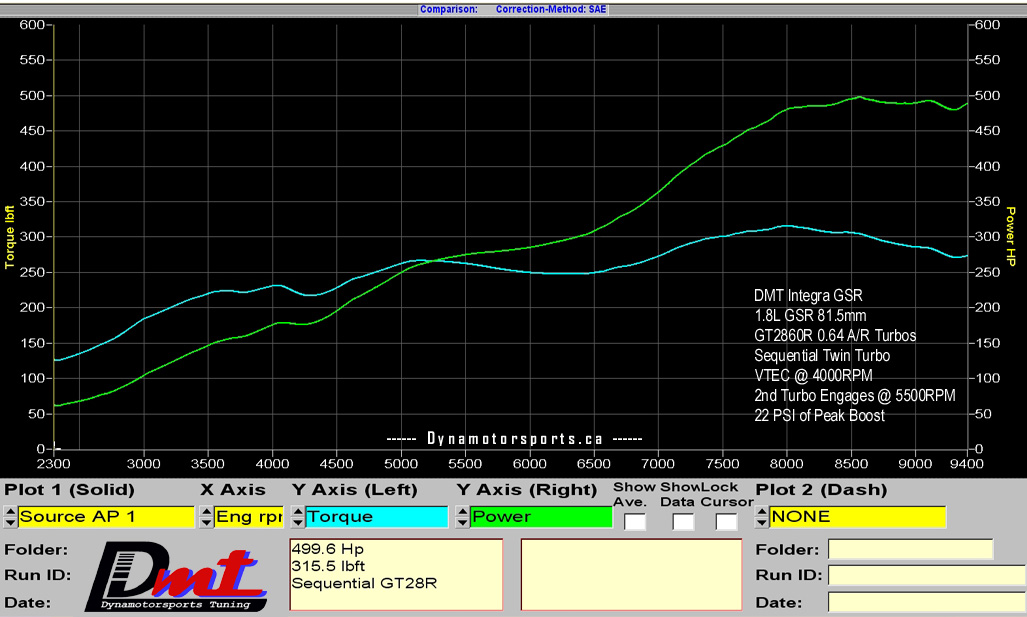
The power delivery is indeed more broad, and twin turbos rarely spool up like an on/off switch. I had a twin GT2860R setup early last year, and combined size, it is very similar to a single GT4088R by comparison. Both setups spooled up relatively the same, but the twin turbos had a softer spool up, faster torque delivery upon hitting the throttle at lower-mid RPM, but lacked the sharp response between shifts during WOT like a big single. In sequential mode, the transition was like another VTEC kick-in-the-pants, but the first turbo spooled up to 18 PSI at 3000-3500RPM and the next turbo came in at 5500RPM. However, due to boost limitations (read below), I abandoned the setup later on.
The biggest drawback for a twin turbo setup only applies to those who are pushing big power. Almost all the small turbos out there can combine as twins for lots of air flow (eg: twin GT2860R = 70 lbs/min worth of airflow), but on a small Honda engine, it needs a lot of boost pressure to push that air flow through the engine.
There are simply no small turbos out there that are sized well but still able to have a high enough pressure ratio to make use of their combined flow on a small Honda engine. My twin GT2860R setup did not work out too well because I was "boost pressure limited" to 550 WHP since the GT2860R's did not have high a enough pressure ratio to continue to make power beyond 22-23 PSI. There was enough flow for 700+ WHP, but not enough pressure to get there.
Here are some pics:


Sequential components:

Short driving video:
http://www.youtube.com/watch?v=CZpji...147&feature=iv
Last year I did some comparisons and the TT setup didn't spool noticeable better than a single turbo setup in parallel. I had dyno comparisons, street videos and track comparisons. I also went through two stages for this build, having both turbos spooling up in parallel, and also in sequential mode using all the OEM Toyota Supra components (ACIS, EGCV, VSV's and pressure tanks, controlled via GPO's and a PWM solenoid). A few guys here thought I was being over-creative though, but in fact, I was trying to perform a clean comparison test versus a single turbo within similar size... But it lacked interest and not many here cared about the results, so I never talked about it afterwards.
The power delivery is indeed more broad, and twin turbos rarely spool up like an on/off switch. I had a twin GT2860R setup early last year, and combined size, it is very similar to a single GT4088R by comparison. Both setups spooled up relatively the same, but the twin turbos had a softer spool up, faster torque delivery upon hitting the throttle at lower-mid RPM, but lacked the sharp response between shifts during WOT like a big single. In sequential mode, the transition was like another VTEC kick-in-the-pants, but the first turbo spooled up to 18 PSI at 3000-3500RPM and the next turbo came in at 5500RPM. However, due to boost limitations (read below), I abandoned the setup later on.
The biggest drawback for a twin turbo setup only applies to those who are pushing big power. Almost all the small turbos out there can combine as twins for lots of air flow (eg: twin GT2860R = 70 lbs/min worth of airflow), but on a small Honda engine, it needs a lot of boost pressure to push that air flow through the engine.
There are simply no small turbos out there that are sized well but still able to have a high enough pressure ratio to make use of their combined flow on a small Honda engine. My twin GT2860R setup did not work out too well because I was "boost pressure limited" to 550 WHP since the GT2860R's did not have high a enough pressure ratio to continue to make power beyond 22-23 PSI. There was enough flow for 700+ WHP, but not enough pressure to get there.
Here are some pics:
Sequential components:
Short driving video:
http://www.youtube.com/watch?v=CZpji...147&feature=iv


Honda-Tech Member
Joined: Aug 2009
Posts: 512
Likes: 7
From: Vancouver BC
Re: Twin Turbo Setup?
Twin turbos will work just fine, especially with two really small turbos.
Last year I did some comparisons and the TT setup didn't spool noticeable better than a single turbo setup in parallel. I had dyno comparisons, street videos and track comparisons. I also went through two stages for this build, having both turbos spooling up in parallel, and also in sequential mode using all the OEM Toyota Supra components (ACIS, EGCV, VSV's and pressure tanks, controlled via GPO's and a PWM solenoid). A few guys here thought I was being over-creative though, but in fact, I was trying to perform a clean comparison test versus a single turbo within similar size... But it lacked interest and not many here cared about the results, so I never talked about it afterwards.
The power delivery is indeed more broad, and twin turbos rarely spool up like an on/off switch. I had a twin GT2860R setup early last year, and combined size, it is very similar to a single GT4088R by comparison. Both setups spooled up relatively the same, but the twin turbos had a softer spool up, faster torque delivery upon hitting the throttle at lower-mid RPM, but lacked the sharp response between shifts during WOT like a big single. In sequential mode, the transition was like another VTEC kick-in-the-pants, but the first turbo spooled up to 18 PSI at 3000-3500RPM and the next turbo came in at 5500RPM. However, due to boost limitations (read below), I abandoned the setup later on.
The biggest drawback for a twin turbo setup only applies to those who are pushing big power. Almost all the small turbos out there can combine as twins for lots of air flow (eg: twin GT2860R = 70 lbs/min worth of airflow), but on a small Honda engine, it needs a lot of boost pressure to push that air flow through the engine.
There are simply no small turbos out there that are sized well but still able to have a high enough pressure ratio to make use of their combined flow on a small Honda engine. My twin GT2860R setup did not work out too well because I was "boost pressure limited" to 550 WHP since the GT2860R's did not have high a enough pressure ratio to continue to make power beyond 22-23 PSI. There was enough flow for 700+ WHP, but not enough pressure to get there.
Here are some pics:
Sequential components:
Short driving video:
http://www.youtube.com/watch?v=CZpji...147&feature=iv
Last year I did some comparisons and the TT setup didn't spool noticeable better than a single turbo setup in parallel. I had dyno comparisons, street videos and track comparisons. I also went through two stages for this build, having both turbos spooling up in parallel, and also in sequential mode using all the OEM Toyota Supra components (ACIS, EGCV, VSV's and pressure tanks, controlled via GPO's and a PWM solenoid). A few guys here thought I was being over-creative though, but in fact, I was trying to perform a clean comparison test versus a single turbo within similar size... But it lacked interest and not many here cared about the results, so I never talked about it afterwards.
The power delivery is indeed more broad, and twin turbos rarely spool up like an on/off switch. I had a twin GT2860R setup early last year, and combined size, it is very similar to a single GT4088R by comparison. Both setups spooled up relatively the same, but the twin turbos had a softer spool up, faster torque delivery upon hitting the throttle at lower-mid RPM, but lacked the sharp response between shifts during WOT like a big single. In sequential mode, the transition was like another VTEC kick-in-the-pants, but the first turbo spooled up to 18 PSI at 3000-3500RPM and the next turbo came in at 5500RPM. However, due to boost limitations (read below), I abandoned the setup later on.
The biggest drawback for a twin turbo setup only applies to those who are pushing big power. Almost all the small turbos out there can combine as twins for lots of air flow (eg: twin GT2860R = 70 lbs/min worth of airflow), but on a small Honda engine, it needs a lot of boost pressure to push that air flow through the engine.
There are simply no small turbos out there that are sized well but still able to have a high enough pressure ratio to make use of their combined flow on a small Honda engine. My twin GT2860R setup did not work out too well because I was "boost pressure limited" to 550 WHP since the GT2860R's did not have high a enough pressure ratio to continue to make power beyond 22-23 PSI. There was enough flow for 700+ WHP, but not enough pressure to get there.
Here are some pics:
Sequential components:
Short driving video:
http://www.youtube.com/watch?v=CZpji...147&feature=iv
Thread Starter
Honda-Tech Member
Joined: Oct 2009
Posts: 941
Likes: 0
Re: Twin Turbo Setup?
That is all excellent information. Like I said I want to run a sequential setup and see how those hold up pushing no more than 8-10lbs if I decide to go through with it. I feel like at that kind of boost range I dont hve to worry about abusing the turbos or pushing them go their limits.


Honda-Tech Member
Joined: Apr 2007
Posts: 589
Likes: 0
From: Phoenix, AZ, USA
Re: Twin Turbo Setup?
I mean, I feel that this is something that's not done often and actually has real world use. They're baby turbos to start with and I think the orientation wouldn't be a big deal as long as I delete my a/c. And using something small like a log manifold would give me enough room but if I can run a ramhorn or somethin that would be excellent.
This thread is not asking "do you think I should." the question is "what is involved." If you're going to offer negativity, give reasoning. Don't tell me it shouldn't be done. I'm just trying to do something different while trying to learn. For someone who's never done a turbo build I am kind of excited to do it if I can. And the turbos are off a junked supra. I'm getting them both for <$100 and that's usually one of the most expensive parts
of a turbo
This thread is not asking "do you think I should." the question is "what is involved." If you're going to offer negativity, give reasoning. Don't tell me it shouldn't be done. I'm just trying to do something different while trying to learn. For someone who's never done a turbo build I am kind of excited to do it if I can. And the turbos are off a junked supra. I'm getting them both for <$100 and that's usually one of the most expensive parts
of a turbo
http://www.full-race.com/catalog/pro...oducts_id=2165

Honda-Tech Member
Joined: Mar 2000
Posts: 2,859
Likes: 1
From: Toronto, ON, Canada
Re: Twin Turbo Setup?
Nope, I didn't make a build thread here.. I made one on a local forum, but I basically mirrored the information on this thread anyway just now. You have all the important info here already.
There is a similar TT build on an S2000 by Epic, which proved to spool as well as a GT35R but had the capacity similar to a GT40R instead. This was a parallel setup:
https://honda-tech.com/forums/forced-induction-16/twin-turbo-s2000-built-epic-tuning-2595792/
If you are looking for such low power like 8-10 PSI, then it's pointless to go twin turbo. Even the stock twins off the Supra, combined, can flow for 450-480 WHP. They are already too big for your application. For 250-300 WHP, you are better off with a small single.
Building a sequential setup takes good fabrication skills, and you also need to know how to tune it as well to blend in the transition. One turbo gets full stream of exhaust, but midway, the other turbo has to "pre-spool" first before you can kick in the 2nd turbo.
Before you do anything, make sure you have a tuner that can set it up for you if you are really planning to go TT.
Think sequential...
It worked great for lower power levels (ie: 500 WHP) and under the pressure limits of the twins. If only the GT28R turbo has different wheel options suited better for higher pressure ratios, it is an unbeatable combination because you can run them to their flow limit on a Honda engine.
It managed to make 200 lbft of torque and over 18 PSI from 3200RPM and up. The sequential setup introduced another "layer" of restriction unfortunately, thus, making the turbos reach their pressure limits even sooner than expected. I was only able to top out at 500 WHP with the sequential setup. Consider that the first ever sequential TT setup ever on a Honda.
You will never find a single turbo that can match the low-end and midrange spool and still have the flow capability for 500 WHP on a 1.8L GSR versus a sequential twin turbo setup. It's more than just being unique if you understand benefits of the system and know how to set it up.
I definitely scored a lot of points when I had the TT setup as well... So many guys at the local meets were in total shock that I could fry my tires with smoke in 2nd gear from a roll but 500WHP on tap. But you know, it gets old after a few months, and I was a happier person with 650+ WHP and trying to score 140+ mph traps on street tires and pump gas instead...lol
Divided scroll is nowhere near close to twin turbo in terms of reducing lag. I have a "twin-scroll" (real correct term is divided-scroll -- courtesy of TheShodan) setup right now, and yes, it helps spool quite nicely but not like a TT setup though.
There is a similar TT build on an S2000 by Epic, which proved to spool as well as a GT35R but had the capacity similar to a GT40R instead. This was a parallel setup:
https://honda-tech.com/forums/forced-induction-16/twin-turbo-s2000-built-epic-tuning-2595792/
That is all excellent information. Like I said I want to run a sequential setup and see how those hold up pushing no more than 8-10lbs if I decide to go through with it. I feel like at that kind of boost range I dont hve to worry about abusing the turbos or pushing them go their limits.
Building a sequential setup takes good fabrication skills, and you also need to know how to tune it as well to blend in the transition. One turbo gets full stream of exhaust, but midway, the other turbo has to "pre-spool" first before you can kick in the 2nd turbo.
Before you do anything, make sure you have a tuner that can set it up for you if you are really planning to go TT.
It worked great for lower power levels (ie: 500 WHP) and under the pressure limits of the twins. If only the GT28R turbo has different wheel options suited better for higher pressure ratios, it is an unbeatable combination because you can run them to their flow limit on a Honda engine.
It managed to make 200 lbft of torque and over 18 PSI from 3200RPM and up. The sequential setup introduced another "layer" of restriction unfortunately, thus, making the turbos reach their pressure limits even sooner than expected. I was only able to top out at 500 WHP with the sequential setup. Consider that the first ever sequential TT setup ever on a Honda.
You will never find a single turbo that can match the low-end and midrange spool and still have the flow capability for 500 WHP on a 1.8L GSR versus a sequential twin turbo setup. It's more than just being unique if you understand benefits of the system and know how to set it up.
I definitely scored a lot of points when I had the TT setup as well... So many guys at the local meets were in total shock that I could fry my tires with smoke in 2nd gear from a roll but 500WHP on tap. But you know, it gets old after a few months, and I was a happier person with 650+ WHP and trying to score 140+ mph traps on street tires and pump gas instead...lol
Why not use a twin-scroll design? It's almost like having twin-turbo but much less work.
http://www.full-race.com/catalog/pro...oducts_id=2165
http://www.full-race.com/catalog/pro...oducts_id=2165
Last edited by Tony the Tiger; Dec 21, 2010 at 05:07 AM.
Thread Starter
Honda-Tech Member
Joined: Oct 2009
Posts: 941
Likes: 0
Re: Twin Turbo Setup?
Why not use a twin-scroll design? It's almost like having twin-turbo but much less work.
http://www.full-race.com/catalog/pro...oducts_id=2165
http://www.full-race.com/catalog/pro...oducts_id=2165
And please correct me if I'm wrong. But in a sequential setup, the
cold side of turbo #1 feeds into the manifold side of turbo#2, right? What about the hot side of turbo #2? Does it still have to go through a dumptube? Or can it just be expelled?
Honda-Tech Member
Joined: Mar 2000
Posts: 2,859
Likes: 1
From: Toronto, ON, Canada
Re: Twin Turbo Setup?
Just google how the Supra TT sequential works, and follow the sequence. But as I said earlier, for your budget and power goals, there is no reason to go twins unless you are looking for 400WHP and the best possible spool under that given scenario.
You'd be a much happy camper if you just run one of the CT12 turbo off the Supra. Each is good for about 220-240 WHP.
Thread Starter
Honda-Tech Member
Joined: Oct 2009
Posts: 941
Likes: 0
Re: Twin Turbo Setup?
The ct12 is what came stock on the 2jz motor right? The reason I wanted to go twin with those turbos is not for boost numbers, as it's gonna be a baby build for now. Small turbos, small numbers, small boost, but zero lag was my ultimate goal. And really a compounded setup is what I wanted to run to begin with as I want to only use a single turbo manifold and have one feed the other.
Honda-Tech Member
Joined: Mar 2000
Posts: 2,859
Likes: 1
From: Toronto, ON, Canada
Re: Twin Turbo Setup?
The ct12 is what came stock on the 2jz motor right? The reason I wanted to go twin with those turbos is not for boost numbers, as it's gonna be a baby build for now. Small turbos, small numbers, small boost, but zero lag was my ultimate goal. And really a compounded setup is what I wanted to run to begin with as I want to only use a single turbo manifold and have one feed the other.
I have a dyno graph of my sequential setup, so you can use this as a comparison:
Thread Starter
Honda-Tech Member
Joined: Oct 2009
Posts: 941
Likes: 0
Re: Twin Turbo Setup?
Well after all you've told me I'm having trouble deciding if I want to run a sequential setup like you had or if compounded is the way to go. It seems like you had to do a lot of fabricating to run a true sequential setup. With a compound setup, i think all i would have to fab up would be mating to the two turbos, the oil lines, and the cold and hot pipings. Any advice as which way to go?

Thread
Thread Starter
Forum
Replies
Last Post
1000kg88hb
Tech / Misc
1
Mar 12, 2007 01:01 PM
