


Stock fuel lines limits


Thread Starter
Honda-Tech Member
Joined: Jul 2015
Posts: 6
Likes: 0
 Stock fuel lines limits
Hallo guys!
I know that the stock lines has limit over 500whp...
I have 1300cc EG chassis! Has it narrower fuel lines? Or the same with vti b16?
Anyone know exactly how many mm are the stock fuel lines?
I am looking to run it without any fuel filter because for sure it drop the pressure and with stock FPR and fuel rail.
I bought the car with an aeromotive fuel pump but I think that it is useless if I have stock lines.
I know that the stock lines has limit over 500whp...
I have 1300cc EG chassis! Has it narrower fuel lines? Or the same with vti b16?
Anyone know exactly how many mm are the stock fuel lines?
I am looking to run it without any fuel filter because for sure it drop the pressure and with stock FPR and fuel rail.
I bought the car with an aeromotive fuel pump but I think that it is useless if I have stock lines.

Honda-Tech Member
Joined: Aug 2007
Posts: 1,997
Likes: 9
From: Florida, usa
Re: Stock fuel lines limits
Hallo guys!
I know that the stock lines has limit over 500whp...
I have 1300cc EG chassis! Has it narrower fuel lines? Or the same with vti b16?
Anyone know exactly how many mm are the stock fuel lines?
I am looking to run it without any fuel filter because for sure it drop the pressure and with stock FPR and fuel rail.
I bought the car with an aeromotive fuel pump but I think that it is useless if I have stock lines.
I know that the stock lines has limit over 500whp...
I have 1300cc EG chassis! Has it narrower fuel lines? Or the same with vti b16?
Anyone know exactly how many mm are the stock fuel lines?
I am looking to run it without any fuel filter because for sure it drop the pressure and with stock FPR and fuel rail.
I bought the car with an aeromotive fuel pump but I think that it is useless if I have stock lines.

 Re: Stock fuel lines limits
The stock FPR and rail can easily do about 350-500whp. Don't sweat that. Even in the chassis that had a smaller engine. When you swap it to a B-series, that changes. Remember, this is a fuel return style system. You're good to go.
Thread Starter
Honda-Tech Member
Joined: Jul 2015
Posts: 6
Likes: 0
Re: Stock fuel lines limits
My EVO from factory don't have any fuel filter.. Just fuel pump filter..
You don't need this **** in a high hp turbo B16..
My goal is 500-600whp
But I just ask if 1300 chassis have smaller lines than VTI..
For VTI I know that I can go for 600whp with stock lines, fpr, fuel rail
You don't need this **** in a high hp turbo B16..
My goal is 500-600whp
But I just ask if 1300 chassis have smaller lines than VTI..
For VTI I know that I can go for 600whp with stock lines, fpr, fuel rail

Honda-Tech Member
Joined: Apr 2015
Posts: 82
Likes: 0
Re: Stock fuel lines limits
Just in case you've missed the obvious, this is a Honda and not a Mitsubishi Evo.  Sorry I just felt I had to say it. Now back to the main question topic, you've asked and most of us said keep your fuel filter. If concerned then replace the factory filter with a performance one.
Sorry I just felt I had to say it. Now back to the main question topic, you've asked and most of us said keep your fuel filter. If concerned then replace the factory filter with a performance one.
Re: Stock fuel lines limits
This will be the one and only comment on H-T about the Evolution. After this, you'll need to go back to the Evolution forums.
It's typically underneath the charcoal canister in front of the axles and close to the gear linkage from what I remember. But you didn't say which Evolution, so I'm going by IV-IX.

You can change that out with either an OEM unit or a performance one from a variety of companies. Don't ask which is best, because we won't know, so you'll need to perform your own investigations.
Trending Topics
Thread Starter
Honda-Tech Member
Joined: Jul 2015
Posts: 6
Likes: 0
Re: Stock fuel lines limits
EVO 1-6 have fuel filter...
7-8-9-10 don't have any fuel filter.
ONLY in-tank pump fuel filter but anyway
Also many other stock fast cars don't have any fuel filter...
Nissan GTR R35 have only intank fuel filter..
I just wanted to know if VTI and 1.3chassis have the same diameter fuel lines!!
7-8-9-10 don't have any fuel filter.
ONLY in-tank pump fuel filter but anyway
Also many other stock fast cars don't have any fuel filter...
Nissan GTR R35 have only intank fuel filter..
I just wanted to know if VTI and 1.3chassis have the same diameter fuel lines!!

Who is Mr Robot?
iTrader: (2)
Joined: Jul 2004
Posts: 21,474
Likes: 10
From: ATL - Where the Pimps and Players dwell
Re: Stock fuel lines limits
ah ok, you didn't clarify.
however it is worth noting that while the pump has an inlet sock, there is an actual fuel filter built into the pump basket/hanger.
In this photo it's the white mass on the side that the vertical fuel line comes out of above.
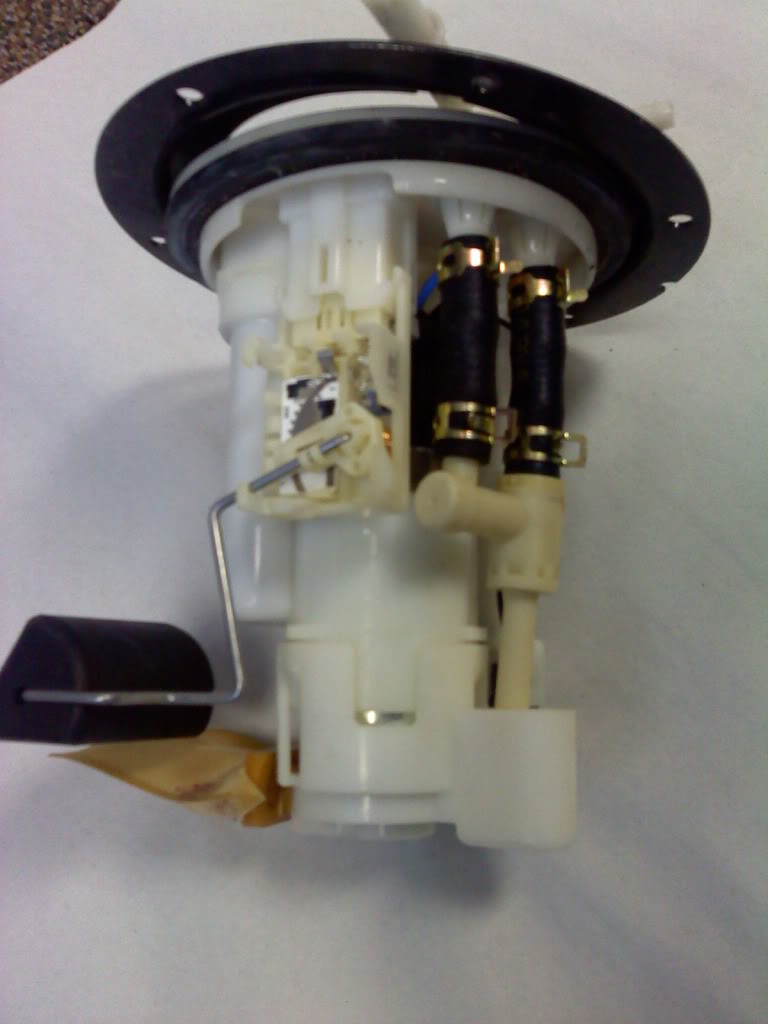
Without getting entirely off topic, if you are a serious EVO owner then you know a lot of people have concerns with the OEM system, especially in performance applications. With the OEM fuel filter not being serviceable and requiring removing the pump/dropping the tank to replace it is quite stupid. Lots of people upgrade to an external inline fuel filter that is user serviceable.
I know quite a lot of my EVO buddies remove the OEM filter on the hanger/basket when the upgrade or change fuel pumps and put an external inline filter somewhere in the engine bay for easy access. They do keep the pump inlet sock as this acts like a pre-filter preventing any debris that is large enough to damage or clog the pump from entering it.
Lots of high Hp/boost pressure E85/93 EVO guys are finding out that when the OEM filter starts to clog it causes fuel pressure drop and fuel flow drop. Given that like I said it isn't user serviceable it makes life a headache.
If you were to do a quick Google search on "Stock evo fuel filter" or something similar you'll find a lot of threads mentioning exactly what I just said.
Anyways back on topic.
Here is what the limiting factors are in regards to injectors, pump, and fuel being used

As far as line size vs horsepower limit here is an excellent article by IPG Parts that covers the topic pretty in-depth.
Fuel Line Sizing ? What Size Do I Need? :: IPG Parts Blog :: IPGParts.com
Another thing to consider is that it's better to have a larger line on the suction (intake) side of the fuel pump, normally one size larger than what the outlet feed diameter is. For example, if you have a 6an (3/8in 9.525mm) feedline from the pump to the fuel rail then you'd want to run an 8an (1/2in 12.7mm) on the inlet side and so on. This little trick helps reduce pressure differential across the pump and allows the pump to more efficiently draw fuel into itself.
however it is worth noting that while the pump has an inlet sock, there is an actual fuel filter built into the pump basket/hanger.
In this photo it's the white mass on the side that the vertical fuel line comes out of above.
Without getting entirely off topic, if you are a serious EVO owner then you know a lot of people have concerns with the OEM system, especially in performance applications. With the OEM fuel filter not being serviceable and requiring removing the pump/dropping the tank to replace it is quite stupid. Lots of people upgrade to an external inline fuel filter that is user serviceable.
I know quite a lot of my EVO buddies remove the OEM filter on the hanger/basket when the upgrade or change fuel pumps and put an external inline filter somewhere in the engine bay for easy access. They do keep the pump inlet sock as this acts like a pre-filter preventing any debris that is large enough to damage or clog the pump from entering it.
Lots of high Hp/boost pressure E85/93 EVO guys are finding out that when the OEM filter starts to clog it causes fuel pressure drop and fuel flow drop. Given that like I said it isn't user serviceable it makes life a headache.
If you were to do a quick Google search on "Stock evo fuel filter" or something similar you'll find a lot of threads mentioning exactly what I just said.
Anyways back on topic.
Here is what the limiting factors are in regards to injectors, pump, and fuel being used
As far as line size vs horsepower limit here is an excellent article by IPG Parts that covers the topic pretty in-depth.
Fuel Line Sizing ? What Size Do I Need? :: IPG Parts Blog :: IPGParts.com
Another thing to consider is that it's better to have a larger line on the suction (intake) side of the fuel pump, normally one size larger than what the outlet feed diameter is. For example, if you have a 6an (3/8in 9.525mm) feedline from the pump to the fuel rail then you'd want to run an 8an (1/2in 12.7mm) on the inlet side and so on. This little trick helps reduce pressure differential across the pump and allows the pump to more efficiently draw fuel into itself.

Thread
Thread Starter
Forum
Replies
Last Post
boomslang
Forced Induction
9
Dec 5, 2002 10:36 AM