


Apexi AVCR help install


Thread Starter
Honda-Tech Member
Joined: Mar 2012
Posts: 37
Likes: 0
 Apexi AVCR help install
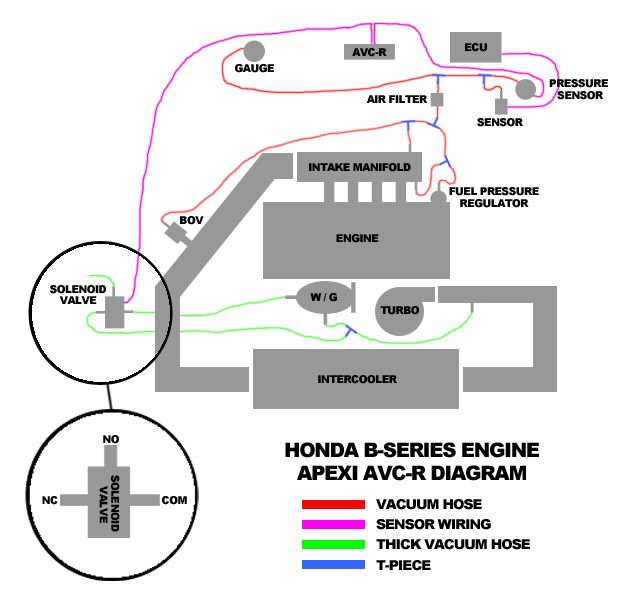
HT members, does this diagram look correct to install?? If not, how would you reroute or edit this diagram picture. I have a golden eagle vaccum source, so probably wouldn't need to spice all that hoses. If any of you HT members had a previous AVCR install before, confirm this with me to see if it's correct.


Honda-Tech Member
Joined: Jan 2000
Posts: 6,212
Likes: 2
From: Toronto, Canada
Re: Apexi AVCR help install
i installed my avcr many years ago so i have no idea about the wiring but it looks like you have allot of "t's" and splices in the vacuum lines which is just asking for trouble...

 Re: Apexi AVCR help install
Re: Apexi AVCR help install
Re: Apexi AVCR help install
Here's the PDF on the AVC-R
http://www.fd3s.net/avc-r_manual.pdf
Some older instructions I had.
STEP 1) Install the Solenoid
The solenoid controls the air pressure provided to the precontrol and wastegate actuators, thus allowing user control of boost. If you blow through the solenoid (NO or COM port) you will feel a little resistance, but air will flow. If air doesn't flow there is probably a problem. (So loss of power to the solenoid will result in low boost, not max boost...)
Remove air box and intake piping so that you can access the precontrol and WG actuators (look almost straight down).
Remove both of the hoses going from the manifold to Precontrol & WG actuators - hoses are held on by expandable metal clips
Following the directions, use the supplied plastic 'T's and hoses, and 'T' the manifold ports to the NO port on solenoid.
'T' the Precontrol & WG actuator ports to the COM port on solenoid.
Mount the solenoid - use the rubber pad. Mine is mounted on the fender wall near the ABS unit.
STEP 2) Disconnect factory solenoids
This MUST be done, otherwise boost cannot be controlled.
There are two ports each on the wastegate & precontrol actuators. The top port from each is running to the solenoid (step above), the second port is at the bottom and to the right... you cant see it, but it's easy to feel.
Disconnect bottom ports on each
Plug both these ports (i.e. rubber stopper and tie wrap)
Plug both hoses that were connected to the ports
STEP 3) Install pressure sensor
Pressure sensor monitors manifold pressure to provide 'closed-loop' boost control.
Find a hose on intake manifold and 'T' it to the pressure sensor.
Use the supplied air filter and mount the sensor so the hose connector points downward.
On my car there were two threaded holes on the fender-wall, close to the firewall, next to the ABS. The pressure sensor mounted there PERFECTLY (supply your own machine screws).
STEP 4) Wiring harness
Start with harness inside the car and run the solenoid and pressure sensor wires into the engine compartment.
You do not need to cut the wires, the wire 'ends' can be removed from the plastic connector using a small screwdriver (pop out plastic insert.)
Hole in firewall behind/under ABS and behind glove-box works well.
Follow the supplied FD ECU wiring diagram (Z3-b) and spice into required ECU wires. I used 'RPM' wiring, not 'injector duty' wiring.
Attach all sensor and head-unit connectors
STEP 5) Sensor Check
Put everything back together (at least enough to turn ignition on).
Turn ignition on (don't need to start the car yet)
AVC-R logo will scroll across the screen
Go to 'Etc.' section, 'Sensor chk'
My values:
Boost: 1.513V
Throttle: 0.634V (no throttle) / 4.218V (full throttle)
SCSW: OFF
If your values are close, the unit and sensors are working.
Put everything back together - enough to drive car. Complete system checkout is in next section.
TUNING:
Basic tuning will take a few hours, but fine tuning all the parameter will take a while. The tuning instructions in the manual leave a lot to be desired... the translation is fairly poor. Read and re-read this section, about the third time you read it, it does start making sense. And if it seems that a word is missing in a sentence... it IS! I guess the translator didnt know the English word. So I attempt to explain what each of the parameters does along with how to set it.
Also, the boost is displayed in Kg/cm^2... the conversion to PSI is 14.22:1 NOT 14.5 or 14.7 or anything else.
STEP 1) System parameter setup - All in 'Etc.' menu
Car Select:
Cyl=4 (# of rotors * 2)
Spd=4
Thr=Arrow pointing up
Sensor Sel:
Relative1 (leave as default)
http://www.fd3s.net/avc-r_manual.pdf
Some older instructions I had.
STEP 1) Install the Solenoid
The solenoid controls the air pressure provided to the precontrol and wastegate actuators, thus allowing user control of boost. If you blow through the solenoid (NO or COM port) you will feel a little resistance, but air will flow. If air doesn't flow there is probably a problem. (So loss of power to the solenoid will result in low boost, not max boost...)
Remove air box and intake piping so that you can access the precontrol and WG actuators (look almost straight down).
Remove both of the hoses going from the manifold to Precontrol & WG actuators - hoses are held on by expandable metal clips
Following the directions, use the supplied plastic 'T's and hoses, and 'T' the manifold ports to the NO port on solenoid.
'T' the Precontrol & WG actuator ports to the COM port on solenoid.
Mount the solenoid - use the rubber pad. Mine is mounted on the fender wall near the ABS unit.
STEP 2) Disconnect factory solenoids
This MUST be done, otherwise boost cannot be controlled.
There are two ports each on the wastegate & precontrol actuators. The top port from each is running to the solenoid (step above), the second port is at the bottom and to the right... you cant see it, but it's easy to feel.
Disconnect bottom ports on each
Plug both these ports (i.e. rubber stopper and tie wrap)
Plug both hoses that were connected to the ports
STEP 3) Install pressure sensor
Pressure sensor monitors manifold pressure to provide 'closed-loop' boost control.
Find a hose on intake manifold and 'T' it to the pressure sensor.
Use the supplied air filter and mount the sensor so the hose connector points downward.
On my car there were two threaded holes on the fender-wall, close to the firewall, next to the ABS. The pressure sensor mounted there PERFECTLY (supply your own machine screws).
STEP 4) Wiring harness
Start with harness inside the car and run the solenoid and pressure sensor wires into the engine compartment.
You do not need to cut the wires, the wire 'ends' can be removed from the plastic connector using a small screwdriver (pop out plastic insert.)
Hole in firewall behind/under ABS and behind glove-box works well.
Follow the supplied FD ECU wiring diagram (Z3-b) and spice into required ECU wires. I used 'RPM' wiring, not 'injector duty' wiring.
Attach all sensor and head-unit connectors
STEP 5) Sensor Check
Put everything back together (at least enough to turn ignition on).
Turn ignition on (don't need to start the car yet)
AVC-R logo will scroll across the screen
Go to 'Etc.' section, 'Sensor chk'
My values:
Boost: 1.513V
Throttle: 0.634V (no throttle) / 4.218V (full throttle)
SCSW: OFF
If your values are close, the unit and sensors are working.
Put everything back together - enough to drive car. Complete system checkout is in next section.
TUNING:
Basic tuning will take a few hours, but fine tuning all the parameter will take a while. The tuning instructions in the manual leave a lot to be desired... the translation is fairly poor. Read and re-read this section, about the third time you read it, it does start making sense. And if it seems that a word is missing in a sentence... it IS! I guess the translator didnt know the English word. So I attempt to explain what each of the parameters does along with how to set it.
Also, the boost is displayed in Kg/cm^2... the conversion to PSI is 14.22:1 NOT 14.5 or 14.7 or anything else.
STEP 1) System parameter setup - All in 'Etc.' menu
Car Select:
Cyl=4 (# of rotors * 2)
Spd=4
Thr=Arrow pointing up
Sensor Sel:
Relative1 (leave as default)
Trending Topics

Honda-Tech Member
Joined: Feb 2010
Posts: 392
Likes: 1
From: Dirty Jersey
Re: Apexi AVCR help install
While I love Apex'i can you explain how the AVC-R is so great, or great on a a FI motor?
Re: Apexi AVCR help install
When you say for an FI motor, I hope you're not confusing this with a V-AFC.. that's a VTEC controller, not a boost controller. Just want you to be sure you're clear.
Apex'i electronics go WAY beyond their VTEC controllers and timers. They have a wonderful array of products. Just not cheap ones.
Honda-Tech Member
Joined: Feb 2010
Posts: 392
Likes: 1
From: Dirty Jersey
Re: Apexi AVCR help install
Um. an FI motor uses boost. An AVC-R is a gear-based boost controller that has secondary "scramble" to time for several seconds for a higher rate of boost (for circuit racing) in a very nice integrated package.
When you say for an FI motor, I hope you're not confusing this with a V-AFC.. that's a VTEC controller, not a boost controller. Just want you to be sure you're clear.
Apex'i electronics go WAY beyond their VTEC controllers and timers. They have a wonderful array of products. Just not cheap ones.
When you say for an FI motor, I hope you're not confusing this with a V-AFC.. that's a VTEC controller, not a boost controller. Just want you to be sure you're clear.
Apex'i electronics go WAY beyond their VTEC controllers and timers. They have a wonderful array of products. Just not cheap ones.
I would assume that if you are going to go with an AVCR it should be on a built motor correct? In most cases those with D and B motors turbo charge them in stock form for the max output before the rods break, or other engine damage occurs. It seems like this would push the motor to or beyond that point, no?
Re: Apexi AVCR help install
Sorry didn't mean to put the word FI in there, but when I hear of Apex'i my mind thinks about their VTEC controller. Its like Kleenex and tissue :-)
I would assume that if you are going to go with an AVCR it should be on a built motor correct? In most cases those with D and B motors turbo charge them in stock form for the max output before the rods break, or other engine damage occurs. It seems like this would push the motor to or beyond that point, no?
I would assume that if you are going to go with an AVCR it should be on a built motor correct? In most cases those with D and B motors turbo charge them in stock form for the max output before the rods break, or other engine damage occurs. It seems like this would push the motor to or beyond that point, no?
Some want the ability to control it from the car without everything else tied into the ECU and such. It's not that "crazy" of a phenomenon.. hehe.
Honda-Tech Member
Joined: Feb 2010
Posts: 392
Likes: 1
From: Dirty Jersey
Re: Apexi AVCR help install
Hehe. its like any other boost controller, my friend. Whether it is "built" or not has nothing to do with its ability for someone to control boost with it. I mean, it all depends upon the setup and what's used. There's no more criteria to use it than any other boost controller on the market.
Some want the ability to control it from the car without everything else tied into the ECU and such. It's not that "crazy" of a phenomenon.. hehe.
Some want the ability to control it from the car without everything else tied into the ECU and such. It's not that "crazy" of a phenomenon.. hehe.
Re: Apexi AVCR help install
actually it has its own features over being in-cabin. The best benefit that I like from it is the fact that 1) its brain actually "learns' the pattern of boost that you're making to prevent spiking. 2) It has a "gain" feature like the Profec B solenoid, in which it can actually increase boost response. That alone made it more worthwhile than the AEM "truboost" that is offered that goes strictly off of duty cycle.

Honda-Tech Member
Joined: Jan 2006
Posts: 2,449
Likes: 1
From: miami, fl, usa
Re: Apexi AVCR help install
I prefer to run a 3-4 port solenoid like the hondata boost solenoid and control it with my ecu. It's actually cheaper then buying a AVCR and most racers are running the boost solenoids
Re: Apexi AVCR help install
Again. these modules were designed for on-the-fly control for different circuits and tracks involving the street and road racing, not some drag strip. The solenoids used with these systems don't need multiple ports to make adjustments or multiple settings. These solenoids were ahead of any 3-4 port solenoids 10 years ago; and have the boost by gear (and can go based on RPM) all included in one little box. I still have yet to see a 3-4 port solenoid actuate well enough to allow enough "gain" to control how the turbo actually will "spool", and not just based on duty cycle.
Again, to each his own, but for one that doesn't want to worry about some ECU or laptop interface, this is a great way to go..
Honda-Tech Member
Joined: Feb 2010
Posts: 392
Likes: 1
From: Dirty Jersey
Re: Apexi AVCR help install
Again. these modules were designed for on-the-fly control for different circuits and tracks involving the street and road racing, not some drag strip. The solenoids used with these systems don't need multiple ports to make adjustments or multiple settings. These solenoids were ahead of any 3-4 port solenoids 10 years ago; and have the boost by gear (and can go based on RPM) all included in one little box. I still have yet to see a 3-4 port solenoid actuate well enough to allow enough "gain" to control how the turbo actually will "spool", and not just based on duty cycle.
Again, to each his own, but for one that doesn't want to worry about some ECU or laptop interface, this is a great way to go..
Again, to each his own, but for one that doesn't want to worry about some ECU or laptop interface, this is a great way to go..
Re: Apexi AVCR help install
I'm not trying to sound snobish or as though I'm rich by any means, but to those that race, its all expensive. so you suck it up and get over it.. Too expensive? find another hobby, ya know?
Honda-Tech Member
Joined: Jan 2006
Posts: 2,449
Likes: 1
From: miami, fl, usa
Re: Apexi AVCR help install
I understand what your saying as far as being easier. I understand to some pulling out a laptop and making changes is a pain. But in my opinion I like all the things you can do with a 60-80 dollar solenoid. Like fast spool, being able to run 4-5x wastegate spring pressure, boost by gear, boost by rpm, boost by mph (depending on tuning program). It's great. I personally wouldn't waste the money in a AVCR but I guess it's preference
Re: Apexi AVCR help install
I understand what your saying as far as being easier. I understand to some pulling out a laptop and making changes is a pain. But in my opinion I like all the things you can do with a 60-80 dollar solenoid. Like fast spool, being able to run 4-5x wastegate spring pressure, boost by gear, boost by rpm, boost by mph (depending on tuning program). It's great. I personally wouldn't waste the money in a AVCR but I guess it's preference

Honda-Tech Member
Joined: Mar 2000
Posts: 2,859
Likes: 1
From: Toronto, ON, Canada
Re: Apexi AVCR help install
The AVCR is very convenient to use.. The display allows you to monitor a few vitals, and a basic graph feature lets you know how your curve looks like on the road.
The closed loop function compensates well for weather changes, and probably better than any Hondata/Neptune/ECTune/AEM EMS/Standalones out there.
On a drag car, you are always accelerating under one specific condition, so the AVCR won't make much economical sense. Any boost solenoid setup would do the job.
For a daily driven street car, time attack or circuit car, the 3-boost modes that can be changed on the fly + scramble boost makes up well for the price.
I have multiple AVCR's on my own cars, and there is a reason for that
The closed loop function compensates well for weather changes, and probably better than any Hondata/Neptune/ECTune/AEM EMS/Standalones out there.
On a drag car, you are always accelerating under one specific condition, so the AVCR won't make much economical sense. Any boost solenoid setup would do the job.
For a daily driven street car, time attack or circuit car, the 3-boost modes that can be changed on the fly + scramble boost makes up well for the price.
I have multiple AVCR's on my own cars, and there is a reason for that


Thread
Thread Starter
Forum
Replies
Last Post
