


Differnce between MIG and TIG-small writeup


Thread Starter
Joined: Nov 2002
Posts: 981
Likes: 0
From: Florence, AL, USA
 Differnce between MIG and TIG-small writeup
Here is a small chop up of a wrtieup for the basics. What is the Differnece between TIG and MIG welding...
So here we go.
The TIG process lets you weld thinner material than other processes. If you want to solve problems related to burn-through or warping when Stick or wire welding, TIG might be the solution. TIG also provides excellent fusion. While it's hard to learn, takes a lot of skill and is slow, the quality of a TIG weld bead meets the needs of aerospace, power piping and other critical applications. TIG also produces the best looking weld beads, which is why it is often specified when cosmetic appearances really count — and why TIG welding operators are considered the artists of the welding world.

Here shows the gun, electrode, and rod...the rod is held in hand and melts to the metal which you are welding.
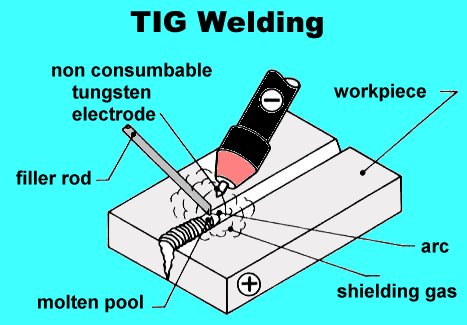
Here helps you actually realize why it welds...The "electricity" melts the filler rod (thing you hold in your hand that melts the metal together) to the metal you are working on.
MIG and flux cored welding offer advantages over other welding processes, especially for the novice. With these two processes, the welding machine creates an arc between the work piece (what you want to weld) and a continuously consumable electrode (the "wire" in these wire welding processes). The operator need only focus on directing the MIG gun at the joint and proper motion. Most welding machines that can MIG weld can also flux cored weld.

Here is the outlay of the gun... Understanding what all the parts are and what they do is very helpful.

Fluxed core welding as asked:
Your average solder has a cleaning agent in-usually Rosin core. The filler actually helps to clean the metal so the new metal can adhere to it. Flux cored welding takes on the same principal. Gas MIG uses an Argon gas mix to shield of atmospheric gases and create a clean weld. Instead of using gas, Fluxed core welding has a type of "solder-like Rosin core"...just not actual Rosin. Flux cored welding can get really hot and is not usually used on really thin metal do the the weld "burning through".
Here is your typcial MIG, you usually had a spot in the back to hook up gas, Gas is used to "purify" the weld and have differnt heat characteristics. Gas welds usually look better than non gas-flux cored welds.
 Let me know guys about if this confuses you or something, I am only 17 years old...bare with me
Modified by Anthonyl469 at 10:32 PM 8/15/2004
Modified by Anthonyl469 at 10:33 PM 8/15/2004
So here we go.
The TIG process lets you weld thinner material than other processes. If you want to solve problems related to burn-through or warping when Stick or wire welding, TIG might be the solution. TIG also provides excellent fusion. While it's hard to learn, takes a lot of skill and is slow, the quality of a TIG weld bead meets the needs of aerospace, power piping and other critical applications. TIG also produces the best looking weld beads, which is why it is often specified when cosmetic appearances really count — and why TIG welding operators are considered the artists of the welding world.
Here shows the gun, electrode, and rod...the rod is held in hand and melts to the metal which you are welding.
Here helps you actually realize why it welds...The "electricity" melts the filler rod (thing you hold in your hand that melts the metal together) to the metal you are working on.
MIG and flux cored welding offer advantages over other welding processes, especially for the novice. With these two processes, the welding machine creates an arc between the work piece (what you want to weld) and a continuously consumable electrode (the "wire" in these wire welding processes). The operator need only focus on directing the MIG gun at the joint and proper motion. Most welding machines that can MIG weld can also flux cored weld.
Here is the outlay of the gun... Understanding what all the parts are and what they do is very helpful.
Fluxed core welding as asked:
Your average solder has a cleaning agent in-usually Rosin core. The filler actually helps to clean the metal so the new metal can adhere to it. Flux cored welding takes on the same principal. Gas MIG uses an Argon gas mix to shield of atmospheric gases and create a clean weld. Instead of using gas, Fluxed core welding has a type of "solder-like Rosin core"...just not actual Rosin. Flux cored welding can get really hot and is not usually used on really thin metal do the the weld "burning through".
Here is your typcial MIG, you usually had a spot in the back to hook up gas, Gas is used to "purify" the weld and have differnt heat characteristics. Gas welds usually look better than non gas-flux cored welds.
Let me know guys about if this confuses you or something, I am only 17 years old...bare with me Modified by Anthonyl469 at 10:32 PM 8/15/2004
Modified by Anthonyl469 at 10:33 PM 8/15/2004


Honda-Tech Member
Joined: Nov 2002
Posts: 17,227
Likes: 2
From: Illinois
Re: Differnce between MIG and TIG-small writeup (Anthonyl469)
Nice little write up, it seems like you did not touch a lot on flux core welds, care to explain a flux core weld a little more.

Honda-Tech Member
Joined: Oct 2002
Posts: 12,653
Likes: 7
From: Cali
Re: Differnce between MIG and TIG-small writeup (90blackcrx)
This will help alot of people understand the difference. This should really stay at the top in red letters.
Edit: changed read to red.
Modified by Luserkid at 6:42 PM 8/15/2004
Edit: changed read to red.
Modified by Luserkid at 6:42 PM 8/15/2004

Honda-Tech Member
Joined: Aug 2003
Posts: 2,462
Likes: 0
From: 310, Ca
Re: Differnce between MIG and TIG-small writeup (Luserkid)
<TABLE WIDTH="90%" CELLSPACING=0 CELLPADDING=0 ALIGN=CENTER><TR><TD>Quote, originally posted by Luserkid »</TD></TR><TR><TD CLASS="quote">This will help alot of people understand the difference. This should really stay at the top in read letters. </TD></TR></TABLE>
</TD></TR></TABLE>
Trending Topics

Honda-Tech Member
Joined: Nov 2002
Posts: 17,227
Likes: 2
From: Illinois
Re: (Anthonyl469)
<TABLE WIDTH="90%" CELLSPACING=0 CELLPADDING=0 ALIGN=CENTER><TR><TD>Quote, originally posted by Anthonyl469 »</TD></TR><TR><TD CLASS="quote">a little on Flux now</TD></TR></TABLE>
Thanks, just stopeed in, will read it all again later.
Thanks, just stopeed in, will read it all again later.


Honda-Tech Member
Joined: May 2003
Posts: 2,365
Likes: 1
From: San Jose, Ca, USA
Re: (vtec69)
dont wanna start a new thread for this question so ill ask it here
any difference in strength between MIG and TIG welds? if i wanted to weld some mounts for an engine with a MIG welder would they hold? how skilled do i have to be? will some practice welds do the job?
any difference in strength between MIG and TIG welds? if i wanted to weld some mounts for an engine with a MIG welder would they hold? how skilled do i have to be? will some practice welds do the job?

Rotary Lift Specialist
Joined: Dec 2003
Posts: 15,298
Likes: 0
Re: (91civicLX)
im new with welding, but it seems that tig welding is somewhat like soldering(sp?), ive mig welded before, i sucked, but it takes practice, after awhile i got pretty good, and i made my girlfriend a table, it turned out rather sweet

Honda-Tech Member
Joined: Jun 2003
Posts: 4,167
Likes: 0
From: Portland, OR
Re: (turtlecx92)
<TABLE WIDTH="90%" CELLSPACING=0 CELLPADDING=0 ALIGN=CENTER><TR><TD>Quote, originally posted by turtlecx92 »</TD></TR><TR><TD CLASS="quote">im new with welding, but it seems that tig welding is somewhat like soldering(sp?), ive mig welded before, i sucked, but it takes practice, after awhile i got pretty good, and i made my girlfriend a table, it turned out rather sweet</TD></TR></TABLE>
TIG is not really like soldering at all. Oxy-Ac is kinda like soldering. MIG and TIG both use gas to sheild. MIG's filler wire come out of the gun and causes the arc and is used as filler. TIG uses a tungsten (the T in TIG) electrode to creat the arc and you feed the filler in with the other hand.
MIG and TIG are both very strong, but there must be a reason that most racing associations only allow TIGed welds on your roll cage.
TIG is not really like soldering at all. Oxy-Ac is kinda like soldering. MIG and TIG both use gas to sheild. MIG's filler wire come out of the gun and causes the arc and is used as filler. TIG uses a tungsten (the T in TIG) electrode to creat the arc and you feed the filler in with the other hand.
MIG and TIG are both very strong, but there must be a reason that most racing associations only allow TIGed welds on your roll cage.


Joined: Jan 2004
Posts: 700
Likes: 0
From: Rubicon, WI, USA
Re: Differnce between MIG and TIG-small writeup (Anthonyl469)
[QUOTE=Anthonyl469] the filler rod (thing you hold in your hand that melts the metal together)QUOTE]
Not always true: Filler rod is not needed to melt the metals together, it simply aids the welder by filling in gaps and increasing weld strength. The Tig torch arc creates enough heat to melt surrounding metal and can be bonded togethed without filler rod if there a small enough gap between two work-peices being welded.
Not always true: Filler rod is not needed to melt the metals together, it simply aids the welder by filling in gaps and increasing weld strength. The Tig torch arc creates enough heat to melt surrounding metal and can be bonded togethed without filler rod if there a small enough gap between two work-peices being welded.

Thread
Thread Starter
Forum
Replies
Last Post
Touge Tuning
Welding / Fabrication
15
Feb 15, 2006 11:19 AM
