


general ignition discussion/question


Thread Starter
Joined: Nov 2004
Posts: 61
Likes: 0
From: Lake Stevens, wa
 general ignition discussion/question
To better understand how engine ignition works, I have been doing some research on it. To the best of my knowledge, I believe it works as follows:
In relation to piston, piston rod movement, and crankshaft movement, there is a point in the rotation of the crank where the piston is still, but the piston rod still moves (I believe it to be somewhere around 15-20 degrees). It takes a certain amount of time for the flame front (from the ignited air/fuel) to reach the piston and actually start pushing down on the piston. The engine computer takes this into account and advances the ignition to cause the spark plug to spark before the piston rod/crank rotation reaches 0 degrees, creating enough time for the flame front to reach the piston when the piston rod/crank rotate to the point where they begin to move the piston down.
Now lets start getting technical:
More air=More power, as well as more heat = pre-ignition
To compensate, we use gasolines with higher detonation thresholds, or higher octane numbers. As pressures increase from the added air, there is extra heat generated, but the gasoline octane content controls pre-ignition or pinging, allowing us to keep the same ignition timing as before.
Lets now start talking about power adders (superchargers, turbo's, nitrous):
Superchargers and turbo's force more air into the cylinder than would normally be allowed. Extra air + extra fuel = more power
BUT, this all equates to more heat and pressure inside the cylinder. Because of the added air/fuel, the mixture burns faster than before. The computer recognises this, so it "pulls" timing and causes the spark to ignite after the piston rod/crank are beyond 0 degrees, this is called ignition retard. Also, the added heat/pressures generated cause pre-ignition of the mixture resulting in a loss of power. Ways to fix that is to run higher octane numbered gasoline and/or drop the compression. Dropping the compression changes the time it takes for the flame front to reach the piston, so the computer will change the ignition timing accordingly.
The concept with Nitrous is similar to that of a supercharged/turbo motor. Nitrous is an oxygenator, so it adds more air than what would normally be drawn into a cylinder. More air means more fuel, which means faster burning of the mixture. This means the computer has to tell the ignition that it needs to fire that spark plug later in the stroke (retard).
Things to get out of the way:
Advance timing under nitrous and boost is a NO NO because the ignition may be advanced to the point where its igniting right before the piston stops moving up. This means the piston rod/crank is well before 0 degrees. If ignited at the wrong time, the flame front will actually be pushing down on the piston while the piston rod/crank are still rotating up. Physics 101 tells us that the stronger opposing force will overcome the weaker force. The weaker force is generally the piston rod as its along for the ride going up. Flame front forcing down while piston rod going up = snapped rod through the crankcase

I feel it was relevant to mention the above as I may ask this question. Pre-ignition occurs because of low octane fuel and too high compression for the air/fuel mixture. One of the things that I had been reading is computers can figure out if a vehicle is running low grade fuel, so it will retard the ignition a bit to prevent pre-ignition/detonation. Can someone explain this to me how it works? It seems that it would still pre-ignite regardless of ignition timing to me. Also, feel free to correct terms I may have incorrect or add to this if you feel the need. I am just trying to better understand the workings of the automobile.
If this is a repost, I apologize.
In relation to piston, piston rod movement, and crankshaft movement, there is a point in the rotation of the crank where the piston is still, but the piston rod still moves (I believe it to be somewhere around 15-20 degrees). It takes a certain amount of time for the flame front (from the ignited air/fuel) to reach the piston and actually start pushing down on the piston. The engine computer takes this into account and advances the ignition to cause the spark plug to spark before the piston rod/crank rotation reaches 0 degrees, creating enough time for the flame front to reach the piston when the piston rod/crank rotate to the point where they begin to move the piston down.
Now lets start getting technical:
More air=More power, as well as more heat = pre-ignition
To compensate, we use gasolines with higher detonation thresholds, or higher octane numbers. As pressures increase from the added air, there is extra heat generated, but the gasoline octane content controls pre-ignition or pinging, allowing us to keep the same ignition timing as before.
Lets now start talking about power adders (superchargers, turbo's, nitrous):
Superchargers and turbo's force more air into the cylinder than would normally be allowed. Extra air + extra fuel = more power
BUT, this all equates to more heat and pressure inside the cylinder. Because of the added air/fuel, the mixture burns faster than before. The computer recognises this, so it "pulls" timing and causes the spark to ignite after the piston rod/crank are beyond 0 degrees, this is called ignition retard. Also, the added heat/pressures generated cause pre-ignition of the mixture resulting in a loss of power. Ways to fix that is to run higher octane numbered gasoline and/or drop the compression. Dropping the compression changes the time it takes for the flame front to reach the piston, so the computer will change the ignition timing accordingly.
The concept with Nitrous is similar to that of a supercharged/turbo motor. Nitrous is an oxygenator, so it adds more air than what would normally be drawn into a cylinder. More air means more fuel, which means faster burning of the mixture. This means the computer has to tell the ignition that it needs to fire that spark plug later in the stroke (retard).
Things to get out of the way:
Advance timing under nitrous and boost is a NO NO because the ignition may be advanced to the point where its igniting right before the piston stops moving up. This means the piston rod/crank is well before 0 degrees. If ignited at the wrong time, the flame front will actually be pushing down on the piston while the piston rod/crank are still rotating up. Physics 101 tells us that the stronger opposing force will overcome the weaker force. The weaker force is generally the piston rod as its along for the ride going up. Flame front forcing down while piston rod going up = snapped rod through the crankcase
I feel it was relevant to mention the above as I may ask this question. Pre-ignition occurs because of low octane fuel and too high compression for the air/fuel mixture. One of the things that I had been reading is computers can figure out if a vehicle is running low grade fuel, so it will retard the ignition a bit to prevent pre-ignition/detonation. Can someone explain this to me how it works? It seems that it would still pre-ignite regardless of ignition timing to me. Also, feel free to correct terms I may have incorrect or add to this if you feel the need. I am just trying to better understand the workings of the automobile.
If this is a repost, I apologize.

Honda-Tech Member
Joined: Oct 2001
Posts: 4,611
Likes: 3
From: Severn, MD
Re: general ignition discussion/question (dubman410)
Good effort and good research.
The knock sensor is what enables the ECU to pull timing. If the engine were detonating, or a low grade gas was used which created knock, the knock sensor would hear this (its basically just a microphone), relay that info to the ECU and then the ECU would pull back timing till the knock sensor stopped showing activity.
When the knock sensor stops showing activity, ignition will go back to where it was and if knock occurs again, timing is pulled - rinse, lather, repeat.
The knock sensor is what enables the ECU to pull timing. If the engine were detonating, or a low grade gas was used which created knock, the knock sensor would hear this (its basically just a microphone), relay that info to the ECU and then the ECU would pull back timing till the knock sensor stopped showing activity.
When the knock sensor stops showing activity, ignition will go back to where it was and if knock occurs again, timing is pulled - rinse, lather, repeat.
Thread Starter
Joined: Nov 2004
Posts: 61
Likes: 0
From: Lake Stevens, wa
Re: general ignition discussion/question (EE_Chris)
I figured the knock sensor was nothing more than a microphone listening to the engine. I just can't seem to figure something out about how it works. To the best of my knowledge, pre-ignition is when the mixture ignites before the spark plug fires (hence the name). This leads me to believe that on the compression stroke, the pressures and heat generated is too much for the gasoline, so it ignites. How does retarding the ignition help?

Mad Scientist
Joined: Nov 2002
Posts: 5,827
Likes: 1
From: tallafizzy, FL state
Re: general ignition discussion/question (dubman410)
well, the knock sensor is mainly used to detect detonation, as far as pre-ignition; well you should not be worried about pre-ignition too much since you only gonna get lucky to see pre-ig. once or twice in the engine's life... pre- igniton Melts
dont get them confused.
detonation occurs after the spark plug has ignited the fuel mixture so cyl. pressures created by the knock are way lower as so is heat. detonation breaks pistons because of the shock, not so much the heat
knock sensor listens for knock and pulls timing for the next cycle.
As far as ignition timing; you worry about when the combustion process ends, not where it starts. You want the process to end about 15-25deg. atdc.
too much advance, and the pistons will fight its way to tdc; too little advance and the combustion process will end at a less optimal crank angle thus creating less torque to push the piston down. You can even make the piston actually run away from the flame front..
where you start it depends on load/ rpms/ gas octane, etc.
you could in theory calculate how fast the flame propagates, based on cyl. size; but that never happens since they are soo many variables that account into that.
compression; the reason why using lower compression needs more timing is because as you say, changes flame speed because of less air density ( this is leaving piston design/dome on the side)
more comopression increases air density in the cyl. thus needeing less timing to get the fuel ignited correctly.
more density= faster flame
boost needs less timing because of more air density
dont get them confused.
detonation occurs after the spark plug has ignited the fuel mixture so cyl. pressures created by the knock are way lower as so is heat. detonation breaks pistons because of the shock, not so much the heat
knock sensor listens for knock and pulls timing for the next cycle.
As far as ignition timing; you worry about when the combustion process ends, not where it starts. You want the process to end about 15-25deg. atdc.
too much advance, and the pistons will fight its way to tdc; too little advance and the combustion process will end at a less optimal crank angle thus creating less torque to push the piston down. You can even make the piston actually run away from the flame front..
where you start it depends on load/ rpms/ gas octane, etc.
you could in theory calculate how fast the flame propagates, based on cyl. size; but that never happens since they are soo many variables that account into that.
compression; the reason why using lower compression needs more timing is because as you say, changes flame speed because of less air density ( this is leaving piston design/dome on the side)
more comopression increases air density in the cyl. thus needeing less timing to get the fuel ignited correctly.
more density= faster flame
boost needs less timing because of more air density
Thread Starter
Joined: Nov 2004
Posts: 61
Likes: 0
From: Lake Stevens, wa
Re: general ignition discussion/question (mmuller)
Just to get some terms straightened out;
Pre-ignition is when the mixture is completely ignited well before the spark plug fires. This causes too much heat too fast, melting/siezing the piston to the cylinder wall?
Detonation occurs after the spark plug fires. Since it occurs after the spark, how what are the factors that cause detonation?
Pre-ignition is when the mixture is completely ignited well before the spark plug fires. This causes too much heat too fast, melting/siezing the piston to the cylinder wall?
Detonation occurs after the spark plug fires. Since it occurs after the spark, how what are the factors that cause detonation?
Mad Scientist
Joined: Nov 2002
Posts: 5,827
Likes: 1
From: tallafizzy, FL state
Re: general ignition discussion/question (dubman410)
detonation is incitated by hot spots igniting the mixture at different spots; you you can have the spark plug + 2-3 whatever flames starting too. so then they'll collide with each other creating a big bang.
hot spots like sharp edges, hot ex valves,etc.
edit; i suck at expressing myself..
Modified by mmuller at 5:21 PM 3/16/2005
hot spots like sharp edges, hot ex valves,etc.
edit; i suck at expressing myself..
Modified by mmuller at 5:21 PM 3/16/2005
Thread Starter
Joined: Nov 2004
Posts: 61
Likes: 0
From: Lake Stevens, wa
Re: general ignition discussion/question (mmuller)
Ok, lets see if I got the concepts down:
Detnation occurs when several flame fronts collide, creating a shock wave inside the cylinder. Too much pressure forced onto the piston and it breaks (just the piston, or connecting rod as well?). In order to prevent this, the ecu listens to the knock sensor (tiny microphone). The computer tells the spark plug to fire at X degrees in relation to crank position (crank angle). The computer "hears" the knock sensor, so it retards the timing on the next cycle, and continues to do so until it no longer hears any knocking at about 10 degrees atdc (just to throw a number out). On the next cycle, it advances 1 degree, "hears" a knock, then retards the ignition 1 degree for the next cycle so it no longer hears the knock.
quick questions:
Knocking occurs right before detonation?
Does the computer retard ignition to the point where it fires right before, after, or right at the point where knocking would occur?
Now for before ignition:
Can pre-ignition be interchanged with pinging, or is that a completely unrelated concept?
If retarding timing reduces knocking/detonation, does advancing timing reduce pinging/pre-ignition?
Detnation occurs when several flame fronts collide, creating a shock wave inside the cylinder. Too much pressure forced onto the piston and it breaks (just the piston, or connecting rod as well?). In order to prevent this, the ecu listens to the knock sensor (tiny microphone). The computer tells the spark plug to fire at X degrees in relation to crank position (crank angle). The computer "hears" the knock sensor, so it retards the timing on the next cycle, and continues to do so until it no longer hears any knocking at about 10 degrees atdc (just to throw a number out). On the next cycle, it advances 1 degree, "hears" a knock, then retards the ignition 1 degree for the next cycle so it no longer hears the knock.
quick questions:
Knocking occurs right before detonation?
Does the computer retard ignition to the point where it fires right before, after, or right at the point where knocking would occur?
Now for before ignition:
Can pre-ignition be interchanged with pinging, or is that a completely unrelated concept?
If retarding timing reduces knocking/detonation, does advancing timing reduce pinging/pre-ignition?
Trending Topics

Honda-Tech Member
Joined: Jan 2003
Posts: 8,132
Likes: 5
Re: general ignition discussion/question (dubman410)
Knocking & pinging are sorta descriptions of the sound. There's not really complete agreement about the details of what goes on, & it's not easy to measure or see it as it's happening.
Normally, a flame-front starts at the spark & moves across the combustion chamber nice & orderly. You chose your spark timing to get the most push delivered to the top of the piston, without causing problems. You also have to choose a timing that doesn't make too much NOx.
The end-gas is the stuff in the corners, where the flame-front hasn't reached yet. This end-gas gets hotter & more compressed as the flame-front moves towards it. Pre-flame chemical reactions are already starting. Sometimes it actually ignites before the flame gets there. That's pre-ignition. It's not before the SPARK, but it IS before the flame-front gets there.
Detonation technically is when the flame-front moves at a supersonic speed. That alone makes a shock wave even without pre-ignition of the end gas.
Either way, the shocks create a pretty strong signal for the knock sensor to hear. It doesn't matter which reason is truly causing the shock, retarding the spark timing controls it.
Normally, a flame-front starts at the spark & moves across the combustion chamber nice & orderly. You chose your spark timing to get the most push delivered to the top of the piston, without causing problems. You also have to choose a timing that doesn't make too much NOx.
The end-gas is the stuff in the corners, where the flame-front hasn't reached yet. This end-gas gets hotter & more compressed as the flame-front moves towards it. Pre-flame chemical reactions are already starting. Sometimes it actually ignites before the flame gets there. That's pre-ignition. It's not before the SPARK, but it IS before the flame-front gets there.
Detonation technically is when the flame-front moves at a supersonic speed. That alone makes a shock wave even without pre-ignition of the end gas.
Either way, the shocks create a pretty strong signal for the knock sensor to hear. It doesn't matter which reason is truly causing the shock, retarding the spark timing controls it.
Mad Scientist
Joined: Nov 2002
Posts: 5,827
Likes: 1
From: tallafizzy, FL state
Re: general ignition discussion/question (JimBlake)
<TABLE WIDTH="90%" CELLSPACING=0 CELLPADDING=0 ALIGN=CENTER><TR><TD>Quote, originally posted by dubman410 »</TD></TR><TR><TD CLASS="quote">
quick questions:
Knocking occurs right before detonation?
Does the computer retard ignition to the point where it fires right before, after, or right at the point where knocking would occur?
</TD></TR></TABLE>
the pinging is the pressure wave from the 2 or more flame fronts ''colliding''
<TABLE WIDTH="90%" CELLSPACING=0 CELLPADDING=0 ALIGN=CENTER><TR><TD>Quote, originally posted by JimBlake »</TD></TR><TR><TD CLASS="quote">
The end-gas is the stuff in the corners, where the flame-front hasn't reached yet. This end-gas gets hotter & more compressed as the flame-front moves towards it. Pre-flame chemical reactions are already starting. Sometimes it actually ignites before the flame gets there.</TD></TR></TABLE>
as far as detonation, im going to edit my past post , Jim is right, i ment to say that hot spots incitates detonation.like for example hot ex. valves
Im going to have to disagree with Jimon the pre- ignition part , pre ignition is no means the same as detonation.
pre- ignition is also mainly a result of enough detonation before hand; That in order heats up the ''critical'' part enough( usually spark plug tip) that when the next cycle , as piston compresses the air; it auto ignites the mixture.
this happens BEFORE the spark tries to ignite the mixture.it kinda acts like a glow plug. and this can happen anytime in the compression stroke. Thats why they are only a lucky few to survive.
pre- ignition gives no warning.
quick questions:
Knocking occurs right before detonation?
Does the computer retard ignition to the point where it fires right before, after, or right at the point where knocking would occur?
</TD></TR></TABLE>
the pinging is the pressure wave from the 2 or more flame fronts ''colliding''
<TABLE WIDTH="90%" CELLSPACING=0 CELLPADDING=0 ALIGN=CENTER><TR><TD>Quote, originally posted by JimBlake »</TD></TR><TR><TD CLASS="quote">
The end-gas is the stuff in the corners, where the flame-front hasn't reached yet. This end-gas gets hotter & more compressed as the flame-front moves towards it. Pre-flame chemical reactions are already starting. Sometimes it actually ignites before the flame gets there.</TD></TR></TABLE>
as far as detonation, im going to edit my past post , Jim is right, i ment to say that hot spots incitates detonation.like for example hot ex. valves
Im going to have to disagree with Jimon the pre- ignition part , pre ignition is no means the same as detonation.
pre- ignition is also mainly a result of enough detonation before hand; That in order heats up the ''critical'' part enough( usually spark plug tip) that when the next cycle , as piston compresses the air; it auto ignites the mixture.
this happens BEFORE the spark tries to ignite the mixture.it kinda acts like a glow plug. and this can happen anytime in the compression stroke. Thats why they are only a lucky few to survive.
pre- ignition gives no warning.

Honda-Tech Member
Joined: Jan 2003
Posts: 8,132
Likes: 5
Re: general ignition discussion/question (mmuller)
<TABLE WIDTH="90%" CELLSPACING=0 CELLPADDING=0 ALIGN=CENTER><TR><TD>Quote, originally posted by mmuller »</TD></TR><TR><TD CLASS="quote">Im going to have to disagree with Jim on the pre-ignition part, pre ignition is no means the same as detonation.</TD></TR></TABLE>I didn't mean to say that pre-ignition is the the same as detonation. Detonation is supersonic combustion. Pre-ignition is what I said, but I should have said surface ignition to include pre- & post-ignition.
I looked up some stuff in my old textbook...
Surface ignition is initiation of a new flame-front by some hot surface - not the spark.
Pre-ignition is surface ignition occurring before the spark.
Post-ignition is surface ignition occurring after the spark.
Hot spots don't indicate detonation, they can be caused by other things. For example end-gas that's too rich, making soot that builds up; this layer of carbon stays hot for the next cycle & acts like a glow-plug. You don't need detonation for this to happen.
I don't work in that field, & my textbook is more than 25 years old, but at that time there was not very good agreement about everything that's actually going on in the combustion chamber. But certainly the pre-flame chemical reactions are pretty complicated & the end-gas (before it's burned) isn't simply air & gasoline.
I looked up some stuff in my old textbook...
Surface ignition is initiation of a new flame-front by some hot surface - not the spark.
Pre-ignition is surface ignition occurring before the spark.
Post-ignition is surface ignition occurring after the spark.
Hot spots don't indicate detonation, they can be caused by other things. For example end-gas that's too rich, making soot that builds up; this layer of carbon stays hot for the next cycle & acts like a glow-plug. You don't need detonation for this to happen.
I don't work in that field, & my textbook is more than 25 years old, but at that time there was not very good agreement about everything that's actually going on in the combustion chamber. But certainly the pre-flame chemical reactions are pretty complicated & the end-gas (before it's burned) isn't simply air & gasoline.

Honda-Tech Member
Joined: Sep 2002
Posts: 1,475
Likes: 0
From: Caracas, Venezuela
Re: general ignition discussion/question (dubman410)
First, i wanna say to the creator of the thread that i admire the aproach to learn he is using.
second, like jim said, what happend on the cc is pretty unknown (altough this might have changed already or is on it's way since i know lotus did an all glass cc to study the phenomenon) all that we have to talk about is theory and some studies. i'm not saying what we are saying is wrong, but that it might not be 100% true.
Anyway, i don't know much, but your info sounds about good, altough i should read it again, lol... (english not my first language)
A question i want to throw since i think i'm wrong, wouldn't a way to lower combustion temperatures would be to get more fuel in there, since if we have too much heat wouldn't that mean we can have more fuel to use the heat? now that i go back and really think about it i'm kinda confused.
Also, i remember reading somewhere that on hondas when the engine heard knocking the ecu retarded the timming a predetermined amount (i think it was either 12 or 21 degrees, but i can't remember) might be something we should look up to keep on our knowledge.
Also, mmuller said something about hot spots, this, IMHO, is VERY important when building an engine, since it will determine how good the builder is. (i'm not doing any in depth of that since this is not the topic)
hope i gave something to the thread.
second, like jim said, what happend on the cc is pretty unknown (altough this might have changed already or is on it's way since i know lotus did an all glass cc to study the phenomenon) all that we have to talk about is theory and some studies. i'm not saying what we are saying is wrong, but that it might not be 100% true.
Anyway, i don't know much, but your info sounds about good, altough i should read it again, lol... (english not my first language)
A question i want to throw since i think i'm wrong, wouldn't a way to lower combustion temperatures would be to get more fuel in there, since if we have too much heat wouldn't that mean we can have more fuel to use the heat? now that i go back and really think about it i'm kinda confused.
Also, i remember reading somewhere that on hondas when the engine heard knocking the ecu retarded the timming a predetermined amount (i think it was either 12 or 21 degrees, but i can't remember) might be something we should look up to keep on our knowledge.
Also, mmuller said something about hot spots, this, IMHO, is VERY important when building an engine, since it will determine how good the builder is. (i'm not doing any in depth of that since this is not the topic)
hope i gave something to the thread.
Thread Starter
Joined: Nov 2004
Posts: 61
Likes: 0
From: Lake Stevens, wa
Re: general ignition discussion/question (GZERO)
Thanks GZERO, just trying to get facts straightend out. It is a big pet peeve of mine to read/hear what ignorant people say when they think they know what they are talking about when they actually dont.
Back on topic:
I found another discussion very similar to what is going on here:
http://www.automotivetech.org/...=6299
From the reading there, I figured detonation is caused by firing the spark plug too early in the compression stroke (n/a or forced induction, doesnt matter I don't think). As the piston continous up, fighting the flame front, it generates too much pressure and heat, then BOOOM, detonation. To solve that, retard ignition firing so the pressures are no longer high enough to cause detonation/knocking/pinging.
mmuller, that was a good description about pre-ignition, exactly what I was looking for. How about this:
Octane ratings are used to show energy thresholds of the bonds between the hydrocarbon molecules (correct?). Higher the octane rating, higher threshold for breaking these bonds and generating energy (aka, explosion). Too little octane rating coupled with high cylinder pressures (either from raised compression or boost) causes the mixture to ignite pre-maturally on the compression stroke. What does this have to do with ignition? From what I have been reading, car ecu's sense this and retards the ignition. Now how does retarded ignition protect from this happening, or am I getting a few things turned around and mixed up?
Back on topic:
I found another discussion very similar to what is going on here:
http://www.automotivetech.org/...=6299
From the reading there, I figured detonation is caused by firing the spark plug too early in the compression stroke (n/a or forced induction, doesnt matter I don't think). As the piston continous up, fighting the flame front, it generates too much pressure and heat, then BOOOM, detonation
. To solve that, retard ignition firing so the pressures are no longer high enough to cause detonation/knocking/pinging.mmuller, that was a good description about pre-ignition, exactly what I was looking for. How about this:
Octane ratings are used to show energy thresholds of the bonds between the hydrocarbon molecules (correct?). Higher the octane rating, higher threshold for breaking these bonds and generating energy (aka, explosion). Too little octane rating coupled with high cylinder pressures (either from raised compression or boost) causes the mixture to ignite pre-maturally on the compression stroke. What does this have to do with ignition? From what I have been reading, car ecu's sense this and retards the ignition. Now how does retarded ignition protect from this happening, or am I getting a few things turned around and mixed up?
Honda-Tech Member
Joined: Jan 2003
Posts: 8,132
Likes: 5
Re: general ignition discussion/question (dubman410)
GZERO, I bet the spark retards a lot less than that. The one example I can remember is my former '89 Saab retarded it's spark in 3-degree steps. I bet things have only gotten more sophisticated since then.
Dubman,
Spark is always timed before TDC. There's a chemical delay time before the flame gets going. When it starts it's a small kernel around the spark. So the majority of the combustion & pressure rise are happening close to or after TDC. If you retard the spark it happens later, as the piston is already moving down. That lowers the peak temperature & pressure which reduces the tendency of the end-gas to ignite before the flame-front gets there.
Don't get buried in details of hydrocarbon bonds & stuff like that. Think of the anti-knock ('octane') rating of a fuel is a way to capture more than one phenomenon together. You don't know (don't care) whether it's really caused by gasoline chemistry, pre-flame reactions making the end-gas easy to ignite, or maybe it's carbon build-up in the CC, or whatever. Nearly all of these will improve when you retard the spark, & hopefully the engine-designer has eliminated the ones that don't respond to spark timing.
Now the ECU can't measure any fuel chemistry, there's no sensors in the car to do that. When you read about cars that 'sense' when you use low-octane fuel, that's marketing BS. All it does is 'listen' with the knock sensor. When it hears something it backs off the timing until it's happy. Some turbo cars can also back off the boost & throttle at the same time, but it's still driven by the ecu 'hearing' the knock.
Dubman,
Spark is always timed before TDC. There's a chemical delay time before the flame gets going. When it starts it's a small kernel around the spark. So the majority of the combustion & pressure rise are happening close to or after TDC. If you retard the spark it happens later, as the piston is already moving down. That lowers the peak temperature & pressure which reduces the tendency of the end-gas to ignite before the flame-front gets there.
Don't get buried in details of hydrocarbon bonds & stuff like that. Think of the anti-knock ('octane') rating of a fuel is a way to capture more than one phenomenon together. You don't know (don't care) whether it's really caused by gasoline chemistry, pre-flame reactions making the end-gas easy to ignite, or maybe it's carbon build-up in the CC, or whatever. Nearly all of these will improve when you retard the spark, & hopefully the engine-designer has eliminated the ones that don't respond to spark timing.
Now the ECU can't measure any fuel chemistry, there's no sensors in the car to do that. When you read about cars that 'sense' when you use low-octane fuel, that's marketing BS. All it does is 'listen' with the knock sensor. When it hears something it backs off the timing until it's happy. Some turbo cars can also back off the boost & throttle at the same time, but it's still driven by the ecu 'hearing' the knock.
Thread Starter
Joined: Nov 2004
Posts: 61
Likes: 0
From: Lake Stevens, wa
Re: (GZERO)
I believe it would work, and heres why:
14.7 air/fuel ratio was figured out to be the best ratio for a complete chemical reaction. It uses all the reactants completely, leaving H2O and CO2 as byproducts of ignition. This works out on paper, but due to the properties of compression and other various elements in the air (mainly nitrogen), we see NOx gasses as well, but that is another topic.
Given the same amount of air, and adjusting the fuel amount, it changes various variables in the reaction. I am sure we know that hotter EGT's come from too lean a mixture (above 14.7 a/f ratio), and cooler EGT's come from richer mixture (below 14.7 a/f ratio). I believe that leaner = hotter temps because there is nothing to absorb the heat, except for the air, and it has a very low heat exchange rate. Add more liquids in this mix (in our case, fuel), less gets ignited, and the rest absorbs the heat. I think the only problem with that is since the combustion isn't as complete as it would be at 14.7 a/f ratio, then it could leave deposits which over time could cause problems later on.
Thats my thinking behind it and the best I could do without actually getting too involved in the physics/chemistry of the properties of the two.
JimBlake, I am curious about how retarding helps with the knocking. Lets say, overtime, you get carbon deposits inside the combustion chamber. These tend to raise the compression slightly in the cylinder, and generate hot spots in certain areas. As the piston moves to the compression stroke, the mixture increases in pressure and temperature (normal operation). Somewhere after the piston stops, but before the spark plug fires, a hot spot created by the carbon deposits ignites the mixture prematurally, then the spark plug fires and we get a collision between the two flame fronts, generating an audible signal picked up by the knock sensor (or however it reads a knock whether it be when the hot spot ignites or if the flame fronts combine). How will retarding the ignition help, since its the hot spot is igniting the mixture before the spark plug fires? Its seems a certain amount of advancement would solve this, but then you run into having too far of an advance, and the piston then actually fights its way up to TDC, lossing power, and creating more wear on the parts.
14.7 air/fuel ratio was figured out to be the best ratio for a complete chemical reaction. It uses all the reactants completely, leaving H2O and CO2 as byproducts of ignition. This works out on paper, but due to the properties of compression and other various elements in the air (mainly nitrogen), we see NOx gasses as well, but that is another topic.
Given the same amount of air, and adjusting the fuel amount, it changes various variables in the reaction. I am sure we know that hotter EGT's come from too lean a mixture (above 14.7 a/f ratio), and cooler EGT's come from richer mixture (below 14.7 a/f ratio). I believe that leaner = hotter temps because there is nothing to absorb the heat, except for the air, and it has a very low heat exchange rate. Add more liquids in this mix (in our case, fuel), less gets ignited, and the rest absorbs the heat. I think the only problem with that is since the combustion isn't as complete as it would be at 14.7 a/f ratio, then it could leave deposits which over time could cause problems later on.
Thats my thinking behind it and the best I could do without actually getting too involved in the physics/chemistry of the properties of the two.
JimBlake, I am curious about how retarding helps with the knocking. Lets say, overtime, you get carbon deposits inside the combustion chamber. These tend to raise the compression slightly in the cylinder, and generate hot spots in certain areas. As the piston moves to the compression stroke, the mixture increases in pressure and temperature (normal operation). Somewhere after the piston stops, but before the spark plug fires, a hot spot created by the carbon deposits ignites the mixture prematurally, then the spark plug fires and we get a collision between the two flame fronts, generating an audible signal picked up by the knock sensor (or however it reads a knock whether it be when the hot spot ignites or if the flame fronts combine). How will retarding the ignition help, since its the hot spot is igniting the mixture before the spark plug fires? Its seems a certain amount of advancement would solve this, but then you run into having too far of an advance, and the piston then actually fights its way up to TDC, lossing power, and creating more wear on the parts.
Honda-Tech Member
Joined: Sep 2002
Posts: 1,475
Likes: 0
From: Caracas, Venezuela
Re: (dubman410)
what you say is the same thing i tought about, but there's is something i think you don't have right, 14.7 is a good number.. for cruising and emissions, the thing is the engines doesn't see it as often as they should, under acceleration a car goes down to like 11:1 A/F ratio (turbos like 11 while NA like it a lil more lean at around 12, off course, this numbers are aproximations, since every car is different)
Carbon Build up is just something you can't stop (or at least not till the day), maybe if you throw some maintainance to clean it (ATF oil in cylincers, or the good old water vapors). And yes, carbon deposits can usually start hot spots, in fact, most of the times a valve breaks down is because a carbon deposit help overheating the valve and caused for it to melt.
Carbon Build up is just something you can't stop (or at least not till the day), maybe if you throw some maintainance to clean it (ATF oil in cylincers, or the good old water vapors). And yes, carbon deposits can usually start hot spots, in fact, most of the times a valve breaks down is because a carbon deposit help overheating the valve and caused for it to melt.
Honda-Tech Member
Joined: Jan 2003
Posts: 8,132
Likes: 5
Re: (dubman410)
<TABLE WIDTH="90%" CELLSPACING=0 CELLPADDING=0 ALIGN=CENTER><TR><TD>Quote, originally posted by GZERO »</TD></TR><TR><TD CLASS="quote">so if you have high temperatures, you can just inject more fuel and get the temps down? or i'm just wrong?</TD></TR></TABLE>Adding extra fuel cools down the process, but that just creates more unburned HC which the smog police don't like. WOT enrichment is used because most cars don't go to WOT during their EPA test cycle.
<TABLE WIDTH="90%" CELLSPACING=0 CELLPADDING=0 ALIGN=CENTER><TR><TD>Quote, originally posted by dubman410 »</TD></TR><TR><TD CLASS="quote">JimBlake, I am curious about how retarding helps with the knocking...</TD></TR></TABLE>The spark is always before TDC, so it always goes off while the piston is still moving upwards. The reason it doesn't have to fight it's way up is the chemical & physical delay before the flame front starts moving across the combustion chamber.
The flame front travels across the CC WHILE the piston starts moving down. Even so, the end-gases are compressed & heated by the approaching flame front. If the spark is delayed, that compression & heating is less strong.
Generally the carbon deposits (hot spots) aren't enough to ignite the end-gas. The approaching flame-front has to do a lot more compression & heating, & the pre-flame reactions have time to happen.
<TABLE WIDTH="90%" CELLSPACING=0 CELLPADDING=0 ALIGN=CENTER><TR><TD>Quote, originally posted by dubman410 »</TD></TR><TR><TD CLASS="quote">JimBlake, I am curious about how retarding helps with the knocking...</TD></TR></TABLE>The spark is always before TDC, so it always goes off while the piston is still moving upwards. The reason it doesn't have to fight it's way up is the chemical & physical delay before the flame front starts moving across the combustion chamber.
The flame front travels across the CC WHILE the piston starts moving down. Even so, the end-gases are compressed & heated by the approaching flame front. If the spark is delayed, that compression & heating is less strong.
Generally the carbon deposits (hot spots) aren't enough to ignite the end-gas. The approaching flame-front has to do a lot more compression & heating, & the pre-flame reactions have time to happen.
Thread Starter
Joined: Nov 2004
Posts: 61
Likes: 0
From: Lake Stevens, wa
Re: (JimBlake)
<TABLE WIDTH="90%" CELLSPACING=0 CELLPADDING=0 ALIGN=CENTER><TR><TD>Quote, originally posted by GZERO »</TD></TR><TR><TD CLASS="quote">14.7 is a good number.. for cruising and emissions, the thing is the engines doesn't see it as often as they should, under acceleration a car goes down to like 11:1 A/F ratio (turbos like 11 while NA like it a lil more lean at around 12, off course, this numbers are aproximations, since every car is different)</TD></TR></TABLE>
I wasn't aware that an N/A motor drops that low. I know that forced induction motors tend to like it rich under WOT, and as you approach redline, it's usually best to go richer. I think the richest I have seen at WOT and at redline, was close to 11:1, and the person tuning said that was a bit richer than what he liked (turboed car). I thought that N/A wouldn't drop below MAYBE 12.7:1, if that rich, could be wrong on my part though.
<TABLE WIDTH="90%" CELLSPACING=0 CELLPADDING=0 ALIGN=CENTER><TR><TD>Quote, originally posted by JimBlake »</TD></TR><TR><TD CLASS="quote">The spark is always before TDC, so it always goes off while the piston is still moving upwards. The reason it doesn't have to fight it's way up is the chemical & physical delay before the flame front starts moving across the combustion chamber.
The flame front travels across the CC WHILE the piston starts moving down. Even so, the end-gases are compressed & heated by the approaching flame front. If the spark is delayed, that compression & heating is less strong.
Generally the carbon deposits (hot spots) aren't enough to ignite the end-gas. The approaching flame-front has to do a lot more compression & heating, & the pre-flame reactions have time to happen.
</TD></TR></TABLE>
Yeah, I was aware that there is a slight delay (milliseconds) between spark and when the flame front reaches the piston, so I knew that it would fire before TDC. Also, after reading this article:
http://www.automotivetech.org/...=6299
it said what you were talking about, how delaying one part of the reaction delays the whole cycle.
Perhaps what I was trying to describe was a form of pre-ignition. Hot spots generated by something (i.e. carbon deposits, or something else), creating an ignition located somewhere else other than at the spark plug (say, by the cylinder wall). I understand that carbon deposits generally not enough to ignite, but thats typically, so it does occur on a rare basis I would believe. Is this a sort of pre-ignition that destroys the engine without warning, or is this similar to a knocking that can be controlled by the ecu?
The big thing about that ^^ is its happening before the spark plug fires. I believe that most of the time, it ignites the mixture first (from the hot spot), then within less than .25-.5 degrees of crank rotation, the spark plug fires, igniting whatever is left that hasn't been ignited. I understand the problems that can arise from such an incident like detonation. Here are a few pics to show what I am talking about:


All this is happening before TDC. Is that pre-ignition, or a form of detonation/knocking/pinging, and if it is, how does retarding the ignition help?
I wasn't aware that an N/A motor drops that low. I know that forced induction motors tend to like it rich under WOT, and as you approach redline, it's usually best to go richer. I think the richest I have seen at WOT and at redline, was close to 11:1, and the person tuning said that was a bit richer than what he liked (turboed car). I thought that N/A wouldn't drop below MAYBE 12.7:1, if that rich, could be wrong on my part though.
<TABLE WIDTH="90%" CELLSPACING=0 CELLPADDING=0 ALIGN=CENTER><TR><TD>Quote, originally posted by JimBlake »</TD></TR><TR><TD CLASS="quote">The spark is always before TDC, so it always goes off while the piston is still moving upwards. The reason it doesn't have to fight it's way up is the chemical & physical delay before the flame front starts moving across the combustion chamber.
The flame front travels across the CC WHILE the piston starts moving down. Even so, the end-gases are compressed & heated by the approaching flame front. If the spark is delayed, that compression & heating is less strong.
Generally the carbon deposits (hot spots) aren't enough to ignite the end-gas. The approaching flame-front has to do a lot more compression & heating, & the pre-flame reactions have time to happen.
</TD></TR></TABLE>
Yeah, I was aware that there is a slight delay (milliseconds) between spark and when the flame front reaches the piston, so I knew that it would fire before TDC. Also, after reading this article:
http://www.automotivetech.org/...=6299
it said what you were talking about, how delaying one part of the reaction delays the whole cycle.
Perhaps what I was trying to describe was a form of pre-ignition. Hot spots generated by something (i.e. carbon deposits, or something else), creating an ignition located somewhere else other than at the spark plug (say, by the cylinder wall). I understand that carbon deposits generally not enough to ignite, but thats typically, so it does occur on a rare basis I would believe. Is this a sort of pre-ignition that destroys the engine without warning, or is this similar to a knocking that can be controlled by the ecu?
The big thing about that ^^ is its happening before the spark plug fires. I believe that most of the time, it ignites the mixture first (from the hot spot), then within less than .25-.5 degrees of crank rotation, the spark plug fires, igniting whatever is left that hasn't been ignited. I understand the problems that can arise from such an incident like detonation. Here are a few pics to show what I am talking about:
All this is happening before TDC. Is that pre-ignition, or a form of detonation/knocking/pinging, and if it is, how does retarding the ignition help?
Honda-Tech Member
Joined: Jan 2003
Posts: 8,132
Likes: 5
Re: (dubman410)
<TABLE WIDTH="90%" CELLSPACING=0 CELLPADDING=0 ALIGN=CENTER><TR><TD>Quote, originally posted by dubman410 »</TD></TR><TR><TD CLASS="quote">All this is happening before TDC. Is that pre-ignition, or a form of detonation/knocking/pinging, and if it is, how does retarding the ignition help?</TD></TR></TABLE>That would be pre-ignition. It can cause knocking or pinging sounds. Pre-ignition, post-ignition, & detonation are specific processes. Knocking & pinging are ways to try to describe sounds.
But you're describing something that occurs before the spark. So retarding the spark won't help. I'm saying that would be a pretty rare thing that the engine-designer has already tried to eliminate. A backyard booster putting on a turbo without changing pistons or CR would have to worry about that.
Most likely, the hot spot can't start it's own flame front until after the end-gas is further compressed & heated by the main flame-front.
Don't be so quick to dismiss the delays of a few millliseconds. Remember, at 6,000 rpm the crank moves 36 degrees each millisecond.
Also, be aware of how you're using the term detonation. What you're describing has nothing to do with the flame-front being subsonic or supersonic.
But you're describing something that occurs before the spark. So retarding the spark won't help. I'm saying that would be a pretty rare thing that the engine-designer has already tried to eliminate. A backyard booster putting on a turbo without changing pistons or CR would have to worry about that.
Most likely, the hot spot can't start it's own flame front until after the end-gas is further compressed & heated by the main flame-front.
Don't be so quick to dismiss the delays of a few millliseconds. Remember, at 6,000 rpm the crank moves 36 degrees each millisecond.
Also, be aware of how you're using the term detonation. What you're describing has nothing to do with the flame-front being subsonic or supersonic.
Thread Starter
Joined: Nov 2004
Posts: 61
Likes: 0
From: Lake Stevens, wa
Re: (JimBlake)
Awsome, that was exactly what I needed to find out. I don't think I was trying to describe the flame front being sub or supersonic in motion.  All this info is good, kinda makes me want to boost now
  Thanks all!!
All this info is good, kinda makes me want to boost now Thanks all!!
Honda-Tech Member
Joined: Sep 2002
Posts: 1,475
Likes: 0
From: Caracas, Venezuela
Re: (dubman410)
ok, so we could sum things up, pre ignition is caused by other elements on the combustion chamber (hot spots, carbon deposits, bad fuel, problems with lubrication and high temps, etc...) and not because of ignition (well maybe if you advance it too much and you overheat the metals starting the hot spots).
And Detonation will happend mainly cuz of ignition settings, meaning, the car is not properly tuned, or it was tuned too close to the threshold and when the ambient changed drastically threw the ignition chart of the map....
And Detonation will happend mainly cuz of ignition settings, meaning, the car is not properly tuned, or it was tuned too close to the threshold and when the ambient changed drastically threw the ignition chart of the map....
Thread Starter
Joined: Nov 2004
Posts: 61
Likes: 0
From: Lake Stevens, wa
I believe that about sums it up. It seems that too far of an advance in ignition timing generates too high cylinder pressure and temperatures causing detonation.
Hots spots in CC = pre-ignition
All big NO NO'S when it comes to motor life and tuning.
Hots spots in CC = pre-ignition
All big NO NO'S when it comes to motor life and tuning.
Honda-Tech Member
Joined: Jan 2003
Posts: 8,132
Likes: 5
Re: (dubman410)
Hot spots in CC can produce surface-ignition.
When it happens before the spark it's called pre-ignition.
After the spark (but before the flame-front gets there) it's called post-ignition.
Timing too far advanced helps to create these hot spots which will cause problems later. Once the hot spots exist, advanced timing makes surface-ignition more likely, by raising temperature & pressure during combustion.
When it happens before the spark it's called pre-ignition.
After the spark (but before the flame-front gets there) it's called post-ignition.
Timing too far advanced helps to create these hot spots which will cause problems later. Once the hot spots exist, advanced timing makes surface-ignition more likely, by raising temperature & pressure during combustion.
Mad Scientist
Joined: Nov 2002
Posts: 5,827
Likes: 1
From: tallafizzy, FL state
Re: (JimBlake)
this turned into a pretty nice info thread, nice going
now;
i guess everybody is relating hot spots with pre- ignition only.
as we all know detonation is the spontaneous combustion of end gasses after the spark plug fired its round. because of heat, pressure.. whatever.
for my understanding if you have have hot spots of any kind it will induce or should i say make it easier for end gases to self combust. of course there are many variables to consider.
Hence it comes the roughing of piston top( to help create BASE carbon Cristal's that aid in combustion and protect the piston from heat); smoothing out sharp edges in piston top and bowl..etc. Quench are plays a BIG role in how detonation resistant the chamber is going to be, but that's another subject not being discussed here.
Fuel has also a big effect( leaving octane to the side), as everybody is saying by acting as cooling.
Everybody has its thoughts on that matter.
The engine can ''live'' detonation since most of the time happens when the piston is after tdc. so pressure/ heat created by detonation is coped with a lot better.
I should of explained myself better in my reply before, the ping that you hear when detonating is in fact the pressure waves colliding; but meaning against each other, the piston, head..they ''resonate'' kinda like hitting the metal with a big *** hammer. that's the ping that you hear.
here is a pic that i scanned that i think came form the Honda website.
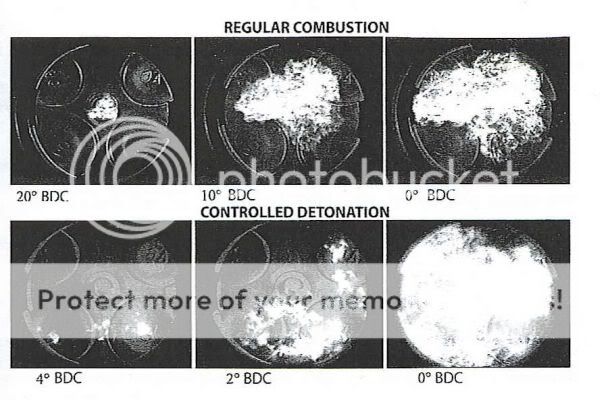
Look how fast the flame goes when ignited by detonation.. a LOT faster hugh?
As far as pre- igntion,
I wanted to clear up that knock sensors will most likely not pick up pre-ignition since as sayd it does not give a warning.
since we all know how pre-igntion occurs, we should not really worry about that much since i mean; something has to be very wrong, and we could hopefully diagnose it before it happens. ( for example running colder plugs, more fuel )
Once it happens its too late...really...
Also, pre-ignition is more likely to happen when the pistons is close to BDC on its compression stroke; not when its close to TDC.
The mixture is a lot easier to ignite when its not compressed.
SOO you can figure why pre-ignition. is soo bad..ouch.
The explosion is happening very very early in the compression stroke so the piston is trying to compress all that most likely failing and melting whatever created the ''spark''
Usually melted spark plug tips(or whole bottom of spark plug for that matter); next in turn are the pistons by making holes in them.
now;
i guess everybody is relating hot spots with pre- ignition only.
as we all know detonation is the spontaneous combustion of end gasses after the spark plug fired its round. because of heat, pressure.. whatever.
for my understanding if you have have hot spots of any kind it will induce or should i say make it easier for end gases to self combust. of course there are many variables to consider.
Hence it comes the roughing of piston top( to help create BASE carbon Cristal's that aid in combustion and protect the piston from heat); smoothing out sharp edges in piston top and bowl..etc. Quench are plays a BIG role in how detonation resistant the chamber is going to be, but that's another subject not being discussed here.
Fuel has also a big effect( leaving octane to the side), as everybody is saying by acting as cooling.
Everybody has its thoughts on that matter.
The engine can ''live'' detonation since most of the time happens when the piston is after tdc. so pressure/ heat created by detonation is coped with a lot better.
I should of explained myself better in my reply before, the ping that you hear when detonating is in fact the pressure waves colliding; but meaning against each other, the piston, head..they ''resonate'' kinda like hitting the metal with a big *** hammer. that's the ping that you hear.
here is a pic that i scanned that i think came form the Honda website.
Look how fast the flame goes when ignited by detonation.. a LOT faster hugh?
As far as pre- igntion,
I wanted to clear up that knock sensors will most likely not pick up pre-ignition since as sayd it does not give a warning.
since we all know how pre-igntion occurs, we should not really worry about that much since i mean; something has to be very wrong, and we could hopefully diagnose it before it happens. ( for example running colder plugs, more fuel )
Once it happens its too late...really...
Also, pre-ignition is more likely to happen when the pistons is close to BDC on its compression stroke; not when its close to TDC.
The mixture is a lot easier to ignite when its not compressed.
SOO you can figure why pre-ignition. is soo bad..ouch.
The explosion is happening very very early in the compression stroke so the piston is trying to compress all that most likely failing and melting whatever created the ''spark''
Usually melted spark plug tips(or whole bottom of spark plug for that matter); next in turn are the pistons by making holes in them.