


What tire size to run on stock GS-R blades?


Thread Starter
Honda-Tech Member
Joined: Jun 2001
Posts: 1,087
Likes: 0
From: Portland
 What tire size to run on stock GS-R blades?
Currently running 205/45/16 Khumos on my Slips but looking to go back to the
GSR blades. What tire size can you safely run on the 15's. Is it 195/55? Or can you run 205 series tires on 15's? If suspension setup comes to play I have a set of ITR coilovers on my car but looking to get some Koni Yellows and GCs possibly. Thanks!
GSR blades. What tire size can you safely run on the 15's. Is it 195/55? Or can you run 205 series tires on 15's? If suspension setup comes to play I have a set of ITR coilovers on my car but looking to get some Koni Yellows and GCs possibly. Thanks!

Thread Starter
Honda-Tech Member
Joined: Jun 2001
Posts: 1,087
Likes: 0
From: Portland
Re: What tire size to run on stock GS-R blades? (mr.beeks)
Would the differences be with 205 and 195 series on a 15 inch wheel be massive? Stockies are 15x6.5 I think, correct me if I'm wrong. Thanks.

H-T Order of Merit
Joined: Jan 2000
Posts: 23,478
Likes: 2
From: Chicago
Re: What tire size to run on stock GS-R blades? (GoodTimes)
Stock wheels are 15x6, not 15x6.5.
I recommend using 195/55-15 as long as the tire you want to use comes in that size.
'94 GS-R 195/55-15 Yokohama AVS ES100 (street)
'94 GS-R 185/65-14 Bridgestone Blizzak MZ-02 (winter)
'01 ITR 195/55-15 Bridgestone RE010 (street)
'01 ITR 195/55-15 Michelin Arctic Alpin (winter)
'01 ITR 205/50-15 Yokohama A032R (track)
I recommend using 195/55-15 as long as the tire you want to use comes in that size.
'94 GS-R 195/55-15 Yokohama AVS ES100 (street)
'94 GS-R 185/65-14 Bridgestone Blizzak MZ-02 (winter)
'01 ITR 195/55-15 Bridgestone RE010 (street)
'01 ITR 195/55-15 Michelin Arctic Alpin (winter)
'01 ITR 205/50-15 Yokohama A032R (track)


Joined: Jan 2002
Posts: 30,041
Likes: 59
From: Nowhere and Everywhere
Re: What tire size to run on stock GS-R blades? (GoodTimes)
I recommend 205/50-15 because the amount of choices in that size is MASSIVE compared to the relatively odd 195/55 size. As a result, most of the choices are also cheaper in 205/50 size because it's a very common tire size.
H-T Order of Merit
Joined: Jan 2000
Posts: 23,478
Likes: 2
From: Chicago
Re: What tire size to run on stock GS-R blades? (PatrickGSR94)
<TABLE WIDTH="90%" CELLSPACING=0 CELLPADDING=0 ALIGN=CENTER><TR><TD>Quote, originally posted by PatrickGSR94 »</TD></TR><TR><TD CLASS="quote">I recommend 205/50-15 because the amount of choices in that size is MASSIVE compared to the relatively odd 195/55 size.</TD></TR></TABLE>
That was true a number of years ago, but it is less and less true today. Now you can get a variety of different tires in the 195/55-15 size, largely because of the popularity of the Integra. These include everything from ultra high performance tires like the Bridgestone Potenza RE010 that is the OEM tire for the Integra Type R, to economical high-performance tires like the Yokohama AVS ES100 and the Kumho Ecsta Supra 712, to a variety of winter tires.
<TABLE WIDTH="90%" CELLSPACING=0 CELLPADDING=0 ALIGN=CENTER><TR><TD>Quote, originally posted by PatrickGSR94 »</TD></TR><TR><TD CLASS="quote">As a result, most of the choices are also cheaper in 205/50 size because it's a very common tire size.</TD></TR></TABLE>
That's not true, either. For example, according to the Tire Rack:
Yokohama AVS ES100 195/55-15: $58
Yokohama AVS ES100 205/50-15: $74
Sure, the Kumho 712 is a whopping $4 cheaper, but that's about the only tire that is (and the ES100 trounces the 712 in testing).
That was true a number of years ago, but it is less and less true today. Now you can get a variety of different tires in the 195/55-15 size, largely because of the popularity of the Integra. These include everything from ultra high performance tires like the Bridgestone Potenza RE010 that is the OEM tire for the Integra Type R, to economical high-performance tires like the Yokohama AVS ES100 and the Kumho Ecsta Supra 712, to a variety of winter tires.
<TABLE WIDTH="90%" CELLSPACING=0 CELLPADDING=0 ALIGN=CENTER><TR><TD>Quote, originally posted by PatrickGSR94 »</TD></TR><TR><TD CLASS="quote">As a result, most of the choices are also cheaper in 205/50 size because it's a very common tire size.</TD></TR></TABLE>
That's not true, either. For example, according to the Tire Rack:
Yokohama AVS ES100 195/55-15: $58
Yokohama AVS ES100 205/50-15: $74
Sure, the Kumho 712 is a whopping $4 cheaper, but that's about the only tire that is (and the ES100 trounces the 712 in testing).
Trending Topics
Joined: Jan 2002
Posts: 30,041
Likes: 59
From: Nowhere and Everywhere
Re: What tire size to run on stock GS-R blades? (nsxtasy)
<TABLE WIDTH="90%" CELLSPACING=0 CELLPADDING=0 ALIGN=CENTER><TR><TD>Quote, originally posted by nsxtasy »</TD></TR><TR><TD CLASS="quote">
That was true a number of years ago, but it is less and less true today. Now you can get a variety of different tires in the 195/55-15 size, largely because of the popularity of the Integra. These include everything from ultra high performance tires like the Bridgestone Potenza RE010 that is the OEM tire for the Integra Type R, to economical high-performance tires like the Yokohama AVS ES100 and the Kumho Ecsta Supra 712, to a variety of winter tires.</TD></TR></TABLE>
Well I was going by websites like The Tire Rack. Do a search on the 2 sizes, and you get 16 choices for 195/55-15 and a whopping 56 choices in 205/50-15.
<TABLE WIDTH="90%" CELLSPACING=0 CELLPADDING=0 ALIGN=CENTER><TR><TD>Quote, originally posted by nsxtasy »</TD></TR><TR><TD CLASS="quote">
That's not true, either. For example, according to the Tire Rack:
Yokohama AVS ES100 195/55-15: $58
Yokohama AVS ES100 205/50-15: $74
Sure, the Kumho 712 is a whopping $4 cheaper, but that's about the only tire that is (and the ES100 trounces the 712 in testing).
</TD></TR></TABLE>
I wasn't necessarily referring to tires offered in both sizes, but just in general. For example the POS stock tires which usually sell for $130-$140 apiece, while most 205/50-15 tires are in the $50-$100 range.
That was true a number of years ago, but it is less and less true today. Now you can get a variety of different tires in the 195/55-15 size, largely because of the popularity of the Integra. These include everything from ultra high performance tires like the Bridgestone Potenza RE010 that is the OEM tire for the Integra Type R, to economical high-performance tires like the Yokohama AVS ES100 and the Kumho Ecsta Supra 712, to a variety of winter tires.</TD></TR></TABLE>
Well I was going by websites like The Tire Rack. Do a search on the 2 sizes, and you get 16 choices for 195/55-15 and a whopping 56 choices in 205/50-15.
<TABLE WIDTH="90%" CELLSPACING=0 CELLPADDING=0 ALIGN=CENTER><TR><TD>Quote, originally posted by nsxtasy »</TD></TR><TR><TD CLASS="quote">
That's not true, either. For example, according to the Tire Rack:
Yokohama AVS ES100 195/55-15: $58
Yokohama AVS ES100 205/50-15: $74
Sure, the Kumho 712 is a whopping $4 cheaper, but that's about the only tire that is (and the ES100 trounces the 712 in testing).
</TD></TR></TABLE>
I wasn't necessarily referring to tires offered in both sizes, but just in general. For example the POS stock tires which usually sell for $130-$140 apiece, while most 205/50-15 tires are in the $50-$100 range.


Joined: Jan 2002
Posts: 30,041
Likes: 59
From: Nowhere and Everywhere
Re: What tire size to run on stock GS-R blades? (bboynekro)
<TABLE WIDTH="90%" CELLSPACING=0 CELLPADDING=0 ALIGN=CENTER><TR><TD>Quote, originally posted by bboynekro »</TD></TR><TR><TD CLASS="quote">for my drop I cant go past 195-55-15s</TD></TR></TABLE>
My car is at least as low as yours if not more, and I'm running 205/50 ES100's.
My car is at least as low as yours if not more, and I'm running 205/50 ES100's.

Honda-Tech Member
Joined: Nov 2002
Posts: 2,265
Likes: 0
From: NorCal, USA
Re: What tire size to run on stock GS-R blades? (bboynekro)
<TABLE WIDTH="90%" CELLSPACING=0 CELLPADDING=0 ALIGN=CENTER><TR><TD>Quote, originally posted by bboynekro »</TD></TR><TR><TD CLASS="quote">for my drop I cant go past 195-55-15s</TD></TR></TABLE>
running 205-50 is better for lowered vehicles (imo). the wall height is slightly shorter than 195-55 .. which that slightly more room in your wheel well. the only other factor would be tire width.. but from looking at the picture, i don't think that would be a concern.
running 205-50 is better for lowered vehicles (imo). the wall height is slightly shorter than 195-55 .. which that slightly more room in your wheel well. the only other factor would be tire width.. but from looking at the picture, i don't think that would be a concern.

Honda-Tech Member
Joined: Apr 2002
Posts: 3,608
Likes: 0
From: Orange County
Re: What tire size to run on stock GS-R blades? (PatrickGSR94)
<TABLE WIDTH="90%" CELLSPACING=0 CELLPADDING=0 ALIGN=CENTER><TR><TD>Quote, originally posted by PatrickGSR94 »</TD></TR><TR><TD CLASS="quote">
My car is at least as low as yours if not more, and I'm running 205/50 ES100's. </TD></TR></TABLE>
Same here.
My car is at least as low as yours if not more, and I'm running 205/50 ES100's.
</TD></TR></TABLE>Same here.

Honda-Tech Member
Joined: Sep 2003
Posts: 1,835
Likes: 0
From: Oakland, CA
Why are 195/55/15's more expensive then 195/50/15's for the same tire and brand? And does anyone know the major differences besides the sidewall being little shorter? Any performance differences? Thanks in advance
H-T Order of Merit
Joined: Jan 2000
Posts: 23,478
Likes: 2
From: Chicago
Re: (1998_4dr_gsr)
<TABLE WIDTH="90%" CELLSPACING=0 CELLPADDING=0 ALIGN=CENTER><TR><TD>Quote, originally posted by 1998_4dr_gsr »</TD></TR><TR><TD CLASS="quote">Why are 195/55/15's more expensive then 195/50/15's for the same tire and brand?</TD></TR></TABLE>
The 195/55-15 is a bigger tire (bigger outer diameter), so it contains more rubber.
Keep in mind that we're talking about a difference of $2/tire on the ES100...
The 195/55-15 is a bigger tire (bigger outer diameter), so it contains more rubber.
Keep in mind that we're talking about a difference of $2/tire on the ES100...
H-T Order of Merit
Joined: Jan 2000
Posts: 23,478
Likes: 2
From: Chicago
Re: (GoodTimes)
<u>Advantages of the 195/55-15:</u>
1. Accurate speedometer/odometer (vs 1.6 percent error with the 205)
2. Lower prices on some tires
3. Tire appears more natural vs "stretched" look on stock (15x6) wheels
4. Better traction on wet pavement
<u>Advantages of the 205/50-15:</u>
5. Slightly better cornering capabilities
6. Track tires are available
Most of these differences are very, very minor in either direction. Except maybe for the 28 percent higher price of the 205 tire if you're getting the ES100...
1. Accurate speedometer/odometer (vs 1.6 percent error with the 205)
2. Lower prices on some tires
3. Tire appears more natural vs "stretched" look on stock (15x6) wheels
4. Better traction on wet pavement
<u>Advantages of the 205/50-15:</u>
5. Slightly better cornering capabilities
6. Track tires are available
Most of these differences are very, very minor in either direction. Except maybe for the 28 percent higher price of the 205 tire if you're getting the ES100...
Thread Starter
Honda-Tech Member
Joined: Jun 2001
Posts: 1,087
Likes: 0
From: Portland
Re: (nsxtasy)
Good information. Thanks!
Have 205/45/16 Khumos right now, looking to get the Falken Azenis. Heard good things about that tire!
Modified by GoodTimes at 12:50 PM 12/29/2003
Have 205/45/16 Khumos right now, looking to get the Falken Azenis. Heard good things about that tire!
Modified by GoodTimes at 12:50 PM 12/29/2003

EPIC TUNING
Joined: Sep 2002
Posts: 10,285
Likes: 0
From: WA
Re: (nsxtasy)
<TABLE WIDTH="90%" CELLSPACING=0 CELLPADDING=0 ALIGN=CENTER><TR><TD>Quote, originally posted by nsxtasy »</TD></TR><TR><TD CLASS="quote"><u>Advantages of the 195/55-15:</u>
3. Tire appears more natural vs "stretched" look on stock (15x6) wheels
4. Better traction on wet pavement
</TD></TR></TABLE>
explain these please? how would a skinnier tire have better traction on wet pavement? and my 205/50's look fine to me.
3. Tire appears more natural vs "stretched" look on stock (15x6) wheels
4. Better traction on wet pavement
</TD></TR></TABLE>
explain these please? how would a skinnier tire have better traction on wet pavement? and my 205/50's look fine to me.

Honda-Tech Member
Joined: Dec 2003
Posts: 2,979
Likes: 0
From: Oakland, CA, USA
Re: (rewsnaeht)
personally...i'm running on blades rite now with 195.55.15 kumho supra's.....i was thinkin of switch to 205.50 but i thought....it's not worth payin that 15 more dollars fo each tire and ur gettin a VERY SMALL INCREASE OF CORNER CAPABILITIES...i dont know this fo a fact...but there is a chance of ur tires rubbin on ur fender lining if u have a camber kit on...but that's just personal opinion..
H-T Order of Merit
Joined: Jan 2000
Posts: 23,478
Likes: 2
From: Chicago
Re: (rewsnaeht)
<TABLE WIDTH="90%" CELLSPACING=0 CELLPADDING=0 ALIGN=CENTER><TR><TD>Quote, originally posted by nsxtasy »</TD></TR><TR><TD CLASS="quote">Advantages of the 195/55-15:
3. Tire appears more natural vs "stretched" look on stock (15x6) wheels
4. Better traction on wet pavement</TD></TR></TABLE>
<TABLE WIDTH="90%" CELLSPACING=0 CELLPADDING=0 ALIGN=CENTER><TR><TD>Quote, originally posted by rewsnaeht »</TD></TR><TR><TD CLASS="quote">explain these please? how would a skinnier tire have better traction on wet pavement?</TD></TR></TABLE>
A skinnier tire has better traction on wet pavement because there is less water for the tire to push aside, and therefore less tendency to hydroplane. You can read more about hydroplaning on the Tire Rack website, where it says, "While deeper water, higher speeds, lighter vehicles, wider tires, less tread depth and less efficient tread designs will cause tires to hydroplane at lower speeds; all tires will be forced to hydroplane at some speed."
<TABLE WIDTH="90%" CELLSPACING=0 CELLPADDING=0 ALIGN=CENTER><TR><TD>Quote, originally posted by rewsnaeht »</TD></TR><TR><TD CLASS="quote">my 205/50's look fine to me.</TD></TR></TABLE>
As for the "look", the manufacturer's specs for most tires have an approved range of rim widths on which they can be mounted. They usually give a "measuring rim width", which is (to quote the Tire Rack website again) "the industry standardized rim width upon which the tire must be mounted in order to confirm it meets its dimensional targets". You can think of the measuring rim width as the ideal rim width for that size tire. You can still mount it on any rim width in the approved range of rim widths; however, towards the low end of that range, the tires tend to look like they "bulge out", and towards the high end of that range, the tires tend to look "stretched" across the width of the wheel. Most 195 mm treadwidth tires have a measuring rim width of 6 inches; most 205 mm treadwidth tires have a measuring rim width of 6.5 inches. As I mentioned earlier, the differences between a 195 and a 205 tire are mostly quite small, but those are the advantages and disadvantages.
3. Tire appears more natural vs "stretched" look on stock (15x6) wheels
4. Better traction on wet pavement</TD></TR></TABLE>
<TABLE WIDTH="90%" CELLSPACING=0 CELLPADDING=0 ALIGN=CENTER><TR><TD>Quote, originally posted by rewsnaeht »</TD></TR><TR><TD CLASS="quote">explain these please? how would a skinnier tire have better traction on wet pavement?</TD></TR></TABLE>
A skinnier tire has better traction on wet pavement because there is less water for the tire to push aside, and therefore less tendency to hydroplane. You can read more about hydroplaning on the Tire Rack website, where it says, "While deeper water, higher speeds, lighter vehicles, wider tires, less tread depth and less efficient tread designs will cause tires to hydroplane at lower speeds; all tires will be forced to hydroplane at some speed."
<TABLE WIDTH="90%" CELLSPACING=0 CELLPADDING=0 ALIGN=CENTER><TR><TD>Quote, originally posted by rewsnaeht »</TD></TR><TR><TD CLASS="quote">my 205/50's look fine to me.</TD></TR></TABLE>
As for the "look", the manufacturer's specs for most tires have an approved range of rim widths on which they can be mounted. They usually give a "measuring rim width", which is (to quote the Tire Rack website again) "the industry standardized rim width upon which the tire must be mounted in order to confirm it meets its dimensional targets". You can think of the measuring rim width as the ideal rim width for that size tire. You can still mount it on any rim width in the approved range of rim widths; however, towards the low end of that range, the tires tend to look like they "bulge out", and towards the high end of that range, the tires tend to look "stretched" across the width of the wheel. Most 195 mm treadwidth tires have a measuring rim width of 6 inches; most 205 mm treadwidth tires have a measuring rim width of 6.5 inches. As I mentioned earlier, the differences between a 195 and a 205 tire are mostly quite small, but those are the advantages and disadvantages.
Honda-Tech Member
Joined: Sep 2003
Posts: 1,835
Likes: 0
From: Oakland, CA
Nice information, but how about the advantages of 50/55 series? Which one would be better for 15' stock GSR rims. I know 50 series would make the car look lower, but any other things I should know before purchasing the 50 series? Thanks
H-T Order of Merit
Joined: Jan 2000
Posts: 23,478
Likes: 2
From: Chicago
Re: (aznstyler119)
<TABLE WIDTH="90%" CELLSPACING=0 CELLPADDING=0 ALIGN=CENTER><TR><TD>Quote, originally posted by aznstyler119 »</TD></TR><TR><TD CLASS="quote">personally...i'm running on blades rite now with 195.55.15 kumho supra's.....i was thinkin of switch to 205.50 but i thought....it's not worth payin that 15 more dollars fo each tire and ur gettin a VERY SMALL INCREASE OF CORNER CAPABILITIES...</TD></TR></TABLE>
How about instead switching to the Yokohama AVS ES100 tires in 195/55-15? Not only will you pay a couple of dollars LESS per tire, but you will get a much larger increase in cornering capabilities than merely changing size.
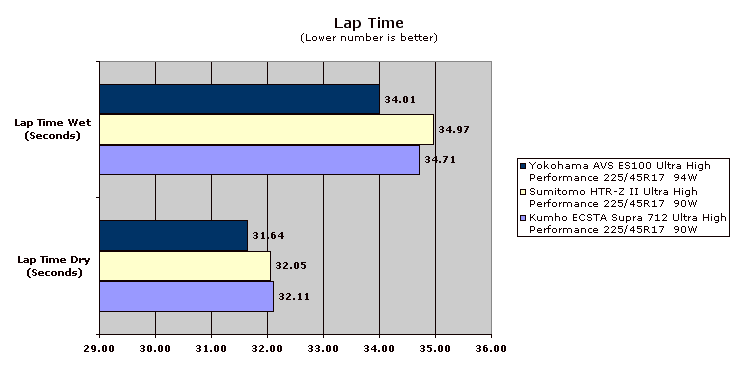
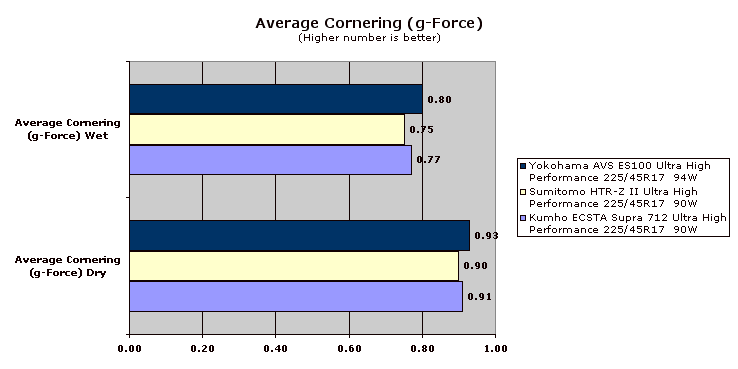
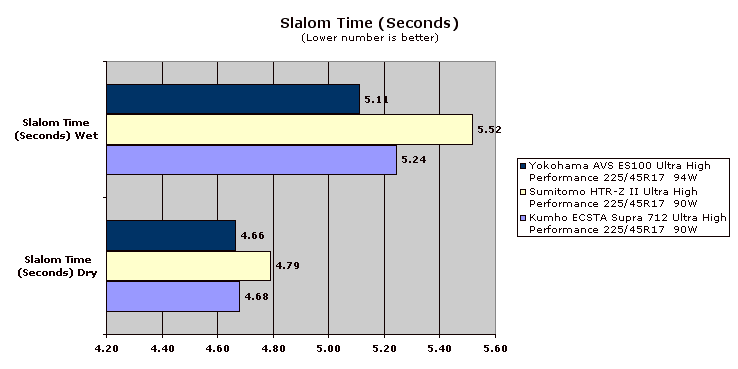
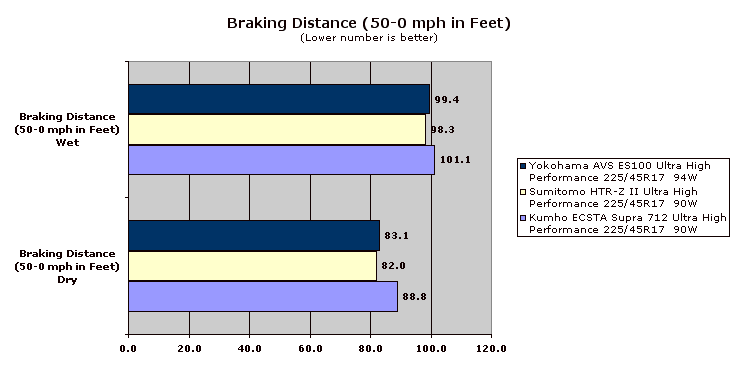
The Tire Rack did a head-to-head test of the Yoko ES100 against the Kumho Supra 712 (as well as a Sumitomo tire), and the ES100 beat the 712 in every category - that's right, the ES100 won in 23 out of 23 categories! You can read the full test results here. Here are the graphs of the test results:
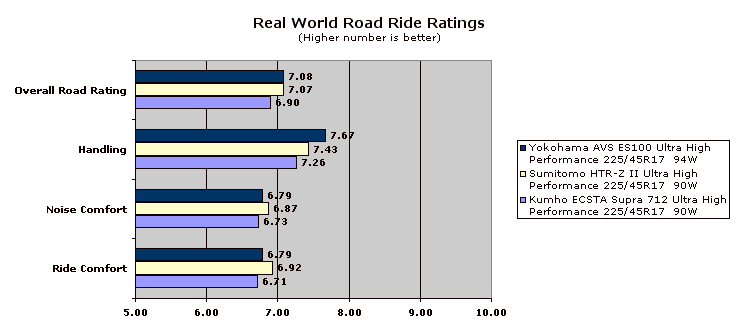
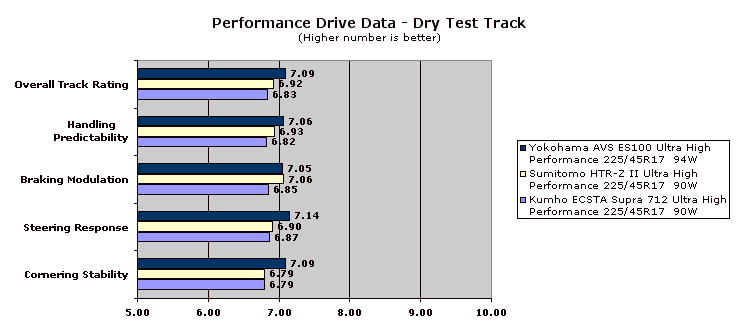
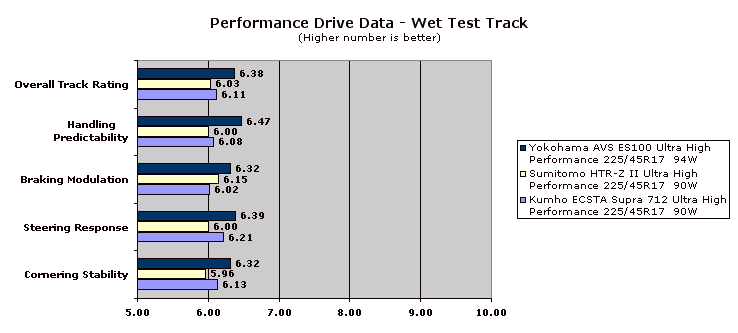
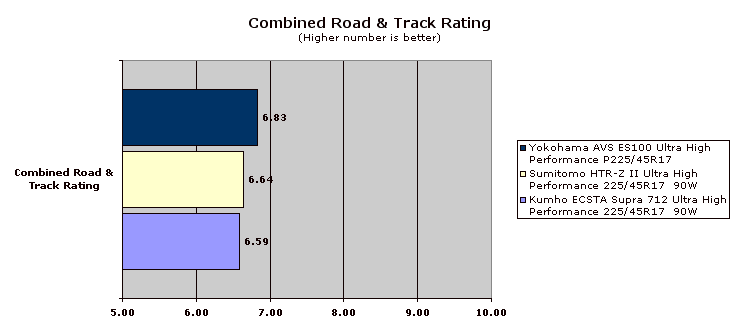
How about instead switching to the Yokohama AVS ES100 tires in 195/55-15? Not only will you pay a couple of dollars LESS per tire, but you will get a much larger increase in cornering capabilities than merely changing size.
The Tire Rack did a head-to-head test of the Yoko ES100 against the Kumho Supra 712 (as well as a Sumitomo tire), and the ES100 beat the 712 in every category - that's right, the ES100 won in 23 out of 23 categories! You can read the full test results here. Here are the graphs of the test results:
EPIC TUNING
Joined: Sep 2002
Posts: 10,285
Likes: 0
From: WA
Re: (nsxtasy)
<TABLE WIDTH="90%" CELLSPACING=0 CELLPADDING=0 ALIGN=CENTER><TR><TD>Quote, originally posted by nsxtasy »</TD></TR><TR><TD CLASS="quote">
A skinnier tire has better traction on wet pavement because there is less water for the tire to push aside, and therefore less tendency to hydroplane. You can read more about hydroplaning on the Tire Rack website, where it says, "While deeper water, higher speeds, lighter vehicles, wider tires, less tread depth and less efficient tread designs will cause tires to hydroplane at lower speeds; all tires will be forced to hydroplane at some speed."
As for the "look", the manufacturer's specs for most tires have an approved range of rim widths on which they can be mounted. They usually give a "measuring rim width", which is (to quote the Tire Rack website again) "the industry standardized rim width upon which the tire must be mounted in order to confirm it meets its dimensional targets". You can think of the measuring rim width as the ideal rim width for that size tire. You can still mount it on any rim width in the approved range of rim widths; however, towards the low end of that range, the tires tend to look like they "bulge out", and towards the high end of that range, the tires tend to look "stretched" across the width of the wheel. Most 195 mm treadwidth tires have a measuring rim width of 6 inches; most 205 mm treadwidth tires have a measuring rim width of 6.5 inches. As I mentioned earlier, the differences between a 195 and a 205 tire are mostly quite small, but those are the advantages and disadvantages.
</TD></TR></TABLE>
ok thanks i just asked u to explain
A skinnier tire has better traction on wet pavement because there is less water for the tire to push aside, and therefore less tendency to hydroplane. You can read more about hydroplaning on the Tire Rack website, where it says, "While deeper water, higher speeds, lighter vehicles, wider tires, less tread depth and less efficient tread designs will cause tires to hydroplane at lower speeds; all tires will be forced to hydroplane at some speed."
As for the "look", the manufacturer's specs for most tires have an approved range of rim widths on which they can be mounted. They usually give a "measuring rim width", which is (to quote the Tire Rack website again) "the industry standardized rim width upon which the tire must be mounted in order to confirm it meets its dimensional targets". You can think of the measuring rim width as the ideal rim width for that size tire. You can still mount it on any rim width in the approved range of rim widths; however, towards the low end of that range, the tires tend to look like they "bulge out", and towards the high end of that range, the tires tend to look "stretched" across the width of the wheel. Most 195 mm treadwidth tires have a measuring rim width of 6 inches; most 205 mm treadwidth tires have a measuring rim width of 6.5 inches. As I mentioned earlier, the differences between a 195 and a 205 tire are mostly quite small, but those are the advantages and disadvantages.
</TD></TR></TABLE>
ok thanks i just asked u to explain