


What is the actual "heat treatment process" for hubs?


Thread Starter
Honda-Tech Member
Joined: Feb 2003
Posts: 2,467
Likes: 0
From: Mainland, USA
 What is the actual "heat treatment process" for hubs?
I know the hubs are an area of concern, specifically on 88-91 crx/civic. I have seen the "heat treated" hubs for sale for alot of $, but what is the actual process they are using to "treat" the hub?


Junior Member
Joined: Sep 2001
Posts: 611
Likes: 0
From: Believeland
Re: What is the actual "heat treatment process" for hubs? (jisu009)
I assume you're referring to wheel bearing hubs?
If so, I can speak with some knowledge -- I used to work for the Delphi Automotive plant that produced some 90% of GM's wheel bearing assemblies.
The hubs and spindles, between which rotate the ball bearings, are case hardened to a Rockwell C hardness of around 60 via induction hardening and immediate quenching.
This is fairly standard surface treatment for bearing components.
If so, I can speak with some knowledge -- I used to work for the Delphi Automotive plant that produced some 90% of GM's wheel bearing assemblies.
The hubs and spindles, between which rotate the ball bearings, are case hardened to a Rockwell C hardness of around 60 via induction hardening and immediate quenching.
This is fairly standard surface treatment for bearing components.
Thread Starter
Honda-Tech Member
Joined: Feb 2003
Posts: 2,467
Likes: 0
From: Mainland, USA
Re: What is the actual "heat treatment process" for hubs? (allenp)
http://www.sbmsinc.com/race_shop.html
These are what I was talking about specifically.....
Just wondering what the actual process is...
These are what I was talking about specifically.....
Just wondering what the actual process is...
Junior Member
Joined: Sep 2001
Posts: 611
Likes: 0
From: Believeland
Re: What is the actual "heat treatment process" for hubs? (jisu009)
Yes, it appears those are the hubs that I was referring to.
I would be shocked if the OEM part was not heat-treated. Any bearing surface must be heat-treated to ensure durability and impact resistance. Untreated metal would be too soft for the contact pressures found in ball bearing races.
To what standard the OEM part is treated to vs. the aftermarket part, I have no idea. Perhaps the aftermarket part is through-hardened instead of case-hardened, meaning the entire thickness of the metal is hardened. This is not always good, however, since the softer interior metal of a case-hardened part will have better fatigue resistance than the harder, more brittle surface metal.
To answer the broader question of “what is heat treatment,” that is a very complicated answer. There are many types of heat treatment, each designed to accomplish a slightly different goal. But the basic premise of heat-treatment is to harden a metal and increase its ultimate strength by heating it, and then rapidly cooling it, thereby changing its crystalline microstructure in order to promote a certain characteristic.
I would be shocked if the OEM part was not heat-treated. Any bearing surface must be heat-treated to ensure durability and impact resistance. Untreated metal would be too soft for the contact pressures found in ball bearing races.
To what standard the OEM part is treated to vs. the aftermarket part, I have no idea. Perhaps the aftermarket part is through-hardened instead of case-hardened, meaning the entire thickness of the metal is hardened. This is not always good, however, since the softer interior metal of a case-hardened part will have better fatigue resistance than the harder, more brittle surface metal.
To answer the broader question of “what is heat treatment,” that is a very complicated answer. There are many types of heat treatment, each designed to accomplish a slightly different goal. But the basic premise of heat-treatment is to harden a metal and increase its ultimate strength by heating it, and then rapidly cooling it, thereby changing its crystalline microstructure in order to promote a certain characteristic.
Thread Starter
Honda-Tech Member
Joined: Feb 2003
Posts: 2,467
Likes: 0
From: Mainland, USA
Re: What is the actual "heat treatment process" for hubs? (allenp)
Allen-
thanks for the reply. Maybe I will give the SBMS a call and see what they have to say...
I will keep you guys posted.
thanks for the reply. Maybe I will give the SBMS a call and see what they have to say...
I will keep you guys posted.

Member
Joined: Apr 2003
Posts: 1,139
Likes: 0
From: Johntown, NY, USA
Re: What is the actual "heat treatment process" for hubs? (jisu009)
The bearing does not ride on the surface of the Honda hubs. The races press onto the hub. My understanding is that they break at the junction between the part the bearing race presses onto and the flanged area that the studs are mounted in. My suspision is that they anneal that area to make it less brittle.
Trending Topics

Thread Starter
Honda-Tech Member
Joined: Feb 2003
Posts: 2,467
Likes: 0
From: Mainland, USA
Re: What is the actual "heat treatment process" for hubs? (Outsane)
Yeah I was thinking of a method that would yeild the same results, but basicly something I could try and get done on a local level and therefor cut cost.

Joined: Mar 2002
Posts: 1,138
Likes: 0
From: Pac NW
Re: What is the actual "heat treatment process" for hubs? (jisu009)


Honda-Tech Member

Joined: Apr 2002
Posts: 18,961
Likes: 76
From: I am Tyson
Re: What is the actual "heat treatment process" for hubs? (jisu009)
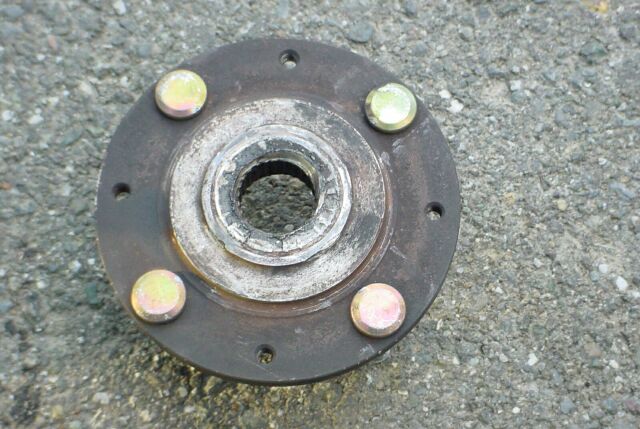
if this is the same stuff sold by OPM, and it looks like it is, then it seems the hub is actually a totally different hub that was machined from scratch using better steel. i bough em after breaking both hubs. cant say they have really performed any better since i didnt race much afterwards, but im sure they are better and worth it.
you MUST replace your old stock hubs and bearings BEFORE racing, and you might as well use these instead of buying stock.
Modified by Tyson at 3:02 AM 11/18/2003
you MUST replace your old stock hubs and bearings BEFORE racing, and you might as well use these instead of buying stock.
Modified by Tyson at 3:02 AM 11/18/2003

Thread
Thread Starter
Forum
Replies
Last Post
anotherstar_noz
Honda CRX / EF Civic (1988 - 1991)
3
Apr 8, 2008 11:56 AM
jisu009
Road Racing / Autocross & Time Attack
22
May 21, 2004 11:42 AM
