


Roll Cage Design?


Thread Starter
Honda-Tech Member
Joined: Apr 2002
Posts: 225
Likes: 0
From: SC
 Re: Roll Cage Design? (BenMara)
NM i found what the dimpled sheetmetal is
"These buttresses first appear to be "double front down bars" with a large perforated gusset connecting the two." from that site just was too lazy to read
ima still lookin for sources for info on cage design
"These buttresses first appear to be "double front down bars" with a large perforated gusset connecting the two." from that site just was too lazy to read
ima still lookin for sources for info on cage design

Honda-Tech Member
Joined: Apr 2000
Posts: 2,293
Likes: 0
From: Upstate NY, NY, USA
Re: Roll Cage Design? (BenMara)
Thread Starter
Honda-Tech Member
Joined: Apr 2002
Posts: 225
Likes: 0
From: SC
Re: Roll Cage Design? (AdamITR)
just get some sheetmetal and some Dimple dies

http://www.akfabshop.com
already lookin at that page
Modified by BenMara at 5:38 PM 7/25/2003
http://www.akfabshop.com
already lookin at that page
Modified by BenMara at 5:38 PM 7/25/2003


Honda-Tech Member
Joined: Dec 2001
Posts: 4,035
Likes: 0
From: Greensboro, NC, USA
Re: Roll Cage Design? (BenMara)
The only things that you really need to know about cage design (or "space frames" more generally) is that (a) corner joints should be assumed to be pivots, without any strength of their own, and (b) tubing is WAY stronger in tension (pulling) or compression (pushing in from the ends) than in bending. These understandings result in the process called "triangulation" - putting diagonals across rectangular bays to create triangles.
This takes a bay that can "lozenge" or go from being a rectangle to a parallelogram and put an element in there in tension/compression, making it way stiffer. Do that in three dimensions and you have a good structure.
The gusseted A-pillars make those elements WAY stiffer in bending, since it is hard to triangulate that piece. It is not, however, impossible.
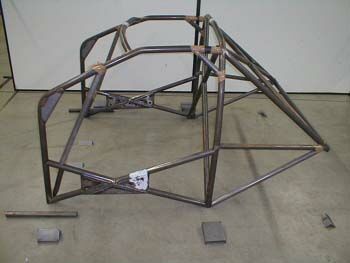
Get a hot glue gun and a bunch of bamboo skewers and model some rollcages. It will do a LOT for your gut understanding of what makes them strong.
Kirk
This takes a bay that can "lozenge" or go from being a rectangle to a parallelogram and put an element in there in tension/compression, making it way stiffer. Do that in three dimensions and you have a good structure.
The gusseted A-pillars make those elements WAY stiffer in bending, since it is hard to triangulate that piece. It is not, however, impossible.
Get a hot glue gun and a bunch of bamboo skewers and model some rollcages. It will do a LOT for your gut understanding of what makes them strong.
Kirk
Trending Topics

Honda-Tech Member

Joined: Apr 2002
Posts: 18,961
Likes: 76
From: I am Tyson
Re: Roll Cage Design? (BenMara)
ben, what is more to understand about a rollcage after satisfying the rules and minimal safety requirements, then just making the chassis as stiff as possible. its no different than conventional truss mechanics.
but the gussets as pointed out are welded to the pillar to give extra points of attachment between the chassis and rollcage.
but the gussets as pointed out are welded to the pillar to give extra points of attachment between the chassis and rollcage.
Thread Starter
Honda-Tech Member
Joined: Apr 2002
Posts: 225
Likes: 0
From: SC
Re: Roll Cage Design? (Tyson)
Well ima not staying into makin cages for road cars and what not thats why i was askin for the Roll cage design aspect i am already lookin at a tubing bender but its leaning towards making a cage for my offroad toy


Thread Starter
Honda-Tech Member
Joined: Apr 2002
Posts: 225
Likes: 0
From: SC
Re: (ITR764)
not exactly more like a roll cage for a 4x4 but ihavent forgoten about the civic
its get quaife and toda flywheel/clutch kit very soon mayb ATS fd if i have some money left over
its get quaife and toda flywheel/clutch kit very soon mayb ATS fd if i have some money left over


New User
Joined: Dec 2000
Posts: 8,960
Likes: 1
From: I hate, you
Re: (BenMara)
The only "resource" I can think of offhand would be one of the Milliken Brother's books:
http://www.millikenresearch.com/books.html
Beyond that I think that cage design and construction is 1/5th Physics, 1/5th engineering and 3/5ths art. There is no real "template" for cage and chassis design. You can't really take a book and duplicate a cage by folowing an instruction manual.
Do what Kirk said - get cheap materials and start building models.
http://www.millikenresearch.com/books.html
Beyond that I think that cage design and construction is 1/5th Physics, 1/5th engineering and 3/5ths art. There is no real "template" for cage and chassis design. You can't really take a book and duplicate a cage by folowing an instruction manual.
Do what Kirk said - get cheap materials and start building models.

Honda-Tech Member
Joined: Jun 2002
Posts: 1,149
Likes: 0
From: Toronto, On, Canada
Re: Roll Cage Design? (BenMara)
thats the one i boought (JD Squared right). The degree wheel is a bit of a pain in the *** to install properly.
I havn;t had time yet to start messing around with tube bending/cages, but the constrcution of the bender is supurb. All peices are thick, heavy steel. Super nice people to talk to as well
I havn;t had time yet to start messing around with tube bending/cages, but the constrcution of the bender is supurb. All peices are thick, heavy steel. Super nice people to talk to as well
Thread Starter
Honda-Tech Member
Joined: Apr 2002
Posts: 225
Likes: 0
From: SC
Re: Roll Cage Design? (zc911)
umm ive just been lookin at benders havnt goten one yet
that one is from MtechSupply MtechSupply
that one is from MtechSupply MtechSupply


Joined: May 2002
Posts: 1,159
Likes: 0
From: Off Course
Re: Roll Cage Design? (BenMara)
<TABLE WIDTH="90%" CELLSPACING=0 CELLPADDING=0 ALIGN=CENTER><TR><TD>Quote, originally posted by BenMara »</TD></TR><TR><TD CLASS="quote">what are some good sites, books....... to look at
and what is the point of doin this?
 </TD></TR></TABLE>
Bending loads: bad
Larger cross sectional moment of inertia: good
i.e. bent tubes are inherently weak, but you can compensate by gusseting them.
and what is the point of doin this?
</TD></TR></TABLE>Bending loads: bad
Larger cross sectional moment of inertia: good
i.e. bent tubes are inherently weak, but you can compensate by gusseting them.

Member
Joined: Jun 2002
Posts: 1,890
Likes: 0
From: Pine Mountain, GA, USA
Re: Roll Cage Design? (cstay)
<TABLE WIDTH="90%" CELLSPACING=0 CELLPADDING=0 ALIGN=CENTER><TR><TD>Quote, originally posted by cstay »</TD></TR><TR><TD CLASS="quote">would that be strong enough to bend a cage</TD></TR></TABLE>
Of course, with a cheater bar on it.
Of course, with a cheater bar on it.


Thread
Thread Starter
Forum
Replies
Last Post
turboteener
Road Racing / Autocross & Time Attack
2
Feb 14, 2008 10:12 PM
