


reverse the polarity of tweeters for improved acoustics?


Thread Starter
Joined: Sep 2002
Posts: 599
Likes: 0
From: ca, usa
 reverse the polarity of tweeters for improved acoustics?
MB Quart suggests that after you install the tweeters, you may want to try reversing the polarity of the tweeters because in some situations, it may lead to improved acoustics. i've tried it but could not hear the difference, could someone explain what's the difference between the 2 polarity settings? thanks
-td
-td

Honda-Tech Member
Joined: Jun 2002
Posts: 5,762
Likes: 1
From: Connecticut
Re: reverse the polarity of tweeters for improved acoustics? (SSBP DC2)
I'm not good with explaining stuff, but lets see...
A tweeter is a speaker, just like any other speaker, it moves in and out.
When Wired correctly (pos & neg), it moves in, then out. When the polarity is reveresed (neg & pos) it moves out then in. Basically, it's just reversing the speakers movement. You can do the same with midbasses, and subs also.
A tweeter is a speaker, just like any other speaker, it moves in and out.
When Wired correctly (pos & neg), it moves in, then out. When the polarity is reveresed (neg & pos) it moves out then in. Basically, it's just reversing the speakers movement. You can do the same with midbasses, and subs also.

Junior Member
Joined: Jan 2003
Posts: 471
Likes: 0
From: calgary, ab, canada
Re: reverse the polarity of tweeters for improved acoustics? (t0p_sh0tta)
With out getting to into it... when AC signal goes through a cap or inductor (or both ie a crossover) they generate a "phase relationship" within the AC circuit. What ends up happening is the voltage and current become 'out of phase with each other (one is ahead of the other).
first order is 90 degrees,
2nd order [12 db] is 180 degrees ( this is the most common passive xover for component sets)
and so on...
so either the tweet or the woofer in the set actually half a wave out of phase with the other.
rev pol on the tweet and now its back in phase but a full wave length behind.
... or something
first order is 90 degrees,
2nd order [12 db] is 180 degrees ( this is the most common passive xover for component sets)
and so on...
so either the tweet or the woofer in the set actually half a wave out of phase with the other.
rev pol on the tweet and now its back in phase but a full wave length behind.
... or something

Honda-Tech Member
Joined: Jun 2002
Posts: 1,538
Likes: 0
From: Pittsburgh, Pa, USA
Re: reverse the polarity of tweeters for improved acoustics? (nOOber)
LOL....so very true. It also depends on where the tweeter is placed
in relation to the mid. This is an old competition trick that I see has
trickled down into there info....on some competions image tracks
you want to re create the 'illusion' that you are facing a stage..by
reverse the tweeters polarity you can some times achieve what you
desire.
in relation to the mid. This is an old competition trick that I see has
trickled down into there info....on some competions image tracks
you want to re create the 'illusion' that you are facing a stage..by
reverse the tweeters polarity you can some times achieve what you
desire.
Thread Starter
Joined: Sep 2002
Posts: 599
Likes: 0
From: ca, usa
Re: reverse the polarity of tweeters for improved acoustics? (nOOber)
in what conditions would you want to reverse the polarity?
my tweeters are 1 foot on top of my mid woofers, ie stock g3 integra location.
thanks
my tweeters are 1 foot on top of my mid woofers, ie stock g3 integra location.
thanks

Honda-Tech Member
Joined: Jan 2002
Posts: 5,143
Likes: 1
From: Beavertown, OR
Re: reverse the polarity of tweeters for improved acoustics? (nOOber)
<TABLE WIDTH="90%" CELLSPACING=0 CELLPADDING=0 ALIGN=CENTER><TR><TD>Quote »</TD></TR><TR><TD CLASS="quote">With out getting to into it... when AC signal goes through a cap or inductor (or both ie a crossover) they generate a "phase relationship" within the AC circuit. What ends up happening is the voltage and current become 'out of phase with each other (one is ahead of the other).
first order is 90 degrees,
2nd order [12 db] is 180 degrees ( this is the most common passive xover for component sets)
and so on...
so either the tweet or the woofer in the set actually half a wave out of phase with the other.
rev pol on the tweet and now its back in phase but a full wave length behind.
... or something</TD></TR></TABLE>
If my math is right you should have a +90 degree phase difference at the cutoff frequency with a 12dB highpass filter. I'll be back in a sec. This means it lags the incoming signal.
first order is 90 degrees,
2nd order [12 db] is 180 degrees ( this is the most common passive xover for component sets)
and so on...
so either the tweet or the woofer in the set actually half a wave out of phase with the other.
rev pol on the tweet and now its back in phase but a full wave length behind.
... or something</TD></TR></TABLE>
If my math is right you should have a +90 degree phase difference at the cutoff frequency with a 12dB highpass filter. I'll be back in a sec. This means it lags the incoming signal.
Trending Topics
Honda-Tech Member
Joined: Jan 2002
Posts: 5,143
Likes: 1
From: Beavertown, OR
Re: reverse the polarity of tweeters for improved acoustics? (nsxxtreme)
-90 degrees means you lead the incoming signal. You will notice that this is frequency dependent. The cutoff frequency is were you will see the largest phase difference. The further you get in the pass band range the less "out of phase" the ouput signal will be.

New User
Joined: Apr 2001
Posts: 3,129
Likes: 0
From: Los Angeles, CA, USA
Re: reverse the polarity of tweeters for improved acoustics? (nsxxtreme)
<TABLE WIDTH="90%" CELLSPACING=0 CELLPADDING=0 ALIGN=CENTER><TR><TD>Quote, originally posted by nsxxtreme »</TD></TR><TR><TD CLASS="quote">-90 degrees means you lead the incoming signal. </TD></TR></TABLE>
This topic has always confused me. And still does. I just listen to which way sounds better. Most of the time I don't mess with it though.
This topic has always confused me. And still does. I just listen to which way sounds better. Most of the time I don't mess with it though.

New User
Joined: Apr 2001
Posts: 3,129
Likes: 0
From: Los Angeles, CA, USA
Re: (drumking15)
<TABLE WIDTH="90%" CELLSPACING=0 CELLPADDING=0 ALIGN=CENTER><TR><TD>Quote, originally posted by drumking15 »</TD></TR><TR><TD CLASS="quote">or you could buy a HU that does all the work for you and calc out the values and it will adjust the sound accordingly...but that involves $</TD></TR></TABLE>
Time correction?
Maybe memorial monday, I will give time correction a try. I want to see if it is really worth it.
Time correction?
Maybe memorial monday, I will give time correction a try. I want to see if it is really worth it.

Honda-Tech Member
Joined: Jun 2001
Posts: 1,101
Likes: 0
From: Toronto, ON, Canada
Polarity Reversal
usually beaing able to hear phase difference is very simple on subs, but much more difficult on your components so adjusting them by ear becomes a problem.
if you reverse the polarity on one set of components, or the tweeter, and from your listening position you can actually hear a difference, change it back and forth and see which sounds the best or most natural. Your trying to blend your tweeters better by reversing the polarity.
If it doesn't sound better/blended, or different at all after you play with your polarity....don't do it. You might also want someone else changing the polarity while you sit in the drivers seat. Some installers actually have a set of switches to reverse each speaker from the drivers seat to try and get all the phasing correct, and then hook up the speakers according to their findings.
You are doing this to adjust for phase differences as well as to try and improve the response from your system. When two speakers are "in" phase, they move together and at the same time; sometimes this can lead to cancellation of certain frequencies depending on how your front stage is aimed. Many people try to reverse the polarity of one side to try and correct this to a certain extent.
HOWEVER - reversing the polarity of the speakers is not a true phase shift, when you do this, your making the speaker move opposite to what it used to. A true phase shift would delay the actual frequency of the sound by the correct amount and you'd leave your speaker polarity alone.
As far as the phase differences on low pass
1st order - 6db/octave = 90 degrees out of phase
2nd order - 12db/octave = 180 degrees out of phase (so when told to push out, they suck in)
3rd - 18db/octave = 270 degrees
4th - 24db/octave = 360 degrees / 0 phase difference
For highpass, nsxextreme said he found the opposite signage, I personally though have no idea....any more input would be nice
Hope I could help - It's a pretty confusing topic for everyone really.
-Rage
if you reverse the polarity on one set of components, or the tweeter, and from your listening position you can actually hear a difference, change it back and forth and see which sounds the best or most natural. Your trying to blend your tweeters better by reversing the polarity.
If it doesn't sound better/blended, or different at all after you play with your polarity....don't do it. You might also want someone else changing the polarity while you sit in the drivers seat. Some installers actually have a set of switches to reverse each speaker from the drivers seat to try and get all the phasing correct, and then hook up the speakers according to their findings.
You are doing this to adjust for phase differences as well as to try and improve the response from your system. When two speakers are "in" phase, they move together and at the same time; sometimes this can lead to cancellation of certain frequencies depending on how your front stage is aimed. Many people try to reverse the polarity of one side to try and correct this to a certain extent.
HOWEVER - reversing the polarity of the speakers is not a true phase shift, when you do this, your making the speaker move opposite to what it used to. A true phase shift would delay the actual frequency of the sound by the correct amount and you'd leave your speaker polarity alone.
As far as the phase differences on low pass
1st order - 6db/octave = 90 degrees out of phase
2nd order - 12db/octave = 180 degrees out of phase (so when told to push out, they suck in)
3rd - 18db/octave = 270 degrees
4th - 24db/octave = 360 degrees / 0 phase difference
For highpass, nsxextreme said he found the opposite signage, I personally though have no idea....any more input would be nice
Hope I could help - It's a pretty confusing topic for everyone really.
-Rage
Honda-Tech Member
Joined: Jan 2002
Posts: 5,143
Likes: 1
From: Beavertown, OR
Re: Polarity Reversal (o_Rage_o)
Where is everyone getting the phase of a 12 dB crossover is 180 degrees? Unless I am goofing horribly on the math it is a 90 degrees difference. The reason for time shifting is you are able to shift the entire wave form without being frequency dependent. This is usually done with a DSP, and yes it does work effectively.
If their is any interest I am willing to try to walk someone through the math on a simple 2nd order passive crossover. And also explain why it is considered a second order. You will need to know how to do simple algebra and convert from degree to radians and back. You will also need to know how to convert to polar notation.
Modified by nsxxtreme at 10:11 PM 5/23/2003
If their is any interest I am willing to try to walk someone through the math on a simple 2nd order passive crossover. And also explain why it is considered a second order. You will need to know how to do simple algebra and convert from degree to radians and back. You will also need to know how to convert to polar notation.
Modified by nsxxtreme at 10:11 PM 5/23/2003


Honda-Tech Member
Joined: Jan 2002
Posts: 5,143
Likes: 1
From: Beavertown, OR
Re: Polarity Reversal (vteg)
<TABLE WIDTH="90%" CELLSPACING=0 CELLPADDING=0 ALIGN=CENTER><TR><TD>Quote »</TD></TR><TR><TD CLASS="quote">OMG. Physics was almost 10 years ago.
My brain does not speak geometry and calculus anymore. Algebra still works though </TD></TR></TABLE>
You actually think we use that stuff. There is no calculus we have a trick that avoids calculus and makes everything simple algebra We convert everything to the S domain then solve it algebraically.
My brain does not speak geometry and calculus anymore. Algebra still works though </TD></TR></TABLE>
You actually think we use that stuff. There is no calculus we have a trick that avoids calculus and makes everything simple algebra
We convert everything to the S domain then solve it algebraically.
Honda-Tech Member
Joined: Jan 2002
Posts: 5,143
Likes: 1
From: Beavertown, OR
Re: Polarity Reversal (vteg)
I don't know I have never looked. Phase shift through a passive crossover or active crossover is not that hard to understand. How it propogates through air also isn't that hard to understand. Sound travels at approx 700MPH. This means it takes time to travel to your ear. Well unless you sit in the middle of your car you ear is closer to one of the speakers then the other. The sound takes longer to travel to your ear from the speaker that is on the right side of the car (if your the driver). Thus the phase shift in time. This is what DSP's are for. They can slow the signal down that is closer to you this way both signals get to you at the same time
Honda-Tech Member
Joined: Jan 2002
Posts: 5,143
Likes: 1
From: Beavertown, OR
Re: Polarity Reversal (vteg)
Well the same type thing applies to the circuit. Each device the signal must travel through has an impedence that slows the signal down. AC signals are allowed to pass through capacitors. capacitors are opens for DC signals . Inductors are opens for AC signals and shorts for DC. What is considered an AC component and what is a considered a DC componet. Well this depends on the value of parts chosen. I chose values for the circuit above that would only allow high frequencies to pass through and block lower frequencies.
This is where it kind of gets hard to explain. Everyone knows DC stands for direct current. What does this mean? It means the current does not change direction. AC stands for alternating current. Which means the current is continuously changing direction. Now if you have a 20 HZ sine wave and a 1kHZ sine wave the 20Hz wave will look more DC than the 1kHz wave. Even though the 20 Hz wave is by no means DC. Make sense?
This is where it kind of gets hard to explain. Everyone knows DC stands for direct current. What does this mean? It means the current does not change direction. AC stands for alternating current. Which means the current is continuously changing direction. Now if you have a 20 HZ sine wave and a 1kHZ sine wave the 20Hz wave will look more DC than the 1kHz wave. Even though the 20 Hz wave is by no means DC. Make sense?
Junior Member
Joined: Jan 2003
Posts: 471
Likes: 0
From: calgary, ab, canada
Re: Polarity Reversal (nsxxtreme)
<TABLE WIDTH="90%" CELLSPACING=0 CELLPADDING=0 ALIGN=CENTER><TR><TD>Quote, originally posted by nsxxtreme »</TD></TR><TR><TD CLASS="quote">Where is everyone getting the phase of a 12 dB crossover is 180 degrees? Unless I am goofing horribly on the math it is a 90 degrees difference. One speaker is always 180 degrees out of phase from the other to begin with. So one "pushes"
while the other "sucks".</TD></TR></TABLE>
anyone know where the theta symbol is ?
for below lets say (/) is theta...
and ignor the "." , they just keep stuff lined up.
phase angle (/) between the current and voltage is given by:
Tan (/) = Xl - Xc
..............______
....................R
there's a bunch more but I'd have to draw it.
while the other "sucks".</TD></TR></TABLE>
anyone know where the theta symbol is ?
for below lets say (/) is theta...
and ignor the "." , they just keep stuff lined up.
phase angle (/) between the current and voltage is given by:
Tan (/) = Xl - Xc
..............______
....................R
there's a bunch more but I'd have to draw it.
Honda-Tech Member
Joined: Jun 2001
Posts: 1,101
Likes: 0
From: Toronto, ON, Canada
Re: Polarity Reversal (nOOber)
wholly crap - the board was down most of the working day yesterday, i come in the following morning and all you west coast guys have already gotten 2/3's through a Signal Processing lesson!!
one of the simple crossover calculators on the net for multiple orders
http://ccs.exl.info/calc_cr.html
this one also goes with the 90 degrees phase shift per every 6db ...I'm trying to look on the net for any other info as to how this is arrived, becuase i'm sure if i break out my fall semester Digital Signals Processing text, i'll get the same 90 degree result on the math.....
Could it have to be because most crossovers are using Linkwitz Riley style ? 2-way vs 3 way? .....?
90 Degree Confused
-Shane
one of the simple crossover calculators on the net for multiple orders
http://ccs.exl.info/calc_cr.html
this one also goes with the 90 degrees phase shift per every 6db ...I'm trying to look on the net for any other info as to how this is arrived, becuase i'm sure if i break out my fall semester Digital Signals Processing text, i'll get the same 90 degree result on the math.....
Could it have to be because most crossovers are using Linkwitz Riley style ? 2-way vs 3 way? .....?
90 Degree Confused
-Shane
Junior Member
Joined: Jan 2003
Posts: 471
Likes: 0
From: calgary, ab, canada
Re: Polarity Reversal (o_Rage_o)
<TABLE WIDTH="90%" CELLSPACING=0 CELLPADDING=0 ALIGN=CENTER><TR><TD>Quote, originally posted by o_Rage_o »</TD></TR><TR><TD CLASS="quote">I'm trying to look on the net for any other info as to how this is arrived
</TD></TR></TABLE>
its derived from the impedance triangle.
the bottom left corner is where the 'action' is

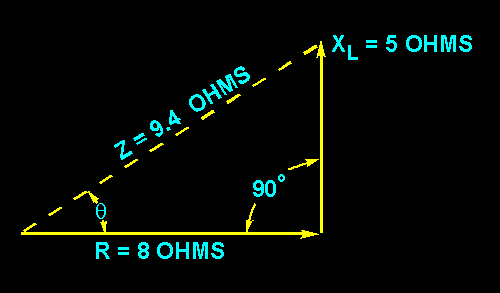
bit more info...
http://www.tpub.com/neets/book2/4e.htm
</TD></TR></TABLE>
its derived from the impedance triangle.
the bottom left corner is where the 'action' is
bit more info...
http://www.tpub.com/neets/book2/4e.htm
Honda-Tech Member
Joined: Jan 2002
Posts: 5,143
Likes: 1
From: Beavertown, OR
Re: Polarity Reversal (o_Rage_o)
ok I knew I wasn't crazy http://www.lalena.com/audio/ca...shtml
I'm not sure why they put both speakers are 180 degrees apart because unless you are using two different types of crossovers the two will alway be 180 degrees apart. That is unless you switch the polarity on one of the speakers then they would be o degrees apart. Is everyone confused yet?
The simulation above also agrees with me.
So does the math.
edit: Now I am confused I still stand by my statement that each speaker will be 90 degrees out of phase through a second order passive crossover.
Modified by nsxxtreme at 12:22 PM 5/22/2003
I'm not sure why they put both speakers are 180 degrees apart because unless you are using two different types of crossovers the two will alway be 180 degrees apart. That is unless you switch the polarity on one of the speakers then they would be o degrees apart. Is everyone confused yet?
The simulation above also agrees with me.
So does the math.
edit: Now I am confused
I still stand by my statement that each speaker will be 90 degrees out of phase through a second order passive crossover.Modified by nsxxtreme at 12:22 PM 5/22/2003
New User
Joined: Apr 2001
Posts: 3,129
Likes: 0
From: Los Angeles, CA, USA
Re: Polarity Reversal (nsxxtreme)
I think a light bulb just came on.
So with a 12db/oct crossover will have the tweet 180 out of phase with the woofer and reversing polarity will make it correct. Is this in the ballpark. I know 12db crossovers are very common, so this may cure problems with them. Previously some have said just to reverse one side though.
So with a 12db/oct crossover will have the tweet 180 out of phase with the woofer and reversing polarity will make it correct. Is this in the ballpark. I know 12db crossovers are very common, so this may cure problems with them. Previously some have said just to reverse one side though.