


so i just did and engine swap.......


Thread Starter
Honda-Tech Member
Joined: Jan 2000
Posts: 6,212
Likes: 2
From: Toronto, Canada
 so i just did a engine swap.......
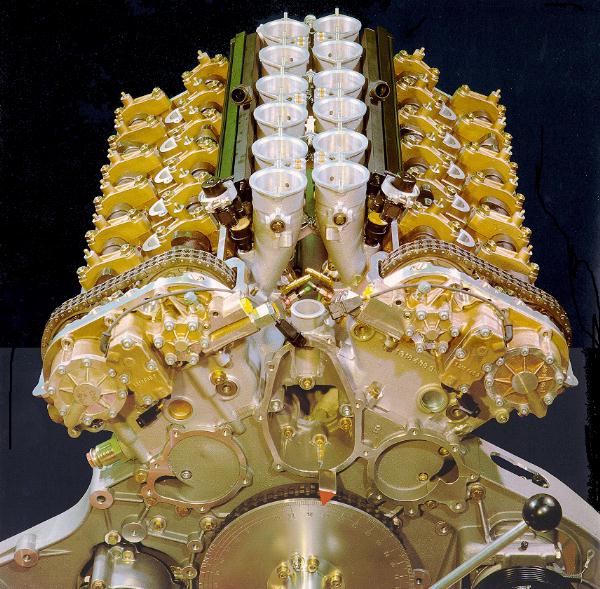
how does it look.........


i know it's the wrong forum for this but as soon as i saw it i was like DAMN!!!!!!!!!
if your wondering it's the Maclaren F1 V12 engine (drool)
ENGINE
V12
Bore & stroke 86.0 x 87.0 mm
Total displacement 6064.0 cc
Compression ratio 10.5:1
Max. power 627 bhp @ 7400 rpm
Max. torque 500 lb-ft @ 5600 rpm
DOHC 48 valve
PERFORMANCE
Top speed 231 mph
0-60 mph 3.2 sec.
0-100 mph 6.3 sec.
0-150 mph 12.8 sec.
0-200mph 28.0 sec.
Curb weight 2425 lb.

Modified by non-VTEC at 11:00 PM 5/9/2003


Trending Topics


Thread Starter
Honda-Tech Member
Joined: Jan 2000
Posts: 6,212
Likes: 2
From: Toronto, Canada
Re: so i just did a engine swap....... (non-VTEC)
i was doing a google search and i came up with that...........
here's the link if anyone cares:
http://www.angelfire.com/biz5/....html
here's the link if anyone cares:
http://www.angelfire.com/biz5/....html

Member
Joined: Feb 2001
Posts: 6,131
Likes: 0
From: Santa Rosa
Re: so i just did a engine swap....... (non-VTEC)
Im gonna put this in my 98 RL. I think Ill have the first RLHybrid.
Jeff at Hybrid Automotive.com will do the swap. Full JDM too y0.


Specs:
Bore - just under 3'2" (965mm). Stroke - just over 8'2" (2489mm).
Available in 6 through 12 cylinder versions (all inline).
Engine weight exceeds 2000 tons in the 12 cylinder version (the crankshaft alone exceeds 300 tons).
Point of maximum continuous power is 89,640 HP (66,844kW) at 100RPM
with the 12 cylinder version. Point of maximum fuel economy is 53,244 HP
(37,704kW) at 90 RPM. The 12-cylinder engine exceeded 100,000
horsepower during overspeed testing (all of 101.5 RPM!) while under test at Japan's Diesel Union works (who built the first engines and from who these pictures are taken).
Fuel consumption at maximum power is 0.278 lbs/HP/hour (BSFC). Fuel
consumption at maximum economy is 0.260 lbs/HP/hour.
At maximum economy the Sulzer engine exceeds 50% thermal efficiency
i.e.
more than 50% of the fuel going into the engine is converted to power).
For
comparison, consider that automotive and small aircraft spark-ignition
engines have British Standard Fuel Consumption figures in the
0.40-0.60
lbs/HP/hour range and 25-30% thermal efficiency.
The Caterpillar 3516s consume roughly 0.42lbs/HP/hour of diesel
(unknown thermal efficiency).
Even at its most efficient power setting, the Sulzer 12 cylinder
consumes
nearly 1,660 gallons of heavy fuel oil an hour.
Jeff at Hybrid Automotive.com will do the swap. Full JDM too y0.
Specs:
Bore - just under 3'2" (965mm). Stroke - just over 8'2" (2489mm).
Available in 6 through 12 cylinder versions (all inline).
Engine weight exceeds 2000 tons in the 12 cylinder version (the crankshaft alone exceeds 300 tons).
Point of maximum continuous power is 89,640 HP (66,844kW) at 100RPM
with the 12 cylinder version. Point of maximum fuel economy is 53,244 HP
(37,704kW) at 90 RPM. The 12-cylinder engine exceeded 100,000
horsepower during overspeed testing (all of 101.5 RPM!) while under test at Japan's Diesel Union works (who built the first engines and from who these pictures are taken).
Fuel consumption at maximum power is 0.278 lbs/HP/hour (BSFC). Fuel
consumption at maximum economy is 0.260 lbs/HP/hour.
At maximum economy the Sulzer engine exceeds 50% thermal efficiency
i.e.
more than 50% of the fuel going into the engine is converted to power).
For
comparison, consider that automotive and small aircraft spark-ignition
engines have British Standard Fuel Consumption figures in the
0.40-0.60
lbs/HP/hour range and 25-30% thermal efficiency.
The Caterpillar 3516s consume roughly 0.42lbs/HP/hour of diesel
(unknown thermal efficiency).
Even at its most efficient power setting, the Sulzer 12 cylinder
consumes
nearly 1,660 gallons of heavy fuel oil an hour.

Member
Joined: Feb 2001
Posts: 6,131
Likes: 0
From: Santa Rosa
Re: so i just did a engine swap....... (KrN_R)
<TABLE WIDTH="90%" CELLSPACING=0 CELLPADDING=0 ALIGN=CENTER><TR><TD>Quote, originally posted by KrN_R »</TD></TR><TR><TD CLASS="quote">thats Korean smart guy</TD></TR></TABLE>
whoops.. sorry.
How white of me
whoops.. sorry.
How white of me


Honda-Tech Member
Joined: Sep 2001
Posts: 2,550
Likes: 0
From: too close to Oklahoma
Re: so i just did a engine swap....... (Chris)
<TABLE WIDTH="90%" CELLSPACING=0 CELLPADDING=0 ALIGN=CENTER><TR><TD>Quote, originally posted by Chris »</TD></TR><TR><TD CLASS="quote">
</TD></TR></TABLE>
Notice the lightweight flywheel. Very trick.
</TD></TR></TABLE>
Notice the lightweight flywheel. Very trick.

Honda-Tech Member
Joined: Oct 2002
Posts: 3,225
Likes: 1
From: Costa Rica
Re: (branch)
<TABLE WIDTH="90%" CELLSPACING=0 CELLPADDING=0 ALIGN=CENTER><TR><TD>Quote, originally posted by branch »</TD></TR><TR><TD CLASS="quote">
yeah but does it VtAk y0?!</TD></TR></TABLE>
no. It has a VANOS system. I think thats what BMW calls it.
yeah but does it VtAk y0?!</TD></TR></TABLE>
no. It has a VANOS system. I think thats what BMW calls it.


Honda-Tech Member

Joined: Mar 2001
Posts: 2,139
Likes: 4
From: Aiea, Hawai'i, USA
Re: so i just did a engine swap....... (SuPeRITR)
honda vtec - varying cam lift
bmw vanos - varying cam phase
honda i-vtec, porsche variocam - varying cam lift and phase
getting back on topic, nice motor btw!
bmw vanos - varying cam phase
honda i-vtec, porsche variocam - varying cam lift and phase
getting back on topic, nice motor btw!


Honda-Tech Member
Joined: Sep 2001
Posts: 2,550
Likes: 0
From: too close to Oklahoma
Re: so i just did a engine swap....... (kepani)
<TABLE WIDTH="90%" CELLSPACING=0 CELLPADDING=0 ALIGN=CENTER><TR><TD>Quote, originally posted by kepani »</TD></TR><TR><TD CLASS="quote">honda vtec - varying cam lift
bmw vanos - varying cam phase
honda i-vtec, porsche variocam - varying cam lift and phase
getting back on topic, nice motor btw!</TD></TR></TABLE>
Actually, BMW's newest version of VANOS uses a rocker arm that moves it's pivot point relative to the camshaft, allowing for essentially infinitely variable lift and phase and also eliminating the need for a throttle plate.
bmw vanos - varying cam phase
honda i-vtec, porsche variocam - varying cam lift and phase
getting back on topic, nice motor btw!</TD></TR></TABLE>
Actually, BMW's newest version of VANOS uses a rocker arm that moves it's pivot point relative to the camshaft, allowing for essentially infinitely variable lift and phase and also eliminating the need for a throttle plate.
