When you click on links to various merchants on this site and make a purchase, this can result in this site earning a commission. Affiliate programs and affiliations include, but are not limited to, the eBay Partner Network.
An intermittent speedo in my EM1 led me to a corroded connector plug on my wiring harness at the Variable Speed Sensor and also on the pins of the VSS itself.
Here's how I chose to clean them.
Here's the problem:
Items needed: Compressed air not pictured.
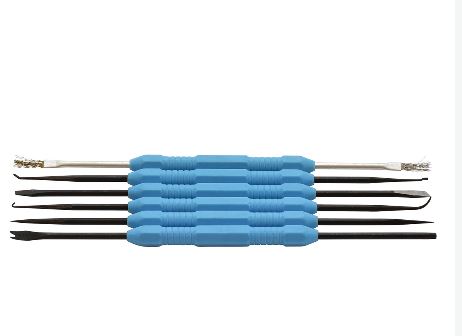
Diamond-tipped terminal cleaning tool kit cost me $28 shipped on Amazon.
Salt 0.45
Vinegar 1.00
Distilled water 1.00
Dielectric grease 1.50
Warm in the microwave for a minute, about 200 mL (half bottle) of white vinegar and add about a tablespoon of salt.
Stir until salt is dissolved, adding a bit more vinegar to cool the solution slightly and help the salt dissolve.
Fill a syringe or turkey baster with the solution.
Flush out the terminal contacts until the corrosion is all gone.
IMPORTANT Flush with warm distilled water once you feel the terminals are clean enough. This solution will make corrosion like crazy if you don't rinse it out.
Grab your girlfriend's toothbrush.
Clean that MFer, because racecar.
Optional, use diamond tipped terminal cleaning tool to ensure good conductivity.
Repeat the steps for the female side of the connection.
Again, I'm going to say this. IMPORTANT Flush with warm distilled water once you feel the terminals are clean enough. This solution will make corrosion like crazy if you don't rinse it out.
The tool can spread open so that you can lightly file the female terminal's insides.
Blow out both connections with air, if possible.
Add dielectric grease to the contacts and plug in the connector.
Before:
After:
Enjoy!
Last edited by petr0lb0mb; Mar 9, 2017 at 07:44 PM.
Reason: Cleaned up formatting
Nice write up.
If you happen to have the crimp tools, you can remove the pins from the housing and clean them a bit more thorough.
You can also spray all the connectors as you remove them when working on the car with DeoxIT D5 spray. Thing works amazingly.
15 employees here at my electronic repair company and all of us have paint thinner and rubbing alcohol on our benches.
i cant tell you how many clusters, ECU's, PCM's and AMPS we've recieved with water damage and corrosion.
and we always use just thinner to clean away the bad stuff and alcohol to clean away the residue. it doesnt harm 99% of the PCB's we repair.
15 employees here at my electronic repair company and all of us have paint thinner and rubbing alcohol on our benches.
i cant tell you how many clusters, ECU's, PCM's and AMPS we've recieved with water damage and corrosion.
and we always use just thinner to clean away the bad stuff and alcohol to clean away the residue. it doesnt harm 99% of the PCB's we repair.
Yeah we buy both in bulk I'll shoot a photo on Monday if you'd like. But yes a lot of clusters and radio boards have a nasty coating that we have to remove before we can de-solder or solder. It ruins the tips. I'm the only person that has wd40 on my bench as well but I use it on plastic more than anything. Everyone else just uses thinner.
Hmmm ok now I'm excited for Monday to come I'll shoot a video of the cluster and radio dept in the mean time feel free to look up RT Grim. Give you a little history prior to when you see the video of our benches. You want just the most senior tech bench? Or do you actually think there's a master opposed to the rest of the techs that have been doing it 20+ years? Hell I'll post the tv repair side bench as well.. come on Monday!!
Well I was incorrect when i said paint thinner. its lacquer thinner, see below in photos.
I only took photos of the radio department benches. the really messy bench is our senior tech. he laughed when i explained why i was taking pictures and he called it paint thinner as well.
so i at least have someone to blame for me thinking it was paint thinner and not lacquer thinner.
I will definitely ask Yakat this question but i already know his response.
top 10 secrets to what? keep in mind me and yakat repair everything that plugs in or has a battery. so asking for secrets to anything, i could sit here for hours telling tips. are we just talking car electronics or home electronics or handheld?
biggest things i know for sure is
1. keep your solder iron clean.
2. stay organized on what your taking apart.
3. the biggest thing i always teach new hires is if your getting angry or something isnt going right get up walk away or start something else.
4. patience patience patience!
i will edit this later when i get yakats answer
Yakats response to his top ten secrets. "Common Sense"
Last edited by Badcopyinc; Mar 21, 2017 at 08:45 AM.
German i cant speak on. we send most of those out because of the tooling required to repair the ribbon cables.
most manufacturers are moving in this direction on their components. when i say most I'm referring to all non German manufactures. but its touch and go for most as we don't get a lot of repairs on 15 and up vehicles. and its seems to be select models as well. i can have a 13 or 14 focus that is dated tech and have a svt version and it will have newer tech. (year and model just an example)
i personally have played around with nissan and ford the most and yes they are a pain in the D***. most clusters are turning into a extension of the ECM/OBC meaning they are "CAN" controlled and wont allow vehicle to run while disconnected.
I never did figure out how a multilayer pcb can be repaired if it gets burned as there are traces on top of traces.
Also makes reverse engineering virtually impossible as you can't just follow the traces to create a schematic as you can only see half of them or less.
I suspect at that point it's a pull and swap scenario for repair.
if anything that is damaged is surface mount that can be repaired but as far as traces the only time I've seen them damaged is from water damage and at that point it's not worth a repair because the board mushroomed from the water. Half the pads are usually missing in such cases.
I think many of us thank you for sharing your experience with us. It's nice to see trade information being shared openly.
I have picked up a precision soldering toolkit as it was on sale but to be honest, I really don't know how the tools are used. I've done a fair share of soldering and have used solder weave, solder sucker and several irons. I've never seen these pick like tools used in soldering.
They are not needed but make life a lot easier.
the other techs at our company minus one guy don't use them at all. mind you they're doing most of the same. Chevy and ford clusters stepper motors and bulbs . Jeff does have them because he does the random stuff like the older international clusters, lcm's and pcm's.
yakat on the other hand has no formal schooling but has been doing it since he was a teenager he has a plethora of picks just like that. No small brushes like in the photo. I will ask him tomorrow morning but me and him use them mostly to de pin plugs like mentioned above. And they're invaluable when doing radios with the super tiny springs.
Theyre also used to scratch away at metal contacts to get a better solder joint imagine doing a ic chip where the pins are fractions of a MM apart and you only want to repair one pin. Probably assuming the brush is also intended to be used in the same manor, prepping the solder points prior to doing it. I use like three pics and that's it. The one also kinda looks like a heat sink separator used to slice between the heat sink and the chip without scratching into to the chip surface.
But it that's me going off of how I use them and have seen them used. Yakat may probably say the same because has never had formal training but has been repairing for 60 some years now. What I can't figure out or don't feel comfortable doing he usually can.
They are not needed but make life a lot easier.
the other techs at our company minus one guy don't use them at all. mind you they're doing most of the same. Chevy and ford clusters stepper motors and bulbs . Jeff does have them because he does the random stuff like the older international clusters, lcm's and pcm's.
yakat on the other hand has no formal schooling but has been doing it since he was a teenager he has a plethora of picks just like that. No small brushes like in the photo. I will ask him tomorrow morning but me and him use them mostly to de pin plugs like mentioned above. And they're invaluable when doing radios with the super tiny springs.
Theyre also used to scratch away at metal contacts to get a better solder joint imagine doing a ic chip where the pins are fractions of a MM apart and you only want to repair one pin. Probably assuming the brush is also intended to be used in the same manor, prepping the solder points prior to doing it. I use like three pics and that's it. The one also kinda looks like a heat sink separator used to slice between the heat sink and the chip without scratching into to the chip surface.
But it that's me going off of how I use them and have seen them used. Yakat may probably say the same because has never had formal training but has been repairing for 60 some years now. What I can't figure out or don't feel comfortable doing he usually can.
Actually all of that makes total sense and now I'm glad I asked as well as picked them up for 5 bucks.
Also seems to me that one of these would be good for the trace cuts, like the old school alarm replacement remotes. Cut traces to set a code in the remote.
I was actually thinking that but they're hard to see. I cut a lot of traces when I wire old radios with 3.5 mm jacks for autozone and advanced. Every single radio requires cuts in order for the headphone jack to work. Those would have been nice compared to a exacto blade.
Well used to do that. Not sure why delco slowed down.
also for anyone else who wanted tools similar to that for de-pining plugs to clean them like in this diy. harbor freight has a nice dental pick set. I believe when I bought mine years ago to help me weed vinyl i only paid 5 or 10.




 How to clean corroded harness connections