


Piston Slap


Thread Starter
Hysterically Calm


Joined: Jan 2013
Posts: 10,439
Likes: 597
 Piston Slap
Hi all,
I'm finally tearing into my old D15B7 SOHC block now that I got an engine stand.
A young mechanic buddy of mine pointed out the piston slap sound when I first got the car that could be heard if you caught just the right rpm blip when you blipped the throttle.
Anyways, now that I just took the pistons out tonight, I confirmed a bit of skirt scuffing on the number 1 piston.
So far all the checks on the bottom end are in the "new" spec category. What I've checked is piston big end play, crank end play, and crank main run out.
That being said, I did get this car used and the head gasket was already replaced with the TSB leak gasket and the new head bolts. So in all reality I can't be sure what all has been done to the car.
I do know I recall still seeing cross hatching on the cylinder walls yet the car was sold to me with 280K km on it.
I swapped the engine and saved my old one to dig into and learn a thing or two for my first round of engine mechanics.
Anyways, now that the back story is out there, what generally causes piston slap? Would it be excessive P2W clearance? Like they honed the cylinders and slapped the old pistons back in sort of thing? You could catch the sound even on a warm engine, you just had to blip the throttle right to get it.
Also of note, none of the piston rings were stuck. There is some signs of blow by oil burning on the oil ring and between the top and second ring on all 4, and one of the pistons also had some above the top ring on the side of the piston. Can take pics if required.
I'll be measuring everything slowly as I go, just seeing if I can get an insight before all that stuff happens.
I'm finally tearing into my old D15B7 SOHC block now that I got an engine stand.
A young mechanic buddy of mine pointed out the piston slap sound when I first got the car that could be heard if you caught just the right rpm blip when you blipped the throttle.
Anyways, now that I just took the pistons out tonight, I confirmed a bit of skirt scuffing on the number 1 piston.
So far all the checks on the bottom end are in the "new" spec category. What I've checked is piston big end play, crank end play, and crank main run out.
That being said, I did get this car used and the head gasket was already replaced with the TSB leak gasket and the new head bolts. So in all reality I can't be sure what all has been done to the car.
I do know I recall still seeing cross hatching on the cylinder walls yet the car was sold to me with 280K km on it.
I swapped the engine and saved my old one to dig into and learn a thing or two for my first round of engine mechanics.
Anyways, now that the back story is out there, what generally causes piston slap? Would it be excessive P2W clearance? Like they honed the cylinders and slapped the old pistons back in sort of thing? You could catch the sound even on a warm engine, you just had to blip the throttle right to get it.
Also of note, none of the piston rings were stuck. There is some signs of blow by oil burning on the oil ring and between the top and second ring on all 4, and one of the pistons also had some above the top ring on the side of the piston. Can take pics if required.
I'll be measuring everything slowly as I go, just seeing if I can get an insight before all that stuff happens.

Honda-Tech Member
Joined: Aug 2004
Posts: 4,167
Likes: 2
From: Atlanta
Re: Piston Slap
Yep. Excessive PTW clearance. Or the piston just hasn't warmed up enough to tighten up the clearance.
Generally though, piston slap is heard on a cold engine and usually goes away as it warms up.
The LS2 in my truck has pretty bad (in my opinion) piston slap, but it always goes away as it warms up. Its especially bad in the winter months. I had a 84mm b18c with forged pistons that also had piston slap when cold.
The sound you were hearing when you blipped the throttle just the right way actually sounds like your describing audible knock...Was it a brief knocking sound right as you stabbed the throttle? Only at full operating temperature? Piston slap has a more rhythmic sound that is constant with rpm, and not necessarily induced by throttle stabs.
In my experience, Piston slap is almost always relative to the temperature of the engine and almost always gets quieter as the engine warms up.
Generally though, piston slap is heard on a cold engine and usually goes away as it warms up.
The LS2 in my truck has pretty bad (in my opinion) piston slap, but it always goes away as it warms up. Its especially bad in the winter months. I had a 84mm b18c with forged pistons that also had piston slap when cold.
The sound you were hearing when you blipped the throttle just the right way actually sounds like your describing audible knock...Was it a brief knocking sound right as you stabbed the throttle? Only at full operating temperature? Piston slap has a more rhythmic sound that is constant with rpm, and not necessarily induced by throttle stabs.
In my experience, Piston slap is almost always relative to the temperature of the engine and almost always gets quieter as the engine warms up.
Thread Starter
Hysterically Calm
Joined: Jan 2013
Posts: 10,439
Likes: 597
Re: Piston Slap
It could have been. It sounded higher up when you did it.
It would be there just for a moment just as you blipped the throttle with your head under the hood. And you couldn't blip the throttle to hard or it wouldn't catch it. And it wouldn't last but a quarter of a second. I think the reason why my buddy said piston slap is it sounded right near the head.
We didn't use a stethoscope so saying definitively where the sound was coming is not possible. Definitely could be mistaken where the sound originated from.
However, I have the block apart and there is both, copper on the top rod bearings and there is evidence of skirt scuffing on all 4 pistons. Yet I don't see any marks on the cylinder walls. Also the weird part is the scuffing is about piston pin height and only on one side of the skirt.
I suppose when rod knock just starts it would sound a bit milder than when it's full blown bout ready to die....
It would be there just for a moment just as you blipped the throttle with your head under the hood. And you couldn't blip the throttle to hard or it wouldn't catch it. And it wouldn't last but a quarter of a second. I think the reason why my buddy said piston slap is it sounded right near the head.
We didn't use a stethoscope so saying definitively where the sound was coming is not possible. Definitely could be mistaken where the sound originated from.
However, I have the block apart and there is both, copper on the top rod bearings and there is evidence of skirt scuffing on all 4 pistons. Yet I don't see any marks on the cylinder walls. Also the weird part is the scuffing is about piston pin height and only on one side of the skirt.
I suppose when rod knock just starts it would sound a bit milder than when it's full blown bout ready to die....
Honda-Tech Member
Joined: Aug 2004
Posts: 4,167
Likes: 2
From: Atlanta
Re: Piston Slap
I dont suppose you checked the ring orientation as you disassembled everything by chance. Curious about rings rotating and how much if any...
Could be spark knock since it occurs in the combustion chamber. An easy way to check could be to retard your base timing a few degrees and see if it goes away... I know it's too late now I was just saying.
Could be a combination of both. If the piston skirts are scuffed, it sounds like the pistons over heated and over expanded eventually causing it to scuff.
Running hot like that also promotes detonation/ spark knock. Coulda been related.
What side of the piston was scuffed? I assume the exhaust side. I'm thinking the exhaust side stays hotter (expanding more) and also sees the most force (power stroke puts the most pressure on the piston).
But yeah piston slap doesn't come and go like on or off. Its generally a constant "knock" sound, kinda hollow sounding to me. At least from what I've seen.
Could be spark knock since it occurs in the combustion chamber. An easy way to check could be to retard your base timing a few degrees and see if it goes away... I know it's too late now I was just saying.
Could be a combination of both. If the piston skirts are scuffed, it sounds like the pistons over heated and over expanded eventually causing it to scuff.
Running hot like that also promotes detonation/ spark knock. Coulda been related.
What side of the piston was scuffed? I assume the exhaust side. I'm thinking the exhaust side stays hotter (expanding more) and also sees the most force (power stroke puts the most pressure on the piston).
But yeah piston slap doesn't come and go like on or off. Its generally a constant "knock" sound, kinda hollow sounding to me. At least from what I've seen.
Thread Starter
Hysterically Calm
Joined: Jan 2013
Posts: 10,439
Likes: 597
Re: Piston Slap
No actually I didn't look at the ring gaps as they came out. I think one I might have and both gaps were of the compression rings were in line with each other. Not really sure though as I can't remember if I spun the rings at all seeing if they were sticking at all.
I will check which side of the skirts, and actually.... Overheating makes sense. I bought the car and they had replaced the head gasket with the TSB leak gasket and new head bolts. So it goes to reason the old graphite gasket blew and the engine likely overheated some. Could be the one time the pistons scuffed. It's not a lot just a bit on all four.
I'll get pics soon and decipher the orientation based on piston arrow.
I will check which side of the skirts, and actually.... Overheating makes sense. I bought the car and they had replaced the head gasket with the TSB leak gasket and new head bolts. So it goes to reason the old graphite gasket blew and the engine likely overheated some. Could be the one time the pistons scuffed. It's not a lot just a bit on all four.
I'll get pics soon and decipher the orientation based on piston arrow.
Thread Starter
Hysterically Calm
Joined: Jan 2013
Posts: 10,439
Likes: 597
Re: Piston Slap
Think you were right on all counts. An over heat once so scuffed a bit then, and then the just right rpm throttle blip was very likely just catching rod knock as all rod cap bearings showed a little bit of copper on the outside edges of the bearings.
Runout and out of round on all the journals were withing new spec so caught in time.
Honda-Tech Member
Joined: Aug 2004
Posts: 4,167
Likes: 2
From: Atlanta
Re: Piston Slap
Cool. Good thing you caught it in time. Hopefully not too much metal got spread through out the engine.
Have you heard/read about removing those little peened in ***** in the crankshaft oil passages for cleaning purposes?
Seems like a lot of crap can get built up in there too.
Have you heard/read about removing those little peened in ***** in the crankshaft oil passages for cleaning purposes?
Seems like a lot of crap can get built up in there too.
Trending Topics

Honda-Tech Member

Joined: Aug 2001
Posts: 459
Likes: 1
From: Knoxville, TN, USA
Re: Piston Slap
Cool. Good thing you caught it in time. Hopefully not too much metal got spread through out the engine.
Have you heard/read about removing those little peened in ***** in the crankshaft oil passages for cleaning purposes?
Seems like a lot of crap can get built up in there too.
Have you heard/read about removing those little peened in ***** in the crankshaft oil passages for cleaning purposes?
Seems like a lot of crap can get built up in there too.
This is a good reference video.
Honda-Tech Member
Joined: Aug 2001
Posts: 459
Likes: 1
From: Knoxville, TN, USA
Re: Piston Slap
Removing the ***** is the only way I know of to make sure it is 100 percent clean. I have heard of guys tig welding to them and pulling them out that way too.
Thread Starter
Hysterically Calm
Joined: Jan 2013
Posts: 10,439
Likes: 597
Re: Piston Slap
Well, I'll tell you, there is no way in the world I'm going to attempt any of that.
The FSM does say use pipe cleaners to clean out the oil journal holes and I've been starting to use Berryman's B-12 Chemtool as an engine cleaner just before my oil changes.
I think religiously using the Chemtool will help clean out and maintain clean oil passages. I've seen how Chemtool melts sludge and oil varnish etc. It even softens carbon on piston rings when you soak the piston overnight.
I think this will be the less costly preventative method and will likely clear out any extra buildup I can't get to during the rebuild process.
Very informative though, and helps with understanding the importance and usefulness of a good engine cleaner. To think I always thought the lube shops were full of it by promoting them. Now I realize, there is a place for them.

The FSM does say use pipe cleaners to clean out the oil journal holes and I've been starting to use Berryman's B-12 Chemtool as an engine cleaner just before my oil changes.
I think religiously using the Chemtool will help clean out and maintain clean oil passages. I've seen how Chemtool melts sludge and oil varnish etc. It even softens carbon on piston rings when you soak the piston overnight.
I think this will be the less costly preventative method and will likely clear out any extra buildup I can't get to during the rebuild process.
Very informative though, and helps with understanding the importance and usefulness of a good engine cleaner. To think I always thought the lube shops were full of it by promoting them. Now I realize, there is a place for them.


Honda-Tech Member
Joined: Jul 2004
Posts: 315
Likes: 0
From: Alton, Illinois, USA
Re: Piston Slap
skirt scuffing is usually caused by the exact opposite problem as a motor with piston slap. I had a motor with forged pistons before that was just clearanced too much. It slapped a little bit even when warmed up. Too lose is better than too tight though. I always heard it the most when it was just lightly revved and held the rpms at around 1500 or so light throttle
Thread Starter
Hysterically Calm
Joined: Jan 2013
Posts: 10,439
Likes: 597
Re: Piston Slap
skirt scuffing is usually caused by the exact opposite problem as a motor with piston slap. I had a motor with forged pistons before that was just clearanced too much. It slapped a little bit even when warmed up. Too lose is better than too tight though. I always heard it the most when it was just lightly revved and held the rpms at around 1500 or so light throttle
Honda-Tech Member
Joined: Jul 2004
Posts: 315
Likes: 0
From: Alton, Illinois, USA
Re: Piston Slap
https://home.comcast.net/~rwsr50/Com...Piston_006.jpg
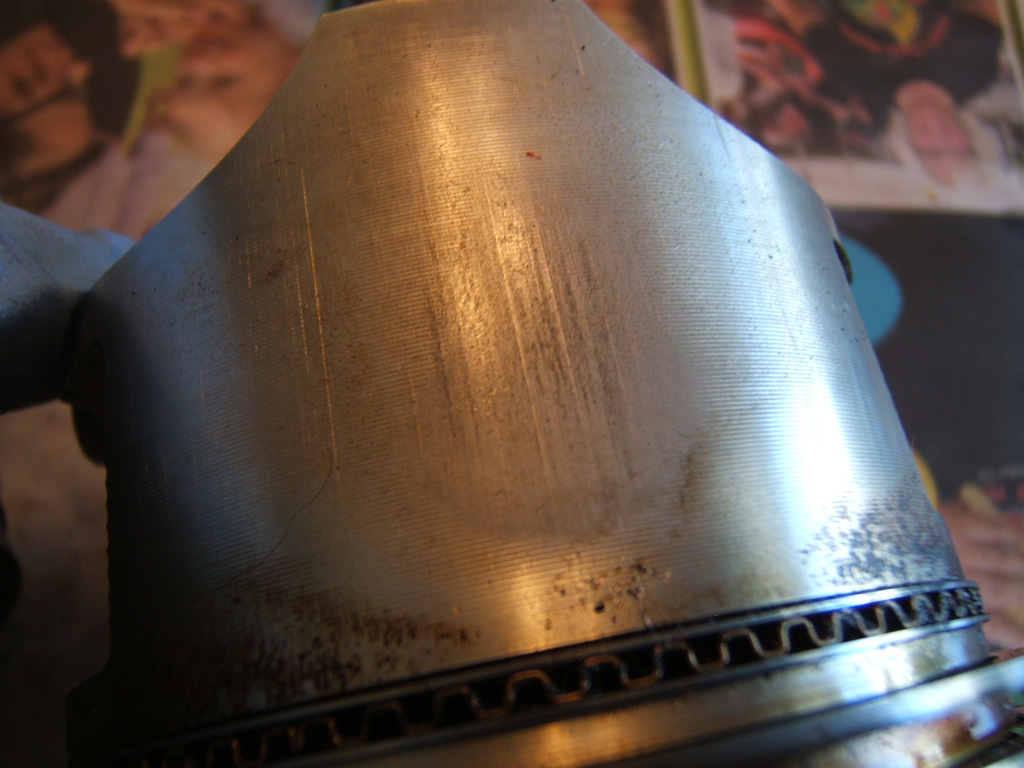


 Re: Piston Slap
True 'piston slap' is usually found on forged internals when they are fired up cold and the piston hasn't had time to expand in the cylinder.
It's possible that's excessive P2W clearance, but I actually don't think that piston looks very bad. That could just be wear.
It's possible that's excessive P2W clearance, but I actually don't think that piston looks very bad. That could just be wear.
Thread Starter
Hysterically Calm
Joined: Jan 2013
Posts: 10,439
Likes: 597
Re: Piston Slap
That's good to hear, I believe those pistons are original so had over 274,000 KM on them. I don't remember if I broke 300K before swapping the motor out with another B7.

Thread
Thread Starter
Forum
Replies
Last Post
PrecisionH23a
Honda Prelude
8
Mar 26, 2006 06:10 PM
cyrix12
All Motor / Naturally Aspirated
9
Nov 11, 2005 07:35 AM