


c v j boot replacement


Thread Starter
Honda-Tech Member
Joined: Feb 2014
Posts: 39
Likes: 0
 c v j boot replacement
If you have a cracked c v joint boot [1.5L] where all of the grease hasn't flung out and don't have the dreaded 'clicking' noise on turns, I found a cheap and easy fix not requiring axle removal.
This is for 1.5L engine with cvj hub diameter 3.15" [3 5/32"] 1.6L may have different diameter hub and shaft size.
I found the Dorman C V Joint split boot kit part # 03607 to be an exact fit. It's a split boot, attached together with very small bolts/nuts, straps for hub and axle, grease is included.
Jack car under wheel strut, remove wheel, to get equal grease/boot distribution during installation. Before removing old boot, mark axle for new boot attachment location.
This is for 1.5L engine with cvj hub diameter 3.15" [3 5/32"] 1.6L may have different diameter hub and shaft size.
I found the Dorman C V Joint split boot kit part # 03607 to be an exact fit. It's a split boot, attached together with very small bolts/nuts, straps for hub and axle, grease is included.
Jack car under wheel strut, remove wheel, to get equal grease/boot distribution during installation. Before removing old boot, mark axle for new boot attachment location.

CRX God
Joined: Jan 2007
Posts: 1,106
Likes: 2
Re: c v j boot replacement
I've seen it and I wouldn't trust it. Maybe for a quick fix on a beater, but nothing more.
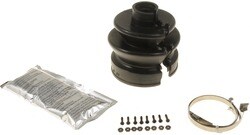
The ones with screws will cause vibrations, and the ones with glue are hard to put on. They don't end up lasting and end up leaking eventually. It is better just to do it right the first time.
The ones with screws will cause vibrations, and the ones with glue are hard to put on. They don't end up lasting and end up leaking eventually. It is better just to do it right the first time.
CRX God
Joined: Jan 2007
Posts: 1,106
Likes: 2
Re: c v j boot replacement
First, there is the question of reliability. The glue-together seam must be perfectly clean when the glue is applied for a good bond. A small speck of dirt or any grease on either surface will weaken the seam and may cause it to fail.
Second, the boot must be left undisturbed for up to an hour while the adhesive cures. Otherwise the seam will not hold. In the bolt-together boot, glue is not used to seal the seam. The manufacturer supplies an extra quantity of lubricant to replace grease that is continuously lost during normal operation. This necessitates periodic relubrication.
Third, Its very difficult to thoroughly clean and inspect a CV joint on the car. Some contaminated grease will remain in the bottom of the joint regardless of how much solvent is sprayed or brushed on the joint.
Fourth, and most importantly, a joint with a bad boot and contaminated grease may be damaged and need to be replaced anyway. It's impossible to detect certain types of cage damage and race wear without removing the joint from the car.
Second, the boot must be left undisturbed for up to an hour while the adhesive cures. Otherwise the seam will not hold. In the bolt-together boot, glue is not used to seal the seam. The manufacturer supplies an extra quantity of lubricant to replace grease that is continuously lost during normal operation. This necessitates periodic relubrication.
Third, Its very difficult to thoroughly clean and inspect a CV joint on the car. Some contaminated grease will remain in the bottom of the joint regardless of how much solvent is sprayed or brushed on the joint.
Fourth, and most importantly, a joint with a bad boot and contaminated grease may be damaged and need to be replaced anyway. It's impossible to detect certain types of cage damage and race wear without removing the joint from the car.
I've used the split type before on my '91 Accord and didn't like them. They didn't hold the grease long. And however little the screws weighed, it was still enough to cause a vibration at freeway speeds. I ended up just replacing my axle instead. A rebuilt axle cost me about $50 and took me less than an hour to replace.

Thread
Thread Starter
Forum
Replies
Last Post
SHG_Claudio
Honda Civic / Del Sol (1992 - 2000)
21
Dec 18, 2009 06:13 AM