


EF traction bar/radius rod modification for proper triangulation.


Thread Starter
Honda-Tech Member
Joined: Jul 2004
Posts: 9,846
Likes: 0
From: VA, USA
 EF traction bar/radius rod modification for proper triangulation.
I had another member ask me about some custom radius rods I made so I figured I'd make a thread and help anyone with an EF to get their suspension correct.
I had a problem with wheelhop and axle breakage so I went nuts redoing my front end. I bought a K-tuned (ETD) traction bar with rear stabilizing bars, had Chris at Kingpin Machine do my upper and lower arms, got solid aluminum mounts, yadda yadda. Then I read a bunch of stuff about how EF's have different geometry than EG's (duh) and that the radius rod (what some would call the traction bar) has to be solidly mounted to the LCA.
Most traction bars for the EF/DA have a heim joint at the front crossmember and at the LCA which is WRONG. It adds a second pivot point to the suspension that wasn't there before. Chris Brinson says it better than me:
So what are you to do if you already have an ETD/Full Race/etc. traction bar and want to make it right? I used the heims/hardware from the cross-member side of the K-tuned bar and the factory radius rod sides flat "bolt hole" piece that bolts to the LCA. May not be pretty but neither is my EF.
I have a stock parts car so I measured the distance from the shock fork bushing to a little tab on the body.


I ordered some 1" chromoly and some tube ends ((Mfr. #: ALL22046-4) and (Mfr. #: 1844-122)) and got to work. The tube ends are the same thread as most traction bars (5/8-18). I screwed the heim joint into the tube end as little as I felt safe. Then I counted the turns til it bottomed out, then screwed it out half way. This gives me max adjustability for caster in and out.


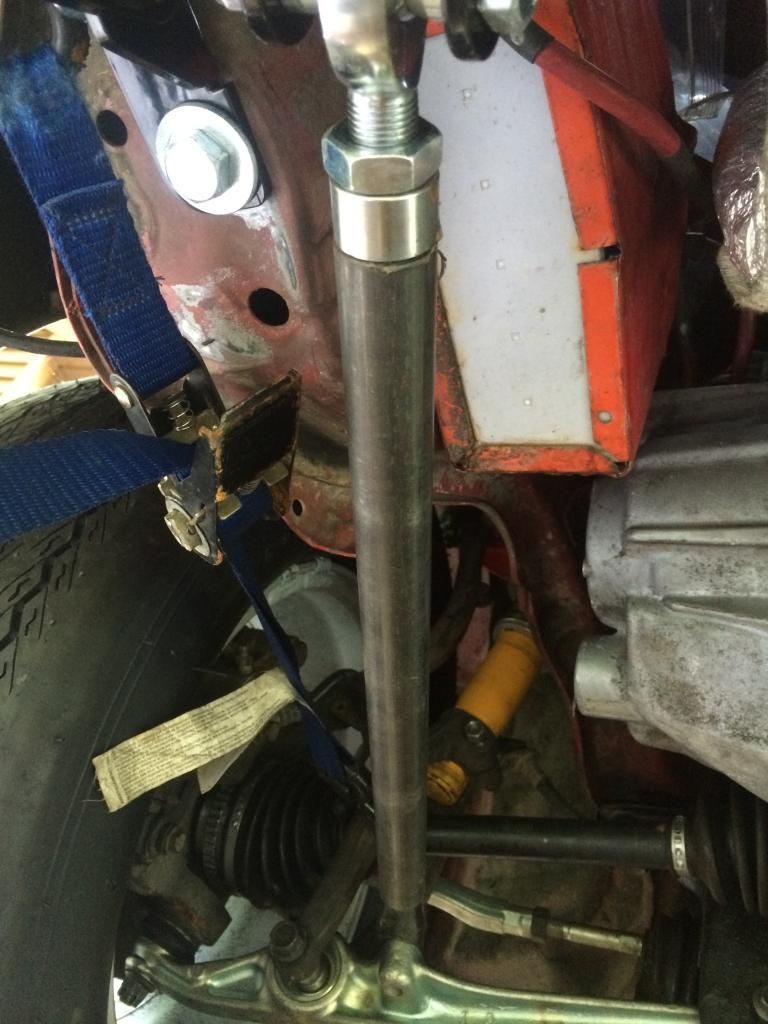
I cut the factory "bolt hole flat piece" off of the radius rods with about 4" of round part left on it. They hammer into the 1" chromoly pretty snugly. Still have to wiggle it to get it straight before fully welding, though. I then test fitted and used a ratchet strap to pull it all together. Keep measuring against the LCA/body to get the length right.
Gather all necessary fab supplies:

Weld 'er up. Super professional ***-core styling. Look at dem dimes:


I had to wallow out the holes to get the angle straight. To minimize the amount of metal removed I opened up the hole on one opposite side of each hole like in this pic:
I painted them with some bed-liner , bolted them on, look good. Have a delicious malt liquor.
I had a problem with wheelhop and axle breakage so I went nuts redoing my front end. I bought a K-tuned (ETD) traction bar with rear stabilizing bars, had Chris at Kingpin Machine do my upper and lower arms, got solid aluminum mounts, yadda yadda. Then I read a bunch of stuff about how EF's have different geometry than EG's (duh) and that the radius rod (what some would call the traction bar) has to be solidly mounted to the LCA.
Most traction bars for the EF/DA have a heim joint at the front crossmember and at the LCA which is WRONG. It adds a second pivot point to the suspension that wasn't there before. Chris Brinson says it better than me:
Originally Posted by Kingpin Machine
Attention EF/DA customers!! If you own a traction bar setup made by any company that consists of two pairs of heim joints in each leg of the traction bar it is 100% wrong. Period. I am running into this issue with at least 3 customers and probably more depending on how many of my EF/DA customers are running traction bars.
The stock suspension design of the EF/DA locks the front LCA and the radius rod rigidly into the same axis. In other words, the front suspension is triangulated. In contrast, the EF/DA/EG/DC rear LCA is not triangulated. Even with stock bushings if you take a large breaker bar and clamp it to the rear LCA you can rotate it fore and aft. Once you put bearings in the rear LCA you can grab it by hand and rotate the rear LCA until the bearing spacer contacts the bearing sleeve. That is why I engineered a solution to combat this inherent problem in the rear of our chassis.
But this issue does NOT occur on a stock EF/DA/EG/DC front suspension. However, if you were (for reasons I can't understand) to "engineer" a traction bar setup for the EF/DA that has rod ends on each end of both traction bar legs you will create this rotation issue. The problem is that you have one too many heim joints. You obviously want the heim joint that connects to what is now your front crossmember. That is what allows the suspension to articulate. But why on God's green earth would you want another heim joint attached to the LCA? Now the front LCA and the traction bar are no longer a triangulated unit. The LCA can now rotate independently of the traction bar leg and produce undesirable handling effects.
Worse yet, say you buy Kingpin Machine spherical LCAs for your EF/DA. At least with the rubber bushings they are so stiff that they dampen the rotation of the LCA somewhat. But with sphericals you have low stiction so the untriangulated LCA can easily be rotated now by hand and produce dramatically bad handling effects.
But the problem here lies in the traction bar. It is not designed to work like the stock radius rod does and again is 100% incorrect. A proper traction bar setup would simply work and mount like the stock radius rod does. The rear of the traction bar leg would rigidly mount to the LCA. The front of the traction bar legs would have a rod end that would connect to what is now the de facto front crossmember. It would work just like the Kingpin Machine radius rod bearings do by eliminating the deflection inherent in rubber bushings while allowing the suspension to freely articulate with very low stiction. It is simple really. Honda did a great job designing this suspension. These traction bar setups are like reinventing the wheel and replacing it with a triangle or a square!!
The stock suspension design of the EF/DA locks the front LCA and the radius rod rigidly into the same axis. In other words, the front suspension is triangulated. In contrast, the EF/DA/EG/DC rear LCA is not triangulated. Even with stock bushings if you take a large breaker bar and clamp it to the rear LCA you can rotate it fore and aft. Once you put bearings in the rear LCA you can grab it by hand and rotate the rear LCA until the bearing spacer contacts the bearing sleeve. That is why I engineered a solution to combat this inherent problem in the rear of our chassis.
But this issue does NOT occur on a stock EF/DA/EG/DC front suspension. However, if you were (for reasons I can't understand) to "engineer" a traction bar setup for the EF/DA that has rod ends on each end of both traction bar legs you will create this rotation issue. The problem is that you have one too many heim joints. You obviously want the heim joint that connects to what is now your front crossmember. That is what allows the suspension to articulate. But why on God's green earth would you want another heim joint attached to the LCA? Now the front LCA and the traction bar are no longer a triangulated unit. The LCA can now rotate independently of the traction bar leg and produce undesirable handling effects.
Worse yet, say you buy Kingpin Machine spherical LCAs for your EF/DA. At least with the rubber bushings they are so stiff that they dampen the rotation of the LCA somewhat. But with sphericals you have low stiction so the untriangulated LCA can easily be rotated now by hand and produce dramatically bad handling effects.
But the problem here lies in the traction bar. It is not designed to work like the stock radius rod does and again is 100% incorrect. A proper traction bar setup would simply work and mount like the stock radius rod does. The rear of the traction bar leg would rigidly mount to the LCA. The front of the traction bar legs would have a rod end that would connect to what is now the de facto front crossmember. It would work just like the Kingpin Machine radius rod bearings do by eliminating the deflection inherent in rubber bushings while allowing the suspension to freely articulate with very low stiction. It is simple really. Honda did a great job designing this suspension. These traction bar setups are like reinventing the wheel and replacing it with a triangle or a square!!
I have a stock parts car so I measured the distance from the shock fork bushing to a little tab on the body.
I ordered some 1" chromoly and some tube ends ((Mfr. #: ALL22046-4) and (Mfr. #: 1844-122)) and got to work. The tube ends are the same thread as most traction bars (5/8-18). I screwed the heim joint into the tube end as little as I felt safe. Then I counted the turns til it bottomed out, then screwed it out half way. This gives me max adjustability for caster in and out.
I cut the factory "bolt hole flat piece" off of the radius rods with about 4" of round part left on it. They hammer into the 1" chromoly pretty snugly. Still have to wiggle it to get it straight before fully welding, though. I then test fitted and used a ratchet strap to pull it all together. Keep measuring against the LCA/body to get the length right.
Gather all necessary fab supplies:
Weld 'er up. Super professional ***-core styling. Look at dem dimes:
I had to wallow out the holes to get the angle straight. To minimize the amount of metal removed I opened up the hole on one opposite side of each hole like in this pic:
I painted them with some bed-liner , bolted them on, look good. Have a delicious malt liquor.

Honda-Tech Member
Joined: Oct 2012
Posts: 1,858
Likes: 4
From: Orlando, FL
Re: EF traction bar/radius rod modification for proper triangulation.
Thread Starter
Honda-Tech Member
Joined: Jul 2004
Posts: 9,846
Likes: 0
From: VA, USA
Re: EF traction bar/radius rod modification for proper triangulation.
Correct.
Innovative is the only one currently making "correct" traction bars for the EF.
However, I messed up. I'm sure many other have to, by buying one of the wrongly designed bars out there. This is a cheaper alternative to fix it rather than buy the Innovative bar.
Yes Innovative does sell just the radius rods @ $75 each.
The chromoly and tube adapters cost me $49.70.
Bottom line:
If you are looking at buying a traction bar, buy the Innovative bar. Awesome piece.
If you already have a "traction bar" and it's been poorly designed, re-do it the way I did.
Innovative is the only one currently making "correct" traction bars for the EF.
However, I messed up. I'm sure many other have to, by buying one of the wrongly designed bars out there. This is a cheaper alternative to fix it rather than buy the Innovative bar.
Yes Innovative does sell just the radius rods @ $75 each.
The chromoly and tube adapters cost me $49.70.
Bottom line:
If you are looking at buying a traction bar, buy the Innovative bar. Awesome piece.
If you already have a "traction bar" and it's been poorly designed, re-do it the way I did.
 Re: EF traction bar/radius rod modification for proper triangulation.
I understand what you're getting at, but I have personal experience with the Full Race traction bar and it was excellent. The LCA is still triangulated, the heim pivots on a fixed plane. I had no adverse handling. I think the problem people run into is the cheaper knock offs with poor tolerances and weak materials. I believe ESP and Full Race are similar quality.
Thread Starter
Honda-Tech Member
Joined: Jul 2004
Posts: 9,846
Likes: 0
From: VA, USA
Re: EF traction bar/radius rod modification for proper triangulation.
I understand what you're getting at, but I have personal experience with the Full Race traction bar and it was excellent. The LCA is still triangulated, the heim pivots on a fixed plane. I had no adverse handling. I think the problem people run into is the cheaper knock offs with poor tolerances and weak materials. I believe ESP and Full Race are similar quality.
 Re: EF traction bar/radius rod modification for proper triangulation.
Dang, lucked out. I've always read that you want the single heim and a factory style double bolt to the LCA. A lot of the traction bars have two heim joints, right?
Thread Starter
Honda-Tech Member
Joined: Jul 2004
Posts: 9,846
Likes: 0
From: VA, USA
Re: EF traction bar/radius rod modification for proper triangulation.
Unfortunately, yes they do. It's fine on an EG/DC/EK but on an EF/DA it is not. Matter or fact, get a spherical bearing in the compliance bushing on an EG/DC/EK and you dont even need a traction bar.
Trending Topics

Honda-Tech Member

Joined: Apr 2002
Posts: 18,961
Likes: 76
From: I am Tyson
Re: EF traction bar/radius rod modification for proper triangulation.
Originally Posted by Kingpin Machine
Attention EF/DA customers!! If you own a traction bar setup made by any company that consists of two pairs of heim joints in each leg of the traction bar it is 100% wrong. Period. I am running into this issue with at least 3 customers and probably more depending on how many of my EF/DA customers are running traction bars.
The stock suspension design of the EF/DA locks the front LCA and the radius rod rigidly into the same axis. In other words, the front suspension is triangulated. In contrast, the EF/DA/EG/DC rear LCA is not triangulated. Even with stock bushings if you take a large breaker bar and clamp it to the rear LCA you can rotate it fore and aft. Once you put bearings in the rear LCA you can grab it by hand and rotate the rear LCA until the bearing spacer contacts the bearing sleeve. That is why I engineered a solution to combat this inherent problem in the rear of our chassis.
But this issue does NOT occur on a stock EF/DA/EG/DC front suspension. However, if you were (for reasons I can't understand) to "engineer" a traction bar setup for the EF/DA that has rod ends on each end of both traction bar legs you will create this rotation issue. The problem is that you have one too many heim joints. You obviously want the heim joint that connects to what is now your front crossmember. That is what allows the suspension to articulate. But why on God's green earth would you want another heim joint attached to the LCA? Now the front LCA and the traction bar are no longer a triangulated unit. The LCA can now rotate independently of the traction bar leg and produce undesirable handling effects.
Worse yet, say you buy Kingpin Machine spherical LCAs for your EF/DA. At least with the rubber bushings they are so stiff that they dampen the rotation of the LCA somewhat. But with sphericals you have low stiction so the untriangulated LCA can easily be rotated now by hand and produce dramatically bad handling effects.
But the problem here lies in the traction bar. It is not designed to work like the stock radius rod does and again is 100% incorrect. A proper traction bar setup would simply work and mount like the stock radius rod does. The rear of the traction bar leg would rigidly mount to the LCA. The front of the traction bar legs would have a rod end that would connect to what is now the de facto front crossmember. It would work just like the Kingpin Machine radius rod bearings do by eliminating the deflection inherent in rubber bushings while allowing the suspension to freely articulate with very low stiction. It is simple really. Honda did a great job designing this suspension. These traction bar setups are like reinventing the wheel and replacing it with a triangle or a square!!
Attention EF/DA customers!! If you own a traction bar setup made by any company that consists of two pairs of heim joints in each leg of the traction bar it is 100% wrong. Period. I am running into this issue with at least 3 customers and probably more depending on how many of my EF/DA customers are running traction bars.
The stock suspension design of the EF/DA locks the front LCA and the radius rod rigidly into the same axis. In other words, the front suspension is triangulated. In contrast, the EF/DA/EG/DC rear LCA is not triangulated. Even with stock bushings if you take a large breaker bar and clamp it to the rear LCA you can rotate it fore and aft. Once you put bearings in the rear LCA you can grab it by hand and rotate the rear LCA until the bearing spacer contacts the bearing sleeve. That is why I engineered a solution to combat this inherent problem in the rear of our chassis.
But this issue does NOT occur on a stock EF/DA/EG/DC front suspension. However, if you were (for reasons I can't understand) to "engineer" a traction bar setup for the EF/DA that has rod ends on each end of both traction bar legs you will create this rotation issue. The problem is that you have one too many heim joints. You obviously want the heim joint that connects to what is now your front crossmember. That is what allows the suspension to articulate. But why on God's green earth would you want another heim joint attached to the LCA? Now the front LCA and the traction bar are no longer a triangulated unit. The LCA can now rotate independently of the traction bar leg and produce undesirable handling effects.
Worse yet, say you buy Kingpin Machine spherical LCAs for your EF/DA. At least with the rubber bushings they are so stiff that they dampen the rotation of the LCA somewhat. But with sphericals you have low stiction so the untriangulated LCA can easily be rotated now by hand and produce dramatically bad handling effects.
But the problem here lies in the traction bar. It is not designed to work like the stock radius rod does and again is 100% incorrect. A proper traction bar setup would simply work and mount like the stock radius rod does. The rear of the traction bar leg would rigidly mount to the LCA. The front of the traction bar legs would have a rod end that would connect to what is now the de facto front crossmember. It would work just like the Kingpin Machine radius rod bearings do by eliminating the deflection inherent in rubber bushings while allowing the suspension to freely articulate with very low stiction. It is simple really. Honda did a great job designing this suspension. These traction bar setups are like reinventing the wheel and replacing it with a triangle or a square!!
if the shock bushing was left alone, or designed it with a roller bearing instead you dont have the free rotation condition.
OMG WTF BBQQAQQQQ SQUAREPANTS!
Thread Starter
Honda-Tech Member
Joined: Jul 2004
Posts: 9,846
Likes: 0
From: VA, USA
Re: EF traction bar/radius rod modification for proper triangulation.
Why compromise if you don't have to?


Thread Starter
Honda-Tech Member
Joined: Jul 2004
Posts: 9,846
Likes: 0
From: VA, USA
Re: EF traction bar/radius rod modification for proper triangulation.
From what I see, ESP/Full Race uses a heim joint to mount the LCA to the radius rod, which introduces another pivot point in the front suspension, which is wrong.
How is that "made better/stronger?"
Hell, my ghetto malt liquor design uses two bolts! Holy crap that's way stronger than one heim joint!

Thread Starter
Honda-Tech Member
Joined: Jul 2004
Posts: 9,846
Likes: 0
From: VA, USA
Re: EF traction bar/radius rod modification for proper triangulation.
Re: EF traction bar/radius rod modification for proper triangulation.
yeah just this past month my front end has been making a lot more noise.... i gotta figure it before the next event.
CRX God
Joined: Jan 2007
Posts: 1,106
Likes: 2
Re: EF traction bar/radius rod modification for proper triangulation.
I'll bite. Explain...
From what I see, ESP/Full Race uses a heim joint to mount the LCA to the radius rod, which introduces another pivot point in the front suspension, which is wrong.
How is that "made better/stronger?"
Hell, my ghetto malt liquor design uses two bolts! Holy crap that's way stronger than one heim joint!
From what I see, ESP/Full Race uses a heim joint to mount the LCA to the radius rod, which introduces another pivot point in the front suspension, which is wrong.
How is that "made better/stronger?"
Hell, my ghetto malt liquor design uses two bolts! Holy crap that's way stronger than one heim joint!
Thread Starter
Honda-Tech Member
Joined: Jul 2004
Posts: 9,846
Likes: 0
From: VA, USA

Honda-Tech Member
Joined: Apr 2002
Posts: 525
Likes: 2
From: Buford, GA
Re: EF traction bar/radius rod modification for proper triangulation.
Tyson, what you are saying is not correct and is also completely useless info. Thanks for playing though. About like saying "well, if you didn't modify your race car it would be more reliable and last longer". Well no **** Sherlock. That incorrectly designed Full Race traction bar allows the front LCA to rotate it. Period. End of discussion. It rotates with stock bushings in the lca. Attach a breaker bar to the LCA and put enough force on it and you can rotate. It is still going to rotate with a stock shock bushing. But then you are putting a huge bending force on your shock which will cause premature wear and obviously (to me) reduce much of the benefit of going to sphericals to begin with. Same issue with the roller bearing.
Thanks for the useless feedback though!
Thanks for the useless feedback though!
CRX God
Joined: Jan 2007
Posts: 1,106
Likes: 2
Re: EF traction bar/radius rod modification for proper triangulation.
This is the only difference I can think of after trying to figure out the difference.
I don't think it is that critical. Does anyone see it a different way?
I don't think it is that critical. Does anyone see it a different way?
Honda-Tech Member
Joined: Oct 2012
Posts: 1,858
Likes: 4
From: Orlando, FL
Re: EF traction bar/radius rod modification for proper triangulation.
In your first illistration (the one with double heims), imaging the LCA being twisted around its axis, like if it were to roll.
CRX God
Joined: Jan 2007
Posts: 1,106
Likes: 2

Honda-Tech Member

Joined: Jan 2001
Posts: 2,273
Likes: 3
Re: EF traction bar/radius rod modification for proper triangulation.
Brian from PCI https://honda-tech.com/forums/members/eg6vtec1-999380845/ ( http://www.procarinnovations.com/ ) talked about this like 7 years ago!...that guy knows everything  Too bad you guys didnt listen to him back then
I bet he designed that Innovative traction bar because it is a superior piece of fabrication.
.
Too bad you guys didnt listen to him back then I bet he designed that Innovative traction bar because it is a superior piece of fabrication.
.