


Oil pump inspections


Thread Starter
Honda-Tech Member
Joined: Sep 2003
Posts: 7,421
Likes: 0
From: jacksonville, fl
 Oil pump inspections
For the longest time I've throw away oil pumps just because and purchased new oem units. As of late I've been looking at the parts break down and rebuilding the unit seems to be an option for a person like me that like to tinker.
My issue is that I rebuild hydraulic pumps all day and I have common knowledge with these type of pumps in the Honda engines. But my question is the circular markings on the housing and gear are normal?
My issue is that I rebuild hydraulic pumps all day and I have common knowledge with these type of pumps in the Honda engines. But my question is the circular markings on the housing and gear are normal?

Honda-Tech Member
Joined: Aug 2003
Posts: 3,537
Likes: 4
From: Albany, NY
Re: Oil pump inspections
I used to do the same thing. They are extremely simple units and the failures I have seen were either:
A. High hp harmonics with solid or aluminum cranks pulleys, the rotor can crack.
B. The pump ingested debris from other parts failure.
Now some very light scratches on the housing from use are normal. Deep scoring or material removed is not ok and will decrease the output. If the pump is in good shape I will absolutely reuse it without issue. Make sure to check and clean the relief as well.
A. High hp harmonics with solid or aluminum cranks pulleys, the rotor can crack.
B. The pump ingested debris from other parts failure.
Now some very light scratches on the housing from use are normal. Deep scoring or material removed is not ok and will decrease the output. If the pump is in good shape I will absolutely reuse it without issue. Make sure to check and clean the relief as well.
Thread Starter
Honda-Tech Member
Joined: Sep 2003
Posts: 7,421
Likes: 0
From: jacksonville, fl
Re: Oil pump inspections
That's what I'm going to do. I figured I'm tossing money out the window. Yea this unit is in greAt shape with minimal scoring. No marring or discoloration.

Honda-Tech Member
Joined: Jan 2008
Posts: 177
Likes: 0
From: Ottawa, ON, Canada
Re: Oil pump inspections
I measure the clearance fallowing the FSM....takes 2 seconds and, never found one to be out of spec.
I then totally disassemble it removing the relief valve and the 2 hex plugs. Inspect the plunger, again, never found a problem.
Next I port the pump. I start with the inlet port, just slight enlargement. then I move to where the oil actually flows into the pump housing. This area can be a bit of a bitch to port. There's a ridge, remove it and smooth everything out. Be careful and take your time. Next move to where the oil leaves the pump housing. You'll see another ridge and sharp edges at the opening. Smooth everything out. Next match the size of the pump outlet to the opening in the block. This is very important on d-series pumps, less so on the b-series pumps. clean everything really well and reassemble. There's some controversy on shimming the relief spring, I have done it in the past but opted not to this time.
My last track day was chilly....only 4*C. When I left my house at 6am to drive to the track it wasn't above freezing. Cold start saw oil pressures reaching 85 psi....a bit high for my liking. How ever, once warm it hold strong all day at 65psi. I get 10psi per 1000 rpm till 65 psi then you can see the valve open and it holds firm. a big cooler helps as well.
EDIT**** replace the front main seal as well!
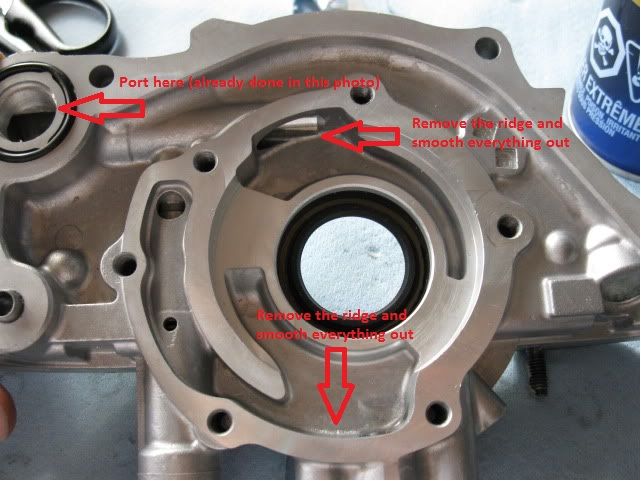
I then totally disassemble it removing the relief valve and the 2 hex plugs. Inspect the plunger, again, never found a problem.
Next I port the pump. I start with the inlet port, just slight enlargement. then I move to where the oil actually flows into the pump housing. This area can be a bit of a bitch to port. There's a ridge, remove it and smooth everything out. Be careful and take your time. Next move to where the oil leaves the pump housing. You'll see another ridge and sharp edges at the opening. Smooth everything out. Next match the size of the pump outlet to the opening in the block. This is very important on d-series pumps, less so on the b-series pumps. clean everything really well and reassemble. There's some controversy on shimming the relief spring, I have done it in the past but opted not to this time.
My last track day was chilly....only 4*C. When I left my house at 6am to drive to the track it wasn't above freezing. Cold start saw oil pressures reaching 85 psi....a bit high for my liking. How ever, once warm it hold strong all day at 65psi. I get 10psi per 1000 rpm till 65 psi then you can see the valve open and it holds firm. a big cooler helps as well.
EDIT**** replace the front main seal as well!

Thread Starter
Honda-Tech Member
Joined: Sep 2003
Posts: 7,421
Likes: 0
From: jacksonville, fl
Re: Oil pump inspections
Yea I've ported the d pumps before to get rid of the rigid edges and try to smooth that sharp turn in the pump. Seems to work fine same engine lost the bottom end twice before the owner found the pump was bad. Ported new unit got the rods refreshed and been going strong for 4 years now.
Lost the bottom I mean slight tap and bearing material not a total failure
Lost the bottom I mean slight tap and bearing material not a total failure
Honda-Tech Member
Joined: Jan 2008
Posts: 177
Likes: 0
From: Ottawa, ON, Canada
Re: Oil pump inspections
Same boat. The pump in that picture now has 4 track seasons of hard use on it. I refreshed the rings 2 seasons ago and the bearings looked brand new. Checked the clearances and chucked them back in.
Just finished a B-series pump for an endurance race car, next is a GSR pump for my new track only setup. My new engine will be reving out to 9000 rpm (gearing and long straight). I'm going to be running an ATI super damper on it to help the pump with any strange harmonics and loading. The pump rotor and crank snout look pretty fresh so I'll try to keep them that way.
Just finished a B-series pump for an endurance race car, next is a GSR pump for my new track only setup. My new engine will be reving out to 9000 rpm (gearing and long straight). I'm going to be running an ATI super damper on it to help the pump with any strange harmonics and loading. The pump rotor and crank snout look pretty fresh so I'll try to keep them that way.

Thread
Thread Starter
Forum
Replies
Last Post