


intake manifold design on b20z2 and d16y8


Thread Starter
B*a*n*n*e*d
iTrader: (1)
Joined: May 2005
Posts: 5,222
Likes: 2
From: sea,WA in my car
 intake manifold design on b20z2 and d16y8
Looking at these 2 manifolds they are not standard shape
Y8 has a lump on top making it bigger plenum size
B20z2 has a chamber on top that from my reading supposed to help with midrange torque.
Anyone has a dyno with the box and without it fir b20z2?
And if it does increase midrange wouldnt a similar setup have a benefit on any other NA engine?
Say for example a box can be tuned to specific size on a dyno to get rid of a dip in torque curve at specific rpm.
Anyone has tried it possibly?
Rocket 4 piston other guys that know about intake design?
Y8 has a lump on top making it bigger plenum size
B20z2 has a chamber on top that from my reading supposed to help with midrange torque.
Anyone has a dyno with the box and without it fir b20z2?
And if it does increase midrange wouldnt a similar setup have a benefit on any other NA engine?
Say for example a box can be tuned to specific size on a dyno to get rid of a dip in torque curve at specific rpm.
Anyone has tried it possibly?
Rocket 4 piston other guys that know about intake design?

Honda-Tech Member
Joined: Mar 2007
Posts: 11,399
Likes: 69
From: East Coast 506, Canada
Re: intake manifold design on b20z2 and d16y8
Yes people have designed plenums to attain power based on different volumes. The OE are designed that way. In most cases however, they have more of an emissions and fuel economy minded design.
There was a member on here with a thread all about his 8k and 9K RPM manifolds. Each was designed based on a specific runner and plenum volumes.
There was a member on here with a thread all about his 8k and 9K RPM manifolds. Each was designed based on a specific runner and plenum volumes.
Thread Starter
B*a*n*n*e*d
iTrader: (1)
Joined: May 2005
Posts: 5,222
Likes: 2
From: sea,WA in my car
Re: intake manifold design on b20z2 and d16y8
So would that benefit to add a chamber similar to that to somwthing like aebs manifold it has a perfect flat area on top to do that to fine tune the plenum size?
Honda-Tech Member
Joined: Mar 2007
Posts: 11,399
Likes: 69
From: East Coast 506, Canada
Re: intake manifold design on b20z2 and d16y8
If you look into it the distance from the runner opening and the back of hte plenum along with it's overall volume can effect the engines performance. Volume has to do with cylinder filling. The distance between the runner opening and back of the plenum is based on intake resonance pulse calculations.
I am about to leave for hockey so I don't have time to get into real details...... Look up runner length calculations and Helmholtz resonance tuning.
I am about to leave for hockey so I don't have time to get into real details...... Look up runner length calculations and Helmholtz resonance tuning.
Thread Starter
B*a*n*n*e*d
iTrader: (1)
Joined: May 2005
Posts: 5,222
Likes: 2
From: sea,WA in my car
Re: intake manifold design on b20z2 and d16y8
I red about that. I just dont understand these 2 examples.
Y8 the hump is on the top not the back of plenum
And b20z2 the box is also on top of the manifold with a small opening to the box
Y8 the hump is on the top not the back of plenum
And b20z2 the box is also on top of the manifold with a small opening to the box
Honda-Tech Member
Joined: Mar 2007
Posts: 11,399
Likes: 69
From: East Coast 506, Canada
Re: intake manifold design on b20z2 and d16y8
If you look at the direction the runners are pointing I think you will see that they point toward that hump. Where I said back I probably should have said the top in this situation. I'm not that familiar with the Y8, only going by the images that I have just found online. The hump actually increases the distance between the runner opening in the plenum and the inside surface of the manifold that faces the the runners.
Trending Topics



 Re: intake manifold design on b20z2 and d16y8
You've clearly never looked under the hood of a later model first-gen CR-V:

Side by side, the P75 manifold is alomost identical in dimensions to the PHK manifold, save for the resonator chamber. This picture makes the plenums look like they are offset differently, but it's kind of an illusion from the angle:
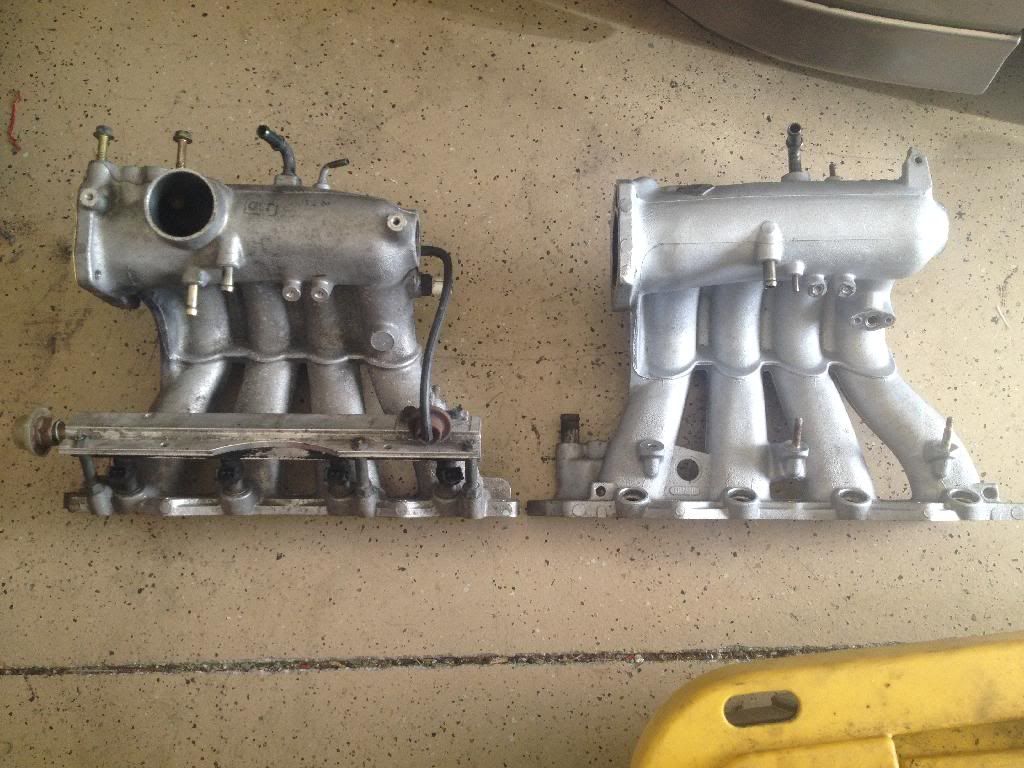
Note that the plenums are shaped a little differently (tapers down toward #1 on the PHK), but the obdII P75 manifold is even more similar looking.
I wouldn't necessarily call that box additional plenum volume, although its interaction with the actual plenum surely has some effect to that end. It probably acts more like a damper to to balance the waves though the non resonant regions of the Z's rpm range. The "hump" on the Y8 manifold is very simply additional volume, but I'm sure that it was added in such a way as to make the most of (or at least exactly whatever the design called for).
There are so many differing design techniques for selecting plenum volume and runner size/shape that it's hard to take a look at an oem manifold and guess exactly what the engineers were going for. Even then, looking in, we could be overthinking it. It could simply have been the packaging guys going back and forth with the engine guys trying to get xxL of plenum into yycm^3 of underhood space.
If I could get a hold of one of the plenum boxes I'd totally be down to do some testing and see what it does to the power band. Hell, I'd run it if it cured the midrange dip in my power curve.
Side by side, the P75 manifold is alomost identical in dimensions to the PHK manifold, save for the resonator chamber. This picture makes the plenums look like they are offset differently, but it's kind of an illusion from the angle:

Note that the plenums are shaped a little differently (tapers down toward #1 on the PHK), but the obdII P75 manifold is even more similar looking.
I wouldn't necessarily call that box additional plenum volume, although its interaction with the actual plenum surely has some effect to that end. It probably acts more like a damper to to balance the waves though the non resonant regions of the Z's rpm range. The "hump" on the Y8 manifold is very simply additional volume, but I'm sure that it was added in such a way as to make the most of (or at least exactly whatever the design called for).
There are so many differing design techniques for selecting plenum volume and runner size/shape that it's hard to take a look at an oem manifold and guess exactly what the engineers were going for. Even then, looking in, we could be overthinking it. It could simply have been the packaging guys going back and forth with the engine guys trying to get xxL of plenum into yycm^3 of underhood space.
If I could get a hold of one of the plenum boxes I'd totally be down to do some testing and see what it does to the power band. Hell, I'd run it if it cured the midrange dip in my power curve.
Honda-Tech Member
Joined: Mar 2007
Posts: 11,399
Likes: 69
From: East Coast 506, Canada
Re: intake manifold design on b20z2 and d16y8
That's a resonance chamber..... not sure that it has anything more than taking noise out of the equation.... Although some say that removing the resonance increases velocity in different regions of the engines power range. I haven't looked that far into the theories.
Images definitely help this thread out greatly as I will admit I have never seen one of those chambers. The later CR-V K series engines do not have these.... I have never worked on the B20 CR-V variant.
Images definitely help this thread out greatly as I will admit I have never seen one of those chambers. The later CR-V K series engines do not have these.... I have never worked on the B20 CR-V variant.
Thread Starter
B*a*n*n*e*d
iTrader: (1)
Joined: May 2005
Posts: 5,222
Likes: 2
From: sea,WA in my car
Re: intake manifold design on b20z2 and d16y8
sorry i thought it was pretty common but then realize that only usdm 99-01 crv comes with it...
if someone has a swap in their car at the dyno could just remve it and plug the hole and do a run without it to see what changes.
ill pick it up if i see one at junkyard
if someone has a swap in their car at the dyno could just remve it and plug the hole and do a run without it to see what changes.
ill pick it up if i see one at junkyard
Re: intake manifold design on b20z2 and d16y8
That just demonstrates my age a bit. When I was still turning wrenches CR-V's had just barely begun showing up at the dealer with K's in them... dear god that 2nd gen was an ugly beast!
I agree that it is definitely a resonance chamber, but almost definitely its purpose was aimed at flow rather than sound. It is much easier to add a Helmholtz device to the intake tract to attenuate certain frequencies. If you've ever looked at the fuel curve of an b20b/z with a p75 you can almost always see a big dip in the middle of the range. It is of course all speculation unless someone wants to experiment and document
Running with and without the box would be the most straightforward way to test it since the two manifolds are different enough that it wouldn't just be a quick swap on/off. The only tricky part would be having something to cap of that bigass hole.
I agree that it is definitely a resonance chamber, but almost definitely its purpose was aimed at flow rather than sound. It is much easier to add a Helmholtz device to the intake tract to attenuate certain frequencies. If you've ever looked at the fuel curve of an b20b/z with a p75 you can almost always see a big dip in the middle of the range. It is of course all speculation unless someone wants to experiment and document
Running with and without the box would be the most straightforward way to test it since the two manifolds are different enough that it wouldn't just be a quick swap on/off. The only tricky part would be having something to cap of that bigass hole.
Honda-Tech Member
Joined: Jul 2008
Posts: 40
Likes: 0
From: 410, Maryland, United States
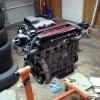
I just did this swap. I am running an obd2 p75 ecu with it. I keep getting a lean burn code thrown. I might go with an obd1 p75 and tune it. With the box, I get an good torque curve until about 5.1k rpm with a steady throttle, where its almost at a studder. But as soon as I open it to WOT, it pulls hard. I'm in search of a cap to put over the hole and test her out. With hood clearance, I used hood spacers for the test run, but I believe without them, I'll have about a ½" clearance. I will post back with my findings soon.


Thread
Thread Starter
Forum
Replies
Last Post
Smith Wise
Honda Civic / Del Sol (1992 - 2000)
22
Apr 24, 2003 07:50 PM