


[DIY] NSX (NA2) 300mm Brake Install


Thread Starter
Honda-Tech Member
iTrader: (5)
Joined: Apr 2003
Posts: 23,967
Likes: 9
From: Las Vegas
 [DIY] NSX (NA2) 300mm Brake Install
After fiddling around with the idea of putting NSX calipers on the R, I finally made the decision and picked up NSX front calipers from a 2000 model.
NSX (NA1) [91-96] brakes are 282mm
NSX (NA2) [97-05] brakes are 300mm
It has been stated that CL1 Accord Type-R rotors will fit, but many of us won't have access to them. TSX and Euro R rotors are the size we need except the bores are different and require boring out the TSX/Euro R rotor from 64mm to 70mm. I may have found a solution for us North Americans without having to do rotor modifications.
Those researching this will know the 97-05 NSX (NA2) front rotors are larger than 91-96 NSX (NA1) front rotors. The two calipers look the same, use the same pads, but are slightly different. Besides the caliper brackets size difference, the NA1 calipers have 40mm and 36mm pistons, while the NA2 calipers have 40mm and 34mm pistons. Either are interchangeable as long as you use the newer caliper bracket made for the 300mm brakes (well, technically 298mm). We will need a larger front rotor too (because of the slightly larger bracket), with a 300mm diameter and 28mm thickness. Let's do a comparison between the Integra Type-R and 99-04 (KA9) RL front rotors, and while we're at it the 04-08 (CL9) TSX front rotor .
Integra Type-R Front Rotor (left) & 99-04 Acura RL Front Rotor (middle) & 04-08 Acura TSX Front Rotor (right):


Finally, Accord Type-R (CL1) rotors below (which will also work):

So, looking at the specs, we have our rotor diameter and thickness we need. Hat height and bore are very similar. Looks like it will be a perfect candidate. The TSX also works, but with the smaller bore.
Stuff you need:
- 97-05 NSX front calipers with brackets
- 99-04 Acura RL (KA9) front rotors
- 4 washers
The equipment: RL front rotors, ITR rear rotors, TechnaFit SS brake lines, and NA2 front calipers.

Comparing the stock ITR front rotor with the RL front rotor, there is a small visible difference.

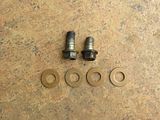
My calipers came with the NSX caliper bracket bolts (left). As you can see, they are longer than the ITR ones (right). You will be using the stock ITR caliper bracket bolts as the NSX ones will hit the rotor. You will also need 4 washers to space the caliper bracket from the knuckle. I picked up 4 hardened washers to do the trick.
You can see where I used the washers to space the caliper bracket out from the knuckle.

Voila! You have NSX (NA2) 300mm brakes on your ITR.

Ignore the red lugs (yes, they are ball seated) as I couldn't find my OEM black ones. The NSX calipers fit nicely under the JDM 16s without spacers.


Note: I had to bend the dust shield a little on the passenger side only for some reason, otherwise the caliper bracket would not slide in.
NSX (NA1) [91-96] brakes are 282mm
NSX (NA2) [97-05] brakes are 300mm
It has been stated that CL1 Accord Type-R rotors will fit, but many of us won't have access to them. TSX and Euro R rotors are the size we need except the bores are different and require boring out the TSX/Euro R rotor from 64mm to 70mm. I may have found a solution for us North Americans without having to do rotor modifications.
Those researching this will know the 97-05 NSX (NA2) front rotors are larger than 91-96 NSX (NA1) front rotors. The two calipers look the same, use the same pads, but are slightly different. Besides the caliper brackets size difference, the NA1 calipers have 40mm and 36mm pistons, while the NA2 calipers have 40mm and 34mm pistons. Either are interchangeable as long as you use the newer caliper bracket made for the 300mm brakes (well, technically 298mm). We will need a larger front rotor too (because of the slightly larger bracket), with a 300mm diameter and 28mm thickness. Let's do a comparison between the Integra Type-R and 99-04 (KA9) RL front rotors, and while we're at it the 04-08 (CL9) TSX front rotor .
Integra Type-R Front Rotor (left) & 99-04 Acura RL Front Rotor (middle) & 04-08 Acura TSX Front Rotor (right):


Finally, Accord Type-R (CL1) rotors below (which will also work):

So, looking at the specs, we have our rotor diameter and thickness we need. Hat height and bore are very similar. Looks like it will be a perfect candidate. The TSX also works, but with the smaller bore.
Stuff you need:
- 97-05 NSX front calipers with brackets
- 99-04 Acura RL (KA9) front rotors
- 4 washers
The equipment: RL front rotors, ITR rear rotors, TechnaFit SS brake lines, and NA2 front calipers.

Comparing the stock ITR front rotor with the RL front rotor, there is a small visible difference.

My calipers came with the NSX caliper bracket bolts (left). As you can see, they are longer than the ITR ones (right). You will be using the stock ITR caliper bracket bolts as the NSX ones will hit the rotor. You will also need 4 washers to space the caliper bracket from the knuckle. I picked up 4 hardened washers to do the trick.

You can see where I used the washers to space the caliper bracket out from the knuckle.

Voila! You have NSX (NA2) 300mm brakes on your ITR.

Ignore the red lugs (yes, they are ball seated) as I couldn't find my OEM black ones. The NSX calipers fit nicely under the JDM 16s without spacers.


Note: I had to bend the dust shield a little on the passenger side only for some reason, otherwise the caliper bracket would not slide in.
Last edited by BlueIntegraBoy; Feb 24, 2011 at 06:57 PM.


 good write up bro!

 Re: [DIY] NSX (NA2) 300mm Brake Install
Nice setup. Do you feel a difference between the original setup versus your current setup? Does your brake pedal feel more firm, or does it have a little more travel in it?


Honda-Tech Member
Joined: Apr 2002
Posts: 1,979
Likes: 0
Re: [DIY] NSX (NA2) 300mm Brake Install
FYI
just did this the same way in june. here were my quarks.
the extra 2 hundredths of hub diameter is noticable. i had to clean off what little rust was on there and torque the wheels a few times to get smooth uninterupted rotation. could have been the autozone rotors too. their hub hole is beveled. who knows.
I also used different bolts from my local 'we have every size you could imagine' store. with the spacers in there i didnt feel comfortable with fewer threads.
that is all. enjoy.
BTW made it through the season with no material transfer issues. im happy with my 150 dollar investment.
just did this the same way in june. here were my quarks.
the extra 2 hundredths of hub diameter is noticable. i had to clean off what little rust was on there and torque the wheels a few times to get smooth uninterupted rotation. could have been the autozone rotors too. their hub hole is beveled. who knows.
I also used different bolts from my local 'we have every size you could imagine' store. with the spacers in there i didnt feel comfortable with fewer threads.
that is all. enjoy.
BTW made it through the season with no material transfer issues. im happy with my 150 dollar investment.
Trending Topics


Honda-Tech Member


Joined: Jan 2002
Posts: 2,350
Likes: 154
From: Charlotte, NC
Re: [DIY] NSX (NA2) 300mm Brake Install
The parts list should include any year NSX front caliper. A 97-05 caliper isn't required for the 11.8" rotors. The 91-96 are the same except for the larger piston.
Good work. Nice to see another 300mm rotor set up.
Good work. Nice to see another 300mm rotor set up.
Thread Starter
Honda-Tech Member
iTrader: (5)
Joined: Apr 2003
Posts: 23,967
Likes: 9
From: Las Vegas
Re: [DIY] NSX (NA2) 300mm Brake Install
For the sake of this thread, I just listed 97-05 to avoid mix and matching. There is another thread for using the 91-96 NSX calipers and brackets.


Honda-Tech Member
Joined: Apr 2009
Posts: 2,770
Likes: 2
From: Florida
Re: [DIY] NSX (NA2) 300mm Brake Install
Excellent write up! However I agree with the extra weight in rotational mass of the bigger brake setup possibly being not beneficial. They look great though thats for sure. 11.1" rotors with good pads is actually a huge amount of stopping power for the weight of these cars. Again why a stock ITR is pretty much a perfect car. How is the braking bias now or what is the rear setup? I have seen a fellow R owner on here do a NSX rear brake setup before.
 Re: [DIY] NSX (NA2) 300mm Brake Install
Increasing the rotor diameter at the front will push bias forward. Increasing the the piston area at the front will also push bias forward. The result will be an increase in stopping distance due to the rear tires being under-worked. Ideally you would decrease piston area when increasing rotor size to maintain or even reduce front brake torque. I wonder if the NSX 2-pot calipers have more or less piston area than the R caliper.
Of course big brakes sure do look cool, and I'm sure the ABS can keep up with the change.
Of course big brakes sure do look cool, and I'm sure the ABS can keep up with the change.
 Re: [DIY] NSX (NA2) 300mm Brake Install
just some old info from various post a while back. Some people may find it helpful.
* Dual piston legend calipers only came in 94-95 GS sedan. The calipers are also stamped as "17CL15VN" just like non dual piston, you have to look at the casting on the side to see. The brackets they come with are 28T.
* Dual piston size between 94-95 Legend GS and all-NSX very similar but NOT THE SAME.
- Legend GS dual piston size 40mm & 38mm
- NSX dual piston size 40mm & 36mm, but has cooling fins & bling'n "NSX" stamp on the caliper!
* Dual pistons legend/nsx calipers are directional as 40mm piston engages first applying greater force towards the front of the pad, which results in compromising the effectiveness of the 38/36mm piston that is to follow.
The # on the bracket refers to how many mm the rotor is.
Legend GS & NSX have 28mm thick rotors so their bracket say 28T.
So all brackets are interchangeable with the 17CL15VN caliper. But you'll want to match the BRACKET to which rotor you use.
So which is better ITR or 94-95 Legend GS or NSX? A lot of it what determines how hard a brake is able to apply force is the hydraulic principle.
Dual piston 94-95 Legend GS:
The piston area of the 38mm piston will be 1134 square millimeters
The piston area of the 42mm piston is 1385 square millimeters
Total = 2519 square millimeters of hydraulic pressure
Dual piston NSX
The piston area of the 36mm piston is 1017 square millimeters
The piston area of the 40mm piston is 1256 square millimeters
Total = 2273 square millimeters of hydraulic pressure
Single piston ITR:
The piston of the 57mm piston is 2550 square millimeters of of hydraulic pressure.
If it was just about PISTON hydraulic pressure,then ITR wins hands down because it applies more hydraulic pressure per square millimeters, next best would be the 94-95 Legend GS, then the NSX.
But there other things to factor into also such as:
- The main advantage of using the NSX braking system is the use of the larger rotor (28mm) vs the ITR rotor (23mm). You have a much better heat sink and thus better fade resistance/pad performance. Modulation is also better.
- With 2 pistons you are in theory utilizing more pad area more effectively which will then transfer into better stop power when it contacts the disc.
- The multiple piston setup provides more even clamping force over the entire area of the pad - and thus you get better pad wear/life too
- I think that the biggest issue here is heat and its effects. A larger pad has a greater ability to disperse heat than a smaller pad, and as such the temperature of the pad will not increase as much. Therefore, since its the heat that alters the physical characteristics of the pad (changes the coefficient of friction???) the larger pad will provide better braking than a smaller pad
So....despite the calculations of force applied the the back of the pad are correct. Thus on paper the ITR caliper design might be able to provide a higher total clamping force - but once you take into account the other things - this advantage becomes moot. The engineers are smart. If the pistons were a little bigger you'd probably flip the car when it stops, or end up breaking steering components.
Nuff said...
Re: [DIY] NSX (NA2) 300mm Brake Install
300mm is 11.8...
if you ever seen stock ITR 15" rims you'll see that there is practically no room left even with 11.1" rotors.
Aside from looks, I don't see the signficant benefits of upgrading from 11.1 to 11.8" rotors when your adding more weight to the car and rotating mass.
Good post. It's written very well.
But honestly here is my take on the whole "oem big brake" setups. Keep in mind I've sold several of these kits, but even I have to admit their limited range of usablity.
I would argue that this upgrade is purley only for looks because if someone wanted braking performance there are better options within the same price range as 11.8" RL rotor/nsx caliper combo.
for the price of new parts, I would never rock that setup even if was for road racing applications. Unless your eating through stock 10.3"gsr or 11.1" ITR rotors with crazy pads.... there is no need to go larger.
Those that upgrade to larger (than 11.1") do it only IF it saves weight. I doubt you'll find an civic/teg road race setup that is willing to go to larger rotors for better stopping power. If your going to upgrade make sure it's an upgrade (like 2 piece rotors that are very light) and not down grading the car's overalll track performance by adding weight/mass to the drivetrain.
That is similar to thinking that adding +40lbs to your current flywheel is an upgrade. I've love to see that argument.
I know that the caliper is no considered to be "rotoating mass" but still mass non the less. Also ITR, NSX, GS legend calipers are the same weight.
FACTS:
Weight for PAIR "Loaded Calipers":
ITR = 28 lbs
GSR/EX = 18 lbs
DX/LX = 15 lbs
HF = 13 lbs
*note all are different in pad suraface area & piston size
Weight for PAIR of front rotors:
RL 11.8" rotors = 36lbs
Prelude 11.1" rotors = 27 lbs
GSR/EX 10.3" rotors = 22 lbs
DX/LX 9.4" rotors = 20 lbs
HF 9" rotors = 14 lbs
Weight of front calipers & rotors:
ITR calipers + 11.8" = 64lbs
ITR calipers + 11.1" = 55 lbs
GSR calipers + 10.3" = 40 lbs
DX/LX calipers + 9.4" = 35 lbs
HF calipers + 9" = 27 lbs
ITR calipers + 10.3" =50lbs *hybrid combo
With those numbers provided, I go back to my earlier statement.
Nobody for funtional track purpouses would consider this an upgrade.
I highly doubt there is a difference in actual stopping distance test from 140-0mph, 60-10pmh ect between say 11.1" vs. 11.8" rotor (same caliper/pad).
Larger rotors on OEM cars are for helping with reducing heat sink and therefore helping with pad/rotor life under normal driving conditions. So don't try to get performance out of a heavy *** over sized OEM rotor and ignore the obvious downsides.
For Drag racing I'd like to try to use the HF rotor/caliper (stock pads) but i'm worried if it has enough braking power to stop my car from 120 to 20mph in the short distance at the end of the track. I have yet to find a company that makes and aggresive pad for it. If someone did make aggressive pad, I'm very confident it would stop the car efficently.
For street, there's really no need to go larger than 10.3" gsr rotors & calipers. But if your really picky, get the ITR caliper with 10.3" rotor.
But keep in mind ITR pads cost 35-40% more than GSR pads.... so it won't be worth it for many people.
For road racing, I'd still feel confident with 10.3" rotor, ITR calipers and aggressive pads. This summer I guess I'll find out if I max out my rotors/calipers, if so I have the 11.1" prelude rotors + ITR calipers I could test out but I doubt I'll neeed it. I'd probably only swap it on for show events.
So 11.8" is not an performance upgrade (IMHO) But it does looks bad ***.
I'm not busting your chops bud..., I just didn't want tons of people jumping on the "bigger" rotors is better band wagon. lol
if you ever seen stock ITR 15" rims you'll see that there is practically no room left even with 11.1" rotors.
Aside from looks, I don't see the signficant benefits of upgrading from 11.1 to 11.8" rotors when your adding more weight to the car and rotating mass.
Good post. It's written very well.
But honestly here is my take on the whole "oem big brake" setups. Keep in mind I've sold several of these kits, but even I have to admit their limited range of usablity.
I would argue that this upgrade is purley only for looks because if someone wanted braking performance there are better options within the same price range as 11.8" RL rotor/nsx caliper combo.
for the price of new parts, I would never rock that setup even if was for road racing applications. Unless your eating through stock 10.3"gsr or 11.1" ITR rotors with crazy pads.... there is no need to go larger.
Those that upgrade to larger (than 11.1") do it only IF it saves weight. I doubt you'll find an civic/teg road race setup that is willing to go to larger rotors for better stopping power. If your going to upgrade make sure it's an upgrade (like 2 piece rotors that are very light) and not down grading the car's overalll track performance by adding weight/mass to the drivetrain.
That is similar to thinking that adding +40lbs to your current flywheel is an upgrade. I've love to see that argument.
I know that the caliper is no considered to be "rotoating mass" but still mass non the less. Also ITR, NSX, GS legend calipers are the same weight.
FACTS:
Weight for PAIR "Loaded Calipers":
ITR = 28 lbs
GSR/EX = 18 lbs
DX/LX = 15 lbs
HF = 13 lbs
*note all are different in pad suraface area & piston size
Weight for PAIR of front rotors:
RL 11.8" rotors = 36lbs
Prelude 11.1" rotors = 27 lbs
GSR/EX 10.3" rotors = 22 lbs
DX/LX 9.4" rotors = 20 lbs
HF 9" rotors = 14 lbs
Weight of front calipers & rotors:
ITR calipers + 11.8" = 64lbs
ITR calipers + 11.1" = 55 lbs
GSR calipers + 10.3" = 40 lbs
DX/LX calipers + 9.4" = 35 lbs
HF calipers + 9" = 27 lbs
ITR calipers + 10.3" =50lbs *hybrid combo
With those numbers provided, I go back to my earlier statement.
Nobody for funtional track purpouses would consider this an upgrade.
I highly doubt there is a difference in actual stopping distance test from 140-0mph, 60-10pmh ect between say 11.1" vs. 11.8" rotor (same caliper/pad).
Larger rotors on OEM cars are for helping with reducing heat sink and therefore helping with pad/rotor life under normal driving conditions. So don't try to get performance out of a heavy *** over sized OEM rotor and ignore the obvious downsides.
For Drag racing I'd like to try to use the HF rotor/caliper (stock pads) but i'm worried if it has enough braking power to stop my car from 120 to 20mph in the short distance at the end of the track. I have yet to find a company that makes and aggresive pad for it. If someone did make aggressive pad, I'm very confident it would stop the car efficently.
For street, there's really no need to go larger than 10.3" gsr rotors & calipers. But if your really picky, get the ITR caliper with 10.3" rotor.
But keep in mind ITR pads cost 35-40% more than GSR pads.... so it won't be worth it for many people.
For road racing, I'd still feel confident with 10.3" rotor, ITR calipers and aggressive pads. This summer I guess I'll find out if I max out my rotors/calipers, if so I have the 11.1" prelude rotors + ITR calipers I could test out but I doubt I'll neeed it. I'd probably only swap it on for show events.
So 11.8" is not an performance upgrade (IMHO) But it does looks bad ***.
I'm not busting your chops bud..., I just didn't want tons of people jumping on the "bigger" rotors is better band wagon. lol
Re: [DIY] NSX (NA2) 300mm Brake Install
just one of my older post I found....
I might as well throw this info on this thread for what it's worth
Yes, going from 9" HF rotors to 10.3"gsr rotors is a big upgrade, and I doubt you'll need anything more than 10.3" rotors, gsr caliper & kick *** pads.
But you can't make the claim that going with 11.1" rotors compared to 11.8" rotor will yeild better stopping power because your still using the same size PAD size (contact surface space) !
So the next question would be when does rotor size become important?
That would be whenever your rotor is taking too much heat for example....when your extreemly abusing your brakes like in a road race condition, not just practice lapping or street driving.
So under normal driving condition or even spirted driving I'll put money on the fact that a 10.3" rotor with ITR caliper combo feels & stops just as solid as any 11.1" or 11.8" with ITR caliper combo. Same caliper & pad just different rotor size.
Horse power loss from rotational mass applies to any whp application.
Your vain of through is correct regarding what some may seem as "acceptable" range of whp loss with respect to a 200whp vs. 500whp application.
The point I'm trying to make is that there should be a threashold point in which "adding" bigger & heavier rotors is not effective.
Having a lot of power does help to reduce the poorer acceleration & throttle response "affects" of having heavier rotors BUT you build your brake setup around the speeds your car will see & stopping requirements it needs NOT WHP. If your car constanly sees lower speeds of 45mph to 10mph or 160whp to 20mph there is a big difference in which is the a better performing & ideal balance brake setup.
I've spoken with one of the guys who track their cars at BIR (FF Bseres turbo 475whp).... he would hit 160mph top speed of the longest strait and need to slow down to about 35-40mph for the end corner and his 11.1" itr rotor/caliper combo with carbotech xp10's started to have fade from all the heat sink. When that happened he upgraded to willwood 12.6" rotors which were like only 9lbs each rotor (2 piece) compared to 17lbs per 11.1" rotor. Also keep in mind that all of the rotor's weight is pushed outward and makes stopping even harder compared to if rotational mass was kept neutral or centered. Needless to say he was happy.
For my current whp setup (250-300whp) I don't make enough power to even get my car up to 160whp even through my gearing allows for it. But with +375whp most civic/tegs should be able to see 160mph (if you want to punsih your motor with a long WOT pull in 5th)
sorry for the rant. I just hate over kill setups that don't improve power.
But if your rocking it for looks, I have no quams, just admit to it... lol
I might as well throw this info on this thread for what it's worth
What about if you're going from say 200hp at the flywheel to 500 hp? Also if you're just slightly going bigger? ITR to NSX instead of HF to NSX, obviously not soo much weight being added. I'm sure overall vehicle weight factors in to how big of brakes you really need as well. (ie: EF vs DC)
Just wondering.
Just wondering.
Yes, going from 9" HF rotors to 10.3"gsr rotors is a big upgrade, and I doubt you'll need anything more than 10.3" rotors, gsr caliper & kick *** pads.
But you can't make the claim that going with 11.1" rotors compared to 11.8" rotor will yeild better stopping power because your still using the same size PAD size (contact surface space) !
So the next question would be when does rotor size become important?
That would be whenever your rotor is taking too much heat for example....when your extreemly abusing your brakes like in a road race condition, not just practice lapping or street driving.
So under normal driving condition or even spirted driving I'll put money on the fact that a 10.3" rotor with ITR caliper combo feels & stops just as solid as any 11.1" or 11.8" with ITR caliper combo. Same caliper & pad just different rotor size.
Horse power loss from rotational mass applies to any whp application.
Your vain of through is correct regarding what some may seem as "acceptable" range of whp loss with respect to a 200whp vs. 500whp application.
The point I'm trying to make is that there should be a threashold point in which "adding" bigger & heavier rotors is not effective.
Having a lot of power does help to reduce the poorer acceleration & throttle response "affects" of having heavier rotors BUT you build your brake setup around the speeds your car will see & stopping requirements it needs NOT WHP. If your car constanly sees lower speeds of 45mph to 10mph or 160whp to 20mph there is a big difference in which is the a better performing & ideal balance brake setup.
I've spoken with one of the guys who track their cars at BIR (FF Bseres turbo 475whp).... he would hit 160mph top speed of the longest strait and need to slow down to about 35-40mph for the end corner and his 11.1" itr rotor/caliper combo with carbotech xp10's started to have fade from all the heat sink. When that happened he upgraded to willwood 12.6" rotors which were like only 9lbs each rotor (2 piece) compared to 17lbs per 11.1" rotor. Also keep in mind that all of the rotor's weight is pushed outward and makes stopping even harder compared to if rotational mass was kept neutral or centered. Needless to say he was happy.
For my current whp setup (250-300whp) I don't make enough power to even get my car up to 160whp even through my gearing allows for it. But with +375whp most civic/tegs should be able to see 160mph (if you want to punsih your motor with a long WOT pull in 5th)
sorry for the rant. I just hate over kill setups that don't improve power.
But if your rocking it for looks, I have no quams, just admit to it... lol

Honda-Tech Member
Joined: May 2002
Posts: 11,209
Likes: 2
From: Tampa, FL
Re: [DIY] NSX (NA2) 300mm Brake Install
Charlie, I'm assuming you are copy/pasting from threads/posts or are you writing that?
This setup won't make your car stop any shorter if all is equal. If whatever brakes you have can be at impending lockup (or floored with an ABS car activating the ABS pump), the limiting factor will always be tires.
However, a larger rotor (diameter and/or thickness) = a larger heat sink = more heat capacity. Now ITR brakes are good enough for almost all tracks by varying pads to meet the heat range you need, but some courses will still overheat ITR brakes, in which case the larger rotors make sense.
The better wear and modulation make sense also, but it's subjective on whether or not it's worth the extra cash there as it'll take a LONG time for the wear benefits to catch up with most brake upgrades (although this one can be done cheap, especially if you need to rebuild/replace your OEM calipers anyways). Modulation is always personal preference and IMO isn't a big deal in an ABS car, but it's a bigger deal in a race car that can't have ABS, or on a race car where the driver doesn't want ABS, or in a race car that never came with ABS (not the case here of course).
This setup won't make your car stop any shorter if all is equal. If whatever brakes you have can be at impending lockup (or floored with an ABS car activating the ABS pump), the limiting factor will always be tires.
However, a larger rotor (diameter and/or thickness) = a larger heat sink = more heat capacity. Now ITR brakes are good enough for almost all tracks by varying pads to meet the heat range you need, but some courses will still overheat ITR brakes, in which case the larger rotors make sense.
The better wear and modulation make sense also, but it's subjective on whether or not it's worth the extra cash there as it'll take a LONG time for the wear benefits to catch up with most brake upgrades (although this one can be done cheap, especially if you need to rebuild/replace your OEM calipers anyways). Modulation is always personal preference and IMO isn't a big deal in an ABS car, but it's a bigger deal in a race car that can't have ABS, or on a race car where the driver doesn't want ABS, or in a race car that never came with ABS (not the case here of course).
 Re: [DIY] NSX (NA2) 300mm Brake Install
dave -
Post#15 are random cut and pasted from various people I've spoken with through PM and some of them are from old ITR post on honda-tech or other forms (from 3-4yrs ago)
Post#16/18 my own words resulting from me being bored and thinking too much about stuff. lol
Post#15 are random cut and pasted from various people I've spoken with through PM and some of them are from old ITR post on honda-tech or other forms (from 3-4yrs ago)
Post#16/18 my own words resulting from me being bored and thinking too much about stuff. lol
Re: [DIY] NSX (NA2) 300mm Brake Install
And just to reiterate: The factory has set your brake system so that the front tires will lock up long before the rears (when braking in a straight line). This is called brake bias. The only way to shorten your stopping distance is to push bias rearward and make the rear tires work a little bit harder. Just keep in mind that this can/will eventually reduce braking stability locking up rear wheels first (without ABS).
This can be as simple as putting a more aggressive pad in the rear. Worked wonders on my R powered street EG (Metallic up front and Kevlar/ceramic in the rear).

BTW: Nice to see those caliper comparisons Charlie. I'm wondering if that was quoted out of an old thread I participated in. Seems familiar...
 Re: [DIY] NSX (NA2) 300mm Brake Install
Great post OP and responses from several posters...
What about using an S2000 rotor, arnt they 23mm and would help cut down on weight at the corners?
What about using an S2000 rotor, arnt they 23mm and would help cut down on weight at the corners?
Re: [DIY] NSX (NA2) 300mm Brake Install
Here's my the biggest problem I have with tire. Just like pads they are wear and tear item. yes BOTH can be switched out for track use only and then drive home with softer pads/all season tires.
Ultimately, if I had to pick between R rated tires with sporty $55-80 pads (hawk yellow), I would much rather go for Z rated tires and spend money on nicer pads in the $140-160 range (carbotech xp8/xp10/cobalt friction xr3/xr4)
But so this doesn't turn into argument, it's safe to say it's a balance of both decent tires & decent pads & not overkill on one or the other that will yield good results.
The number of about the caliper weights was my old thread, maybe you just read it.
But when it comes to the "hydraulic force" numbers, no way are those my figures... lol
Re: [DIY] NSX (NA2) 300mm Brake Install
I've read about the sk2 calipers being used before on civic/teg. The pad surface is about the same as ITR but the casting of the caliper is smaller and really saves weight compared to ITR calipers.
I don't know about the rotor though or have heard of anyone using it.