


EGR system or Ignition? Which would you start with?


Thread Starter
Honda-Tech Member
Joined: Sep 2010
Posts: 8
Likes: 0
 EGR system or Ignition? Which would you start with?
I have a 1992 Accord with 126,000 miles on it. In the last three weeks, the engine has quit after the car had been driven about 15 - 25 minutes. Immediately after, the engine will not start (it turns over). This has happened four times. I did some research and learned about the main relay problem. I pulled that and did some tests and it failed. I bought a new one and installed it. Problem persists. Car will start after sitting for a couple of hours. I just learned how to read the ECU error codes -- I'm getting #12 (EGR system) and #15 (Ignition output signal). Which do you think is most likely causing this problem?
Thanks!
Jay
Thanks!
Jay

Former Moderator


Joined: Oct 2001
Posts: 16,612
Likes: 55
From: Southside ATL, GA
Re: EGR system or Ignition? Which would you start with?
I've worked at the same Honda/Acura repair shop for 10 years now, and I've never seen an EGR problem cause a random shutting off and difficulty restarting.
Having said that your code 15 is most likely being caused by the igniter unit within your distributor:

Testing for igniter is as follows:
1. Disconnect the BLK/YEL, LT GRN, YEL/GRN and BLU wires from the igniter unit.
2. Turn the ignition switch ON and check for battery voltage between the BLK/YEL wire and body ground. If there is no battery voltage, check the BLK/YEL (YEL) wire between the ignition switch and the igniter unit. If there is battery voltage proceed to step 3.
3. Turn the ignition switch ON and check for battery voltage between the LT GRN wire and body ground. If there is no battery voltage check the ignition coil for proper operation or for an open circuit on the LT GRN (BLK/WHT) wire between the ignition coil and the igniter unit. If there is battery voltage proceed to step 4.
4. Check the YEL/GRN wire between the PGM-FI ECU and the igniter unit.
5. Check the BLU wire between the tachometer and the igniter unit.
6. If all tests are normal, replace the igniter unit.
HOWEVER!!!
A code 15 can be caused by a wiring issue or the ECU itself too, but again most likely it's the igniter. If your distributor base has any oil leaking inside of it from the internal seal I'd suggest just buying an entire new distributor assembly from Richporter Technology/Distributor King. Their complete unit is brand new, quality, and is completely assembled including the base, cyp/ckp sensors, igniter, cap, rotor, and if applicable ignition coil if it's an internal coil model.
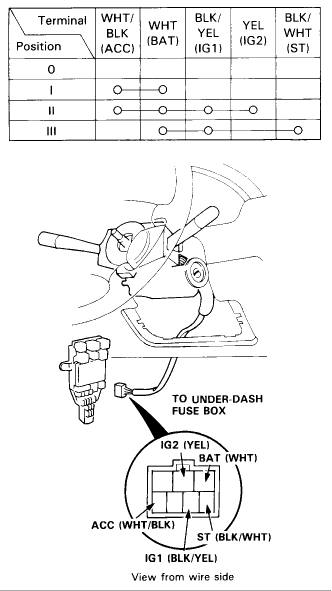
Also USUALLY a bad igniter can cause the engine to shut off and not restart as well, but you might also have a bad ignition pigtail/electrical harness. That can commonly cause shut off, spins over but wont' start at random.
I'd probably address the code 15 issue and fix it first, then see if your shutting off problem persists. If it does even after getting rid of that code 15 I'd look hard at that ignition pigtail.
There is an input test for the ignition switch pigtail:
Having said that your code 15 is most likely being caused by the igniter unit within your distributor:
Testing for igniter is as follows:
1. Disconnect the BLK/YEL, LT GRN, YEL/GRN and BLU wires from the igniter unit.
2. Turn the ignition switch ON and check for battery voltage between the BLK/YEL wire and body ground. If there is no battery voltage, check the BLK/YEL (YEL) wire between the ignition switch and the igniter unit. If there is battery voltage proceed to step 3.
3. Turn the ignition switch ON and check for battery voltage between the LT GRN wire and body ground. If there is no battery voltage check the ignition coil for proper operation or for an open circuit on the LT GRN (BLK/WHT) wire between the ignition coil and the igniter unit. If there is battery voltage proceed to step 4.
4. Check the YEL/GRN wire between the PGM-FI ECU and the igniter unit.
5. Check the BLU wire between the tachometer and the igniter unit.
6. If all tests are normal, replace the igniter unit.
HOWEVER!!!
A code 15 can be caused by a wiring issue or the ECU itself too, but again most likely it's the igniter. If your distributor base has any oil leaking inside of it from the internal seal I'd suggest just buying an entire new distributor assembly from Richporter Technology/Distributor King. Their complete unit is brand new, quality, and is completely assembled including the base, cyp/ckp sensors, igniter, cap, rotor, and if applicable ignition coil if it's an internal coil model.
Also USUALLY a bad igniter can cause the engine to shut off and not restart as well, but you might also have a bad ignition pigtail/electrical harness. That can commonly cause shut off, spins over but wont' start at random.
I'd probably address the code 15 issue and fix it first, then see if your shutting off problem persists. If it does even after getting rid of that code 15 I'd look hard at that ignition pigtail.
There is an input test for the ignition switch pigtail:
Thread Starter
Honda-Tech Member
Joined: Sep 2010
Posts: 8
Likes: 0
Re: EGR system or Ignition? Which would you start with?
Thanks for the reply. After having done some more looking into the problem, I was leaning toward troubleshooting the ignition side of things. One question regarding the troubleshooting steps for the igniter...when you say:
6. If all tests are normal, replace the igniter unit.
Do you mean "replace" as in put it back in or "replace" as in buy a new one. Because if it's "buy a new one," why would you do that if the tests are normal?
Thanks again!
6. If all tests are normal, replace the igniter unit.
Do you mean "replace" as in put it back in or "replace" as in buy a new one. Because if it's "buy a new one," why would you do that if the tests are normal?
Thanks again!
Former Moderator
Joined: Oct 2001
Posts: 16,612
Likes: 55
From: Southside ATL, GA
Re: EGR system or Ignition? Which would you start with?
Thanks for the reply. After having done some more looking into the problem, I was leaning toward troubleshooting the ignition side of things. One question regarding the troubleshooting steps for the igniter...when you say:
6. If all tests are normal, replace the igniter unit.
Do you mean "replace" as in put it back in or "replace" as in buy a new one. Because if it's "buy a new one," why would you do that if the tests are normal?
Thanks again!
6. If all tests are normal, replace the igniter unit.
Do you mean "replace" as in put it back in or "replace" as in buy a new one. Because if it's "buy a new one," why would you do that if the tests are normal?
Thanks again!
It means that if all the wiring tests are good then you have a bad igniter. Replace the igniter as in replace it with another (new) one. Those tests for battery voltage at the various wires are basically making sure that wiring isn't the issue, which only leaves the igniter itself as the culprit for the code 15.
Like I said though, if there is any oil leaking inside the distributor just buy a complete brand new Richporter/Distributor King one and call it a day. It costs about the same as a new igniter alone from Honda, and includes other important wear items such as the distributor base, cyp and ckp sensors.
Thread Starter
Honda-Tech Member
Joined: Sep 2010
Posts: 8
Likes: 0
Re: EGR system or Ignition? Which would you start with?
lol - I figured that out about two minutes after clicking the Submit button. If I did everything right, it looks like the igniter is bad. The local Honda dealership wanted $113.00 for a new one. I checked with Distributor King and a new distributor, with everything including an igniter, is only $133.00. Needless to say, I bought it.
Thanks again for the help.
Thanks again for the help.
Former Moderator
Joined: Oct 2001
Posts: 16,612
Likes: 55
From: Southside ATL, GA
Re: EGR system or Ignition? Which would you start with?
lol - I figured that out about two minutes after clicking the Submit button. If I did everything right, it looks like the igniter is bad. The local Honda dealership wanted $113.00 for a new one. I checked with Distributor King and a new distributor, with everything including an igniter, is only $133.00. Needless to say, I bought it.
Thanks again for the help.
Thanks again for the help.
I've been using distributor King units for over 5 years now with not a single one coming back needing to be replaced. I've gotten a few bad ones out of the box, but they were always for the 96-98 Civic EX with the D16Y8 engine. They are of great quality.

Honda-Tech Member
Joined: Jul 2007
Posts: 1,730
Likes: 1
Re: EGR system or Ignition? Which would you start with?
After confirming the inputs to the igniter, ie, power, ECM timing signal etc, the way I confirm a failed igniter is to check for a pulsing ground command to the negative terminal of the primary ignition coil. I do this with a test light.
Honda has you running around in circles trying to diagnose igniters when it's actually extremely simple.
Honda has you running around in circles trying to diagnose igniters when it's actually extremely simple.
Trending Topics
Thread Starter
Honda-Tech Member
Joined: Sep 2010
Posts: 8
Likes: 0
Bad Fuel Cap?
Should you hear a whooshing sound when removing the fuel filler cap after the engine runs for about 10 minutes? A whooshing sound would mean the air pressure between the inside and outside of the tank is equalizing, meaning either pressure is building up or decreasing inside the tank. As you run the engine and fuel is being drawn out of the tank, isn't air allowed to come in? Are the fuel caps supposed to be vented? So shouldn't the air pressure be equal? I'm wondering if my problem is being caused by the fuel tank not getting vented. After driving for about 20 minutes, with no air coming into the tank, fuel cannot be drawn out of the tank, and the engine dies. By the way, I AM hearing a whooshing sound when I open the cap.

Honda-Tech Member
Joined: Dec 2008
Posts: 1,210
Likes: 1
From: Albuquerque
Re: EGR system or Ignition? Which would you start with?
Thats what I do to! Its never failed me with a misdiagnosis.
Thread Starter
Honda-Tech Member
Joined: Sep 2010
Posts: 8
Likes: 0
Re: EGR system or Ignition? Which would you start with?


Honda-Tech Member
Joined: Sep 2010
Posts: 20
Likes: 0
Re: EGR system or Ignition? Which would you start with?
sounds like you could use the factory service manual to help you it tells you everything and how to trouble shoot step by step i can email you a copy it would not hurt to have

Trial User
Joined: Sep 2010
Posts: 1
Likes: 0
Re: EGR system or Ignition? Which would you start with?
my 92 accord is exhibiting the same symptoms and i would like to perform the checks as shown but....i cant figure out how to remove the rotor after taking the cap off 
does it just slide off with a little persuasion? I wrench my Tahoe often enough but my first dance with the Honda.
Thanks
does it just slide off with a little persuasion? I wrench my Tahoe often enough but my first dance with the Honda.
Thanks

Thread
Thread Starter
Forum
Replies
Last Post
Georgie
Honda Accord (1990 - 2002)
17
Jun 24, 2013 03:08 PM
slammedvtec
Honda Civic / Del Sol (1992 - 2000)
1
Apr 17, 2008 02:17 PM
