


Do all BB turbos sound like this


Thread Starter
Honda-Tech Member
Joined: Mar 2003
Posts: 112
Likes: 0
From: PA, US
 Do all BB turbos sound like this
http://www.youtube.com/watch?v=pBUpB8v9UDY&NR=1
Shouldn't be too long b4 I can hear the same thing if so.
Shouldn't be too long b4 I can hear the same thing if so.


Honda-Tech Member
Joined: Mar 2006
Posts: 6,381
Likes: 0
From: Newark, DE




Trending Topics

 Re: Do all BB turbos sound like this
The side effect is a cool "whiring" sound during "spool up", and even while slowing down. The sound is most prominent in the GT3076R and S256-S262 and S366 because the groove is quite large, and for the GT3076R, that movement of air in the groove resonates within the compressor cover. Most T3/T4s do not have one, and the Anti-surge "drilled" housings don't make that sound as prominent either. This groove is used mainly because the designers had the feeling that most of these GT-R ported shroud turbos were going to be pushed to their surge limits, and this stabilization gives them a little bit of an edge in keeping the turbo alive at those surge-inducing speeds.
The drawback is that this process of bleed creates additional heat because the air is slightly compressed more than once. The added heat lowers the compressor's overall efficiency, though you and I will never be able to feel it or know any difference.
But being ball-bearing (either steel or ceramic) has really nothing to do with that sound. Its just that most Ball-bearing CHRAs that you're used to seeing, mainly in the GT-R series, have a compressor cover that contains an inducer-bleed groove in it for additional stabilization. That's why the Borg-warner Extended Tip Series makes those wonderful jet sounds, and their still in a journal bearing CHRA.
Sorry for the book. Just thought I'd help
 Re: Do all BB turbos sound like this
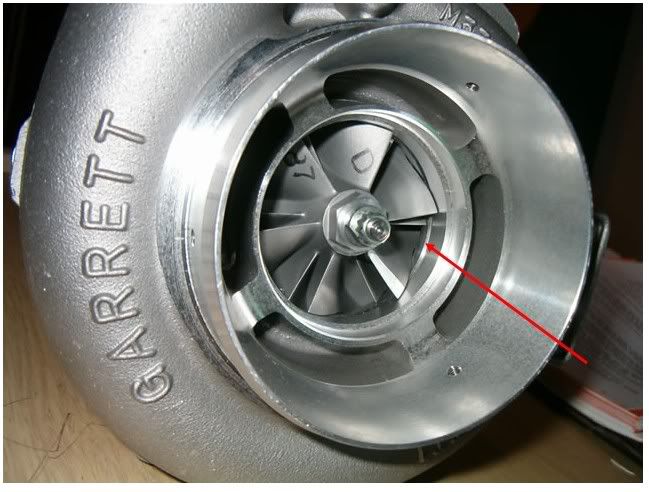
Right in between where the primary and secondary blades split, you'll see a groove there. It goes through to the other side of the inducer portion of the housing out to the anti-surge portion (Main inlet) of the compressor cover.
In the video shown, you can see that groove (as a machined line) if you look deeper into the compressor inlet.
Last edited by TheShodan; Apr 4, 2010 at 07:09 PM.

Honda-Tech Member
Joined: Feb 2009
Posts: 167
Likes: 0
From: Midwest
Re: Do all BB turbos sound like this
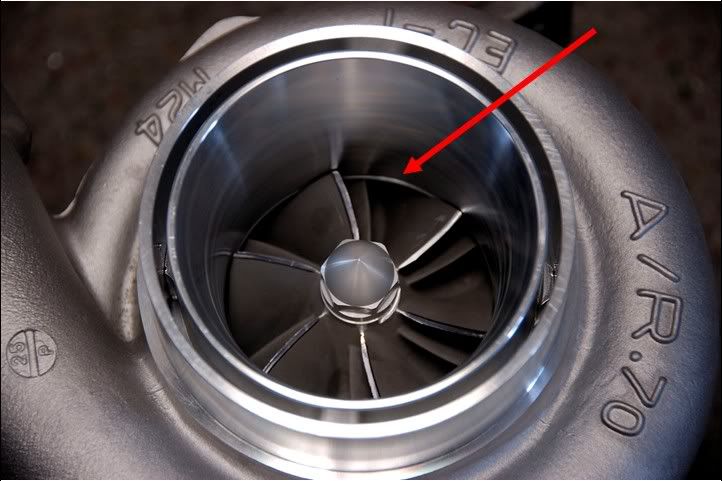
Well for both the S256 and the GT30R & GT35R,that "whirring" sound is from the groove that you see in the housing that is just below the inducer. That is called a Map Width Enhancement groove (AKA Inducer Bleeder), and is used to help keep the air entering into the compressor inlet remain stable at higher speeds, so that the turbulence of the air doesn't throw the impeller blade off balance at those speeds. This groove creates "inducer bleed", where a small amount of the airflow is recirculated back from the inducer back to the main inlet, thereby stabilizing the entire compressor stage when operated near its surge point. This design can also extend the max-flow range near the point where it starts to "choke", or "max out".
The side effect is a cool "whiring" sound during "spool up", and even while slowing down. The sound is most prominent in the GT3076R and S256-S262 and S366 because the groove is quite large, and for the GT3076R, that movement of air in the groove resonates within the compressor cover. Most T3/T4s do not have one, and the Anti-surge "drilled" housings don't make that sound as prominent either. This groove is used mainly because the designers had the feeling that most of these GT-R ported shroud turbos were going to be pushed to their surge limits, and this stabilization gives them a little bit of an edge in keeping the turbo alive at those surge-inducing speeds.
The drawback is that this process of bleed creates additional heat because the air is slightly compressed more than once. The added heat lowers the compressor's overall efficiency, though you and I will never be able to feel it or know any difference.
But being ball-bearing (either steel or ceramic) has really nothing to do with that sound. Its just that most Ball-bearing CHRAs that you're used to seeing, mainly in the GT-R series, have a compressor cover that contains an inducer-bleed groove in it for additional stabilization. That's why the Borg-warner Extended Tip Series makes those wonderful jet sounds, and their still in a journal bearing CHRA.
Sorry for the book. Just thought I'd help
The side effect is a cool "whiring" sound during "spool up", and even while slowing down. The sound is most prominent in the GT3076R and S256-S262 and S366 because the groove is quite large, and for the GT3076R, that movement of air in the groove resonates within the compressor cover. Most T3/T4s do not have one, and the Anti-surge "drilled" housings don't make that sound as prominent either. This groove is used mainly because the designers had the feeling that most of these GT-R ported shroud turbos were going to be pushed to their surge limits, and this stabilization gives them a little bit of an edge in keeping the turbo alive at those surge-inducing speeds.
The drawback is that this process of bleed creates additional heat because the air is slightly compressed more than once. The added heat lowers the compressor's overall efficiency, though you and I will never be able to feel it or know any difference.
But being ball-bearing (either steel or ceramic) has really nothing to do with that sound. Its just that most Ball-bearing CHRAs that you're used to seeing, mainly in the GT-R series, have a compressor cover that contains an inducer-bleed groove in it for additional stabilization. That's why the Borg-warner Extended Tip Series makes those wonderful jet sounds, and their still in a journal bearing CHRA.
Sorry for the book. Just thought I'd help
 Re: Do all BB turbos sound like this
I'm blushing.. But I only know what I know, because I've learned, shadowed, designed, and always continue to learn from the best in turbocharger design and engineering. I'm simply a Padawan Learner compared to my colleagues and the current experts. Without them, I wouldn't be doing this for as long as I have.
Last edited by TheShodan; Apr 4, 2010 at 07:11 PM.


Honda-Tech Member
Joined: May 2010
Posts: 38
Likes: 0
From: Central NC
Re: Do all BB turbos sound like this
Bringing it back
Shodan, I have a gt25r, without looking in the dark right now, do you know this feature is on my turbo? Im getting the same symptoms on my setup and want to make sure everything is good.
Can this whirring sound ever indicate a problem?
Thanks
Shodan, I have a gt25r, without looking in the dark right now, do you know this feature is on my turbo? Im getting the same symptoms on my setup and want to make sure everything is good.
Can this whirring sound ever indicate a problem?
Thanks

Thread
Thread Starter
Forum
Replies
Last Post
mrspeaker
Forced Induction
13
Jan 12, 2005 04:44 PM
