


Smokey Yunick and the secret of his "adiabatic engine


Thread Starter
B*a*n*n*e*d
Joined: Feb 2009
Posts: 870
Likes: 1
From: Aquilonia
 Smokey Yunick and the secret of his "adiabatic engine
I have always considered Smokey Yunick to be the ultimate bad ***. guy flew 50 missions in a B17 over Europe and goes on to write the book on competitive american engine building and auto aero. oh, and cheating.
well, he came up with this design around 1983. called it the adiabatic engine. it will make your head spin.
2 cylinders. 150whp. 60mpg. im going to copy and paste section of a few different articles. give them a read. there are 3 parts to this engine, and from the articles i read, Smokey revealed 2 and died with the 3rd. the patent expired in 2002.
paraphrased, the thing runs over 22:1 AF on pump gas, and engineers from the "big 3" could not get it to detonate. they used the word "spike" for detonation in some of the articles. but read on...
--------------------------------------------------------------------------
No loss
If we should start on a soft track and try to describe how this new engine works. Not easy, kept in mind that only two persons knows about it. Smokey and his right hand svenskättade(?) Ralph Johnson is reserved for the important details until they really got the world patent. Such things take time.
The theory have actually been known for long by engineers all over the world and we should keep in mind that thousands of engineers have tried to build this engine. All have failed. Besides Smokey.
He actually calls the project "Phase 1 adiabatic engine".
"Adiabatic" or "adiabetisk" [sweedish], is a technical term which describes the process where there is neither a gain or loss of heat.
A full adiabatic engine is not possible but the more heat which can be used during the process the more effective the engine becomes. In all aspects.
Most of todays engines uses only 25% of the potential heat energy in fuel. The other 75% is just lost in exhaust, cooling etc. This is just what have retat(?) Smokey and all other engineers. To be able to use more heat energy have been the target. Heat is the keyword.
The engine construction is traditional. We find a engine block, crankshaft, stakar(?), pistons, top block, camshaft, inlet, exhaust, etc. The good old components are here, despite fitted for the Hot Vapor. The fact is that one should be able to convert a normal engine to this Hot Vapor version.
Besides building a 1-, 2- and 3-cylinder himself, Smokey has successfully converted existing 4-cylinder engines.
The thing which makes the difference between a Hot Vapor and a normal engine is by first view an advanced pipe system. It is just in this pipe system everything happens. Here happens what have given the project its name: "Hot Vapor". Here happens the heat förångningen(?) of the fuel and air mixture. The trick! To heat up the fuel. It happens in three steps.
In hot air
On the wall in Smokeys office is an exploded drawing of the 2 cylinder engine which is placed in the Golf. We take that engine as example. Smokey takes his glasses from his hat and put them on his nose and starts pointing and talking...
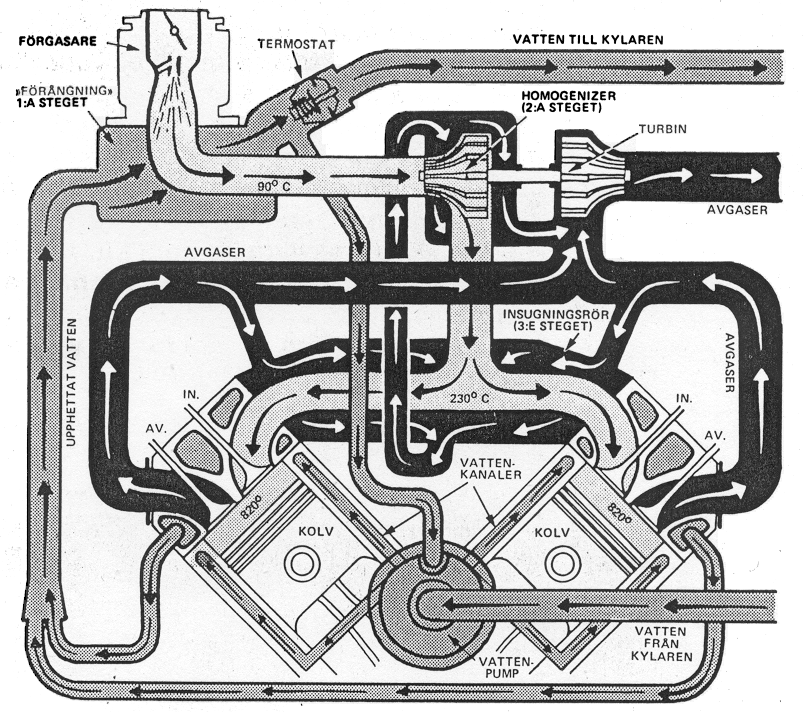
It should not work with any fuel injection it is very important with a caburator to hinna(?) prepare the mixture properly. he explains. Here happens the first heating says Smokey and points at a box below the caburator which omslutar(?) first part of the inlet pipe.
All water in the cooling system is forced through this box. All water is just 2 liter inclusive the radiator(?). There is no fan at all. Adiabatic... When the mixture has passed the box and is heated up to 90° Cit comes to the second step.
The homogenizer says Smokey and points at an exhaust turbin wheel which is connected to an inlet turbin wheel. Aha, like a turbo, yes? I nod to the cowboy hat so he will think that I can follow him. Smart guy and so on. No! Not turbo! he says a little offended. A homogenizer it should be. The purpose of the homogenizer is to fully atomized the fuel air mixture to an extreme fine vapor. Otherwise it would be impossible to futher heat up the mixture. When the mixture has passed the turbin wheel it is more heated. Partly because of the friction and partly because the homogenizer is incapsulated in the exhaust system. The mixture is now 140° C.
Next step is the inlet system which is totally incapsulated in the exhaust system. Here the mixture gets heated up to 230° C! Now things starts to happend.
Here it expands like hell Smokey explains and thinks that the fuel vapor expands a lot at this temperature. Exactly as we want to. Ofcourse. Here the homogenizer has a futher role: to be a back valve, to hold back the pressure which comes from the expanded fuel mixture. Without this back valve the top will be thrown to Orlando... well.. Besides the homogenizer presses with 0.45 kg. When the mixture reaches the combustion chamber more than 25% of the energy "is ready to go" (230° C). And with full compression, before ignition, the mixture has reached the extreme 820° C. After this comes the spark.
You see says Smokey, what forces the piston down is not the heat, it is the pressure... Because of the heat I hopefully reply (to win back some valuable points). Thats right says Smokey and put the glasses on his hat and go sit in his chair. The boots is naturly on the table. Thats about the story he says and light his pibe.
Smokeys secret
There is something missing in Smokeys Hot Vapor engine. Actually the engine should destroy it self. Most people knows that too high temperature in the combustion chamber will let to spikes(?) (uncontrolled self ignition in the combustion chamber) if not the fuel has the highest octane class. But with those figures Smokey forces up in the combustion chamber, no fuel in the world would be able to save the engine. At all.
Even though it runs good on unleaded regular gas. Not a single spike! Be welcome, you are free to guess. Because here is Smokey like mummie. The solution to this problem is the keyword to the patent. Real secret.
It is really quite simple, and I am carefull not saying too much. This is the only way I can be sure nobody knows how the system exactly works says Smokey who not just get visitors from sneaking news papers.
GM, Ford, Chrysler and many foreign car manufactors comes around in "Best damn garage in town". To stress test Smokeys test cars with the new engine. It is the best engineers from the manufators who show up andd they come several times. Smokey is laughin. They come back because they can not get the engine to spike. Some of them does everything to get the engine spiking. No one has succeseeded.
A technician drove about 30 km/t in highest gear and suddently pressed the throttle. The only thing which happend was that he drove from everything that day.
Some of them turn of the engine and starst again and gives full throttle. Wheel spin. Others just get speed champs at the high way in hunt for spikes.
1. The air/fuel ratio was something on the order of 22:1 to 27:1.
2. Peak combustion temperature was above 5000 degrees F.
3. Exhaust gas temperature (before the turbocharger) was about 2200 deg F.
4. Assuming no loss of cylinder heat to the cylinder walls (i.e., an actual adiabatic engine) the best possible efficiency was about 38%. If the engine used a Miller cycle modification, an efficiency of 48% would be possible (no mention was made of the Miller cycle)
long read i know. but after some thought, i think i have figured out how he was able to keep that motor running, and making that power at those temps. its so so so so simple.

well, he came up with this design around 1983. called it the adiabatic engine. it will make your head spin.
2 cylinders. 150whp. 60mpg. im going to copy and paste section of a few different articles. give them a read. there are 3 parts to this engine, and from the articles i read, Smokey revealed 2 and died with the 3rd. the patent expired in 2002.
paraphrased, the thing runs over 22:1 AF on pump gas, and engineers from the "big 3" could not get it to detonate. they used the word "spike" for detonation in some of the articles. but read on...
--------------------------------------------------------------------------
No loss
If we should start on a soft track and try to describe how this new engine works. Not easy, kept in mind that only two persons knows about it. Smokey and his right hand svenskättade(?) Ralph Johnson is reserved for the important details until they really got the world patent. Such things take time.
The theory have actually been known for long by engineers all over the world and we should keep in mind that thousands of engineers have tried to build this engine. All have failed. Besides Smokey.
He actually calls the project "Phase 1 adiabatic engine".
"Adiabatic" or "adiabetisk" [sweedish], is a technical term which describes the process where there is neither a gain or loss of heat.
A full adiabatic engine is not possible but the more heat which can be used during the process the more effective the engine becomes. In all aspects.
Most of todays engines uses only 25% of the potential heat energy in fuel. The other 75% is just lost in exhaust, cooling etc. This is just what have retat(?) Smokey and all other engineers. To be able to use more heat energy have been the target. Heat is the keyword.
The engine construction is traditional. We find a engine block, crankshaft, stakar(?), pistons, top block, camshaft, inlet, exhaust, etc. The good old components are here, despite fitted for the Hot Vapor. The fact is that one should be able to convert a normal engine to this Hot Vapor version.
Besides building a 1-, 2- and 3-cylinder himself, Smokey has successfully converted existing 4-cylinder engines.
The thing which makes the difference between a Hot Vapor and a normal engine is by first view an advanced pipe system. It is just in this pipe system everything happens. Here happens what have given the project its name: "Hot Vapor". Here happens the heat förångningen(?) of the fuel and air mixture. The trick! To heat up the fuel. It happens in three steps.
In hot air
On the wall in Smokeys office is an exploded drawing of the 2 cylinder engine which is placed in the Golf. We take that engine as example. Smokey takes his glasses from his hat and put them on his nose and starts pointing and talking...
It should not work with any fuel injection it is very important with a caburator to hinna(?) prepare the mixture properly. he explains. Here happens the first heating says Smokey and points at a box below the caburator which omslutar(?) first part of the inlet pipe.
All water in the cooling system is forced through this box. All water is just 2 liter inclusive the radiator(?). There is no fan at all. Adiabatic... When the mixture has passed the box and is heated up to 90° Cit comes to the second step.
The homogenizer says Smokey and points at an exhaust turbin wheel which is connected to an inlet turbin wheel. Aha, like a turbo, yes? I nod to the cowboy hat so he will think that I can follow him. Smart guy and so on. No! Not turbo! he says a little offended. A homogenizer it should be. The purpose of the homogenizer is to fully atomized the fuel air mixture to an extreme fine vapor. Otherwise it would be impossible to futher heat up the mixture. When the mixture has passed the turbin wheel it is more heated. Partly because of the friction and partly because the homogenizer is incapsulated in the exhaust system. The mixture is now 140° C.
Next step is the inlet system which is totally incapsulated in the exhaust system. Here the mixture gets heated up to 230° C! Now things starts to happend.
Here it expands like hell Smokey explains and thinks that the fuel vapor expands a lot at this temperature. Exactly as we want to. Ofcourse. Here the homogenizer has a futher role: to be a back valve, to hold back the pressure which comes from the expanded fuel mixture. Without this back valve the top will be thrown to Orlando... well.. Besides the homogenizer presses with 0.45 kg. When the mixture reaches the combustion chamber more than 25% of the energy "is ready to go" (230° C). And with full compression, before ignition, the mixture has reached the extreme 820° C. After this comes the spark.
You see says Smokey, what forces the piston down is not the heat, it is the pressure... Because of the heat I hopefully reply (to win back some valuable points). Thats right says Smokey and put the glasses on his hat and go sit in his chair. The boots is naturly on the table. Thats about the story he says and light his pibe.
Smokeys secret
There is something missing in Smokeys Hot Vapor engine. Actually the engine should destroy it self. Most people knows that too high temperature in the combustion chamber will let to spikes(?) (uncontrolled self ignition in the combustion chamber) if not the fuel has the highest octane class. But with those figures Smokey forces up in the combustion chamber, no fuel in the world would be able to save the engine. At all.
Even though it runs good on unleaded regular gas. Not a single spike! Be welcome, you are free to guess. Because here is Smokey like mummie. The solution to this problem is the keyword to the patent. Real secret.
It is really quite simple, and I am carefull not saying too much. This is the only way I can be sure nobody knows how the system exactly works says Smokey who not just get visitors from sneaking news papers.
GM, Ford, Chrysler and many foreign car manufactors comes around in "Best damn garage in town". To stress test Smokeys test cars with the new engine. It is the best engineers from the manufators who show up andd they come several times. Smokey is laughin. They come back because they can not get the engine to spike. Some of them does everything to get the engine spiking. No one has succeseeded.
A technician drove about 30 km/t in highest gear and suddently pressed the throttle. The only thing which happend was that he drove from everything that day.
Some of them turn of the engine and starst again and gives full throttle. Wheel spin. Others just get speed champs at the high way in hunt for spikes.
1. The air/fuel ratio was something on the order of 22:1 to 27:1.
2. Peak combustion temperature was above 5000 degrees F.
3. Exhaust gas temperature (before the turbocharger) was about 2200 deg F.
4. Assuming no loss of cylinder heat to the cylinder walls (i.e., an actual adiabatic engine) the best possible efficiency was about 38%. If the engine used a Miller cycle modification, an efficiency of 48% would be possible (no mention was made of the Miller cycle)
long read i know. but after some thought, i think i have figured out how he was able to keep that motor running, and making that power at those temps. its so so so so simple.
Last edited by Conan the Destroyer; Jul 7, 2009 at 02:12 AM.
Thread Starter
B*a*n*n*e*d
Joined: Feb 2009
Posts: 870
Likes: 1
From: Aquilonia
Re: Smokey Yunick and the secret of his "adiabatic engine
i peg Don Flores as the type of guy who would be able to figure out "the secret" and why it never went into production and why we subsequently dont have 450hp 60mpg 2 liter production engines (smokey was using plymouth horizon motors)


Honda-Tech Member
Joined: Nov 2004
Posts: 931
Likes: 0
From: cortland, ohio, usa
Re: Smokey Yunick and the secret of his "adiabatic engine
it would never go into production because you have to remember that idiots typically run auto manufacturing companies and would think its vodoo or something. that or they realize that they would loose money to something being overly efficient, and that does happen very often.


Honda-Tech Member
Joined: Nov 2006
Posts: 345
Likes: 0
From: Orlando, FL, U.S
Re: Smokey Yunick and the secret of his "adiabatic engine
didn't read the whole article because im in class and shouldn't be on this site, however I thought id throw it out there.....don't the new direct injection motors have a pretty high AF ratio also?? I say the automakers know how to make this stuff work, they are just holding onto the technology until it is "necessary"....more specifically, holding it until the availability of oil is less so that profits are sustained while the consumption of oil is reduced.

Honda-Tech Member
Joined: Feb 2006
Posts: 610
Likes: 0
From: miserable mitten
Re: Smokey Yunick and the secret of his "adiabatic engine
My boss was good friends with him so I hear stories about Smokey all the time. Cool to see him mentioned here. The stuff they tried back in the day was pretty crazy, there is still a lot that can be learned from the "old school," for sure.
Trending Topics


Honda-Tech Member

Joined: Jul 2004
Posts: 5,957
Likes: 0
From: nothing is real unless it is observed
Re: Smokey Yunick and the secret of his "adiabatic engine
Anyone know the autoignition temperature gasoline? Seems a bit close to me. Fuel source was never mentioned either unless I missed it.
Honda-Tech Member
Joined: Jul 2004
Posts: 5,957
Likes: 0
From: nothing is real unless it is observed
Re: Smokey Yunick and the secret of his "adiabatic engine
Emissions would be another reason the engine would not ever see street use. with the lean burn it would require quite a catalyst to convert it to today's standards.
Thread Starter
B*a*n*n*e*d
Joined: Feb 2009
Posts: 870
Likes: 1
From: Aquilonia
Re: Smokey Yunick and the secret of his "adiabatic engine
fuel was pump gas. it mentions that a few times.
i think the secret is nitrous. i think he was using nitrous oxide to make sure the cylinder walls didnt melt and that is the reason the auto makers wouldnt buy into it.
i think the secret is nitrous. i think he was using nitrous oxide to make sure the cylinder walls didnt melt and that is the reason the auto makers wouldnt buy into it.


Member
Joined: May 2002
Posts: 5,197
Likes: 1
From: Atl. Beach, fl, duval
Re: Smokey Yunick and the secret of his "adiabatic engine
Smokey was brilliant, almost as smart as Jr.Johnson or Yates on engines. His lean burn engines did not work, for the same reason as the Honda CVCC. In controled enviroments or the lab they function fine, when the public gets ahold of it, they screw it up. Cars and engines need to built to the lowest common denominator . Smokey was interesting, being 90 miles away, you could go ask questions, and get a Disney Tour if you were a "car-guy".

Honda-Tech Member
Joined: Dec 2006
Posts: 1,456
Likes: 0
From: Holiday, FL
Re: Smokey Yunick and the secret of his "adiabatic engine
2 things come to mind, however I really havent a clue exactly what the secret is.
1. Perhaps its the combination of very lean AFR's + heat which help not only to create a fully vaporized mixture, but also to help refine the fuel properties sort of like the process of "Thermal Cracking" that is/was used for refining petroleum which could assist in keeping the fuel from "spiking" as its put. (Maybe, i dont know)
2. Ignition timing ATDC (instead of BTDC) since cylinder pressure is already high from the get-go from the heated & pressurized mixture, enough to where power can still be derived well after 12-18 ATDC unlike most tuning.
Im probably wrong but thats my current hypothesis.
1. Perhaps its the combination of very lean AFR's + heat which help not only to create a fully vaporized mixture, but also to help refine the fuel properties sort of like the process of "Thermal Cracking" that is/was used for refining petroleum which could assist in keeping the fuel from "spiking" as its put. (Maybe, i dont know)
2. Ignition timing ATDC (instead of BTDC) since cylinder pressure is already high from the get-go from the heated & pressurized mixture, enough to where power can still be derived well after 12-18 ATDC unlike most tuning.
Im probably wrong but thats my current hypothesis.
Last edited by DC_Legacy; Jul 7, 2009 at 07:19 PM.

Honda-Tech Member
Joined: Mar 2006
Posts: 2,062
Likes: 1
From: Columbus, OH
Re: Smokey Yunick and the secret of his "adiabatic engine
Maybe his engine didn't "detonate" because the mixture is already at its autoignition temperature. Once there is a single source of combustion, it spreads rapidly, and there are no colliding flame fronts. I can't see the engine lasting too long in that case, though.
Honda-Tech Member
Joined: Mar 2006
Posts: 2,062
Likes: 1
From: Columbus, OH
Re: Smokey Yunick and the secret of his "adiabatic engine
Nitrous would be an interesting trick.

Thread
Thread Starter
Forum
Replies
Last Post
