


How do I clean up aluminum welds?


Thread Starter
Honda-Tech Member
Joined: Jul 2008
Posts: 62
Likes: 0
From: Grand Rapids, Michigan, United States of America
 How do I clean up aluminum welds?
Well I've looked around for a while, but I haven't found out how I can clean up aluminum welds. I've always just left it, but now I actually need to sell something that looks sharp. I need to get rid of the black film around the welds the easiest as possible. It may sound like a stupid question, but I figured I'd ask rather than try until something works. I was thinking a buffing wheel on my bench grinder?


Honda-Tech Member
Joined: Jul 2005
Posts: 1,637
Likes: 3
From: West Kingston, RI
Re: How do I clean up aluminum welds?
Maybe it's prep... but I don't get black around my aluminium welds, just the etch area (white). Either way, you can clean all of it out with a stainless wire brush. I also have a cloth wheel on my grinder (not sure what it's really called) that I can polish pipes up with using some clay like stuff for soft metal.
This is (what I think) they should look like after you weld, I don't have a nice clear pic of the polish but I can take one tomorrow when I'm at the shop.

This is (what I think) they should look like after you weld, I don't have a nice clear pic of the polish but I can take one tomorrow when I'm at the shop.
Last edited by downest; Jun 22, 2009 at 06:28 PM.


Honda-Tech Member
Joined: Feb 2009
Posts: 88
Likes: 0
From: Gothenburg, Sweden
Re: How do I clean up aluminum welds?
Black usually means scorched contaminants on the surface of the base metal or on the filler. From the pics it also looks like you have some black spots on parts of the bead. This is definitely from dirty metal. The welds themselves look good, I'd say you just need to clean the base metal and the filler a little more carefully.
As for prettying up the parts afterwards a green scotchbrite pad run in the same direction all over the part gives it a nice brushed look.
As for prettying up the parts afterwards a green scotchbrite pad run in the same direction all over the part gives it a nice brushed look.

Honda-Tech Member
Joined: Aug 2008
Posts: 386
Likes: 0
From: NH
Trending Topics

OG Fabricator
Joined: Dec 2008
Posts: 1,073
Likes: 0
From: texas
OG Fabricator
Joined: Dec 2008
Posts: 1,073
Likes: 0
From: texas
Re: How do I clean up aluminum welds?
unless he just polished this peace and the compound is in the leaning area. thats what it looks like to me. if this is the case just take some 2000grit and wet sand the cleaning aera off and re polish and your good to go
Thread Starter
Honda-Tech Member
Joined: Jul 2008
Posts: 62
Likes: 0
From: Grand Rapids, Michigan, United States of America
Re: How do I clean up aluminum welds?
I really appreciate the responses. I'll try to keep the pieces cleaner and see what results are achieved. I'll also give 2000 grit and some compound a shot and see what happens since I would like the result to be polished.
Thread Starter
Honda-Tech Member
Joined: Jul 2008
Posts: 62
Likes: 0
From: Grand Rapids, Michigan, United States of America
Re: How do I clean up aluminum welds?
Do you guys ever stress relieve or heat treat your aluminum after welding? I'm gonna have to do that for this project. I heard something about 350 degrees for a couple hours, but I almost doubt that would accomplish anything. Any thoughts? I'm using 6061 T6.

Honda-Tech Member
Joined: Nov 2004
Posts: 2,337
Likes: 1
From: PBIR once called MOROSO
Re: How do I clean up aluminum welds?
can give u a trick. take a battery charger. put a rod on the positive end. wrap the tip with wool cloth dip it in acid. put the ground on the piece of metal. as long as u dont touch the metal rod the the part the acid on the cloth will clean it right up brand new.
we do this when we make stainless tops to clean up the welds, works perfect. it will even shine it a little
we do this when we make stainless tops to clean up the welds, works perfect. it will even shine it a little

Honda-Tech Member
Joined: May 2009
Posts: 878
Likes: 1
Re: How do I clean up aluminum welds?
That sounds more like you would be normalizing the metal than a heat treat

OG Fabricator
Joined: Jan 2006
Posts: 661
Likes: 0
From: Saint Helens, OR, USA
Re: How do I clean up aluminum welds?
I would focus more on making those safe with a proper solution heat treatment back to a full T6 (you cant do this at home!) versus trying to make them pretty. I would also make sure you have very good business insurance before you start selling those. 3 months down the road and something fails and a kid ends up under a car... You will be finished in more ways then one.
Thread Starter
Honda-Tech Member
Joined: Jul 2008
Posts: 62
Likes: 0
From: Grand Rapids, Michigan, United States of America
Re: How do I clean up aluminum welds?
I would focus more on making those safe with a proper solution heat treatment back to a full T6 (you cant do this at home!) versus trying to make them pretty. I would also make sure you have very good business insurance before you start selling those. 3 months down the road and something fails and a kid ends up under a car... You will be finished in more ways then one.
"With heat-treatable alloys, however, there are some ways to recover some of the material properties of the parent. Figure 4 shows a plot of tensile stress versus distance from the weld for 6061, revealing curves for both T4 and T6 material in both the as-welded (AW) and post-weld-aged (PWA) conditions. The PWA condition represents a weld that is subsequently aged for one hour at approximately 400°F (205°C). Post weld aging improves the mechanical properties for both T4 and T6 starting materials. In fact, often times it is better to weld in the T4 condition and post weld age after the welding process.
There is one final alternative to discuss. If after welding, the structure is given a complete heat treatment (i.e., solution treat at 1000°F [540°C], quench, age at 400°F [205°C]), all of the material properties (even in the weld) will be recovered and T6 properties will be obtained. This practice is frequently followed on small structures such as bicycle frames, but it is impractical for larger structures. Furthermore, the quenching usually causes enough distortion of the structure that a straightening operation is necessary before aging."
http://www.lincolnelectric.com/knowl...comistakes.asp
The article made me think that 400°F for an hour will recover partial strength, and be better than nothing. I can also do it at home as well. I haven't found a heat treating place around here willing to water quench, and I don't just want the decks annealed.. I also haven't done quite enough research on heat treating. Will a full heat treat make that much difference compared to the 400°F for an hour?

Honda-Tech Member
Joined: Aug 2008
Posts: 386
Likes: 0
From: NH
Re: How do I clean up aluminum welds?
Maybe it's prep... but I don't get black around my aluminium welds, just the etch area (white). Either way, you can clean all of it out with a stainless wire brush. I also have a cloth wheel on my grinder (not sure what it's really called) that I can polish pipes up with using some clay like stuff for soft metal.
This is (what I think) they should look like after you weld, I don't have a nice clear pic of the polish but I can take one tomorrow when I'm at the shop.
This is (what I think) they should look like after you weld, I don't have a nice clear pic of the polish but I can take one tomorrow when I'm at the shop.
that pic looks like you have no penetration

Honda-Tech Member
Joined: Jul 2005
Posts: 1,637
Likes: 3
From: West Kingston, RI
Re: How do I clean up aluminum welds?
There's penetration, just too much filler. I haven't done a ton of aluminium, the project I'm working on is helping a lot just through a lot of torch time.

Honda-Tech Member
Joined: Nov 2006
Posts: 467
Likes: 0
From: SoCal, Edwards
Re: How do I clean up aluminum welds?
stainless wire brush works wonders. DOWNEST your welds look pretty good for not doing to much aluminum. what rod are you using 5356?
here is a catch can i had a friend weld up. he is getting certified at the moment. his welds usually look better but not to bad imo. i will be welding soon enough. just decided to learn all the info before tig'n myself. the box was made with .125" 6061 so penetration was a pain. it was sealed up nice too, still cant close it until i drill a hole in it. keep having blow out since its pressure tight.
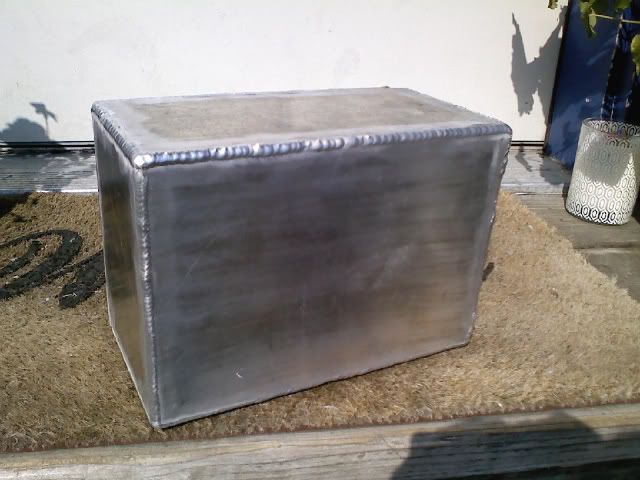
here is a catch can i had a friend weld up. he is getting certified at the moment. his welds usually look better but not to bad imo. i will be welding soon enough. just decided to learn all the info before tig'n myself. the box was made with .125" 6061 so penetration was a pain. it was sealed up nice too, still cant close it until i drill a hole in it. keep having blow out since its pressure tight.
Last edited by 1badteg; Jul 2, 2009 at 11:01 AM.

Honda-Tech Member
Joined: Dec 2005
Posts: 314
Likes: 0
From: Yorba Linda, ca, United States of America
Re: How do I clean up aluminum welds?
My parents made me work through a disclaimer with a family friend who is a lawyer. Proper heat treat will hopefully be in the near future. I was reading on Lincoln's website and found this:
"With heat-treatable alloys, however, there are some ways to recover some of the material properties of the parent. Figure 4 shows a plot of tensile stress versus distance from the weld for 6061, revealing curves for both T4 and T6 material in both the as-welded (AW) and post-weld-aged (PWA) conditions. The PWA condition represents a weld that is subsequently aged for one hour at approximately 400°F (205°C). Post weld aging improves the mechanical properties for both T4 and T6 starting materials. In fact, often times it is better to weld in the T4 condition and post weld age after the welding process.
There is one final alternative to discuss. If after welding, the structure is given a complete heat treatment (i.e., solution treat at 1000°F [540°C], quench, age at 400°F [205°C]), all of the material properties (even in the weld) will be recovered and T6 properties will be obtained. This practice is frequently followed on small structures such as bicycle frames, but it is impractical for larger structures. Furthermore, the quenching usually causes enough distortion of the structure that a straightening operation is necessary before aging."
http://www.lincolnelectric.com/knowl...comistakes.asp
The article made me think that 400°F for an hour will recover partial strength, and be better than nothing. I can also do it at home as well. I haven't found a heat treating place around here willing to water quench, and I don't just want the decks annealed.. I also haven't done quite enough research on heat treating. Will a full heat treat make that much difference compared to the 400°F for an hour?
"With heat-treatable alloys, however, there are some ways to recover some of the material properties of the parent. Figure 4 shows a plot of tensile stress versus distance from the weld for 6061, revealing curves for both T4 and T6 material in both the as-welded (AW) and post-weld-aged (PWA) conditions. The PWA condition represents a weld that is subsequently aged for one hour at approximately 400°F (205°C). Post weld aging improves the mechanical properties for both T4 and T6 starting materials. In fact, often times it is better to weld in the T4 condition and post weld age after the welding process.
There is one final alternative to discuss. If after welding, the structure is given a complete heat treatment (i.e., solution treat at 1000°F [540°C], quench, age at 400°F [205°C]), all of the material properties (even in the weld) will be recovered and T6 properties will be obtained. This practice is frequently followed on small structures such as bicycle frames, but it is impractical for larger structures. Furthermore, the quenching usually causes enough distortion of the structure that a straightening operation is necessary before aging."
http://www.lincolnelectric.com/knowl...comistakes.asp
The article made me think that 400°F for an hour will recover partial strength, and be better than nothing. I can also do it at home as well. I haven't found a heat treating place around here willing to water quench, and I don't just want the decks annealed.. I also haven't done quite enough research on heat treating. Will a full heat treat make that much difference compared to the 400°F for an hour?
Thread Starter
Honda-Tech Member
Joined: Jul 2008
Posts: 62
Likes: 0
From: Grand Rapids, Michigan, United States of America
Re: How do I clean up aluminum welds?
I came up with some effective yet simple ideas since I posted last. I also found a machinist yesterday that I will be working with at his shop. I am, however, paying him a little more than I would like, but I need to make it worth his time. I'm testing a new deck tomorrow, so I'll have to see how that goes.

Honda-Tech Member
Joined: Dec 2005
Posts: 314
Likes: 0
From: Yorba Linda, ca, United States of America
Re: How do I clean up aluminum welds?
I would not quench after a 400°F as it would be pointless. I would heat the piece to 400°F until even heat which would be around an hour(I would heat in a furnace). This method will actually lower the strength of the unwelded T6 material and increase the strength around the welds. I believe the finished piece should be around T4 in strength. At least this is how I understand the process. Has anyone ever accomplished this before? I am having trouble finding information on this topic.
I came up with some effective yet simple ideas since I posted last. I also found a machinist yesterday that I will be working with at his shop. I am, however, paying him a little more than I would like, but I need to make it worth his time. I'm testing a new deck tomorrow, so I'll have to see how that goes.
I came up with some effective yet simple ideas since I posted last. I also found a machinist yesterday that I will be working with at his shop. I am, however, paying him a little more than I would like, but I need to make it worth his time. I'm testing a new deck tomorrow, so I'll have to see how that goes.
1) The furnace is a good idea for getting it up to temperature but you don't want to let it air cool. This will soften the metal (just like when you allow a weld to air cool).
2) The rapid cooling of the quenching process will cause the crystal structure of the metal to change to something stronger. In some cases metals were quenched in straight water, others in a heated oil to get it down to a certain temperature then it was removed and allowed to air cool. You have to find a quenching process that will yield your desired hardness.
I would probably check out sites on Metalsmithing to get more ideas.

Honda-Tech Member
Joined: Dec 2008
Posts: 253
Likes: 0
From: WA
Re: How do I clean up aluminum welds?
we just use a little wire brush that attaches to a die grinder. itd prob take you 10 sec to clean your weld with what we use. having trouble find a pic of what exactly it is though.

Thread
Thread Starter
Forum
Replies
Last Post
Turbo-charged
Welding / Fabrication
11
Dec 28, 2004 09:49 PM
civbeater90
Honda / Acura
15
Sep 20, 2002 07:26 AM
