


Engineering school truss update( 1st place)


Thread Starter
Honda-Tech Member
Joined: Sep 2003
Posts: 3,039
Likes: 2
From: insanity
 Engineering school truss update( 1st place)
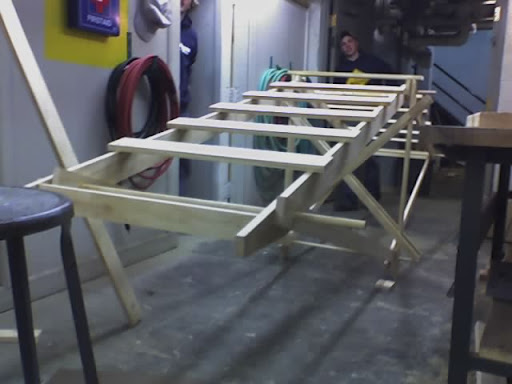
I know some of you guys will remember my truss thread from not to long ago and alot of people wanted to know how it went. Well I managed to get first place, the goal of the project was to build a truss that would fail at exactly 750lbs. Ours failed closest to the goal, failing at 828lbs. While failing at 750 was the goal failing over the 750lbs was more desirable then failing under the mark. Also, I should mention our truss was the only truss that failed exactly were we expected it to fail. On to the pic's:
VIDEO: The video isnt the best, it starts half way through.
View My Video
VIDEO: The video isnt the best, it starts half way through.
View My Video
Last edited by Race Egr; Dec 19, 2008 at 01:04 PM.


Honda-Tech Member
Joined: Feb 2005
Posts: 1,590
Likes: 1
From: Ohio
hey I notice you went with the lap joints  .....i misunderstood you though, I thought it had to hold at least 750lb, not fail at 750lb...what kind of glue did you use? are the square blocks just to reinforce the joints?
.....i misunderstood you though, I thought it had to hold at least 750lb, not fail at 750lb...what kind of glue did you use? are the square blocks just to reinforce the joints?


Trending Topics

Thread Starter
Honda-Tech Member
Joined: Sep 2003
Posts: 3,039
Likes: 2
From: insanity
We had to calculate the force, stress and shear stress for each member. We just went by that and clearly there is an obvious area of higher stress. I updated the post and added a video of the testing session

Thread Starter
Honda-Tech Member
Joined: Sep 2003
Posts: 3,039
Likes: 2
From: insanity
All hand calculations because we had to do it manually to turn in with our report. It was alot of work ,but there was 3 of us in the group so it wasent that bad. Plus we found a program called wintruss, that you can basically draw any 2d truss you would like and add forces and it will calculate the force and stress in each member. We used that just to compare our numbers vs the programs and it was dead on. I just thought it was pretty cool we won. I really am starting to love engineering, it is a hell of alot of work but I think it will be all worth it.
Last edited by Race Egr; Dec 19, 2008 at 06:45 PM.

Honda-Tech Member
Joined: Mar 2006
Posts: 1,153
Likes: 0
I'm assuming the teacher told you an adhesive that would fail well after the wood? If that is the case, that makes this project very simple to design. If you had to figure in joint failure, that adds a decent bit more calculations. I'd imagine where most of your classmates failed was with actually building what they designed. If not, I'd be kind of scared. This is pretty basic 3rd year engineering stuff.
Thread Starter
Honda-Tech Member
Joined: Sep 2003
Posts: 3,039
Likes: 2
From: insanity
I was suprised on how many groups actually didnt know what the hell they were doing( it was kinda scary). It was more or less designed to be a learning experience, its kinda scary in genral how many engineering students can do book work but dont have a clue when it actually comes time to do something hands on. I know this isnt the greatest project in the world I just figured I would share.

Honda-Tech Member
Joined: Jun 2003
Posts: 9,555
Likes: 0
From: NYC bitchessss
this is sooo true in my school.(manhattan college 4th year mech. eng student) I feel that is where someone like you and i have an advantage over them, we are very good with hands on and can put our ideas not only on paper, but produce them as well.

Honda-Tech Member
Joined: Dec 2000
Posts: 20,006
Likes: 3
From: Tampa, FL
That is a cool project. At Cal state they have a huge bridge competition where they build a larger scale bridge for a civil engineering project. I can't get over the people that suck when it comes to actually applying things you learn in lecture/books.

Resident Vagabond
Joined: Nov 2004
Posts: 1,872
Likes: 0
From: Brooklyn
Just wait until you get into real engineering world. It is great to see those people that had 4.0s in college struggle with the simplest things....a little common sense anyone? lol.
That is a cool project. At Cal state they have a huge bridge competition where they build a larger scale bridge for a civil engineering project. I can't get over the people that suck when it comes to actually applying things you learn in lecture/books.
That is a cool project. At Cal state they have a huge bridge competition where they build a larger scale bridge for a civil engineering project. I can't get over the people that suck when it comes to actually applying things you learn in lecture/books.
Most people just built something that would work, and did no calculations to the strength of the bridge. It was pretty sad. Our group won by a long shot, and even though it just had to support our 290 lb professor, we all climbed on for a picture.
As an added bonus, we built a 2 foot deep pool of water under the gap the bridges had to cross. Given that we tested these in December, in Pittsburgh, and there was ice on the water earlier in the morning, a failure would have been unfortunate.
After about 75 man hours. 14 feet long and balances perfectly on the 3.5" wide center section.
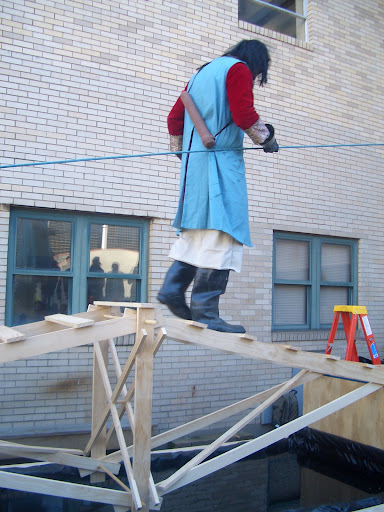
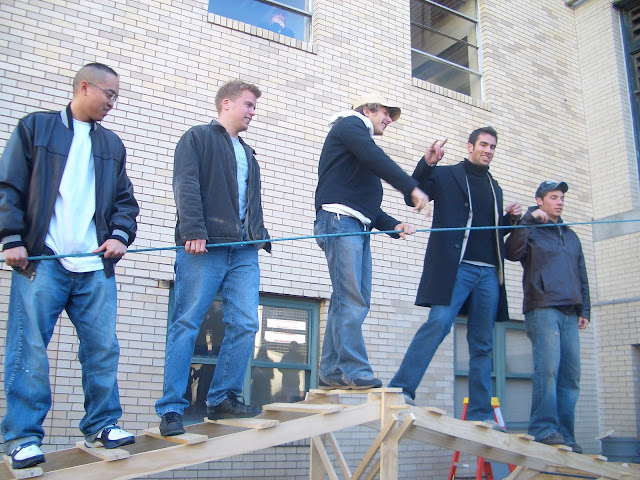
What kind of engineering are you studying?

Honda-Tech Member
Joined: Feb 2007
Posts: 3,211
Likes: 0
From: fl, usa
I was suprised on how many groups actually didnt know what the hell they were doing( it was kinda scary). It was more or less designed to be a learning experience, its kinda scary in genral how many engineering students can do book work but dont have a clue when it actually comes time to do something hands on. I know this isnt the greatest project in the world I just figured I would share.
 . but i built a 4oz balsa wood bridge that supported 101lbs. the kid that beat me cheated and made a damn I-beam and called it a bridge
  .
. i weight 126lbs. and was able to stand on one foot on top of my bridge but thats a different subject
 .
. congrats. was there any weight requirement to contructing your bridge and what wood was used

Member
Joined: Jan 2003
Posts: 2,933
Likes: 1
From: northern, ma, US
Re: Engineering school truss update( 1st place)
Our final project was to design a bridge to span 12 feet using no fasteners (no nails, screws, glue, etc) and with no power tools, and with 8 feet members as the maximum length. The goal was to be the lightest possible. Our bridge was 56 lbs, the next lightest was 98 lbs, and one group even came in at over 200 lbs. It was absurd. One group's bridge was a "self-supporting suspension bridge" which didn't even pass a simple free body diagram.
Most people just built something that would work, and did no calculations to the strength of the bridge. It was pretty sad. Our group won by a long shot, and even though it just had to support our 290 lb professor, we all climbed on for a picture.
As an added bonus, we built a 2 foot deep pool of water under the gap the bridges had to cross. Given that we tested these in December, in Pittsburgh, and there was ice on the water earlier in the morning, a failure would have been unfortunate.
After about 75 man hours. 14 feet long and balances perfectly on the 3.5" wide center section.
What kind of engineering are you studying?
Most people just built something that would work, and did no calculations to the strength of the bridge. It was pretty sad. Our group won by a long shot, and even though it just had to support our 290 lb professor, we all climbed on for a picture.
As an added bonus, we built a 2 foot deep pool of water under the gap the bridges had to cross. Given that we tested these in December, in Pittsburgh, and there was ice on the water earlier in the morning, a failure would have been unfortunate.
After about 75 man hours. 14 feet long and balances perfectly on the 3.5" wide center section.
What kind of engineering are you studying?
and i cant stand the 4.0 people who can run calcs for days on end...but when i comes to actaully doing something other that given problem they are all lost out in the blue.
Honda-Tech Member
Joined: Feb 2007
Posts: 3,211
Likes: 0
From: fl, usa
Re: Engineering school truss update( 1st place)
 . i have yet to meet an employee from MIT or CalTech at NASA
Resident Vagabond
Joined: Nov 2004
Posts: 1,872
Likes: 0
From: Brooklyn
Re: Engineering school truss update( 1st place)
Yeah, we drilled holes 1/2" deep. Split the end of the dowel with a chisel, and made tiny wedges out of oak. Put the wedges just barely in the dowel, and then when we hammered them into the hole the wedge was driven in. It was pretty slick if I do say so myself, we did the same thing for the top, so those planks were secure.

Thread
Thread Starter
Forum
Replies
Last Post
black jdm type R
Road Racing / Autocross & Time Attack
1
Sep 29, 2009 10:16 AM
CivicSiRacer
Road Racing / Autocross & Time Attack
9
Mar 18, 2003 09:18 AM
