


adding ball bearings to non ball bearing turbo


Thread Starter
Honda-Tech Member
Joined: Jan 2006
Posts: 1,239
Likes: 2
From: sndy r, nc, usa
 adding ball bearings to non ball bearing turbo
I have been thinking of getting one of those cheap turbos on ebay and adding ceramic ball bearings to it. i have a machine shop and felt as if could make a sleeve put the ball bearing in it. i talked to a bearing guy that i know, he said that he had some machine spindle bearings that would handle 150000 rpms. also will i have to get it rebalanced if i take it apart. i wander if these would work just want your thoughts.

Thread Starter
Honda-Tech Member
Joined: Jan 2006
Posts: 1,239
Likes: 2
From: sndy r, nc, usa
Re: adding ball bearings to non ball bearing turbo (blinx9900)
yeah i have 2 turbonetics t3/t4 but dont want to mess them up. thats why i wanted to get cheap turbo off ebay.

Trending Topics
 Re: (ashb82)
Originally Posted by ashb82
why would it not spool faster. would it let the shaft spin at a higher speed
Ceramic bearings are not as sturdy as the steel-ball bearing system that garrett uses. I"ll put it like this. Ceramic ball-bearings were originally used in the 80's, until the bearings started disintegrating. Old technology, for little benefit.

Man U FTW

Joined: Sep 2005
Posts: 11,973
Likes: 2
From: Phoenix, AZ
Re: (ashb82)
Originally Posted by ashb82
why would it not spool faster. would it let the shaft spin at a higher speed
This can be seen in the BW ETT series both S200 and S300. They're strictly journal bearing and spool just about as fast as the GT-R series. The main reason they dont spool as fast is due to the larger exhaust turbine; however, that does allow them to continue to make power into the higher pressure ratios...
All in all, this would be an expense for little to no gain. It's also an expensive fix if anything on the turbo has an issue...
Thread Starter
Honda-Tech Member
Joined: Jan 2006
Posts: 1,239
Likes: 2
From: sndy r, nc, usa
Re: (Schister66)
where is a good web site that discusses ar and trims so i can get a better understanding of what happens when i change Components of the turbo. i have always been interested in what makes a good turbo for your setup. the problem i always seem to find is that when you purchase a turbo the manufacture tells you that turbo x is good for 250 hp turbo y is good for 500 hp. but what determines this? there has to be something behind it . i would like to be able to put together a turbo and not just have someone tell me it is good for 400hp.
Man U FTW
Joined: Sep 2005
Posts: 11,973
Likes: 2
From: Phoenix, AZ
The first thing you could do is read about flow rates of various turbos and how that corresponds to power potential. The general rule is that for every 1lb/min flow, you get approx 10 bhp. That means that for a 57 trim that flows 51lb/min it can make 510 bhp. Notice that i said BHP (brake horsepower) and not WHP (wheel horsepower or actual power)
After reading up on that and how to calculate CFM and lb/min, you can read about compressor maps and get a general understanding...hell i dont even know much about how to read them, but i can get by . Then its just practice. Once you see Turbo X make a certain amount of power, you can generalise what it can do. Over time you'll start to put the pieces in place. If you have any questions, you can PM me or TheShodan
After reading up on that and how to calculate CFM and lb/min, you can read about compressor maps and get a general understanding...hell i dont even know much about how to read them, but i can get by
. Then its just practice. Once you see Turbo X make a certain amount of power, you can generalise what it can do. Over time you'll start to put the pieces in place. If you have any questions, you can PM me or TheShodan
Just to get you started.. a couple of pics. As Schister66 stated, compressor maps help, but that's 2 dimensional. You have to look at ALL angles of the turbo and use (turbine wheel, power need, Max rpm, displacement, VE, etc)
I post this too much, I really do....
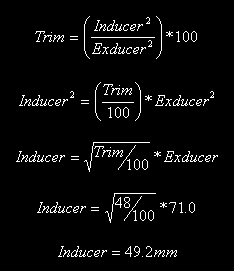
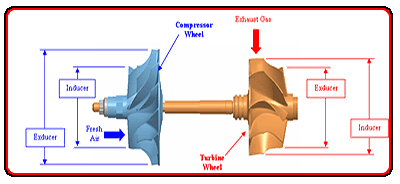
I post this too much, I really do....
Man U FTW
Joined: Sep 2005
Posts: 11,973
Likes: 2
From: Phoenix, AZ
Lol...you really do post that a lot, but its something that people should have a better grasp on. Another thing to look at and understand is AR...what it means and what it does. I'm speaking more of the turbine AR of course, but there is an aspect ratio on compressor housings; however, knowing the actual housing name (B, E, S, etc) is probably a bit more useful.

Honda-Tech Member
Joined: Jan 2005
Posts: 7,015
Likes: 7
From: b00sting my D16s, SoWis, USA
Re: (Schister66)
A few generalizations about turbos:
The Turbine (hot side) affects spool the most, as well as how much exhaust you'll end up flowing. IMO its really the most important factor. A compressor that can flow 200 lb/min (~2000hp) mated to a stage1 T3 turbine will NEVER make close to 2000hp, let alone 500.
The Compressor (cold side) dictates the pressure you'll be running at. A t04b wheel like a 60-1 can make 40psi, but it's efficiency drops way before that. When that happens, it 'blows hot air'. You use the comp map to find where your motor will be running, then you can calculate HP it could make (very rough value).
Turbos get rated based on a typical application. Setup details such as running a 1" exhaust vs a 5" exhaust will change actual output a LOT.
Back to the turbo you want to modify. One issue is that many ebay turbos aren't balance correctly, so the bearings will fail regardless of RPM capacity. THe other is covered above. Ball bearings aren't magical - they mearly reduce some friction, not improve the wheel designs. If there was enough friction to hurt spool by 500rpm, you'd be melting the shaft at idle.
Cliffs: turbos perform mostly based on the wheels & housings, not the CHRA bearings.
The Turbine (hot side) affects spool the most, as well as how much exhaust you'll end up flowing. IMO its really the most important factor. A compressor that can flow 200 lb/min (~2000hp) mated to a stage1 T3 turbine will NEVER make close to 2000hp, let alone 500.
The Compressor (cold side) dictates the pressure you'll be running at. A t04b wheel like a 60-1 can make 40psi, but it's efficiency drops way before that. When that happens, it 'blows hot air'. You use the comp map to find where your motor will be running, then you can calculate HP it could make (very rough value).
Turbos get rated based on a typical application. Setup details such as running a 1" exhaust vs a 5" exhaust will change actual output a LOT.
Back to the turbo you want to modify. One issue is that many ebay turbos aren't balance correctly, so the bearings will fail regardless of RPM capacity. THe other is covered above. Ball bearings aren't magical - they mearly reduce some friction, not improve the wheel designs. If there was enough friction to hurt spool by 500rpm, you'd be melting the shaft at idle.
Cliffs: turbos perform mostly based on the wheels & housings, not the CHRA bearings.

i ♥ snails
Joined: Aug 2004
Posts: 2,293
Likes: 0
From: hmt noggs
well like stated before, ball bearing turbos have special wheel profiles that accompany the ball bearing design. They are opmtimzed or configured, they just didnt put a ball bearing package together and slap it on and say new turbo. There is alot of aspects when it comes to turbos.
Man U FTW
Joined: Sep 2005
Posts: 11,973
Likes: 2
From: Phoenix, AZ
Re: (quicksilver1689)
Originally Posted by quicksilver1689
well like stated before, ball bearing turbos have special wheel profiles that accompany the ball bearing design. They are opmtimzed or configured, they just didnt put a ball bearing package together and slap it on and say new turbo. There is alot of aspects when it comes to turbos.
Man U FTW
Joined: Sep 2005
Posts: 11,973
Likes: 2
From: Phoenix, AZ
You "can" buy them; however, the BB CHRA is a non-rebuildable center section. So basically if you have just the wheel, or mess up a wheel, the turbo is useless anyway...IDK how to explain it better than that. There may be people now who will touch those CHRA's, but to the best of my knowledge, having just the wheels would be totally useless

Honda-Tech Member
Joined: Jan 2004
Posts: 887
Likes: 0
From: gate city, VA, usa
Re: (ashb82)
http://www.turbobygarrett.com would be good place to start looking
im sure theshodan could get about anything that exists that has to do with a turbo haha
im sure theshodan could get about anything that exists that has to do with a turbo haha
Man U FTW
Joined: Sep 2005
Posts: 11,973
Likes: 2
From: Phoenix, AZ
Re: (ashb82)
Originally Posted by ashb82
where do you buy turbo parts at