


Help Needed BAD.


Thread Starter
Joined: May 2007
Posts: 10
Likes: 0
From: New Oxford, PA, US
 Help Needed BAD.
To start off i have a 2000 Civic SI that is being a nightmare.
The car idles very rough sound like it has high lift cams. And other times i purrs like a kitten. It is running very rich and getting horrible gas milage. It keeps tossing out codes like O2 sensor slow response, Fule trim malfunction, System too rich. The car ran worse when i got it. had a few vacuum leaks when i got it. Sensor's were pluged in wrong. I just cant figure it out the car hates me
What i have replaced
-Throttle body on the car came off a 00 si and is spotless> ( car now stalls when u get off the gas ) Put this on last night.
-Computer again out of another si
-Cat was clogged so it now has none. (test Pipe )
-Header was replaced since the other one had a dented primary.
-Both 02 sensors
-Car has 125XXX on it and 60k on motor and trans. JDM swap.
The car idles very rough sound like it has high lift cams. And other times i purrs like a kitten. It is running very rich and getting horrible gas milage. It keeps tossing out codes like O2 sensor slow response, Fule trim malfunction, System too rich. The car ran worse when i got it. had a few vacuum leaks when i got it. Sensor's were pluged in wrong. I just cant figure it out the car hates me
What i have replaced
-Throttle body on the car came off a 00 si and is spotless> ( car now stalls when u get off the gas ) Put this on last night.
-Computer again out of another si
-Cat was clogged so it now has none. (test Pipe )
-Header was replaced since the other one had a dented primary.
-Both 02 sensors
-Car has 125XXX on it and 60k on motor and trans. JDM swap.

Honda-Tech Member
Joined: Feb 2008
Posts: 45,214
Likes: 59
Re: Help Needed BAD. (Shorb97EK)
I can't find P0140 or P0170 in the 96-00 service manual.
P0141 is a secondary O2 sensor code. This would not cause your problem.
Perhaps P0170 is a generic code for running rich or lean?
P0141 is a secondary O2 sensor code. This would not cause your problem.
Perhaps P0170 is a generic code for running rich or lean?
Thread Starter
Joined: May 2007
Posts: 10
Likes: 0
From: New Oxford, PA, US
Re: Help Needed BAD. (RonJ@HT)
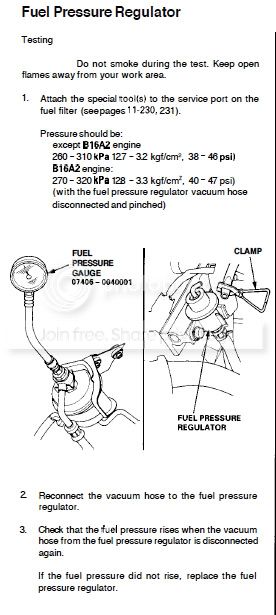
Would a FPR off a LS integra Work ? just to see if this one might be bad. I have No way of checking the pressure. Also the trottle body had lot of soot new the idle screw ? Po 170 is Fuel Trim Malfunction. Maybe it was PO400 something for the Cat being out of tolorance. But that is because of the test pipe. 
Modified by Shorb97EK at 1:55 PM 7/19/2008
Modified by Shorb97EK at 1:55 PM 7/19/2008
Modified by Shorb97EK at 4:56 PM 7/19/2008
Modified by Shorb97EK at 1:55 PM 7/19/2008
Modified by Shorb97EK at 1:55 PM 7/19/2008
Modified by Shorb97EK at 4:56 PM 7/19/2008
Trending Topics
Thread Starter
Joined: May 2007
Posts: 10
Likes: 0
From: New Oxford, PA, US
Re: Help Needed BAD. (Shorb97EK)
I cleaned the IACV Valve again the thing is spot less. But it hums with the car turned on and not running. Idk what that could mean. it idle's rough with the screw the whole way out. @ 500 rpm.

H-T White Ops
Joined: Feb 2004
Posts: 17,603
Likes: 22
From: USA
Re: Help Needed BAD. (Shorb97EK)
<TABLE WIDTH="90%" CELLSPACING=0 CELLPADDING=0 ALIGN=CENTER><TR><TD>Quote, originally posted by Shorb97EK »</TD></TR><TR><TD CLASS="quote">PO170 PO172 PO140 </TD></TR></TABLE>
P0140
O2 CKT No Activity (Bank 1 Sensor 2)
● Oxygen sensor defective
● Fuel system running very rich/lean
● Engine misfire condition (repair)
● Fuel pump or pressure regulator
P0170
Fuel Trim Malfunction (Bank 1)
● MAF sensor (if bank 2 code also)
● O2 sensor
● Ignition misfire
● Fuel pressure
P0172 (45)
System Too Rich
● Fuel supply system
● Primary HO2S (Sensor 1)
● MAP sensor
● Contaminated fuel
● Valve clearance
P0140
O2 CKT No Activity (Bank 1 Sensor 2)
● Oxygen sensor defective
● Fuel system running very rich/lean
● Engine misfire condition (repair)
● Fuel pump or pressure regulator
P0170
Fuel Trim Malfunction (Bank 1)
● MAF sensor (if bank 2 code also)
● O2 sensor
● Ignition misfire
● Fuel pressure
P0172 (45)
System Too Rich
● Fuel supply system
● Primary HO2S (Sensor 1)
● MAP sensor
● Contaminated fuel
● Valve clearance
Honda-Tech Member
Joined: Feb 2008
Posts: 45,214
Likes: 59
Re: Help Needed BAD. (Shorb97EK)
As I mentioned previously, two of those trouble codes are not listed in the Civic service manual, so beware making important conclusions from them.
If you removed the coolant lines when cleaning the IACV, you should also bleed the cooling system of possible trapped air.
If you removed the coolant lines when cleaning the IACV, you should also bleed the cooling system of possible trapped air.
H-T White Ops
Joined: Feb 2004
Posts: 17,603
Likes: 22
From: USA
Re: Help Needed BAD. (RonJ@HT)
<TABLE WIDTH="90%" CELLSPACING=0 CELLPADDING=0 ALIGN=CENTER><TR><TD>Quote, originally posted by RonJ@HT »</TD></TR><TR><TD CLASS="quote">As I mentioned previously, two of those trouble codes are not listed in the Civic service manual, so beware making important conclusions from them.
If you removed the coolant lines when cleaning the IACV, you should also bleed the cooling system of possible trapped air.</TD></TR></TABLE>
All the codes that a car can be subjected to are not listed in their service manuals.
Some codes are make specific and some aren't also. These codes are not specific to any certain make.
If your car is throwing these codes, it's throwing these codes. It's not like a Civic can't have those codes and problems just because the FSM doesn't list them in there. The FSM only mentions a few trouble codes anyway.
If you removed the coolant lines when cleaning the IACV, you should also bleed the cooling system of possible trapped air.</TD></TR></TABLE>
All the codes that a car can be subjected to are not listed in their service manuals.
Some codes are make specific and some aren't also. These codes are not specific to any certain make.
If your car is throwing these codes, it's throwing these codes. It's not like a Civic can't have those codes and problems just because the FSM doesn't list them in there. The FSM only mentions a few trouble codes anyway.
Honda-Tech Member
Joined: Feb 2008
Posts: 45,214
Likes: 59
Re: Help Needed BAD. (NOFX)
NOFX:
I cannot say that you are wrong; however, why would a comprehensive service manual purposely omit critical CEL trouble codes. My point was that there are probably equivalent codes listed in the manual, but I don't know which ones.
I cannot say that you are wrong; however, why would a comprehensive service manual purposely omit critical CEL trouble codes. My point was that there are probably equivalent codes listed in the manual, but I don't know which ones.
H-T White Ops
Joined: Feb 2004
Posts: 17,603
Likes: 22
From: USA
Re: Help Needed BAD. (RonJ@HT)
<TABLE WIDTH="90%" CELLSPACING=0 CELLPADDING=0 ALIGN=CENTER><TR><TD>Quote, originally posted by RonJ@HT »</TD></TR><TR><TD CLASS="quote">NOFX:
I cannot say that you are wrong; however, why would a comprehensive service manual purposely omit critical CEL trouble codes.</TD></TR></TABLE>
The OBD system is pretty much a universal system. All '96+ cars in the US have to be able to use OBDII and many of the codes are just as I mentioned before, universal.
Now, would a service manual really need to tell you, "If you get a code for the O2 sensor, replace the O2 sensor"?
It's left out because there's no reason to include it. LOTS of things are left out in the FSM. There have been so many times I go to see how to remove something and nothing is mentioned about it save for maybe, "Remove the ___".
Most of the codes listed in the manual instead go by the number of flashes the CEL will make if jumped.
I cannot say that you are wrong; however, why would a comprehensive service manual purposely omit critical CEL trouble codes.</TD></TR></TABLE>
The OBD system is pretty much a universal system. All '96+ cars in the US have to be able to use OBDII and many of the codes are just as I mentioned before, universal.
Now, would a service manual really need to tell you, "If you get a code for the O2 sensor, replace the O2 sensor"?
It's left out because there's no reason to include it. LOTS of things are left out in the FSM. There have been so many times I go to see how to remove something and nothing is mentioned about it save for maybe, "Remove the ___".
Most of the codes listed in the manual instead go by the number of flashes the CEL will make if jumped.
Honda-Tech Member
Joined: Feb 2008
Posts: 45,214
Likes: 59
Re: Help Needed BAD. (NOFX)
Yes, I understand that the service manual will omit minor details but, using your example of an O2 sensor, the manual already includes many different O2 sensor codes, so what would be the point of leaving some out and including others. In addition, trouble codes are generally not so simple as to tell you just "replace this sensor." A sensor trouble code can typically represent numerous different problems that require additional troubleshooting. I agree that the P0140 and P0170 definitely indicate specific problems, but I believe the scan tool is spitting out generic codes that have different trouble code designations in the FSM. By the way, if I am wrong on this account, I am happy to learn something new.
Thread Starter
Joined: May 2007
Posts: 10
Likes: 0
From: New Oxford, PA, US
Re: Help Needed BAD. (RonJ@HT)
Well codes or no codes there pointing somewhere. I'll change out the IACV valve tomarrow and let u guys know how i make out. I'm thinking there might be a vacuum leek at the manafold. My next post will be a For Sale one
H-T White Ops
Joined: Feb 2004
Posts: 17,603
Likes: 22
From: USA
Re: Help Needed BAD. (RonJ@HT)
<TABLE WIDTH="90%" CELLSPACING=0 CELLPADDING=0 ALIGN=CENTER><TR><TD>Quote, originally posted by RonJ@HT »</TD></TR><TR><TD CLASS="quote">Yes, I understand that the service manual will omit minor details but, using your example of an O2 sensor, the manual already includes many different O2 sensor codes, so what would be the point of leaving some out and including others. In addition, trouble codes are generally not so simple as to tell you just "replace this sensor." A sensor trouble code can typically represent numerous different problems that require additional troubleshooting. I agree that the P0140 and P0170 definitely indicate specific problems, but I believe the scan tool is spitting out generic codes that have different trouble code designations in the FSM. By the way, if I am wrong on this account, I am happy to learn something new.</TD></TR></TABLE>
I wanted to PM this to you, but you disabled it. Hopefully you can drop this in this thread and go do some searches, even on this site, to learn a little more about the ODB system that you apparently do not understand.
Either way, they leave them out. The codes STILL WORK for these meanings. The codes are universal and used for all kinds of cars.
The ECU is saying, "Here is this code." Just because it's not in the FSM doesn't mean it's not a problem.
The codes all mean THE SAME THING no matter the car.
None of those codes in the FSM have different meanings. Some codes are specific to a certain make, but that's all. I have no doubt that the codes I posted have the meanings I posted.
You are the first one I have ever seen dispute any of this. You're making something simple and helpful into something confusing and doubtful.
In fact, let me break it down for you:
Powertrain Codes
P0xxx - Generic (SAE)
P1xxx - Manufacturer Specific
P2xxx - Generic (SAE)
P30xx-P33xx - Manufacturer Specific
P34xx-P39xx - Generic (SAE)
Chassis Codes
C0xxx - Generic (SAE)
C1xxx - Manufacturer Specific
C2xxx - Manufacturer Specific
C3xxx - Generic (SAE)
Body Codes
B0xxx - Generic (SAE)
B1xxx - Manufacturer Specific
B2xxx - Manufacturer Specific
B3xxx - Generic (SAE)
Network Codes
U0xxx - Generic (SAE)
U1xxx - Manufacturer Specific
U2xxx - Manufacturer Specific
U3xxx - Generic (SAE)
http://autorepair.about.com/cs...a.htm
http://www.actron.com/code_lookup.php
So there, that's the end of it. Enable PMs and fight about it there if you still doubt it.
I wanted to PM this to you, but you disabled it. Hopefully you can drop this in this thread and go do some searches, even on this site, to learn a little more about the ODB system that you apparently do not understand.
Either way, they leave them out. The codes STILL WORK for these meanings. The codes are universal and used for all kinds of cars.
The ECU is saying, "Here is this code." Just because it's not in the FSM doesn't mean it's not a problem.
The codes all mean THE SAME THING no matter the car.
None of those codes in the FSM have different meanings. Some codes are specific to a certain make, but that's all. I have no doubt that the codes I posted have the meanings I posted.
You are the first one I have ever seen dispute any of this. You're making something simple and helpful into something confusing and doubtful.
In fact, let me break it down for you:
Powertrain Codes
P0xxx - Generic (SAE)
P1xxx - Manufacturer Specific
P2xxx - Generic (SAE)
P30xx-P33xx - Manufacturer Specific
P34xx-P39xx - Generic (SAE)
Chassis Codes
C0xxx - Generic (SAE)
C1xxx - Manufacturer Specific
C2xxx - Manufacturer Specific
C3xxx - Generic (SAE)
Body Codes
B0xxx - Generic (SAE)
B1xxx - Manufacturer Specific
B2xxx - Manufacturer Specific
B3xxx - Generic (SAE)
Network Codes
U0xxx - Generic (SAE)
U1xxx - Manufacturer Specific
U2xxx - Manufacturer Specific
U3xxx - Generic (SAE)
http://autorepair.about.com/cs...a.htm
http://www.actron.com/code_lookup.php
So there, that's the end of it. Enable PMs and fight about it there if you still doubt it.
H-T White Ops
Joined: Feb 2004
Posts: 17,603
Likes: 22
From: USA
Re: Help Needed BAD. (Shorb97EK)
<TABLE WIDTH="90%" CELLSPACING=0 CELLPADDING=0 ALIGN=CENTER><TR><TD>Quote, originally posted by Shorb97EK »</TD></TR><TR><TD CLASS="quote">Well codes or no codes there pointing somewhere. I'll change out the IACV valve tomarrow and let u guys know how i make out. I'm thinking there might be a vacuum leek at the manafold. My next post will be a For Sale one</TD></TR></TABLE>
Why won't you bring it to a shop at least before you sell it?
Why won't you bring it to a shop at least before you sell it?


Honda-Tech Member
Joined: Feb 2008
Posts: 45,214
Likes: 59
Re: Help Needed BAD. (NOFX)
<TABLE WIDTH="90%" CELLSPACING=0 CELLPADDING=0 ALIGN=CENTER><TR><TD>Quote, originally posted by NOFX »</TD></TR><TR><TD CLASS="quote">Hopefully you can drop this in this thread and go do some searches, even on this site, to learn a little more about the ODB system that you apparently do not understand.
Either way, they leave them out. The codes STILL WORK for these meanings. The codes are universal and used for all kinds of cars.
The ECU is saying, "Here is this code." Just because it's not in the FSM doesn't mean it's not a problem.
The codes all mean THE SAME THING no matter the car.
None of those codes in the FSM have different meanings. Some codes are specific to a certain make, but that's all. I have no doubt that the codes I posted have the meanings I posted.
You are the first one I have ever seen dispute any of this. You're making something simple and helpful into something confusing and doubtful.
</TD></TR></TABLE>
I never stated that the generic codes are not signifying a problem. I was wrong if I gave that impression. Nonetheless, I continue to believe and have been trying to say that codes matching those found in the FSM are the most informative because the FSM provides specific details about how to troubleshoot such codes for a Civic. Hence, I focused on code P0172 and provided a logical suggestion to check the fuel pressure regulator.
By contrast, you have made a huge deal out of the two generic codes, but I have yet to read about you using those codes to suggest any solutions to the problem. For example, do you really believe that the secondary O2 sensor code P0140 is an important avenue for troubleshooting with respect to the idle problem? Is code P0170 providing any additional important information not obtained by chasing code P0172? Also with respect to code P0170, will you suggest testing for a bad MAF sensor? I think not.
That's the end of it. Hopefully you can now drop it.
Either way, they leave them out. The codes STILL WORK for these meanings. The codes are universal and used for all kinds of cars.
The ECU is saying, "Here is this code." Just because it's not in the FSM doesn't mean it's not a problem.
The codes all mean THE SAME THING no matter the car.
None of those codes in the FSM have different meanings. Some codes are specific to a certain make, but that's all. I have no doubt that the codes I posted have the meanings I posted.
You are the first one I have ever seen dispute any of this. You're making something simple and helpful into something confusing and doubtful.
</TD></TR></TABLE>
I never stated that the generic codes are not signifying a problem. I was wrong if I gave that impression. Nonetheless, I continue to believe and have been trying to say that codes matching those found in the FSM are the most informative because the FSM provides specific details about how to troubleshoot such codes for a Civic. Hence, I focused on code P0172 and provided a logical suggestion to check the fuel pressure regulator.
By contrast, you have made a huge deal out of the two generic codes, but I have yet to read about you using those codes to suggest any solutions to the problem. For example, do you really believe that the secondary O2 sensor code P0140 is an important avenue for troubleshooting with respect to the idle problem? Is code P0170 providing any additional important information not obtained by chasing code P0172? Also with respect to code P0170, will you suggest testing for a bad MAF sensor? I think not.
That's the end of it. Hopefully you can now drop it.
H-T White Ops
Joined: Feb 2004
Posts: 17,603
Likes: 22
From: USA
Re: Help Needed BAD. (RonJ@HT)
<TABLE WIDTH="90%" CELLSPACING=0 CELLPADDING=0 ALIGN=CENTER><TR><TD>Quote, originally posted by RonJ@HT »</TD></TR><TR><TD CLASS="quote">I never stated that the generic codes are not signifying a problem. I was wrong if I gave that impression. Nonetheless, I continue to believe and have been trying to say that codes matching those found in the FSM are the most informative because the FSM provides specific details about how to troubleshoot such codes for a Civic. Hence, I focused on code P0172 and provided a logical suggestion to check the fuel pressure regulator.
By contrast, you have made a huge deal out of the two generic codes, but I have yet to read about you using those codes to suggest any solutions to the problem. For example, do you really believe that the secondary O2 sensor code P0140 is an important avenue for troubleshooting with respect to the idle problem? Is code P0170 providing any additional important information not obtained by chasing code P0172? Also with respect to code P0170, will you suggest testing for a bad MAF sensor? I think not.
That's the end of it. Hopefully you can now drop it.</TD></TR></TABLE>
I didn't make a huge deal out of it. You made a huge deal out of not understanding codes and their importance. All three codes are just as important.
Go learn about codes elsewhere. Leave it out of this thread.
All I did was state the meanings of the codes to help the OP. You made sure to bring up a code that isn't even involved in the issue though.
By contrast, you have made a huge deal out of the two generic codes, but I have yet to read about you using those codes to suggest any solutions to the problem. For example, do you really believe that the secondary O2 sensor code P0140 is an important avenue for troubleshooting with respect to the idle problem? Is code P0170 providing any additional important information not obtained by chasing code P0172? Also with respect to code P0170, will you suggest testing for a bad MAF sensor? I think not.
That's the end of it. Hopefully you can now drop it.</TD></TR></TABLE>
I didn't make a huge deal out of it. You made a huge deal out of not understanding codes and their importance. All three codes are just as important.
Go learn about codes elsewhere. Leave it out of this thread.
All I did was state the meanings of the codes to help the OP. You made sure to bring up a code that isn't even involved in the issue though.


Honda-Tech Member
Joined: Feb 2008
Posts: 45,214
Likes: 59
Re: Help Needed BAD. (NOFX)
<TABLE WIDTH="90%" CELLSPACING=0 CELLPADDING=0 ALIGN=CENTER><TR><TD>Quote, originally posted by NOFX »</TD></TR><TR><TD CLASS="quote">
...You made a huge deal out of not understanding codes and their importance...You made sure to bring up a code that isn't even involved in the issue though.</TD></TR></TABLE>
I think that I have an adequate understanding about codes. The OP said "It is running very rich and getting horrible gas milage." So how was my suggestion way off the mark?
Why don't you also play a positive role in this thread by using the generic codes to suggest some useful troubleshooting that will lead to a solution?
...You made a huge deal out of not understanding codes and their importance...You made sure to bring up a code that isn't even involved in the issue though.</TD></TR></TABLE>
I think that I have an adequate understanding about codes. The OP said "It is running very rich and getting horrible gas milage." So how was my suggestion way off the mark?
Why don't you also play a positive role in this thread by using the generic codes to suggest some useful troubleshooting that will lead to a solution?
Thread Starter
Joined: May 2007
Posts: 10
Likes: 0
From: New Oxford, PA, US
Re: (v8killaz)
It Runs like a Champ up top. Pulls very hard to 8200. But it's won't stop trowing cods and running rich. Idk if a dizzy would help any. There are no flat spots in the RPM band.