


crossmember/steering rack bracing...


Thread Starter
Honda-Tech Member
Joined: Oct 2005
Posts: 5,742
Likes: 0
From: Greenville, SC, U S and A
 crossmember/steering rack bracing...
i've seen people do this stuff but what is it really for? i have a bar that has 2 holes on each end of it and it bolts on the top of the steering rack/crossmember at the bottom of the firewall...i just don't know what it does...i can't find any pictures of them on here, yahoo or google or even really any info on them...anyone have any pics of know anything about them...

be professional
Joined: Oct 2002
Posts: 14,842
Likes: 13
From: Pittsburgh, PA
Re: crossmember/steering rack bracing... (TehMan)
<TABLE WIDTH="90%" CELLSPACING=0 CELLPADDING=0 ALIGN=CENTER><TR><TD>Quote, originally posted by TehMan »</TD></TR><TR><TD CLASS="quote">i've seen people do this stuff but what is it really for?</TD></TR></TABLE>
Bling.
I'd cash it in at the local scrap yard. Steel is really high right now.
Bling.
I'd cash it in at the local scrap yard. Steel is really high right now.
Thread Starter
Honda-Tech Member
Joined: Oct 2005
Posts: 5,742
Likes: 0
From: Greenville, SC, U S and A
Re: crossmember/steering rack bracing... (Targa250R)
<TABLE WIDTH="90%" CELLSPACING=0 CELLPADDING=0 ALIGN=CENTER><TR><TD>Quote, originally posted by Targa250R »</TD></TR><TR><TD CLASS="quote">
Bling.
I'd cash it in at the local scrap yard. Steel is really high right now.</TD></TR></TABLE>
sounds good to me
Bling.
I'd cash it in at the local scrap yard. Steel is really high right now.</TD></TR></TABLE>
sounds good to me

Thread Starter
Honda-Tech Member
Joined: Oct 2005
Posts: 5,742
Likes: 0
From: Greenville, SC, U S and A
Re: crossmember/steering rack bracing... (TehMan)
these are the two bolts...they are on both sides...

so i have a bar that fits perfectly...it bolts up like this white line
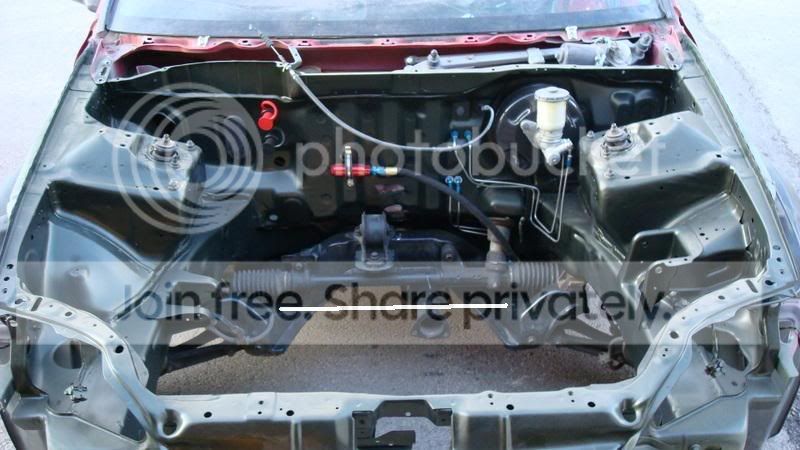
so i have a bar that fits perfectly...it bolts up like this white line

Honda-Tech Member
Joined: Aug 2003
Posts: 140
Likes: 0
From: OR, USA
Re: crossmember/steering rack bracing... (TehMan)
What do you mean, what is it for? Isn't that obvious, it's a brace to prevent the weak sheet metal from bending excessively. Those bars come stock on the Acura's, but not on the Civics, so upgrade your car and bolt it in.


Trending Topics


be professional
Joined: Oct 2002
Posts: 14,842
Likes: 13
From: Pittsburgh, PA
Re: (bmoua)
<TABLE WIDTH="90%" CELLSPACING=0 CELLPADDING=0 ALIGN=CENTER><TR><TD>Quote, originally posted by bmoua »</TD></TR><TR><TD CLASS="quote">doesn't the 94-01 integra's come with one stock...</TD></TR></TABLE>
They come with a front upper tower brace as well - another part that I find useless
They come with a front upper tower brace as well - another part that I find useless

be professional
Joined: Oct 2002
Posts: 14,842
Likes: 13
From: Pittsburgh, PA
Re: (way2much)
<TABLE WIDTH="90%" CELLSPACING=0 CELLPADDING=0 ALIGN=CENTER><TR><TD>Quote, originally posted by way2much »</TD></TR><TR><TD CLASS="quote">Does the EF chasis have these holes? If so, is the Integra CB/CM a direct fit?
thanks</TD></TR></TABLE>
The holes are on the crossmember itself, and no, '88-91 Civic/CRX rear crossmembers are completely different from later models.
thanks</TD></TR></TABLE>
The holes are on the crossmember itself, and no, '88-91 Civic/CRX rear crossmembers are completely different from later models.
Honda-Tech Member
Joined: Aug 2003
Posts: 140
Likes: 0
From: OR, USA
Re: (Targa250R)
Honestly, do you think Honda would've invested time and money putting braces on the car if it didn't help stiffen up the chassis? I just don't understand why people think that braces are a waste just because they can't feel the difference. It's not like humans are the best measuring instruments.

Banned
Joined: Jan 2008
Posts: 526
Likes: 0
From: strathcedar, nsw, australia
Re: (ginsu2k)
<TABLE WIDTH="90%" CELLSPACING=0 CELLPADDING=0 ALIGN=CENTER><TR><TD>Quote, originally posted by ginsu2k »</TD></TR><TR><TD CLASS="quote">I just don't understand why people think that braces are a waste just because they can't feel the difference. It's not like humans are the best measuring instruments. </TD></TR></TABLE>
Five possible reasons (in no particular order):
1) Insensitive driver.
2) Driver only has experience of poor quality tower braces (too floppy) that don't actually work.
3) Suspension settings are so soft they don't cause enough chassis stress to be problematic.
4) Driver places little stress on the chassis (i.e. drives relatively sedately).
5) Some (rare) chassis don't really need them because the basic structure is rigid enough in that area.
Five possible reasons (in no particular order):
1) Insensitive driver.
2) Driver only has experience of poor quality tower braces (too floppy) that don't actually work.
3) Suspension settings are so soft they don't cause enough chassis stress to be problematic.
4) Driver places little stress on the chassis (i.e. drives relatively sedately).
5) Some (rare) chassis don't really need them because the basic structure is rigid enough in that area.
be professional
Joined: Oct 2002
Posts: 14,842
Likes: 13
From: Pittsburgh, PA
Re: (ginsu2k)
<TABLE WIDTH="90%" CELLSPACING=0 CELLPADDING=0 ALIGN=CENTER><TR><TD>Quote, originally posted by ginsu2k »</TD></TR><TR><TD CLASS="quote">Honestly, do you think Honda would've invested time and money putting braces on the car if it didn't help stiffen up the chassis?</TD></TR></TABLE>
Absolutely.
Just because an engineer works for Honda doesn't mean that person won't do silly things. Most engineers live in their own little theoretical world, far removed from reality. I am of the belief that an engineer should be required to gain exprerience working within a racing car development program (both purpose-built and production) and also have 5 years of experience working in car repair before being allowed to design cars.
<TABLE WIDTH="90%" CELLSPACING=0 CELLPADDING=0 ALIGN=CENTER><TR><TD>Quote »</TD></TR><TR><TD CLASS="quote">I just don't understand why people think that braces are a waste just because they can't feel the difference. It's not like humans are the best measuring instruments. </TD></TR></TABLE>
It has nothing to do with "feeling the difference." It has everything to do with diminishing returns in terms of lap time reduction vs. money spent, and clutter, which is undesireable for several reasons.
Absolutely.
Just because an engineer works for Honda doesn't mean that person won't do silly things. Most engineers live in their own little theoretical world, far removed from reality. I am of the belief that an engineer should be required to gain exprerience working within a racing car development program (both purpose-built and production) and also have 5 years of experience working in car repair before being allowed to design cars.
<TABLE WIDTH="90%" CELLSPACING=0 CELLPADDING=0 ALIGN=CENTER><TR><TD>Quote »</TD></TR><TR><TD CLASS="quote">I just don't understand why people think that braces are a waste just because they can't feel the difference. It's not like humans are the best measuring instruments. </TD></TR></TABLE>
It has nothing to do with "feeling the difference." It has everything to do with diminishing returns in terms of lap time reduction vs. money spent, and clutter, which is undesireable for several reasons.

Honda-Tech Member
Joined: Aug 2003
Posts: 140
Likes: 0
From: OR, USA
Re: (Targa250R)
<TABLE WIDTH="90%" CELLSPACING=0 CELLPADDING=0 ALIGN=CENTER><TR><TD>Quote, originally posted by Targa250R »</TD></TR><TR><TD CLASS="quote">
Absolutely.
Just because an engineer works for Honda doesn't mean that person won't do silly things. Most engineers live in their own little theoretical world, far removed from reality. I am of the belief that an engineer should be required to gain exprerience working within a racing car development program (both purpose-built and production) and also have 5 years of experience working in car repair before being allowed to design cars.
</TD></TR></TABLE>
Well that's a little offensive since I'm an engineering student. Most of the students I know already work on their cars and are really into vehicles in general. Personally, I want to be an engineer because it's absolutely reality based as compared to other occupations. Nobody pays an engineer to lie to them, they pay engineers to tell the truth. And when engineers do lie, they usually end up killing people or equipment, so it's not in our best interests.
If anything, what limits an engineer most is the business majors that are only into cost cutting. That's why I know that Honda would not put a reinforcement brace on a car without a damned good reason, their is some penny pincher always looking at the cost, and they would be more than happy to throw out a part, especially if it had negligible effects.
After all, why has no ~$20,000 Honda had double wishbone since the <2000 Honda Civic? It's because some Business major said hey, we don't need to spend xxx dollars on a few extra parts for double-wishbone, when we can just slap some Mac Struts on like every other manufacturer.
Remember, Honda used to be much more engineering oriented. It's the idiotic market that has driven them towards Toyota type vehicles, where performance is secondary.
Absolutely.
Just because an engineer works for Honda doesn't mean that person won't do silly things. Most engineers live in their own little theoretical world, far removed from reality. I am of the belief that an engineer should be required to gain exprerience working within a racing car development program (both purpose-built and production) and also have 5 years of experience working in car repair before being allowed to design cars.
</TD></TR></TABLE>
Well that's a little offensive since I'm an engineering student. Most of the students I know already work on their cars and are really into vehicles in general. Personally, I want to be an engineer because it's absolutely reality based as compared to other occupations. Nobody pays an engineer to lie to them, they pay engineers to tell the truth. And when engineers do lie, they usually end up killing people or equipment, so it's not in our best interests.
If anything, what limits an engineer most is the business majors that are only into cost cutting. That's why I know that Honda would not put a reinforcement brace on a car without a damned good reason, their is some penny pincher always looking at the cost, and they would be more than happy to throw out a part, especially if it had negligible effects.
After all, why has no ~$20,000 Honda had double wishbone since the <2000 Honda Civic? It's because some Business major said hey, we don't need to spend xxx dollars on a few extra parts for double-wishbone, when we can just slap some Mac Struts on like every other manufacturer.
Remember, Honda used to be much more engineering oriented. It's the idiotic market that has driven them towards Toyota type vehicles, where performance is secondary.
Banned
Joined: Jan 2008
Posts: 526
Likes: 0
From: strathcedar, nsw, australia
Re: (Targa250R)
<TABLE WIDTH="90%" CELLSPACING=0 CELLPADDING=0 ALIGN=CENTER><TR><TD>Quote, originally posted by Targa250R »</TD></TR><TR><TD CLASS="quote">It has nothing to do with "feeling the difference." It has everything to do with diminishing returns in terms of lap time reduction vs. money spent, and clutter, which is undesireable for several reasons.</TD></TR></TABLE>
On a road car it's entirely about "<U>feeling</U> the difference". Whether or not any particular part actually makes a road car corner slightly faster is more or less irrelevant. I know from personal experience that tower braces can significantly improve the 'feel' of a road car. The degree to which this will be the case will vary substantially from chassis to chassis, for some chassis it will make little difference to feel, but for other it will.
On a track car it only matters if it makes the car lap faster or makes it easier for the driver to consistantly lap at the faster times, so 'feel' is only of importance if it equates to faster and / or more consistantly fast times. I've never raced cars, but have raced karts quite a lot over the years, and IMO anything that makes the vehicle feel better for the driver is a good thing, unless it shows up as a deficit on the stopwatch.
A stiffer chassis is always a better chassis (unless it's a kart chassis), so any added component that contributes significant rigidity to a particular chassis is a good thing so long as it passes the benefit / deficit test, i.e. increased chassis stiffness vs weight / CG location.
Tower braces are often a good thing, however some other types of added braces provide no significant rigidity increase to any production chassis, but plenty of people seem willing to pay for racy looking junk so many companies offer junk for sale...
On a road car it's entirely about "<U>feeling</U> the difference". Whether or not any particular part actually makes a road car corner slightly faster is more or less irrelevant. I know from personal experience that tower braces can significantly improve the 'feel' of a road car. The degree to which this will be the case will vary substantially from chassis to chassis, for some chassis it will make little difference to feel, but for other it will.
On a track car it only matters if it makes the car lap faster or makes it easier for the driver to consistantly lap at the faster times, so 'feel' is only of importance if it equates to faster and / or more consistantly fast times. I've never raced cars, but have raced karts quite a lot over the years, and IMO anything that makes the vehicle feel better for the driver is a good thing, unless it shows up as a deficit on the stopwatch.
A stiffer chassis is always a better chassis (unless it's a kart chassis), so any added component that contributes significant rigidity to a particular chassis is a good thing so long as it passes the benefit / deficit test, i.e. increased chassis stiffness vs weight / CG location.
Tower braces are often a good thing, however some other types of added braces provide no significant rigidity increase to any production chassis, but plenty of people seem willing to pay for racy looking junk so many companies offer junk for sale...
Banned
Joined: Jan 2008
Posts: 526
Likes: 0
From: strathcedar, nsw, australia
Re: (johnlear)
So, all this begs the question; why are tower braces more effective on some chassis than others?
Note in the above photos how the towers are 'seperate' from the firewall, i.e. they are not an integral part of the firewall (a structural bulkhead) but seperate structures connected to the forewall by relatively narrow section elements ('beams') that are really the rearward parts of the inner fender panels.
As such the chassis is relying on the lateral 'beam strength' of these two 'beams', and any lateral flexure at these points contributes to overall chassis flexure between the front and rear suspensions. Keep in mind that the chassis is made from quite thin guage sheet metal, and also that the lateral width of the 'beams' and their distance from the firewall will vary from chassis to chassis so that the wider the 'beams' and the closer the towers are to the firewall (i.e. the shorter the 'beams') the stiffer the 'beams' will be (and thus the stiffer the chassis will be).
These two narrow 'beams' are weak points in the chassis structure that will allow a degree of lateral flexure between the towers and the firewall when loads are placed into the towers. Placing a brace between the two towers will lessen such undesirable flexure by bracing one tower to the other, but bracing to the firewall as well would be even better.
Note that tower braces <U>only</U> work in compression and tension from one tower to the other, they do not contribute any significant vertical stiffness into the chassis.
On some more modern chassis the towers are more integral with the firewall, i.e. the innermost parts of the towers don't widen out toward the sides of the chassis nearer the firewall, but go straight back (or actually angle a little inward) to the firewall.
This means there are no weak 'beam' sections at the sides of the chassis between the towers and the firewall that would otherwise allow the towers to move laterally (relative to the firewall) as loadings are placed into the towers. Such a chassis would likely show little benefit from fitting a brace between the front towers as the towers are already well braced to the firewall.
Anyway, that's my simpilfied take on frontal chassis rigidity, what about the rear end?
Many sedans suffer from the the rear part of the chassis structure being compromised by the marketing departments insistance upon having a large aperture behind the rear seat back merely in order to allow the carriage of long cargo passing from the trunk cavity into the passenger compartment (the annual Xmas tree and the odd ski or whatever...).
This aperture weakens the rear of the chassis structure between the rear towers and allows unwanted rear chassis flexure (this flexure caused by lack or rear 'closure' will pass well into the passenger section of the chassis). Connecting the towers with a brace does a lot to address this problem, as does fitting an effective 'X' style brace in the trunk (I have a rear tower brace and a home made X style brace that fits behind the rear seat back rather than in the trunk).
Hatchbacks and wagons are even worse than sedans in this respect as they also lack the chassis stiffening affect of the sedan's rear window and rear parcel shelf, the entire rear part of the chassis in effect being unbraced and 'open'. The hatch door or tail door do almost nothing for chassis stiffness because the latch is not a strong enough fastening, and are really in the wrong location to provide much stiffness in any case (too far away from the rear suspension).
Modified by johnlear at 4:20 AM 4/21/2008
Note in the above photos how the towers are 'seperate' from the firewall, i.e. they are not an integral part of the firewall (a structural bulkhead) but seperate structures connected to the forewall by relatively narrow section elements ('beams') that are really the rearward parts of the inner fender panels.
As such the chassis is relying on the lateral 'beam strength' of these two 'beams', and any lateral flexure at these points contributes to overall chassis flexure between the front and rear suspensions. Keep in mind that the chassis is made from quite thin guage sheet metal, and also that the lateral width of the 'beams' and their distance from the firewall will vary from chassis to chassis so that the wider the 'beams' and the closer the towers are to the firewall (i.e. the shorter the 'beams') the stiffer the 'beams' will be (and thus the stiffer the chassis will be).
These two narrow 'beams' are weak points in the chassis structure that will allow a degree of lateral flexure between the towers and the firewall when loads are placed into the towers. Placing a brace between the two towers will lessen such undesirable flexure by bracing one tower to the other, but bracing to the firewall as well would be even better.
Note that tower braces <U>only</U> work in compression and tension from one tower to the other, they do not contribute any significant vertical stiffness into the chassis.
On some more modern chassis the towers are more integral with the firewall, i.e. the innermost parts of the towers don't widen out toward the sides of the chassis nearer the firewall, but go straight back (or actually angle a little inward) to the firewall.
This means there are no weak 'beam' sections at the sides of the chassis between the towers and the firewall that would otherwise allow the towers to move laterally (relative to the firewall) as loadings are placed into the towers. Such a chassis would likely show little benefit from fitting a brace between the front towers as the towers are already well braced to the firewall.
Anyway, that's my simpilfied take on frontal chassis rigidity, what about the rear end?
Many sedans suffer from the the rear part of the chassis structure being compromised by the marketing departments insistance upon having a large aperture behind the rear seat back merely in order to allow the carriage of long cargo passing from the trunk cavity into the passenger compartment (the annual Xmas tree and the odd ski or whatever...).
This aperture weakens the rear of the chassis structure between the rear towers and allows unwanted rear chassis flexure (this flexure caused by lack or rear 'closure' will pass well into the passenger section of the chassis). Connecting the towers with a brace does a lot to address this problem, as does fitting an effective 'X' style brace in the trunk (I have a rear tower brace and a home made X style brace that fits behind the rear seat back rather than in the trunk).
Hatchbacks and wagons are even worse than sedans in this respect as they also lack the chassis stiffening affect of the sedan's rear window and rear parcel shelf, the entire rear part of the chassis in effect being unbraced and 'open'. The hatch door or tail door do almost nothing for chassis stiffness because the latch is not a strong enough fastening, and are really in the wrong location to provide much stiffness in any case (too far away from the rear suspension).
Modified by johnlear at 4:20 AM 4/21/2008

Suspetise...
Joined: Nov 2002
Posts: 12,287
Likes: 1
From: Burninating the peasants yo
Re: crossmember/steering rack bracing... (Targa250R)
<TABLE WIDTH="90%" CELLSPACING=0 CELLPADDING=0 ALIGN=CENTER><TR><TD>Quote, originally posted by Targa250R »</TD></TR><TR><TD CLASS="quote">
I'd cash it in at the local scrap yard. Steel is really high right now.</TD></TR></TABLE>
Sounds like I'm making a trip to the scrap yard
And johnlear, while you make good points, do you not agree with the diminishing return argument? $150 on a strut bar (even if it does improve the car) could also be 1/2 an entry fee for a DE. There's no question whatsoever about which will ultimately have a greater return.
I'd cash it in at the local scrap yard. Steel is really high right now.</TD></TR></TABLE>
Sounds like I'm making a trip to the scrap yard
And johnlear, while you make good points, do you not agree with the diminishing return argument? $150 on a strut bar (even if it does improve the car) could also be 1/2 an entry fee for a DE. There's no question whatsoever about which will ultimately have a greater return.
Banned
Joined: Jan 2008
Posts: 526
Likes: 0
From: strathcedar, nsw, australia
Re: crossmember/steering rack bracing... (Stinkycheezmonky)
<TABLE WIDTH="90%" CELLSPACING=0 CELLPADDING=0 ALIGN=CENTER><TR><TD>Quote, originally posted by Stinkycheezmonky »</TD></TR><TR><TD CLASS="quote"> And johnlear, while you make good points, do you not agree with the diminishing return argument? $150 on a strut bar (even if it does improve the car) could also be 1/2 an entry fee for a DE. There's no question whatsoever about which will ultimately have a greater return.</TD></TR></TABLE>
"DE"? Driver education, i.e. an advanced driving course?? A lot of people will gain a lot from that, but others less. Personally I'm sure I'd learn something, but I doubt it would be a lot since I have skills gained from years of kart racing and from driving a Lotus 7 style sports car stupidly fast on the public road (young and especially stupid once, a bit less stupid these days).
Of course the law of diminishing return applies. The point at which an expense becomes unjustifiable will always differ from person to person, e.g. it might cost say $1000 to get an additional 100hp from an engine, but say another $1000 to get another 50hp. Now for me (assuminmg I could afford the first $1000) I might not consider that extra 50hp worth the added expense, but plenty of others might think it cheap...
Me? If I had a spare $1000 to spend on the car I wouldn't spend it on hp, but on handling. My current handling wish list; stiffer rear ARB, stiffer coils, 16" x 7" wheels with decent 205/50 tyres to suit (already way past the hypothetical $1000!).
From my experience I would consider $150 well spent on a good quality tower brace (not that I spent any $ on mine being home made items), as I would consider $150 well spent on a stiffer rear ARB. I'd probably invest in the rear ARB before spending the $ on the tower brace, but likely to spend $150 on tower bracing before spending $400 (or whatever) on stiffer springs.
The single most important suspension expense though is good quality dampers, they are the basis of the suspension set up and where $ should be spent first and foremost, which is why I stretched my budget to Konis.
Modified by johnlear at 5:19 PM 4/21/2008
"DE"? Driver education, i.e. an advanced driving course?? A lot of people will gain a lot from that, but others less. Personally I'm sure I'd learn something, but I doubt it would be a lot since I have skills gained from years of kart racing and from driving a Lotus 7 style sports car stupidly fast on the public road (young and especially stupid once, a bit less stupid these days).
Of course the law of diminishing return applies. The point at which an expense becomes unjustifiable will always differ from person to person, e.g. it might cost say $1000 to get an additional 100hp from an engine, but say another $1000 to get another 50hp. Now for me (assuminmg I could afford the first $1000) I might not consider that extra 50hp worth the added expense, but plenty of others might think it cheap...
Me? If I had a spare $1000 to spend on the car I wouldn't spend it on hp, but on handling. My current handling wish list; stiffer rear ARB, stiffer coils, 16" x 7" wheels with decent 205/50 tyres to suit (already way past the hypothetical $1000!).
From my experience I would consider $150 well spent on a good quality tower brace (not that I spent any $ on mine being home made items), as I would consider $150 well spent on a stiffer rear ARB. I'd probably invest in the rear ARB before spending the $ on the tower brace, but likely to spend $150 on tower bracing before spending $400 (or whatever) on stiffer springs.
The single most important suspension expense though is good quality dampers, they are the basis of the suspension set up and where $ should be spent first and foremost, which is why I stretched my budget to Konis.
Modified by johnlear at 5:19 PM 4/21/2008

Thread
Thread Starter
Forum
Replies
Last Post
hondaZvic
Honda Civic / Del Sol (1992 - 2000)
3
Sep 20, 2005 08:19 AM
