


Changing Titanium Retainers Every 13,000 Miles ?


Thread Starter
Joined: Dec 2006
Posts: 5
Likes: 0
From: Houston, Texas, United States
 Changing Titanium Retainers Every 13,000 Miles ?
I'm going to use Supertech Retainers and Springs in my 2001 S2000. But someone on either H-I, S2KCA, Honda-Tech, or S2ki said that titanium retainers must be changed every 13,000 miles because they deform over time. Is this true ?
please help.
please help.

Honda-Tech Member
Joined: Nov 2006
Posts: 270
Likes: 0
From: Fort Lauderdale, Florida, USA
Re: Changing Titanium Retainers Every 13,000 Miles ? (Scott Howard)
<TABLE WIDTH="90%" CELLSPACING=0 CELLPADDING=0 ALIGN=CENTER><TR><TD>Quote, originally posted by Scott Howard »</TD></TR><TR><TD CLASS="quote">I'm going to use Supertech Retainers and Springs in my 2001 S2000. But someone on either H-I, S2KCA, Honda-Tech, or S2ki said that titanium retainers must be changed every 13,000 miles because they deform over time. Is this true ?
please help.</TD></TR></TABLE>
Why not go with Ferrea spring/retainer combo that won't have that issue. Ti retainers usually wear out when there is a sloppy fit which is always avoided with a matched Ferrea spring and retainer application. "Spend a little now, spend a lot later" applies here.
please help.</TD></TR></TABLE>
Why not go with Ferrea spring/retainer combo that won't have that issue. Ti retainers usually wear out when there is a sloppy fit which is always avoided with a matched Ferrea spring and retainer application. "Spend a little now, spend a lot later" applies here.
Honda-Tech Member
Joined: Nov 2006
Posts: 270
Likes: 0
From: Fort Lauderdale, Florida, USA
Re: Changing Titanium Retainers Every 13,000 Miles ? (Scott Howard)
<TABLE WIDTH="90%" CELLSPACING=0 CELLPADDING=0 ALIGN=CENTER><TR><TD>Quote, originally posted by Scott Howard »</TD></TR><TR><TD CLASS="quote">What valves?</TD></TR></TABLE>
What valves what? You asked about retainers...but Ferrea makes the best of the best. Retainers or valves.

What valves what? You asked about retainers...but Ferrea makes the best of the best. Retainers or valves.

Honda-Tech Member
Joined: Nov 2006
Posts: 270
Likes: 0
From: Fort Lauderdale, Florida, USA
Re: Changing Titanium Retainers Every 13,000 Miles ? (S@nt0s)
<TABLE WIDTH="90%" CELLSPACING=0 CELLPADDING=0 ALIGN=CENTER><TR><TD>Quote, originally posted by S@nt0s »</TD></TR><TR><TD CLASS="quote">what cams are run plays a factor in the retainers as well....</TD></TR></TABLE>
I disagree...the mating of the retainer to the spring having an interference fit which stops the contacting components from rotating/sliding within/against each other makes the difference.
That is what determines if a Ti retainer will wear itself out or not...and the Ferrea stuff has the correct interference fit and will never need maintenance or replacement over time.
I disagree...the mating of the retainer to the spring having an interference fit which stops the contacting components from rotating/sliding within/against each other makes the difference.
That is what determines if a Ti retainer will wear itself out or not...and the Ferrea stuff has the correct interference fit and will never need maintenance or replacement over time.
Trending Topics
Honda-Tech Member
Joined: Nov 2006
Posts: 270
Likes: 0
From: Fort Lauderdale, Florida, USA
Re: Changing Titanium Retainers Every 13,000 Miles ? (S@nt0s)
<TABLE WIDTH="90%" CELLSPACING=0 CELLPADDING=0 ALIGN=CENTER><TR><TD>Quote, originally posted by S@nt0s »</TD></TR><TR><TD CLASS="quote">i would disagree , with a large enough cam over a period of time will show wear...</TD></TR></TABLE>
...and I would disagree with that as well. Explain to me how something that does not incur any sliding/friction wear, eventually wear out?
I work for Ferrea Racing, so I can speak of what our product is capable of. So you talk about valvetrain function and application ability day in and day out?
Or is the concept that "Ti retainers simply wear out...it's a natural phenomenon" an excuse of my competitor's that has everyone brainwashed?
...and I would disagree with that as well. Explain to me how something that does not incur any sliding/friction wear, eventually wear out?
I work for Ferrea Racing, so I can speak of what our product is capable of. So you talk about valvetrain function and application ability day in and day out?
Or is the concept that "Ti retainers simply wear out...it's a natural phenomenon" an excuse of my competitor's that has everyone brainwashed?


Honda-Tech Member
Joined: Feb 2002
Posts: 221
Likes: 0
From: Huntington Beach, CA, USA
Re: Changing Titanium Retainers Every 13,000 Miles ? (Scott Howard)
<TABLE WIDTH="90%" CELLSPACING=0 CELLPADDING=0 ALIGN=CENTER><TR><TD>Quote, originally posted by Scott Howard »</TD></TR><TR><TD CLASS="quote">I'm going to use Supertech Retainers and Springs in my 2001 S2000. But someone on either H-I, S2KCA, Honda-Tech, or S2ki said that titanium retainers must be changed every 13,000 miles because they deform over time. Is this true ?
please help.</TD></TR></TABLE>
I replaced my titanium retainers after 20,000 miles because they were starting to gall. They were minimally impacted but I replaced them anyway.
please help.</TD></TR></TABLE>
I replaced my titanium retainers after 20,000 miles because they were starting to gall. They were minimally impacted but I replaced them anyway.

Honda-Tech Member
Joined: Aug 2003
Posts: 232
Likes: 0
From: Ocean Springs, MS, United States
Titanium retainers wear out from fatigue much sooner than steel. It's inherent in the material. Ti retainers are for light weight, not longevity. They increase the margin of safety from valve float by reducing the valvetrain mass (inertia). However, they have a relatively short service life and are best suited for racing applications. AP2 retainers are the way to go for a street-driven vehicle.
Honda-Tech Member
Joined: Nov 2006
Posts: 270
Likes: 0
From: Fort Lauderdale, Florida, USA
Re: Changing Titanium Retainers Every 13,000 Miles ? (S@nt0s)
<TABLE WIDTH="90%" CELLSPACING=0 CELLPADDING=0 ALIGN=CENTER><TR><TD>Quote, originally posted by S@nt0s »</TD></TR><TR><TD CLASS="quote">if that is the case why change them out???</TD></TR></TABLE>
Because some of our competitors have/had different levels of concern for the importance of proper fit, accurate engineering and quality control. The stories of Ti retainers wearing out were due to the springs spinning/grinding into the Ti retainer.
Ti has an interesting reputation for being the most incredible material on the planet. People call with a false understanding of Ti being of extremely high strength...such as being stronger than steel, and lighter than aluminum. In reality you could think of it as being a mix of of steel and aluminum. A benefit of being lighter than steel, yes...but not lighter than aluminum. A benefit of being stronger than aluminum, yes...but not as strong as steel.
I like to explain it like the "paper / rock / scissors" game...however in this case, steel always beats Ti. If a steel (harder than Ti) wire spring does not have enough hold onto a Ti (softer than steel) retainer, the harder material will grind into the softer material. If the 2 materials can avoid frictional contact then no one gets hurt.
Why would they need to be changed out? Because they become worn out.
Why would they become worn out? Because of improper/lack of proper holding by means of an interference fit.
Because some of our competitors have/had different levels of concern for the importance of proper fit, accurate engineering and quality control. The stories of Ti retainers wearing out were due to the springs spinning/grinding into the Ti retainer.
Ti has an interesting reputation for being the most incredible material on the planet. People call with a false understanding of Ti being of extremely high strength...such as being stronger than steel, and lighter than aluminum. In reality you could think of it as being a mix of of steel and aluminum. A benefit of being lighter than steel, yes...but not lighter than aluminum. A benefit of being stronger than aluminum, yes...but not as strong as steel.
I like to explain it like the "paper / rock / scissors" game...however in this case, steel always beats Ti. If a steel (harder than Ti) wire spring does not have enough hold onto a Ti (softer than steel) retainer, the harder material will grind into the softer material. If the 2 materials can avoid frictional contact then no one gets hurt.
Why would they need to be changed out? Because they become worn out.
Why would they become worn out? Because of improper/lack of proper holding by means of an interference fit.

FSAE
Joined: Jan 2002
Posts: 5,495
Likes: 1
From: Drinking Beer, UT
Re: Changing Titanium Retainers Every 13,000 Miles ? (KingVR)
If you have had any material science courses, you know that if you have two metals, one is tougher than the other, the softer of the two will wear or gall.
Nearly all valvesprings are steel. Titanium is not stronger than steel. Do the math.
Want the best of both worlds? Use titanium springs with titanium retainers.
You can also use stock retainers with aftermarket springs.
Or inspect your retainers often. With that said, I have been running Supertech springs and Supertech Ti retainers for over 10,000miles with no galling.
Nearly all valvesprings are steel. Titanium is not stronger than steel. Do the math.
Want the best of both worlds? Use titanium springs with titanium retainers.
You can also use stock retainers with aftermarket springs.
Or inspect your retainers often. With that said, I have been running Supertech springs and Supertech Ti retainers for over 10,000miles with no galling.
Honda-Tech Member
Joined: Nov 2006
Posts: 270
Likes: 0
From: Fort Lauderdale, Florida, USA
Re: Changing Titanium Retainers Every 13,000 Miles ? (92TypeR)
<TABLE WIDTH="90%" CELLSPACING=0 CELLPADDING=0 ALIGN=CENTER><TR><TD>Quote, originally posted by 92TypeR »</TD></TR><TR><TD CLASS="quote">Nearly all valvesprings are steel. Titanium is not stronger than steel. Do the math.
Want the best of both worlds? Use titanium springs with titanium retainers.</TD></TR></TABLE>
You wouldn't want a Ti spring...perhaps for material compatibility, but the Ti spring will lose it's tensile strength much faster than you could worry about anything becoming galled...and the cost would be horrendous.
My entire point is, with the correct fitment...which has been solved one way or another through proper engineering of the retainer and spring, will allow you to discard the stock components and never have to worry about your retainers cracking or galling or ever needing replacement.
The stories of Ti retainers needing replacement are from at least 5+ years ago and has been solved while the reputation still floats around today. Perhaps I should write a letter to the thousands of customers who have purchased our product for street use?
The OEM spring is of a single spring design which is nice for reducing the weight of reciprocating mass. The Ferrea spring set for the S2000 is of a Dual Spring arrangement.
Also, avoid using stock locks (also known as keepers or collets) with a Ti retainer because all OEM locks are produced as a "Stamped Steel" unit which can flex/compress/deform at high RPM and load which the S2000 produces. The Ferrea locks are produced from precision machining, then heat treated, then black oxide finished. This allows a precise fitment to provide an accurate and even holding force within a retainer. OEM steel units cannot do the same and when they deform/flex, they wear into the Ti material, leading to them and the valve pulling through adn dropping a valve into a cylinder. For the price of $70 or less, why take that chance?
Want the best of both worlds? Use titanium springs with titanium retainers.</TD></TR></TABLE>
You wouldn't want a Ti spring...perhaps for material compatibility, but the Ti spring will lose it's tensile strength much faster than you could worry about anything becoming galled...and the cost would be horrendous.
My entire point is, with the correct fitment...which has been solved one way or another through proper engineering of the retainer and spring, will allow you to discard the stock components and never have to worry about your retainers cracking or galling or ever needing replacement.
The stories of Ti retainers needing replacement are from at least 5+ years ago and has been solved while the reputation still floats around today. Perhaps I should write a letter to the thousands of customers who have purchased our product for street use?
The OEM spring is of a single spring design which is nice for reducing the weight of reciprocating mass. The Ferrea spring set for the S2000 is of a Dual Spring arrangement.
Also, avoid using stock locks (also known as keepers or collets) with a Ti retainer because all OEM locks are produced as a "Stamped Steel" unit which can flex/compress/deform at high RPM and load which the S2000 produces. The Ferrea locks are produced from precision machining, then heat treated, then black oxide finished. This allows a precise fitment to provide an accurate and even holding force within a retainer. OEM steel units cannot do the same and when they deform/flex, they wear into the Ti material, leading to them and the valve pulling through adn dropping a valve into a cylinder. For the price of $70 or less, why take that chance?
Honda-Tech Member
Joined: Nov 2006
Posts: 270
Likes: 0
From: Fort Lauderdale, Florida, USA
Re: Changing Titanium Retainers Every 13,000 Miles ? (92TypeR)
<TABLE WIDTH="90%" CELLSPACING=0 CELLPADDING=0 ALIGN=CENTER><TR><TD>Quote, originally posted by 92TypeR »</TD></TR><TR><TD CLASS="quote">You can also use stock retainers with aftermarket springs.
</TD></TR></TABLE>
Stock retainers are rarely designed as lightweight as possible, so that would defeat the entire purpose of a "better" solution.
A properly designed spring will never match the fitment dimensions of an OEM spring that it replaces.
</TD></TR></TABLE>
Stock retainers are rarely designed as lightweight as possible, so that would defeat the entire purpose of a "better" solution.
A properly designed spring will never match the fitment dimensions of an OEM spring that it replaces.
Honda-Tech Member
Joined: Nov 2006
Posts: 270
Likes: 0
From: Fort Lauderdale, Florida, USA
Re: Changing Titanium Retainers Every 13,000 Miles ? (KingVR)
While we're talking about retainers.....
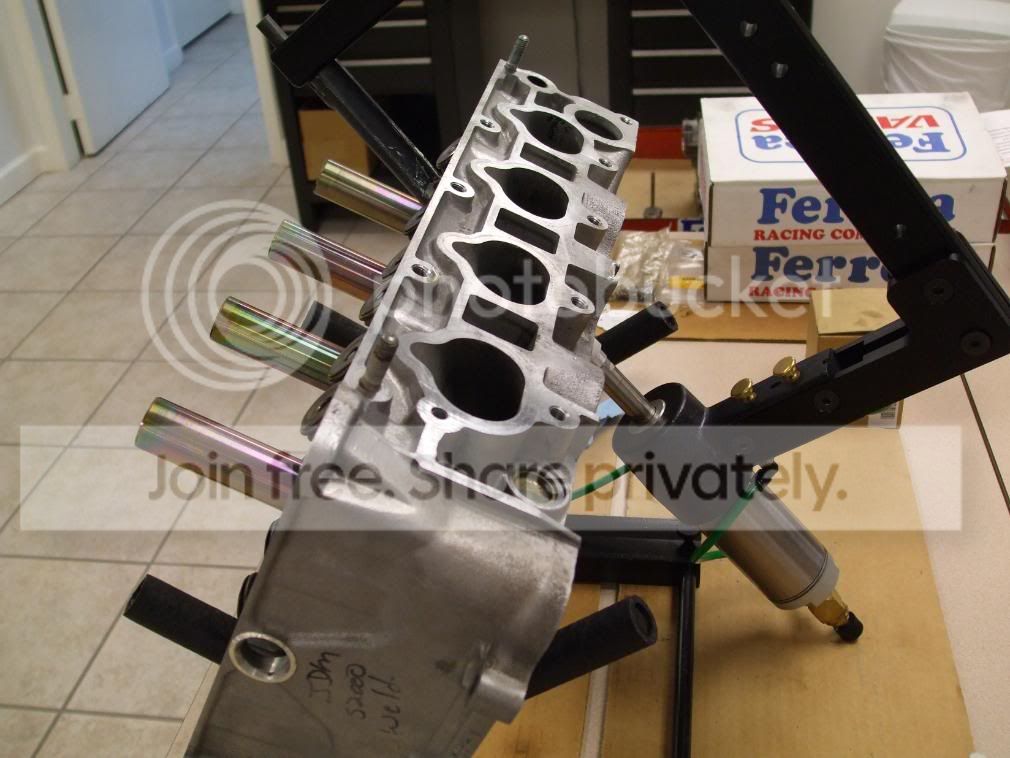
I bought a trashed head last week and finally got around to disassembling the valvetrain from it today.
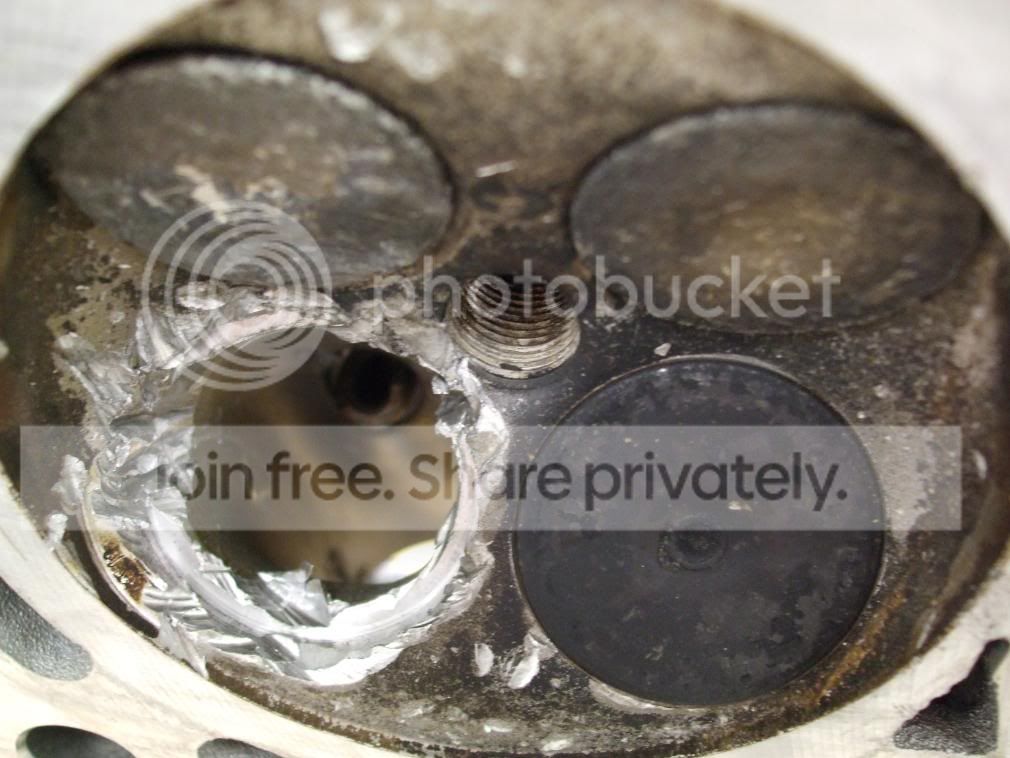
Cylinder #4 looked like this:
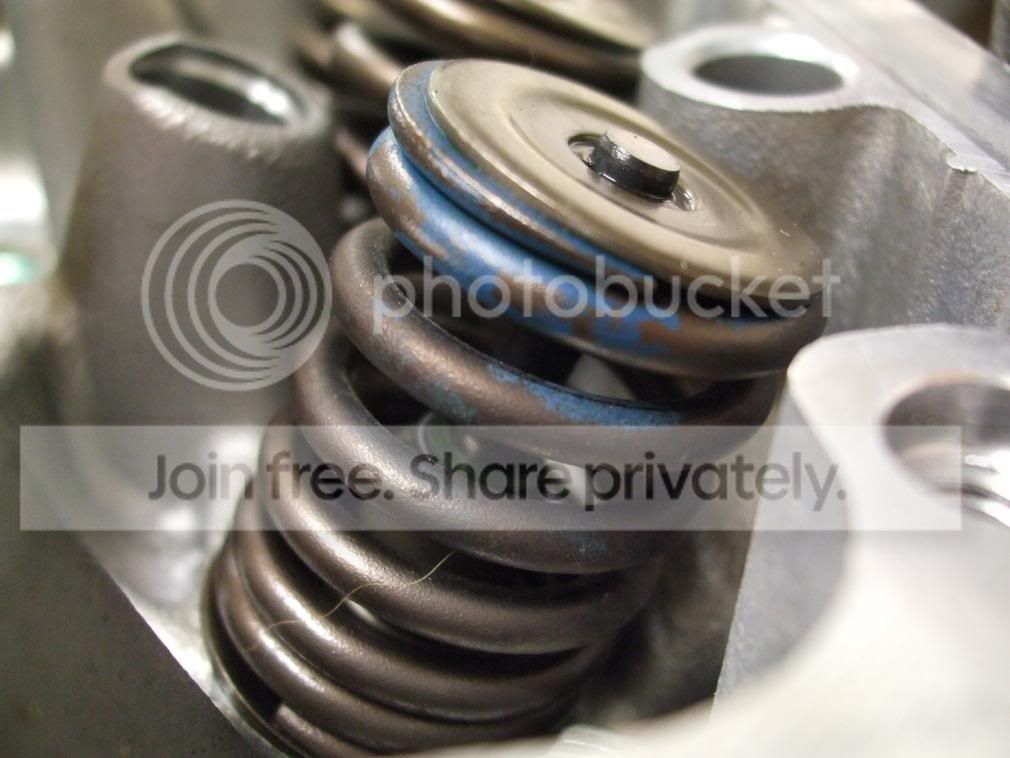
All of the exhaust side's (lighter valves) retainers had the valve stems protruding above them like this:
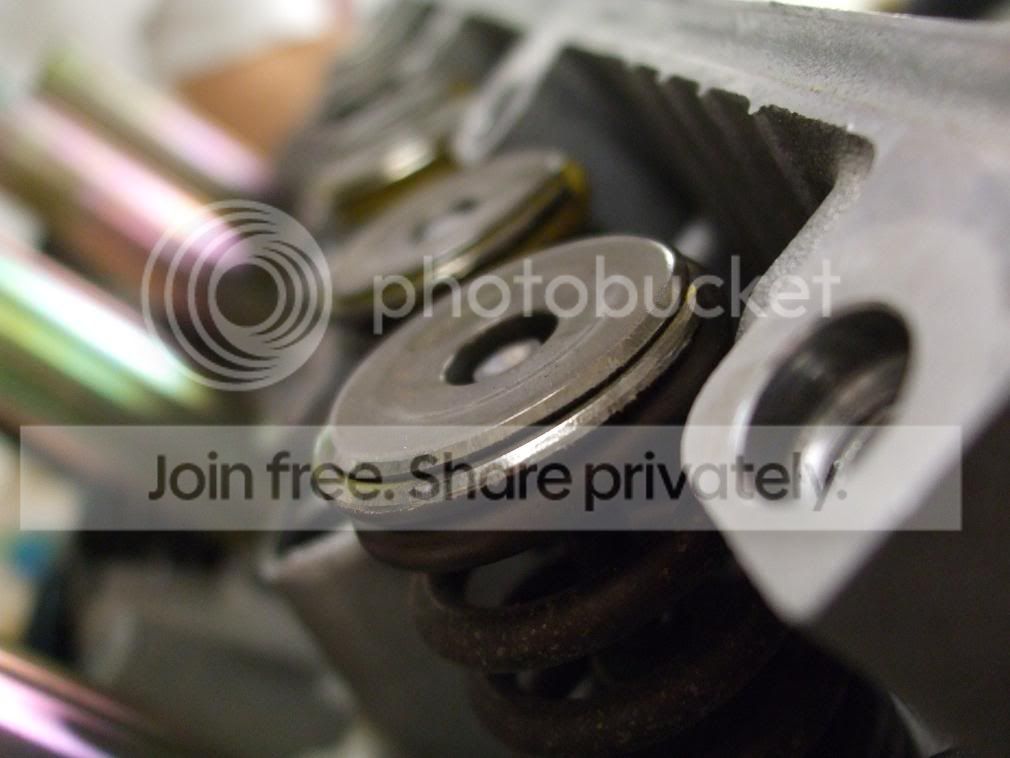
...but the intake side's (heavier valves) retainers had the valve stems receding below the retainers like this:
I always hear about people talking about the routine deal of pulling the valve cover off and looking for retainers with cracks. While some of the retainers had been making contact with the rocker arms and looked like this:
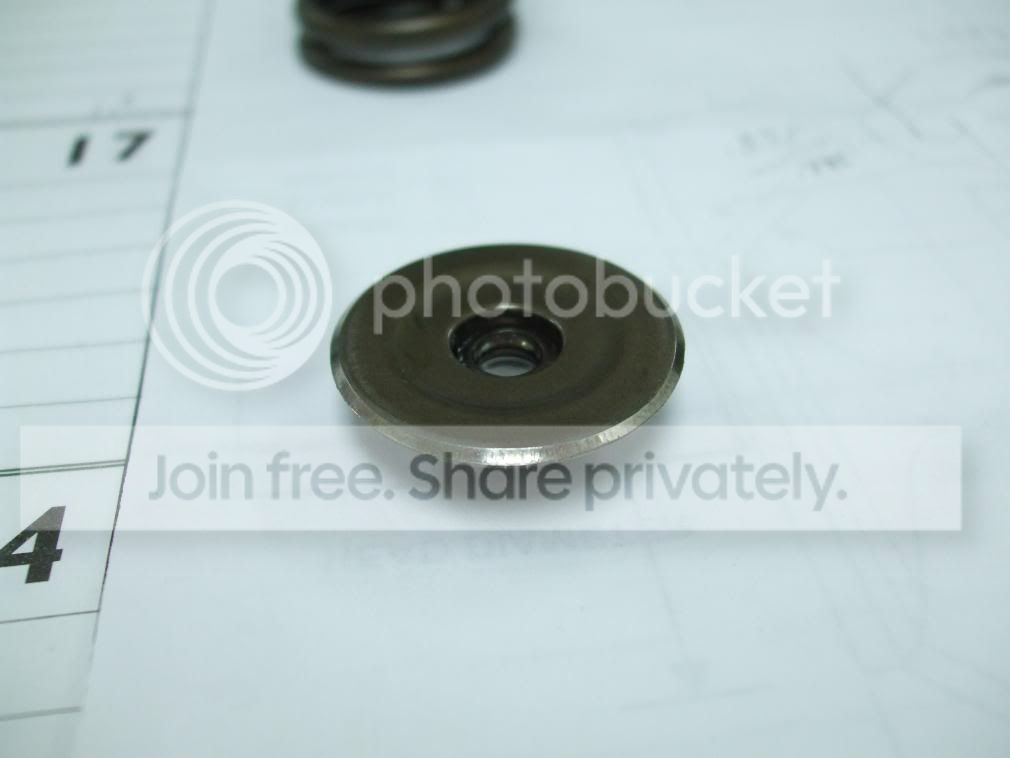
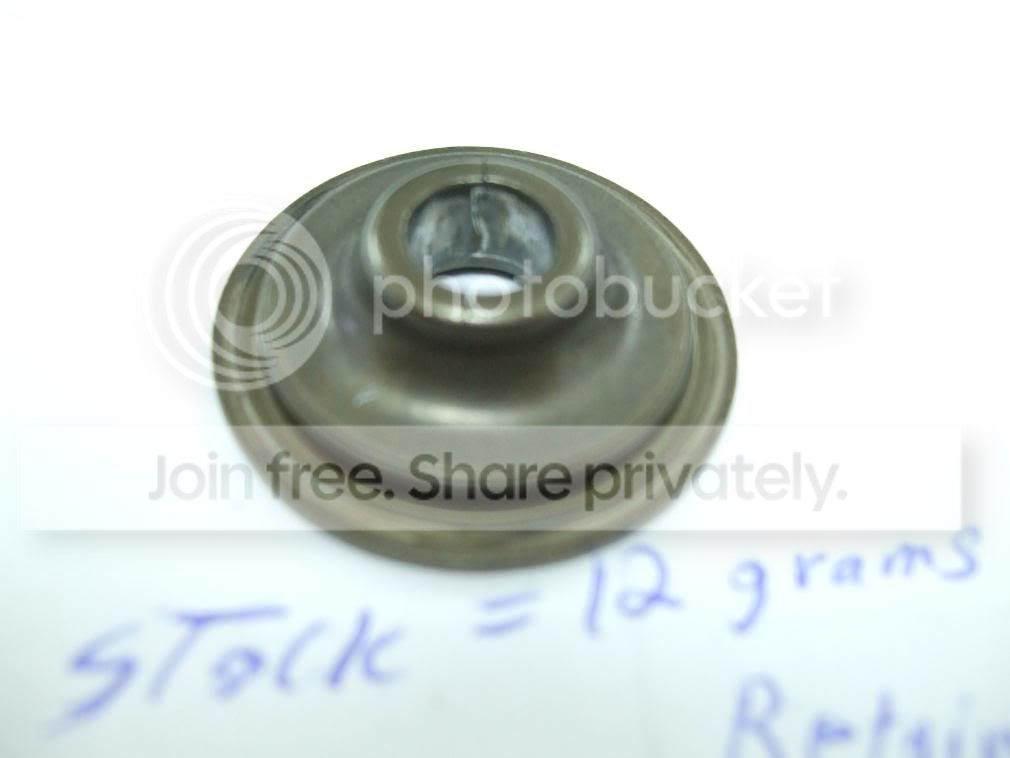
...the retainers at the rear of the engine had no markings like the one above, but like this on the underside: (sorry for being blurry)
The ones that were contacting the retainers (at the front of the engine) looked like this on the underside:
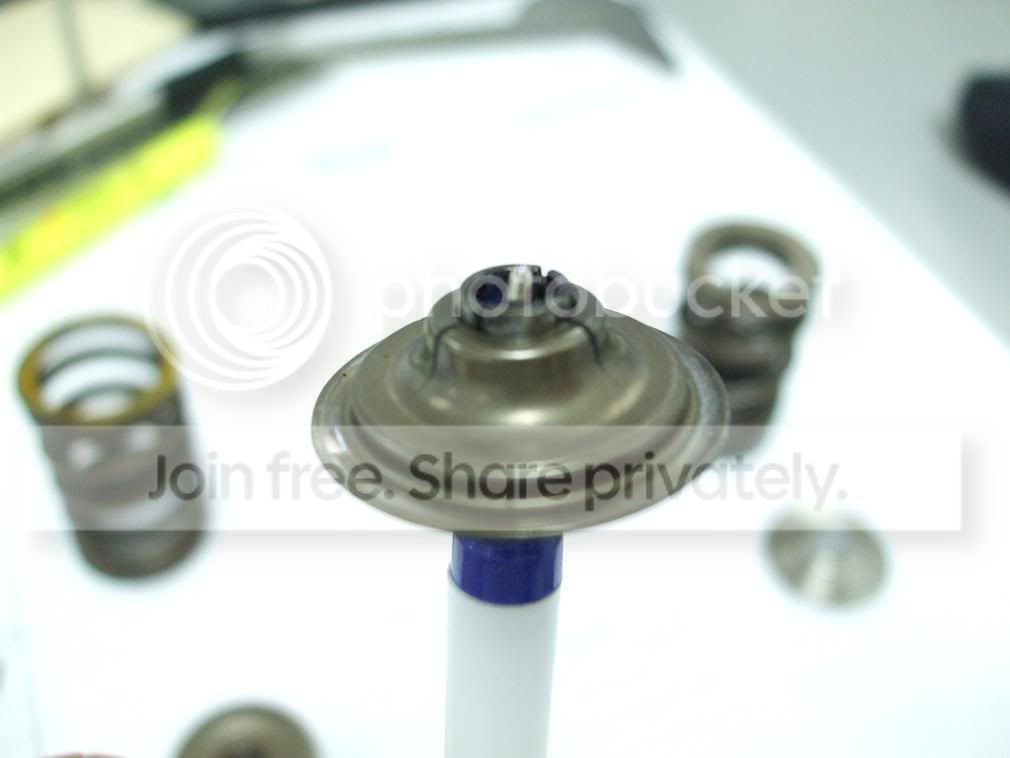
Interesting part is that the valve that dropped was situated near the retainers that had no contact with the rocker arms, but all intake retainers did have cracks and splitting starting to occur. Point being, even if you don't SEE any contact, there's a possibility that they have started cracking. The visual way to tell without removing more that the valve cover would be to look at the tips of the valves to see if they are sitting above the tops of the retainers or not. If they appear to be sucken lower than the exhaust side, or any other valve/retainer, then there may be a problem.
I bought a trashed head last week and finally got around to disassembling the valvetrain from it today.
Cylinder #4 looked like this:
All of the exhaust side's (lighter valves) retainers had the valve stems protruding above them like this:
...but the intake side's (heavier valves) retainers had the valve stems receding below the retainers like this:
I always hear about people talking about the routine deal of pulling the valve cover off and looking for retainers with cracks. While some of the retainers had been making contact with the rocker arms and looked like this:
...the retainers at the rear of the engine had no markings like the one above, but like this on the underside: (sorry for being blurry)
The ones that were contacting the retainers (at the front of the engine) looked like this on the underside:
Interesting part is that the valve that dropped was situated near the retainers that had no contact with the rocker arms, but all intake retainers did have cracks and splitting starting to occur. Point being, even if you don't SEE any contact, there's a possibility that they have started cracking. The visual way to tell without removing more that the valve cover would be to look at the tips of the valves to see if they are sitting above the tops of the retainers or not. If they appear to be sucken lower than the exhaust side, or any other valve/retainer, then there may be a problem.
FSAE
Joined: Jan 2002
Posts: 5,495
Likes: 1
From: Drinking Beer, UT
Re: Changing Titanium Retainers Every 13,000 Miles ? (Scott Howard)
<TABLE WIDTH="90%" CELLSPACING=0 CELLPADDING=0 ALIGN=CENTER><TR><TD>Quote, originally posted by KingVR »</TD></TR><TR><TD CLASS="quote">You wouldn't want a Ti spring...perhaps for material compatibility, but the Ti spring will lose it's tensile strength much faster than you could worry about anything becoming galled...and the cost would be horrendous. </TD></TR></TABLE>
Unless the Ti spring was improperly designed, you should always be operating well within the elastic range of the material, where maximum tensile strength has no play...A friend of mine who works for RCS - an aerospace spring manufacturer that also happens to provide a majority of Titanium springs to Top Fuel teams once told me - "if you can't figure out how to properly design a spring to work with the cam you have, you shouldn't be designing valvesprings."
Ask any top alcohol or top fuel drag team what type of material their valvesprings are - Titanium. Until pneumatic nitrogen systems were established a few years back, a majority of all F1 engines ran Titanium valvesprings. Granted, these are all racing teams with uber-funding and established cycle times for parts, point is they don't use steel, and they don't break, and they do last even during 5 hour races at 16,000RPM's, which if you equate that to road miles on a street car, and you can compare this to the numbers your design engineers use, will be significantly large, as in the hundreds of thousands.
But back to the actual material properties of Titanium - it is superior to steel for valvesprings, no question about it. It's natural frequency lies far outside that of steel - whereas steel you must take into consideration the natural frequency when designing the coil, otherwise you will see some very funky things happen to your valvesprings. All springs go soft, and this holds true for steel as well as titanium, many people would be surprised at what their spring rates are at after 10k miles - not what they were stock. In terms of material fatigue, the Titanium spring will last longer if designed properly.
I understand you are trying to sell a product, and to your credit, the product works well, hell I would kill for a set of B-series Ferrea roller rockers. But do yourself a favor and ask the design engineers, who design and test the product you are selling, what material would be best for spring design on a valve regardless of price.
Yes, it is silly to consider a titanium valvespring for a "ideal solution" for the galling of titanium retainers because of the cost, but it is the best solution. If you get a large production run, RCS can make B-series springs for roughly $2,500 for 16 - all single valvesprings.
As for using OEM retainers on aftermarket springs, sure it won't be as light, but you will be able to run whatever cam you want, and not have to think twice about your retainer causing troubles...although what type of retainer is in those pictures? I'm not familiar with F-series valvetrain components, but they almost look stock. That is interesting stuff nonetheless.
-Cheers
Unless the Ti spring was improperly designed, you should always be operating well within the elastic range of the material, where maximum tensile strength has no play...A friend of mine who works for RCS - an aerospace spring manufacturer that also happens to provide a majority of Titanium springs to Top Fuel teams once told me - "if you can't figure out how to properly design a spring to work with the cam you have, you shouldn't be designing valvesprings."
Ask any top alcohol or top fuel drag team what type of material their valvesprings are - Titanium. Until pneumatic nitrogen systems were established a few years back, a majority of all F1 engines ran Titanium valvesprings. Granted, these are all racing teams with uber-funding and established cycle times for parts, point is they don't use steel, and they don't break, and they do last even during 5 hour races at 16,000RPM's, which if you equate that to road miles on a street car, and you can compare this to the numbers your design engineers use, will be significantly large, as in the hundreds of thousands.
But back to the actual material properties of Titanium - it is superior to steel for valvesprings, no question about it. It's natural frequency lies far outside that of steel - whereas steel you must take into consideration the natural frequency when designing the coil, otherwise you will see some very funky things happen to your valvesprings. All springs go soft, and this holds true for steel as well as titanium, many people would be surprised at what their spring rates are at after 10k miles - not what they were stock. In terms of material fatigue, the Titanium spring will last longer if designed properly.
I understand you are trying to sell a product, and to your credit, the product works well, hell I would kill for a set of B-series Ferrea roller rockers. But do yourself a favor and ask the design engineers, who design and test the product you are selling, what material would be best for spring design on a valve regardless of price.
Yes, it is silly to consider a titanium valvespring for a "ideal solution" for the galling of titanium retainers because of the cost, but it is the best solution. If you get a large production run, RCS can make B-series springs for roughly $2,500 for 16 - all single valvesprings.
As for using OEM retainers on aftermarket springs, sure it won't be as light, but you will be able to run whatever cam you want, and not have to think twice about your retainer causing troubles...although what type of retainer is in those pictures? I'm not familiar with F-series valvetrain components, but they almost look stock. That is interesting stuff nonetheless.
-Cheers

Honda-Tech Member
Joined: Nov 2006
Posts: 270
Likes: 0
From: Fort Lauderdale, Florida, USA
Re: Changing Titanium Retainers Every 13,000 Miles ? (JG-Fabrications)
<TABLE WIDTH="90%" CELLSPACING=0 CELLPADDING=0 ALIGN=CENTER><TR><TD>Quote, originally posted by JG-Fabrications »</TD></TR><TR><TD CLASS="quote">Served 
</TD></TR></TABLE>
...actually, not at all
(some of us are getting facts to back up statements)
</TD></TR></TABLE>
...actually, not at all
(some of us are getting facts to back up statements)


Joined: May 2003
Posts: 8,884
Likes: 0
From: Intelligence plus character
Re: Changing Titanium Retainers Every 13,000 Miles ? (KingVR)
wait wait so your telling me that if i buy titanium valve springs they will never ever wear if i install them correctly and they must be Ferrea. Can i give you a blank check?
Honda-Tech Member
Joined: Nov 2006
Posts: 270
Likes: 0
From: Fort Lauderdale, Florida, USA
Re: Changing Titanium Retainers Every 13,000 Miles ? (JDM knowledge)
<TABLE WIDTH="90%" CELLSPACING=0 CELLPADDING=0 ALIGN=CENTER><TR><TD>Quote, originally posted by JDM knowledge »</TD></TR><TR><TD CLASS="quote">wait wait so your telling me that if i buy titanium valve springs they will never ever wear if i install them correctly and they must be Ferrea. Can i give you a blank check?</TD></TR></TABLE>
...yeah, for $156 per spring we better send them to Japan so that they can be certified as Kosher JDM!!
Seriously, not a single engineering has agreed to the statements about a Ti spring that "his friend" claims. Even if they are 100% correct, you've gotta consider the term "overengineering" which can be done correctly with a Steel spring...and then there's this "Ti is the ultimate...always" approach. I hope he doesn't say that Ti would be the ultimate material for an exhaust valve in a high boost application.
...yeah, for $156 per spring we better send them to Japan so that they can be certified as Kosher JDM!!
Seriously, not a single engineering has agreed to the statements about a Ti spring that "his friend" claims. Even if they are 100% correct, you've gotta consider the term "overengineering" which can be done correctly with a Steel spring...and then there's this "Ti is the ultimate...always" approach. I hope he doesn't say that Ti would be the ultimate material for an exhaust valve in a high boost application.
FSAE
Joined: Jan 2002
Posts: 5,495
Likes: 1
From: Drinking Beer, UT
Re: Changing Titanium Retainers Every 13,000 Miles ? (KingVR)
I appreciate the sarcasm, but fortunately for both of us, I do not suffer from schizophrenia and my friend is not imaginary and does indeed exist. The spring manufacturer he worked for is RCS (website). You can find a little bit of info about the Titanium they use, and a good summary about how Titanium is superior to Steel in spring use.
Once again, I have never once said that I recommend Titanium valvesprings on our cars, because the benefits are greatly outweighed by the costs. I was simply stating that using a Titanium valvespring would eliminate the galling affect of a Steel spring on a Titanium retainer more as a mere statement, not as a recommendation. After-the-fact, I commented on how a properly designed Titanium spring can be superior to a Chrome Silica Steel spring like the units Ferrea manufactures, only because you mentioned tensile strength and somehow came to the conclusion that because Titanium has an lower UTS that it was inferior.
With that said, I believe you when you say your Ferrea engineers do not agree with what I have been saying. That could be the reason why Ferrea isn't making springs and components for the military, aerospace and Formula-1.
I should remind everyone I am not trying to sell a product here either, since the product does not exist in this market. I have no reason to create falsities, certainly not for personal or monetary benefit.
Lastly, I am a Plastics and Composites Engineering major, I would much rather use a properly designed composite in almost every situation. Unfortunately a high temperature epoxy hasn't been developed yet that can withstan temperatures over 700degF, and I don't have a creative enough imagination to construct a carbon valvespring...but don't test me
To answer your question, I would opt for a Inconel exhaust valve over Titanium in any forced induction motor.
-Regards
MPH
Once again, I have never once said that I recommend Titanium valvesprings on our cars, because the benefits are greatly outweighed by the costs. I was simply stating that using a Titanium valvespring would eliminate the galling affect of a Steel spring on a Titanium retainer more as a mere statement, not as a recommendation. After-the-fact, I commented on how a properly designed Titanium spring can be superior to a Chrome Silica Steel spring like the units Ferrea manufactures, only because you mentioned tensile strength and somehow came to the conclusion that because Titanium has an lower UTS that it was inferior.
With that said, I believe you when you say your Ferrea engineers do not agree with what I have been saying. That could be the reason why Ferrea isn't making springs and components for the military, aerospace and Formula-1.
I should remind everyone I am not trying to sell a product here either, since the product does not exist in this market. I have no reason to create falsities, certainly not for personal or monetary benefit.
Lastly, I am a Plastics and Composites Engineering major, I would much rather use a properly designed composite in almost every situation. Unfortunately a high temperature epoxy hasn't been developed yet that can withstan temperatures over 700degF, and I don't have a creative enough imagination to construct a carbon valvespring...but don't test me
To answer your question, I would opt for a Inconel exhaust valve over Titanium in any forced induction motor.
-Regards
MPH
Honda-Tech Member
Joined: Nov 2006
Posts: 270
Likes: 0
From: Fort Lauderdale, Florida, USA
Re: Changing Titanium Retainers Every 13,000 Miles ? (92TypeR)
<TABLE WIDTH="90%" CELLSPACING=0 CELLPADDING=0 ALIGN=CENTER><TR><TD>Quote, originally posted by RCS's Website »</TD></TR><TR><TD CLASS="quote">
Titanium valve springs can be designed with more conservative stress parameters which makes the springs more resistant to set. Titanium is also more resistant to taking set at elevated temperatures. These properties yield a spring that won’t loose its seat pressure a quickly as steel springs.
Titanium springs are not “forever”, Titanium does not exhibit the same “infinite life” characteristic that carbon steel provide at low stress numbers. However for high performance-limited life applications such as racing, where the springs are replaced regularly titanium simply can’t be beat.
The titanium valve springs are also a better value. Although they cost more than the steel valve springs they will last 5 to 7 times longer. The steel springs will begin to take set during the burnout. Whereas the RCS titanium springs will last between 10 and 20 runs.
</TD></TR></TABLE>
I'm curious as to why the 3rd paragraph contradicts the second paragraph. What is their definition of "SET"? Is it referring the drop in spring tension after installation when they settle in? If that's the case, then keep in mind that all springs are not created equal. They are not made from the same materials, receive the same number and duration of heat treatments, or receive the same micro-polishing.
Our import springs generally do not lose more than 5 pounds of pressure, even after multiple seasons of racing. If losing 5 pounds after a burnout, vs 10 - 20 runs with the Ti spring, I think most people would be satisfied with the cost savings. For the unlimited-budget that can afford the Ti springs...more power to them. We've found a way to design our product so that it does not wear the Ti retainer and require a Ti spring to be used.
Titanium valve springs can be designed with more conservative stress parameters which makes the springs more resistant to set. Titanium is also more resistant to taking set at elevated temperatures. These properties yield a spring that won’t loose its seat pressure a quickly as steel springs.
Titanium springs are not “forever”, Titanium does not exhibit the same “infinite life” characteristic that carbon steel provide at low stress numbers. However for high performance-limited life applications such as racing, where the springs are replaced regularly titanium simply can’t be beat.
The titanium valve springs are also a better value. Although they cost more than the steel valve springs they will last 5 to 7 times longer. The steel springs will begin to take set during the burnout. Whereas the RCS titanium springs will last between 10 and 20 runs.
</TD></TR></TABLE>
I'm curious as to why the 3rd paragraph contradicts the second paragraph. What is their definition of "SET"? Is it referring the drop in spring tension after installation when they settle in? If that's the case, then keep in mind that all springs are not created equal. They are not made from the same materials, receive the same number and duration of heat treatments, or receive the same micro-polishing.
Our import springs generally do not lose more than 5 pounds of pressure, even after multiple seasons of racing. If losing 5 pounds after a burnout, vs 10 - 20 runs with the Ti spring, I think most people would be satisfied with the cost savings. For the unlimited-budget that can afford the Ti springs...more power to them. We've found a way to design our product so that it does not wear the Ti retainer and require a Ti spring to be used.

Joined: Oct 2007
Posts: 1
Likes: 0
From: Fort Lauderdale, FL, US
Re: Changing Titanium Retainers Every 13,000 Miles ? (KingVR)
Keep in mind also, that not all titanium alloys are the same when it comes to resisting heat, fatigue, friction, ..etc, etc. I know for a fact that Ferrea takes pride in using only USA Military Spec titanium alloys, I can't say the same about all the other knock offs out there especially for ti retainers. Ferrea specifically chooses the correct titanium alloy for each individual application.
Numerous design parameters need to be addressed before going into manufacturing a titanium retainer. Valvetrain stresses, flex, vibrations, loads, and application usage.
I have had my Ferrea Audi 1.8T valvetrain setup for 30,000 miles now and I periodically check on them, because I am ****, I'll admit it. But wouldn't you be too if you shook thousands on a motor. No problems with wear, grant its a bucket tappet motor, and the S2000 are rockers, if the fitment is correct between spring and retainers, there should be no problems.
Numerous design parameters need to be addressed before going into manufacturing a titanium retainer. Valvetrain stresses, flex, vibrations, loads, and application usage.
I have had my Ferrea Audi 1.8T valvetrain setup for 30,000 miles now and I periodically check on them, because I am ****, I'll admit it. But wouldn't you be too if you shook thousands on a motor. No problems with wear, grant its a bucket tappet motor, and the S2000 are rockers, if the fitment is correct between spring and retainers, there should be no problems.