


Valve Stem Oil Seals


Thread Starter
Joined: Sep 2007
Posts: 62
Likes: 0
 Valve Stem Oil Seals
Guys,
A future job will be to change the valve stem oil seals on my VTEC. Has anyone done this with the head in-situ?
1) Can you use compressed air to keep the valves up while you remove the springs etc?
2) Is there a special tool to remove the valve collets when you have no acess to the underside of the head?
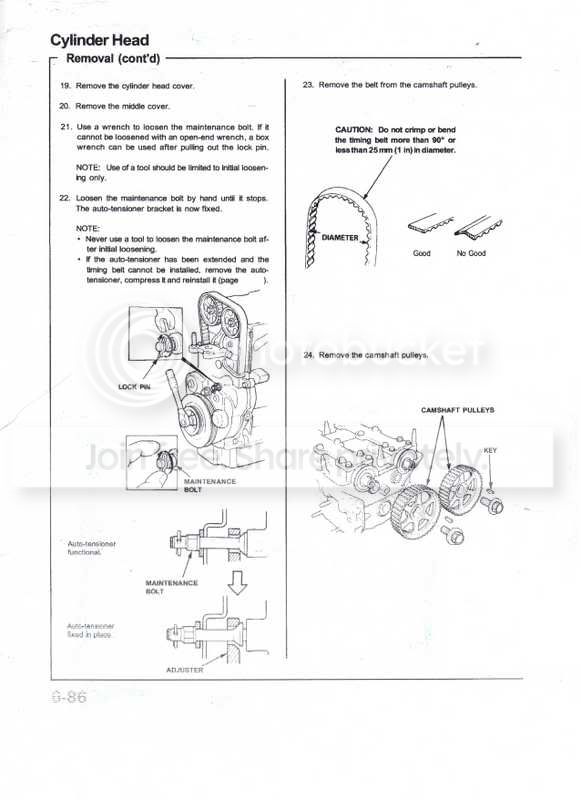
3) is it possible to remove the cams (by removeing the pulleys) *without* removing the timing belt ie if you release belt tension, is there enough clearance in the front cover to move the pulleys forward to clear the cam ends?
Thanks a lot,
Garth.
A future job will be to change the valve stem oil seals on my VTEC. Has anyone done this with the head in-situ?
1) Can you use compressed air to keep the valves up while you remove the springs etc?
2) Is there a special tool to remove the valve collets when you have no acess to the underside of the head?
3) is it possible to remove the cams (by removeing the pulleys) *without* removing the timing belt ie if you release belt tension, is there enough clearance in the front cover to move the pulleys forward to clear the cam ends?
Thanks a lot,
Garth.

Honda-Tech Member
Joined: Jun 2005
Posts: 2,294
Likes: 3
From: Tachikawa Shi, Tokyo, Japan
Re: Valve Stem Oil Seals (dr_g)
zip tie the belt to the cams and remove as you are thinking. Use bungie cords to pull upward on the gears to keep tension on the belt so as to not loose timing down at the crank shaft, run the bungie cords up to the hood. There is a special tool to push down on the collets after the cams are removed but that may be an uneeded expense, compressed air should work. You can as a back up, put the cams back in temperarily and rotate each affected piston to TDC after inserting a length of rope into the cylinder to push up on the valves as you rotate the piston upwards, this will of course require more zip ties bit gives added insurance, this method is used without compressed air and takes a little more time.
I worked at a shop with the special tool and did a seal job with compressed air, no problems, there are other cheaper valve spring compressors that leave access to the two keepers, a small magnet may be nice too.
I worked at a shop with the special tool and did a seal job with compressed air, no problems, there are other cheaper valve spring compressors that leave access to the two keepers, a small magnet may be nice too.
Thread Starter
Joined: Sep 2007
Posts: 62
Likes: 0
Re: Valve Stem Oil Seals (Duane_in_Japan)
Thanks for that - first job though is to change the cambelt (see other thread!). We just cannot shift the crank bolt with air guns, levers or whatever. I am going to make a large hexagon tool this afternoon. I am crapping myself about snapping the bolt. I am assuming it is covered end to end with Loctite which is what is giving me the problem.
Cheers,
Garth.
Cheers,
Garth.

Honda-Tech Member
Joined: Dec 2003
Posts: 2,336
Likes: 1
From: DFW Area, TX
The crank bolts are generally not coated in Loctite. The torque spec is 181 ft*lbs on an H22, so they are quite difficult to get off. Usually around 600 ft*lbs of torque or so.
If you're changing the timing belt already, you don't need to worry about zip tie-ing the cam gears to the timing belt. Just remove the belt and cams to get to the valve retainers. You'll have to remove the rocker assemblies as well. Mark them so they go back exactly where they came from.
There is a guy on eBay that makes some very nice valve spring compressors that would work quite well with the head on the car. Just use compressed air to hold the valves in place. I'd put each piston at BDC, then pressurize the combustion chamber, and you'll be set (unless your valves leak quite a bit).
If you're changing the timing belt already, you don't need to worry about zip tie-ing the cam gears to the timing belt. Just remove the belt and cams to get to the valve retainers. You'll have to remove the rocker assemblies as well. Mark them so they go back exactly where they came from.
There is a guy on eBay that makes some very nice valve spring compressors that would work quite well with the head on the car. Just use compressed air to hold the valves in place. I'd put each piston at BDC, then pressurize the combustion chamber, and you'll be set (unless your valves leak quite a bit).
Honda-Tech Member
Joined: Jun 2005
Posts: 2,294
Likes: 3
From: Tachikawa Shi, Tokyo, Japan
Re: (117)
UNLESS THE VALVES LEAK QUITE A BIT, all the more reason to use a back up plan, putting the pistons at BDC is just giving the valve a better chance to fall all the way out and then you are screwed.
TDC, keep the engine crank pulley from turning and use the rope method if you have any real trust issues and again, keep the crank pulley from turning.
TDC, keep the engine crank pulley from turning and use the rope method if you have any real trust issues and again, keep the crank pulley from turning.
Honda-Tech Member
Joined: Jun 2005
Posts: 2,294
Likes: 3
From: Tachikawa Shi, Tokyo, Japan
Re: (Duane_in_Japan)
I received a couple of posts but dont see them here on the forum, **** happens and this guy does not want it to happen to him and he also does not want to pull the head, this is not the right way to do this job or they would not have invented procedures to do this job without pulling the head.
If the valve falls down even half way, the valve does not fall straight down, the piston moves straight up so there is a chance for a binding action if you use the piston to push the valve back up which may bend the valve, I dont know, never dropped a valve because I used rope and good spring compressors that were small and strong OR I used air in the cylinder and an expensive tool for doing the job the right way but I was very careful and didnt push too hard.
I did mention holding the crank from turning, why didnt this guys post show up yet but I got it twice in my box. If the crank does turn from compressed air it is not going to hurt anything unless your partner is trying to hold the crank by hand, not a good method.
QUOTE
The following reply was posted by 117:
I've never seen a valve fall all the way through the guide by itself, even without anything pressing it against the valve seat, have
you? If you're not paying enough attention and allow a valve to drop all the way down into the engine, you should have done the GD
job right in the first place. Sheesh.
If you're going to put the engine at TDC and pressurize the combustion chamber, you better make sure you don't allow the crank to
move because if it does, it'll move with a fair bit of force. That's more of an issue than the valve falling into the head, IMO.
If you really have trust issues, do the job right and don't halfass it.
If the valve falls down even half way, the valve does not fall straight down, the piston moves straight up so there is a chance for a binding action if you use the piston to push the valve back up which may bend the valve, I dont know, never dropped a valve because I used rope and good spring compressors that were small and strong OR I used air in the cylinder and an expensive tool for doing the job the right way but I was very careful and didnt push too hard.
I did mention holding the crank from turning, why didnt this guys post show up yet but I got it twice in my box. If the crank does turn from compressed air it is not going to hurt anything unless your partner is trying to hold the crank by hand, not a good method.
QUOTE
The following reply was posted by 117:
I've never seen a valve fall all the way through the guide by itself, even without anything pressing it against the valve seat, have
you? If you're not paying enough attention and allow a valve to drop all the way down into the engine, you should have done the GD
job right in the first place. Sheesh.
If you're going to put the engine at TDC and pressurize the combustion chamber, you better make sure you don't allow the crank to
move because if it does, it'll move with a fair bit of force. That's more of an issue than the valve falling into the head, IMO.
If you really have trust issues, do the job right and don't halfass it.
Honda-Tech Member
Joined: Dec 2003
Posts: 2,336
Likes: 1
From: DFW Area, TX
You're the type that must always have the last word aren't you? There's a reason why I deleted my post. Can you not leave well enough alone? You remind me why I stopped posting on here awhile back.
If you do the job right, there won't be any issues like valves dropping into the GD engine. I don't even know why people bother doing such half *** work... I've built enough engines that I know what I'm doing, thanks.
If you do the job right, there won't be any issues like valves dropping into the GD engine. I don't even know why people bother doing such half *** work... I've built enough engines that I know what I'm doing, thanks.
Trending Topics
Honda-Tech Member
Joined: Jun 2005
Posts: 2,294
Likes: 3
From: Tachikawa Shi, Tokyo, Japan
Re: (117)
A future job will be to change the valve stem oil seals on my VTEC. Has anyone done this with the head in-situ?
The guy asked for help to do the job this way, whats wrong with giving as much help as possible, your remarks made even more info possible through reasoning so go ahead and have the last word now, I wont help anymore on this thread. BUT I am not the type to not help just because I will see your (117) in there, if you want to stop posting again, then no one will miss you. I have changed a few seals this way with no problems, the tool was bought to do the job on a M Benz so that customer paid for the tool kit, not the shop.
The guy asked for help to do the job this way, whats wrong with giving as much help as possible, your remarks made even more info possible through reasoning so go ahead and have the last word now, I wont help anymore on this thread. BUT I am not the type to not help just because I will see your (117) in there, if you want to stop posting again, then no one will miss you. I have changed a few seals this way with no problems, the tool was bought to do the job on a M Benz so that customer paid for the tool kit, not the shop.


Honda-Tech Member
Joined: Oct 2003
Posts: 6,619
Likes: 0
From: Chicago
Re: (117)
<TABLE WIDTH="90%" CELLSPACING=0 CELLPADDING=0 ALIGN=CENTER><TR><TD>Quote, originally posted by 117 »</TD></TR><TR><TD CLASS="quote"> You'll have to remove the rocker assemblies as well. Mark them so they go back exactly where they came from.
</TD></TR></TABLE>
Why do you need to do this? Can't you just push them up and out of the way?
</TD></TR></TABLE>
Why do you need to do this? Can't you just push them up and out of the way?
Thread Starter
Joined: Sep 2007
Posts: 62
Likes: 0
Come on guys I don't want to start a big fight here!
I know there's both a right way and a quick way to do engine work. I have rebuilt engines before, as well as two complete cars. I stripped the head off my old 2.3 Prelude to change the gasket (and it turned out the head was cracked nearly in half!), so I know what's involved in taking the head off a Prelude - I don't really want to invest that much time on this car - it simply isn't worth it.
If the replies I'd got were along the lines of 'don't even try it', then I would leave the stem seals alone and put up with a bit of oil consumption. As it is, I might try the compressed air trick, and IF it fails, then oh well, off comes the head. Pain in the ****, but no major problem.
What do I have to lose by trying a quick way of doing a job on a 14 year old £500 car? Seems to me there is nothing to lose. If it were my MG or my E-Type Jag, then the head would come off, no question.
Regards,
Garth.
I know there's both a right way and a quick way to do engine work. I have rebuilt engines before, as well as two complete cars. I stripped the head off my old 2.3 Prelude to change the gasket (and it turned out the head was cracked nearly in half!), so I know what's involved in taking the head off a Prelude - I don't really want to invest that much time on this car - it simply isn't worth it.
If the replies I'd got were along the lines of 'don't even try it', then I would leave the stem seals alone and put up with a bit of oil consumption. As it is, I might try the compressed air trick, and IF it fails, then oh well, off comes the head. Pain in the ****, but no major problem.
What do I have to lose by trying a quick way of doing a job on a 14 year old £500 car? Seems to me there is nothing to lose. If it were my MG or my E-Type Jag, then the head would come off, no question.
Regards,
Garth.
Honda-Tech Member
Joined: Dec 2003
Posts: 2,336
Likes: 1
From: DFW Area, TX
I really wish I could be there to see how you're going to get the seals off the guides without damaging the valve stems. Perhaps the Goodson type slide hammer seal puller fits with the valves in place (although I hear the Goodson valve seal remover doesn't work very well on Honda valve seals)?
Honda-Tech Member
Joined: Dec 2003
Posts: 2,336
Likes: 1
From: DFW Area, TX
Re: (vinuneuro)
Do you know how much the valve stems stick out of the guides when the valve is sitting on the valve seat? Have you removed valve seals with vice grips on an H22 head? 
<TABLE WIDTH="90%" CELLSPACING=0 CELLPADDING=0 ALIGN=CENTER><TR><TD>Quote, originally posted by vinuneuro »</TD></TR><TR><TD CLASS="quote">Why would the valve stems get damaged? Use locking pliers and you'll only be in contact with the seal.</TD></TR></TABLE>
<TABLE WIDTH="90%" CELLSPACING=0 CELLPADDING=0 ALIGN=CENTER><TR><TD>Quote, originally posted by vinuneuro »</TD></TR><TR><TD CLASS="quote">Why would the valve stems get damaged? Use locking pliers and you'll only be in contact with the seal.</TD></TR></TABLE>

moderator emeritus
Joined: Oct 2002
Posts: 16,357
Likes: 6
From: Cantonment, FL
Re: (Duane_in_Japan)
<TABLE WIDTH="90%" CELLSPACING=0 CELLPADDING=0 ALIGN=CENTER><TR><TD>Quote, originally posted by Duane_in_Japan »</TD></TR><TR><TD CLASS="quote"> if you want to stop posting again, then no one will miss you. </TD></TR></TABLE>
ummm....
you should really do your research before calling people out who have contributed to this forum ore than most.
He is an asset.
so yeah. shut up. thanks

ummm....
you should really do your research before calling people out who have contributed to this forum ore than most.
He is an asset.
so yeah. shut up. thanks
Honda-Tech Member
Joined: Oct 2003
Posts: 6,619
Likes: 0
From: Chicago
Re: (117)
<TABLE WIDTH="90%" CELLSPACING=0 CELLPADDING=0 ALIGN=CENTER><TR><TD>Quote, originally posted by 117 »</TD></TR><TR><TD CLASS="quote">Do you know how much the valve stems stick out of the guides when the valve is sitting on the valve seat? Have you removed valve seals with vice grips on an H22 head?
</TD></TR></TABLE>
I just did last weekend. I used the pliers to grab on to the seals. As soon as one was free from the guide, I took it out by hand.
</TD></TR></TABLE>
I just did last weekend. I used the pliers to grab on to the seals. As soon as one was free from the guide, I took it out by hand.
Thread Starter
Joined: Sep 2007
Posts: 62
Likes: 0
Guys,
O.K. "you'd like to be there to see how I'm going to do it...."
No, no, no! This is why I'm asking for advice! If the advice from someone who's been there and tried it and failed is "don't do it" then I won't do it until either a) the oil consumption becomes intolerable or, b) I have time to remove the head.
This was not intended to be a challenge, just a question!
Regards,
Garth.
O.K. "you'd like to be there to see how I'm going to do it...."
No, no, no! This is why I'm asking for advice! If the advice from someone who's been there and tried it and failed is "don't do it" then I won't do it until either a) the oil consumption becomes intolerable or, b) I have time to remove the head.
This was not intended to be a challenge, just a question!
Regards,
Garth.

Honda-Tech Member
Joined: Feb 2002
Posts: 2,072
Likes: 0
From: land of the sheep, home of the hypocrite
Honda-Tech Member
Joined: Dec 2003
Posts: 2,336
Likes: 1
From: DFW Area, TX
Re: (vinuneuro)
You did this with the valves in the head? Can you post a picture of the pliers you used? I usually use long skinny vice grips, and I usually have to really work on them to get them off. I couldn't imagine doing it with the valve stem sticking up out of the guide. I'd be too concerned with nicking the stem, damaging the tip, or even bending the stem if I get too aggressive with the pliers.
<TABLE WIDTH="90%" CELLSPACING=0 CELLPADDING=0 ALIGN=CENTER><TR><TD>Quote, originally posted by vinuneuro »</TD></TR><TR><TD CLASS="quote">I just did last weekend. I used the pliers to grab on to the seals. As soon as one was free from the guide, I took it out by hand.</TD></TR></TABLE>
The comment wasn't directed at you. I was just giving vinuneuro a hard time.
<TABLE WIDTH="90%" CELLSPACING=0 CELLPADDING=0 ALIGN=CENTER><TR><TD>Quote, originally posted by dr_g »</TD></TR><TR><TD CLASS="quote">No, no, no! This is why I'm asking for advice! If the advice from someone who's been there and tried it and failed is "don't do it" then I won't do it until either a) the oil consumption becomes intolerable or, b) I have time to remove the head. </TD></TR></TABLE>
<TABLE WIDTH="90%" CELLSPACING=0 CELLPADDING=0 ALIGN=CENTER><TR><TD>Quote, originally posted by vinuneuro »</TD></TR><TR><TD CLASS="quote">I just did last weekend. I used the pliers to grab on to the seals. As soon as one was free from the guide, I took it out by hand.</TD></TR></TABLE>
The comment wasn't directed at you.
I was just giving vinuneuro a hard time. <TABLE WIDTH="90%" CELLSPACING=0 CELLPADDING=0 ALIGN=CENTER><TR><TD>Quote, originally posted by dr_g »</TD></TR><TR><TD CLASS="quote">No, no, no! This is why I'm asking for advice! If the advice from someone who's been there and tried it and failed is "don't do it" then I won't do it until either a) the oil consumption becomes intolerable or, b) I have time to remove the head. </TD></TR></TABLE>
Honda-Tech Member
Joined: Oct 2003
Posts: 6,619
Likes: 0
From: Chicago
Re: (117)
<TABLE WIDTH="90%" CELLSPACING=0 CELLPADDING=0 ALIGN=CENTER><TR><TD>Quote, originally posted by 117 »</TD></TR><TR><TD CLASS="quote">You did this with the valves in the head? Can you post a picture of the pliers you used? I usually use long skinny vice grips, and I usually have to really work on them to get them off. I couldn't imagine doing it with the valve stem sticking up out of the guide. I'd be too concerned with nicking the stem, damaging the tip, or even bending the stem if I get too aggressive with the pliers.
The comment wasn't directed at you. I was just giving vinuneuro a hard time.
</TD></TR></TABLE>
Yes, the head was in the car. Heating them makes life much easier. After the springs are out, it takes less than a minute to heat the seal a little and remove it. Imo, using locking pliers is what prevents any damage to the valve stem. I used the one on the left.

The comment wasn't directed at you.
I was just giving vinuneuro a hard time. </TD></TR></TABLE>
Yes, the head was in the car. Heating them makes life much easier. After the springs are out, it takes less than a minute to heat the seal a little and remove it. Imo, using locking pliers is what prevents any damage to the valve stem. I used the one on the left.

Honda-Tech Member
Joined: Dec 2004
Posts: 2,801
Likes: 1
From: Drexel Hill, Pa, 19026
Re: (117)
<TABLE WIDTH="90%" CELLSPACING=0 CELLPADDING=0 ALIGN=CENTER><TR><TD>Quote, originally posted by 117 »</TD></TR><TR><TD CLASS="quote">Yep, that's what I use. Very interesting. I need to try the heating trick.</TD></TR></TABLE>
Yes ive tried with the snap on pliers before without heating them and damm they didnt want to move. Once i used the heat gun on them they came off much much easier.
Yes ive tried with the snap on pliers before without heating them and damm they didnt want to move. Once i used the heat gun on them they came off much much easier.

Honda-Tech Member
Joined: Mar 2004
Posts: 15,050
Likes: 3
Re: (117)
<TABLE WIDTH="90%" CELLSPACING=0 CELLPADDING=0 ALIGN=CENTER><TR><TD>Quote, originally posted by 117 »</TD></TR><TR><TD CLASS="quote">You'll have to remove the rocker assemblies as well. </TD></TR></TABLE>
In my experience, you can just flip them upward and leave them all in place. That gave me enough room.
<TABLE WIDTH="90%" CELLSPACING=0 CELLPADDING=0 ALIGN=CENTER><TR><TD>Quote, originally posted by 117 »</TD></TR><TR><TD CLASS="quote">If you do the job right, there won't be any issues like valves dropping into the GD engine. I don't even know why people bother doing such half *** work... I've built enough engines that I know what I'm doing, thanks.</TD></TR></TABLE>
I agree, the rope method sucks. I've never had a problem with compressed air once.
If you simply take a socket (bigger than the keeper hole) and tap the top of the retainer before you try to compress the spring, it will knock the valve loose from the retainer, and everything will come right out.
FYI, when putting everything back in, I recommend taking a center punch and tapping the valve stems after the keepers are back in, to make sure everything seated correctly
In my experience, you can just flip them upward and leave them all in place. That gave me enough room.
<TABLE WIDTH="90%" CELLSPACING=0 CELLPADDING=0 ALIGN=CENTER><TR><TD>Quote, originally posted by 117 »</TD></TR><TR><TD CLASS="quote">If you do the job right, there won't be any issues like valves dropping into the GD engine. I don't even know why people bother doing such half *** work... I've built enough engines that I know what I'm doing, thanks.</TD></TR></TABLE>
I agree, the rope method sucks. I've never had a problem with compressed air once.
If you simply take a socket (bigger than the keeper hole) and tap the top of the retainer before you try to compress the spring, it will knock the valve loose from the retainer, and everything will come right out.
FYI, when putting everything back in, I recommend taking a center punch and tapping the valve stems after the keepers are back in, to make sure everything seated correctly