


Trim... 50, 57, 60, etc... is this a reference to wheel trim?


Thread Starter
Honda-Tech Member
Joined: Jun 2002
Posts: 5,551
Likes: 1
From: USA
 Trim... 50, 57, 60, etc... is this a reference to wheel trim, correct?
Ok so maybe I am confused but I dont understand what all this new nonsense of using what I have asumed is a single wheel trim size as the only description of a turbocharger for identification... example... people say, "I have a 57 trim."
The srt4 guys and the dsm crowd always used this kind of reference but I am seeing it catch on here and it has me confused slightly as to why it is so popular to describe a unit with just a single trim number.
So it is a reference to wheel trim, correct? specifically, the compressor wheel? are we not forgeting the trim of the exhaust wheel then?
As I understand it trim is a term to express the relationship between the inducer and exducer of both turbine and compressor wheels. More accurately, it is an area ratio really. I understand that the trim of a wheel (compressor or turbine) affect performance by changing airflow capacity. The slight problem with this is though is that there are other factors to consider that are not included in just saying, "I have a XX trim."
I understand that generally speaking, if all other factors are held constant than the higher trim wheel will outflow the smaller trim wheel... but all the factors are not a constant in the majority of situations. Also a single trim description does not tell the total story to me that it seems it does others. You say XX trim to me and thats useful but I still need to know more, am I mistaken? Could it not be quite a few different units and yet still be a 50, 57, 60, etc. trim compressor wheel?
Modified by twkdCD595 at 11:55 AM 8/2/2007
The srt4 guys and the dsm crowd always used this kind of reference but I am seeing it catch on here and it has me confused slightly as to why it is so popular to describe a unit with just a single trim number.
So it is a reference to wheel trim, correct? specifically, the compressor wheel? are we not forgeting the trim of the exhaust wheel then?
As I understand it trim is a term to express the relationship between the inducer and exducer of both turbine and compressor wheels. More accurately, it is an area ratio really. I understand that the trim of a wheel (compressor or turbine) affect performance by changing airflow capacity. The slight problem with this is though is that there are other factors to consider that are not included in just saying, "I have a XX trim."
I understand that generally speaking, if all other factors are held constant than the higher trim wheel will outflow the smaller trim wheel... but all the factors are not a constant in the majority of situations. Also a single trim description does not tell the total story to me that it seems it does others. You say XX trim to me and thats useful but I still need to know more, am I mistaken? Could it not be quite a few different units and yet still be a 50, 57, 60, etc. trim compressor wheel?
Modified by twkdCD595 at 11:55 AM 8/2/2007

Honda-Tech Member
iTrader: (1)
Joined: Mar 2003
Posts: 3,215
Likes: 3
From: I drink Seafoam and poo into catch cans, USA
Re: Trim... 50, 57, 60, etc... is this a reference to wheel trim, correct? (twkdCD595)
Usually the exhaust wheel is measured in a stage.
For example, I had a t3/t4 57 trim .60/.48 ar's. The exhaust wheel was a stage 3.
When I bought a different exhaust housing, the stage 3 was the important part to get right. (i believe you measure the exhaust wheel and that equates to a certian trim.)
For example, I had a t3/t4 57 trim .60/.48 ar's. The exhaust wheel was a stage 3.
When I bought a different exhaust housing, the stage 3 was the important part to get right. (i believe you measure the exhaust wheel and that equates to a certian trim.)

Member
Joined: Apr 2002
Posts: 1,029
Likes: 0
From: Dallas, Tx, USA
Re: Trim... 50, 57, 60, etc... is this a reference to wheel trim, correct? (mike1114)
this confuses me too. because i hear trim and then hear a/r. is trim a word that has basically become slang for a/r? like i have a 60 trim. is proper termonology .60 a/r?
i've always kinda assumed the srt4 guys phrase it like that cause they have a more narrow list of turbos they use maybe? and so they just say the 60 or the 57 etc...
remeber they only have one engine that they use. and so they dont have to choose from 1300 different "trims".
they prob have more like 5. but i am DSM ignorant too.
i've always kinda assumed the srt4 guys phrase it like that cause they have a more narrow list of turbos they use maybe? and so they just say the 60 or the 57 etc...
remeber they only have one engine that they use. and so they dont have to choose from 1300 different "trims".
they prob have more like 5. but i am DSM ignorant too.
Thread Starter
Honda-Tech Member
Joined: Jun 2002
Posts: 5,551
Likes: 1
From: USA
Re: Trim... 50, 57, 60, etc... is this a reference to wheel trim, correct? (mike1114)
<TABLE WIDTH="90%" CELLSPACING=0 CELLPADDING=0 ALIGN=CENTER><TR><TD>Quote, originally posted by mike1114 »</TD></TR><TR><TD CLASS="quote">Usually the exhaust wheel is measured in a stage.
For example, I had a t3/t4 57 trim .60/.48 ar's. The exhaust wheel was a stage 3.
When I bought a different exhaust housing, the stage 3 was the important part to get right. (i believe you measure the exhaust wheel and that equates to a certian trim.)</TD></TR></TABLE>
This does not address my questions but it does provoke some other interesting thoughts.
First off let me say I do appreciate the responce so dont get me wrong or anything (thank you), but it does not explain why people suddenly insist on saying they simply have a "50 trim", "57 trim", etc as if thats an adaquet description to identify a tubocharger (which what I am getting at here is, I dont think it is)?
Also just for **** and grins I will add that I measure an exhaust wheel in mm of the inducer/ exducer diameter, and then if you wanted you could describe the ratio of their compared areas with the derived trim number. If you have not guessed where this is going yet... I am kinda like a little kid asking questions on a long car ride, I wanna know why until I get to the most basic root definition of something I understand fully.
So I am curious how does one arrive at a classification for what "stage" wheel you have, if you know... is there some math, formula, chart, etc. thats breaks down what makes an exhaust wheel a specific "stage"? Because when I read through garretts, precisions, turbonetics, etc tech articles... I find nothing identifying exactly what each "stage" label is actually referencing... various trim wheel options, variations in blade pitch or design of a different family of wheel, etc?
Just curious as it appears these stage designations are becoming a dated practice... so I would asume it was just an easy way to reference more technical information that the average consumer did not know or understand.
I hope this all makes sense as I am trying to use the proper wording but as eluded to by agrn93ls... I think there is alot of over-simplification, confusion, and convoluted information is being spread by mistake. The misunderstood specifics and simplifying with turbocharger sizes, specs, variations, etc. is ultimately resulting in people creating some asumed synonymous wording that is not correct (for example calling a .60 a/r housing a 60 trim... which is obviously totally incorrect).
Sorry for the brain fart here, feel free to address anything I have posted though.
Modified by twkdCD595 at 11:24 AM 8/2/2007
For example, I had a t3/t4 57 trim .60/.48 ar's. The exhaust wheel was a stage 3.
When I bought a different exhaust housing, the stage 3 was the important part to get right. (i believe you measure the exhaust wheel and that equates to a certian trim.)</TD></TR></TABLE>
This does not address my questions but it does provoke some other interesting thoughts.
First off let me say I do appreciate the responce so dont get me wrong or anything (thank you), but it does not explain why people suddenly insist on saying they simply have a "50 trim", "57 trim", etc as if thats an adaquet description to identify a tubocharger (which what I am getting at here is, I dont think it is)?
Also just for **** and grins I will add that I measure an exhaust wheel in mm of the inducer/ exducer diameter, and then if you wanted you could describe the ratio of their compared areas with the derived trim number. If you have not guessed where this is going yet... I am kinda like a little kid asking questions on a long car ride, I wanna know why until I get to the most basic root definition of something I understand fully.
So I am curious how does one arrive at a classification for what "stage" wheel you have, if you know... is there some math, formula, chart, etc. thats breaks down what makes an exhaust wheel a specific "stage"? Because when I read through garretts, precisions, turbonetics, etc tech articles... I find nothing identifying exactly what each "stage" label is actually referencing... various trim wheel options, variations in blade pitch or design of a different family of wheel, etc?
Just curious as it appears these stage designations are becoming a dated practice... so I would asume it was just an easy way to reference more technical information that the average consumer did not know or understand.
I hope this all makes sense as I am trying to use the proper wording but as eluded to by agrn93ls... I think there is alot of over-simplification, confusion, and convoluted information is being spread by mistake. The misunderstood specifics and simplifying with turbocharger sizes, specs, variations, etc. is ultimately resulting in people creating some asumed synonymous wording that is not correct (for example calling a .60 a/r housing a 60 trim... which is obviously totally incorrect).
Sorry for the brain fart here, feel free to address anything I have posted though.
Modified by twkdCD595 at 11:24 AM 8/2/2007

Honda-Tech Member
Joined: Jan 2005
Posts: 7,015
Likes: 7
From: b00sting my D16s, SoWis, USA
Re: Trim... 50, 57, 60, etc... is this a reference to wheel trim, correct? (agrn93ls)
So...what have you seen used here on HT in the past?  They've used Trim as a designation for a long time for compressor wheels, at least the whole Honeywell/Garrett/AiResearch/AlliedSignal group has since forever. Other names you've seen are likely the different style of designation that goes with non T3 or T04E parts.
You have to realize there's trim (compressor wheel), AR (both housing area/radius specs), turbine wheel trim/stage (handful of turbine wheel sizes), chra/shaft size, and the general size designation for the various parts (T25/T3/T4).
Max power will largely be determined by the compressor size (trim), while the other specs alter powerband placement. But when you move the powerband higher on an engine that can flow well at that rpm, you obviously see big power gains. There are many factors to consider, but generally you'll find Honda guys using the common T3: chra, stage3 turbine, .63ar turbine housing; with the common T4: .60ar compressor housing and whatever t04e compressor wheel they choose. In other words, the contemporary T3/T04E...
They've used Trim as a designation for a long time for compressor wheels, at least the whole Honeywell/Garrett/AiResearch/AlliedSignal group has since forever. Other names you've seen are likely the different style of designation that goes with non T3 or T04E parts.You have to realize there's trim (compressor wheel), AR (both housing area/radius specs), turbine wheel trim/stage (handful of turbine wheel sizes), chra/shaft size, and the general size designation for the various parts (T25/T3/T4).
Max power will largely be determined by the compressor size (trim), while the other specs alter powerband placement. But when you move the powerband higher on an engine that can flow well at that rpm, you obviously see big power gains. There are many factors to consider, but generally you'll find Honda guys using the common T3: chra, stage3 turbine, .63ar turbine housing; with the common T4: .60ar compressor housing and whatever t04e compressor wheel they choose. In other words, the contemporary T3/T04E...

Honda-Tech Member
Joined: Aug 2004
Posts: 186
Likes: 0
From: Albuquerque, NM, usa
Re: Trim... 50, 57, 60, etc... is this a reference to wheel trim, correct? (agrn93ls)
Trim refers to the wheel size and a/r is the housing size.
The compressor wheel or turbine wheel will have a exducer (larger part/closer to the center section) and a inducer (small part of the wheel/inlet of the compressor or outlet of turbine). So 57trim usually indicates that the compressor's inducer is 57mm.
the a/r is the area from the center of the housing to the middle of the housing snail. The large a/r will flow more but be more laggy too. the smaller a/r will support less power but will spool quicker.
Here is a good link to see spec's on turbo's
http://www.precisionturbo.net/...s.php
Correct me if i got any thing wrong please.
The compressor wheel or turbine wheel will have a exducer (larger part/closer to the center section) and a inducer (small part of the wheel/inlet of the compressor or outlet of turbine). So 57trim usually indicates that the compressor's inducer is 57mm.
the a/r is the area from the center of the housing to the middle of the housing snail. The large a/r will flow more but be more laggy too. the smaller a/r will support less power but will spool quicker.
Here is a good link to see spec's on turbo's
http://www.precisionturbo.net/...s.php
Correct me if i got any thing wrong please.
Thread Starter
Honda-Tech Member
Joined: Jun 2002
Posts: 5,551
Likes: 1
From: USA
Re: Trim... 50, 57, 60, etc... is this a reference to wheel trim, correct? (HiProfile)
I do realize the term "trim" has exsisted for a long time and I am not indicating that it has not... you must have missed that part where I said just recently people (as in consumers or whatnot like those who post here) have decided to use it in common conversation, posts, or whatnot as a sole description for the entire turbocharger they have, want, etc. As you said it is a term to explain a single wheel (compressor or turbines) sizing relationship... inducer and exducer... so why is it being used to completely identify a specific model of turbo.
I am not talking about trim being a recently invented word or anything... rather the mainstream consumers just describing an entire turbo using just a single trim... agian as I said before... as when someone says, "I have a 50 trim" and thats it as if it tells the whole story.
If you have not heard this (see above) then I dont know what to tell you, it has become a trend on everything from local boards to here from what I have seen.
Obviously I can see this post is being misunderstood as if I am totally clueless about the terminology manufacturers use... I am not clueless, I realize what trim, a/r, shaft size, bearing type, housing types, frame size, familys of components, etc. mean from a manufacturers definition. I just need clarification between this (manufacturer) terminology and our (consumer) terminology, as they do not seem to be the same.
Here is agian is another example, which may simplfy the big picture idea I am getting at in my first post:
I have a 57 trim. Now can you tell me what exact model number and option turbo I have? Probably not right? Then why in the hell are people trying to identify an entire turbocharger this way, not just the compressor wheel?
Modified by twkdCD595 at 12:05 PM 8/2/2007
I am not talking about trim being a recently invented word or anything... rather the mainstream consumers just describing an entire turbo using just a single trim... agian as I said before... as when someone says, "I have a 50 trim" and thats it as if it tells the whole story.
If you have not heard this (see above) then I dont know what to tell you, it has become a trend on everything from local boards to here from what I have seen.
Obviously I can see this post is being misunderstood as if I am totally clueless about the terminology manufacturers use... I am not clueless, I realize what trim, a/r, shaft size, bearing type, housing types, frame size, familys of components, etc. mean from a manufacturers definition. I just need clarification between this (manufacturer) terminology and our (consumer) terminology, as they do not seem to be the same.
Here is agian is another example, which may simplfy the big picture idea I am getting at in my first post:
I have a 57 trim. Now can you tell me what exact model number and option turbo I have? Probably not right? Then why in the hell are people trying to identify an entire turbocharger this way, not just the compressor wheel?
Modified by twkdCD595 at 12:05 PM 8/2/2007
Trending Topics
Thread Starter
Honda-Tech Member
Joined: Jun 2002
Posts: 5,551
Likes: 1
From: USA
Re: Trim... 50, 57, 60, etc... is this a reference to wheel trim, correct? (sq_creations)
<TABLE WIDTH="90%" CELLSPACING=0 CELLPADDING=0 ALIGN=CENTER><TR><TD>Quote, originally posted by sq_creations »</TD></TR><TR><TD CLASS="quote">Trim refers to the wheel size and a/r is the housing size.
The compressor wheel or turbine wheel will have a exducer (larger part/closer to the center section) and a inducer (small part of the wheel/inlet of the compressor or outlet of turbine). So 57trim usually indicates that the compressor's inducer is 57mm.
the a/r is the area from the center of the housing to the middle of the housing snail. The large a/r will flow more but be more laggy too. the smaller a/r will support less power but will spool quicker.
Here is a good link to see spec's on turbo's
http://www.precisionturbo.net/...s.php
Correct me if i got any thing wrong please. </TD></TR></TABLE>
Thank you but I know what it means, the question is not what it means... I already defined what trim was per a manufacturer (garrett) in my 1st post. I also am aware what a/r is and agian I do not need it defined.
I am asking for why people use one single trim number description to identify their entire turbocharger... cause by my understanding of turbochargers that is not an accurate method of describing anything other than the relationship of the compressor wheels inducer and exducer with basically an area ratio. As indicated by myself, you, hiprofile, manufacturers, etc... turbochargers have a few more measurements to consider.
The compressor wheel or turbine wheel will have a exducer (larger part/closer to the center section) and a inducer (small part of the wheel/inlet of the compressor or outlet of turbine). So 57trim usually indicates that the compressor's inducer is 57mm.
the a/r is the area from the center of the housing to the middle of the housing snail. The large a/r will flow more but be more laggy too. the smaller a/r will support less power but will spool quicker.
Here is a good link to see spec's on turbo's
http://www.precisionturbo.net/...s.php
Correct me if i got any thing wrong please. </TD></TR></TABLE>
Thank you but I know what it means, the question is not what it means... I already defined what trim was per a manufacturer (garrett) in my 1st post. I also am aware what a/r is and agian I do not need it defined.
I am asking for why people use one single trim number description to identify their entire turbocharger... cause by my understanding of turbochargers that is not an accurate method of describing anything other than the relationship of the compressor wheels inducer and exducer with basically an area ratio. As indicated by myself, you, hiprofile, manufacturers, etc... turbochargers have a few more measurements to consider.
Member
Joined: Apr 2002
Posts: 1,029
Likes: 0
From: Dallas, Tx, USA
Re: Trim... 50, 57, 60, etc... is this a reference to wheel trim, correct? (twkdCD595)
twkdCD595 its ok buddy i understand dont suit up and go postal just yet. someone will read your post thouroughly and actually pay attention to you... 
actually proabably not. in my experience anytime i want to have a "discussion" people go off on their misinterpretation of your question.
i dont have the answer but IMO its because the turbine a/r's are so common to usually be say a .63 that i think people are kinda just using that as a basis assuming they are practically the same so just referring to their compressor a/r as trim and saying i have a 60trim.
actually proabably not. in my experience anytime i want to have a "discussion" people go off on their misinterpretation of your question.
i dont have the answer but IMO its because the turbine a/r's are so common to usually be say a .63 that i think people are kinda just using that as a basis assuming they are practically the same so just referring to their compressor a/r as trim and saying i have a 60trim.
Thread Starter
Honda-Tech Member
Joined: Jun 2002
Posts: 5,551
Likes: 1
From: USA
Re: Trim... 50, 57, 60, etc... is this a reference to wheel trim, correct? (agrn93ls)
<TABLE WIDTH="90%" CELLSPACING=0 CELLPADDING=0 ALIGN=CENTER><TR><TD>Quote, originally posted by agrn93ls »</TD></TR><TR><TD CLASS="quote">twkdCD595 its ok buddy i understand dont suit up and go postal just yet. someone will read your post thouroughly and actually pay attention to you...
actually proabably not. in my experience anytime i want to have a "discussion" people go off on their misinterpretation of your question.
i dont have the answer but IMO its because the turbine a/r's are so common to usually be say a .63 that i think people are kinda just using that as a basis assuming they are practically the same so just referring to their compressor a/r as trim and saying i have a 60trim.
</TD></TR></TABLE>
Thank you!... I dont have the answer either so no worries and thats why I posted... I just was not sure if I missed a memo or something as to why people are doing this.
I see what your saying and hopefully some others will understand what I am getting at, then add their views to all of this... because it seem like a stupid ways to identify a specific turbo as a whole. There is too many variables to say hey I have a 57 trim and expect people to know anything more than what the relationship between inducer and exducer is on the compressor or turbine wheel.
edit: I think the title of the thread is throwing people off... I just wanted to keep it simple so people would open it and read on to why I was asking it. Like, is there more too it than the obvious or maybe another term "trim" I did not know about that is being referenced.
Modified by twkdCD595 at 12:25 PM 8/2/2007
actually proabably not. in my experience anytime i want to have a "discussion" people go off on their misinterpretation of your question.
i dont have the answer but IMO its because the turbine a/r's are so common to usually be say a .63 that i think people are kinda just using that as a basis assuming they are practically the same so just referring to their compressor a/r as trim and saying i have a 60trim.
</TD></TR></TABLE>
Thank you!... I dont have the answer either so no worries and thats why I posted... I just was not sure if I missed a memo or something as to why people are doing this.
I see what your saying and hopefully some others will understand what I am getting at, then add their views to all of this... because it seem like a stupid ways to identify a specific turbo as a whole. There is too many variables to say hey I have a 57 trim and expect people to know anything more than what the relationship between inducer and exducer is on the compressor or turbine wheel.
edit: I think the title of the thread is throwing people off... I just wanted to keep it simple so people would open it and read on to why I was asking it. Like, is there more too it than the obvious or maybe another term "trim" I did not know about that is being referenced.
Modified by twkdCD595 at 12:25 PM 8/2/2007
Honda-Tech Member
iTrader: (1)
Joined: Mar 2003
Posts: 3,215
Likes: 3
From: I drink Seafoam and poo into catch cans, USA
Re: Trim... 50, 57, 60, etc... is this a reference to wheel trim, correct? (twkdCD595)
People refer to turbo's in different ways because of their lack/or basic understading of what they are talking about.
Someone heard it that way when they didn't know **** about turbo's so they perpetuate that ignorance by passing on "what they know"
Here is a good link with some great photos of inducer/exducer etc.....
http://www.moddedmustangs.com/....html
Someone heard it that way when they didn't know **** about turbo's so they perpetuate that ignorance by passing on "what they know"
Here is a good link with some great photos of inducer/exducer etc.....
http://www.moddedmustangs.com/....html
Member
Joined: Apr 2002
Posts: 1,029
Likes: 0
From: Dallas, Tx, USA
Re: Trim... 50, 57, 60, etc... is this a reference to wheel trim, correct? (mike1114)
<TABLE WIDTH="90%" CELLSPACING=0 CELLPADDING=0 ALIGN=CENTER><TR><TD>Quote, originally posted by mike1114 »</TD></TR><TR><TD CLASS="quote">People refer to turbo's in different ways because of their lack/or basic understading of what they are talking about.
Someone heard it that way when they didn't know **** about turbo's so they perpetuate that ignorance by passing on "what they know"
Here is a good link with some great photos of inducer/exducer etc.....
http://www.moddedmustangs.com/....html</TD></TR></TABLE>
 i think that is ALL there is too it.
Someone heard it that way when they didn't know **** about turbo's so they perpetuate that ignorance by passing on "what they know"
Here is a good link with some great photos of inducer/exducer etc.....
http://www.moddedmustangs.com/....html</TD></TR></TABLE>
i think that is ALL there is too it.
Thread Starter
Honda-Tech Member
Joined: Jun 2002
Posts: 5,551
Likes: 1
From: USA
Re: Trim... 50, 57, 60, etc... is this a reference to wheel trim, correct? (agrn93ls)
So basically some people are just stupid sheep and dont know (or take the time to know) what the hell they want/ have or know/ understand the various specific measurements, muchless their meanings/ affects in their application.
I would asume then that some people selling turbochargers labeled like this want to make/ keep it simple for the 'sheep' to understand so they just roll with it, even though they know it is not a good way to identify anything other than a trim of one of the wheels their turbo has (one of many variables).
Sweet, why do I feel like we just proved people are getting dumber in yet another way. Oh yea because things like this illustrating how some are led through decisions like little baby children with limited understanding or brain power cause they dont want to take 30 minutes or whatever time to learn anything.
Lets just hope these people realize that those with some actual knowledge and understanding think they are generally misinformed retarded monkeys who dont know their *** from a hole in the wall unless someone told them such.
The honda-tech community is better than this and thus I hope it does not catch on here like it has in other communities or whatnot.
End super-rant.
Modified by twkdCD595 at 1:03 PM 8/2/2007
I would asume then that some people selling turbochargers labeled like this want to make/ keep it simple for the 'sheep' to understand so they just roll with it, even though they know it is not a good way to identify anything other than a trim of one of the wheels their turbo has (one of many variables).
Sweet, why do I feel like we just proved people are getting dumber in yet another way.
Oh yea because things like this illustrating how some are led through decisions like little baby children with limited understanding or brain power cause they dont want to take 30 minutes or whatever time to learn anything.Lets just hope these people realize that those with some actual knowledge and understanding think they are generally misinformed retarded monkeys who dont know their *** from a hole in the wall unless someone told them such.
The honda-tech community is better than this and thus I hope it does not catch on here like it has in other communities or whatnot.
End super-rant.
Modified by twkdCD595 at 1:03 PM 8/2/2007

Honda-Tech Member
Joined: Jun 2004
Posts: 2,852
Likes: 0
From: Dont Steal My Car, Ct, USA
Re: Trim... 50, 57, 60, etc... is this a reference to wheel trim, correct? (twkdCD595)
i think the reason people only say 57 trim is becuase a 57 trim has a max power output, no matter the rest of the turbos compenents.
With that being said, i beleive its in HT nature to focus on peak HP, rather than everything under the curve.
If we werent so peak crazy, a normal refrence would be
i am using a 57 trim, stg3 wheel, 63/48 ar
With that info, we could tell spool charteristicts (given the engine size) and power range, but thats not what people are focused on in the HT world.
With that being said, i beleive its in HT nature to focus on peak HP, rather than everything under the curve.
If we werent so peak crazy, a normal refrence would be
i am using a 57 trim, stg3 wheel, 63/48 ar
With that info, we could tell spool charteristicts (given the engine size) and power range, but thats not what people are focused on in the HT world.
Honda-Tech Member
Joined: Jun 2004
Posts: 2,852
Likes: 0
From: Dont Steal My Car, Ct, USA
Re: Trim... 50, 57, 60, etc... is this a reference to wheel trim, correct? (93supercoupe)
on a side not, i think that labeling the exhaust wheel with a stage is just too confusing becuase it could change from frame to frame, or company to company.

 Re: Trim... 50, 57, 60, etc... is this a reference to wheel trim, correct? (sq_creations)
Originally Posted by sq_creations
Trim refers to the wheel size and a/r is the housing size.
The compressor wheel or turbine wheel will have a exducer (larger part/closer to the center section) and a inducer (small part of the wheel/inlet of the compressor or outlet of turbine). So 57trim usually indicates that the compressor's inducer is 57mm.
the a/r is the area from the center of the housing to the middle of the housing snail. The large a/r will flow more but be more laggy too. the smaller a/r will support less power but will spool quicker.
Here is a good link to see spec's on turbo's
http://www.precisionturbo.net/...s.php
Correct me if i got any thing wrong please.
The compressor wheel or turbine wheel will have a exducer (larger part/closer to the center section) and a inducer (small part of the wheel/inlet of the compressor or outlet of turbine). So 57trim usually indicates that the compressor's inducer is 57mm.
the a/r is the area from the center of the housing to the middle of the housing snail. The large a/r will flow more but be more laggy too. the smaller a/r will support less power but will spool quicker.
Here is a good link to see spec's on turbo's
http://www.precisionturbo.net/...s.php
Correct me if i got any thing wrong please.
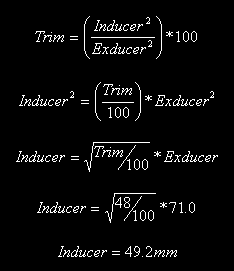
Most of the 50, 57, 60, "trims" utilize the same compressor wheel exducer of about 74.6mm. The size of the inducer is what is going to vary. In these 3 particular examples, the change in the inducer size relative to the exducer diameter means that more cfm volume of air is being compressed. the larger the "trim" (in this case for these 3 examples using the same exducer), the potential for a bit more CFM flow of air. The slight drawback is there is a slightly inherent creation of slower response to move the higher volume (or "LAG") for a given turbocharger.
There is a general equation to find what "trim" is for any particular turbocharger provided that you have the correct measurements for both the inducer and exducer of either the compressor wheel or the exhaust wheel. But remember, when comparing 2 different turbos with 2 different compressor/exhaust wheel diameters, a larger "trim" does not necessarily mean that you have a turbo that has more power potential, or is more efficient. For example, a GT4088R uses a 52 trim in its 88mm exducer compressor wheel. The GT3076R uses a 56 trim in its 76.2mm exducer compressor wheel as its diameter. The GT4088R, though it has a smaller trim, is clearly a larger, higher flowing CFM turbocharger:
Hiprofile is right in stating that there are other factors that are going to determine the maximum efficiency of horsepower used that include but are not limited to A/R size housings. One must also look at the size and shaft speed of the exhaust wheel used for the combination as well. too small, and though you have fast shaft speeds (or "spool" in this case), thermal efficiency and existential heat will limit its output capacity. Slightly larger A/R exhaust housings do affect it slightly, but only by about 20% or so. the CFM of exhaust energy must be harness using a slightly larger exhaust wheel to assist. But be careful. This is when it is important to note which compressor wheel is being used. Have too small of a compressor wheel with too large of an exhaust wheel (in most cases beyond about 20% difference), and you have basically a truck turbo that is used for a lot of stroke and torque, but little hp since the compressor wheel can't carry it through. This perfect example is the use of the 60-1 compressor wheel that is able to flow over 61lbs/min. The common exhaust wheel used is a Stage III 2.555" exducer wheel. This isn't a BAD combination, but not the best because the 60-1 has a limited range in the upper pressure ratio band, where a larger exhaust wheel would be able to assist with the 60-1, and create a bit more power than with the stage III, with less existential heat. The turbo is basically making more power, with a little less duty. Change the turbine housing of the StageIII exhaust wheel, and you get a little bit more power in the upper band, but its still rather stressed. Change the turbine wheel itself, like a 2.944" wheel (P-trim), and now you're getting into good midrange / top end power over 400whp, with less stress, because the differential b/w the compressor wheel exducer diameter, and the P-trim wheel diameter is under 15%. that's a good combo.
I know this was a bit wordy, but read what I typed here a couple of times. I just hope it wasn't too confusing.
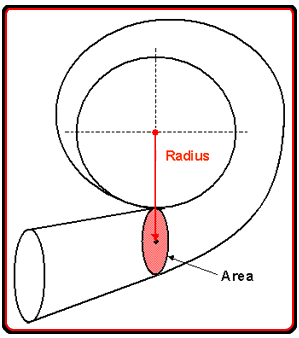
BTW, here's an illustration of how A/R is measured in a compressor housing.
Modified by TheShodan at 6:19 PM 8/3/2007
Re: Trim... 50, 57, 60, etc... is this a reference to wheel trim, correct? (93supercoupe)
<TABLE WIDTH="90%" CELLSPACING=0 CELLPADDING=0 ALIGN=CENTER><TR><TD>Quote, originally posted by 93supercoupe »</TD></TR><TR><TD CLASS="quote">on a side not, i think that labeling the exhaust wheel with a stage is just too confusing becuase it could change from frame to frame, or company to company.</TD></TR></TABLE>
I don't blame you there. Many of the "Stage" names refer to a specific measurement from Turbonetics and Ray Hall that was used back in the day. In fact, on the Turbonetics website, you can still see a chart of the names of "stages" to the measurements. Its more of a quick reference than anything else. Many of us Turbo gurus now use the exact measurement to avoid that same confusion.
I don't blame you there. Many of the "Stage" names refer to a specific measurement from Turbonetics and Ray Hall that was used back in the day. In fact, on the Turbonetics website, you can still see a chart of the names of "stages" to the measurements. Its more of a quick reference than anything else. Many of us Turbo gurus now use the exact measurement to avoid that same confusion.

Honda-Tech Member
Joined: Jul 2004
Posts: 5,463
Likes: 2
From: I'm everywhere Focker
Re: Trim... 50, 57, 60, etc... is this a reference to wheel trim, correct? (TheShodan)
To the O.P....I don't know how many still get what your saying, but plain and simple most of it is understood. Saying a 57 trim truly doesn't tell anyone anything, other than what's already been pointed out. A 57 trim turbo could be massive, or it could be tiny.
The T3/T04e's are the pretty common turbo's and have been for a while. So when someone uses the trim number, like Hipower said, it's pretty understood. Just see it as a slang so to speak.
The T3/T04e's are the pretty common turbo's and have been for a while. So when someone uses the trim number, like Hipower said, it's pretty understood. Just see it as a slang so to speak.


Honda-Tech Member
Joined: May 2004
Posts: 4,222
Likes: 1
From: Tracys Landing, MD
Re: Trim... 50, 57, 60, etc... is this a reference to wheel trim, correct? (riceball777)
<TABLE WIDTH="90%" CELLSPACING=0 CELLPADDING=0 ALIGN=CENTER><TR><TD>Quote, originally posted by RC000E »</TD></TR><TR><TD CLASS="quote">
The T3/T04e's are the pretty common turbo's and have been for a while. So when someone uses the trim number, like Hipower said, it's pretty understood. Just see it as a slang so to speak.</TD></TR></TABLE>
agreed with this. i think so many people, especially honda's are using t3/t4 turbos that compressor trim is used to identify them. i always assume t3/t4 when i hear 50, 57, or 60 trims etc.
i think it is also important to use turbine a/r in the description. for example 57 trim .63 a/r or gt30r .82 a/r. descriptions like this immediately give you an idea of the turbo size and hp capabilities.
and im sure there are just plenty of idiots that think they sound cool tossing around numbers and lingo that they dont even understand.
The T3/T04e's are the pretty common turbo's and have been for a while. So when someone uses the trim number, like Hipower said, it's pretty understood. Just see it as a slang so to speak.</TD></TR></TABLE>
agreed with this. i think so many people, especially honda's are using t3/t4 turbos that compressor trim is used to identify them. i always assume t3/t4 when i hear 50, 57, or 60 trims etc.
i think it is also important to use turbine a/r in the description. for example 57 trim .63 a/r or gt30r .82 a/r. descriptions like this immediately give you an idea of the turbo size and hp capabilities.
and im sure there are just plenty of idiots that think they sound cool tossing around numbers and lingo that they dont even understand.


Thread
Thread Starter
Forum
Replies
Last Post
